








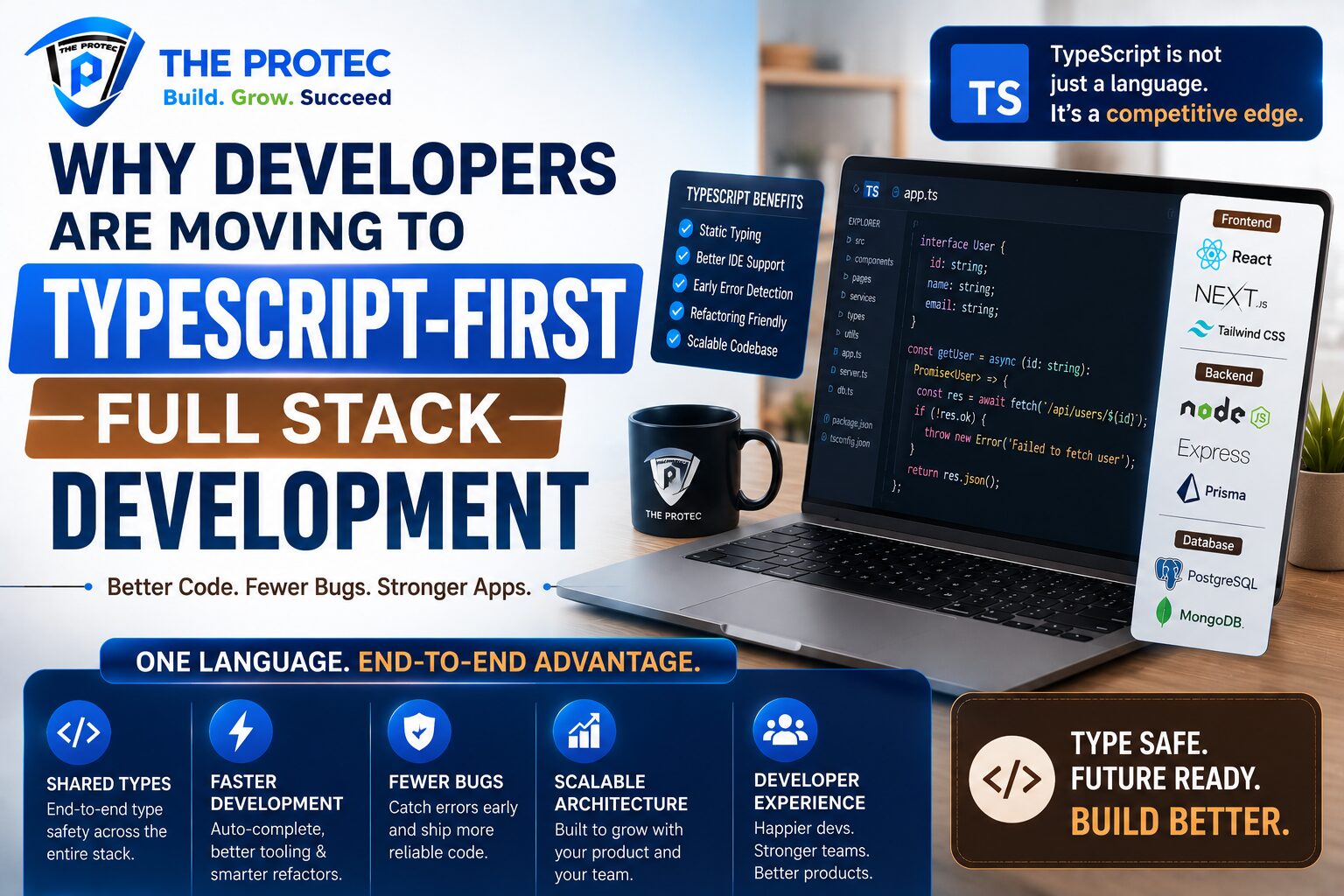
Why TypeScript-First Full Stack Development Is Gaining Momentum
TypeScript has moved far beyond being a “nice-to-have” for frontend teams. It is now shaping how modern products are planned, built, and scaled across the entire stack. As companies push for faster shipping, fewer regressions, and better collaboration between frontend and backend engineers, a TypeScript-first approach has become one of the most practical choices in modern web development.
The shift is not happening because TypeScript is trendy in a superficial way. It is happening because the demands on software teams have changed. Applications are more complex, teams are more distributed, and product cycles are shorter. In that environment, JavaScript alone can feel too loose for the level of coordination required. TypeScript adds structure without removing flexibility, and that balance is exactly why it is showing up in more greenfield projects, platform rebuilds, and enterprise modernization efforts.
When teams talk about TypeScript full stack development today, they are usually talking about a broader operating model: shared types, stronger contracts, better editor support, and less friction between client and server code. That combination improves speed in the long run, even if the initial setup takes more discipline.
What TypeScript-First Actually Means
TypeScript-first does not mean every line of code must be written in a rigid, overengineered style. It means the team chooses TypeScript as the default language for both frontend and backend development, and uses types as a foundation for decision-making rather than an afterthought.
In a TypeScript-first stack, engineers typically define data shapes early, share models across services when appropriate, and treat type definitions as part of the product architecture. That can apply to React or Next.js on the frontend, Node.js services on the backend, and increasingly to serverless functions, edge workloads, API layers, and tooling scripts.
This approach is especially useful in modern web development because the boundary between frontend and backend has blurred. UI components often depend on server data that changes frequently. APIs are now deeply integrated with product logic. Server actions, route handlers, and edge functions are closer to the user experience than ever before. TypeScript helps teams manage that overlap without relying entirely on runtime surprises.
The Main Reasons Companies Are Adopting TypeScript Across the Stack
1. Fewer Bugs Reach Production
The most obvious benefit of TypeScript is type safety, but the real value is fewer avoidable mistakes making it into production. TypeScript catches common issues like missing fields, invalid payload shapes, incorrect function arguments, and inconsistent return types before code is deployed.
That matters more as systems grow. A small app can survive with a few runtime checks. A product with dozens of engineers, multiple services, and fast release cycles cannot afford to discover every mismatch during QA or after deployment. TypeScript reduces the surface area of failure by making data expectations explicit.
This is one reason TypeScript trends continue to accelerate in product teams that care about reliability. The technology does not eliminate bugs, but it shifts many of them from runtime to compile time, where they are cheaper and safer to fix.
One of the strongest arguments for TypeScript full stack development is the ability to share contracts between the client and server. When frontend and backend teams use the same type definitions, both sides can work with a clearer understanding of the data model.
This is especially important in API-heavy applications. If a backend service changes the shape of a response, the frontend can detect the mismatch immediately rather than after a broken release. Likewise, if a UI form submits invalid data, the compiler can catch it before the request ever leaves the browser.
Shared types also improve communication. Instead of vague assumptions about what an endpoint returns, teams can read and depend on the same source of truth. That reduces handoff friction and makes cross-functional development more predictable.
3. Better Developer Experience Speeds Up Daily Work
Modern web development is not just about runtime performance. It is also about how quickly engineers can move with confidence. TypeScript delivers a strong developer experience through autocomplete, inline documentation, jump-to-definition, smarter refactoring, and more helpful error messages.
Those advantages compound over time. In a large codebase, the editor becomes a guide. Engineers can explore unfamiliar modules faster, understand complex object structures, and safely rename or reshape code with less fear of breaking hidden dependencies. That reduces cognitive load and helps teams stay productive even as applications become more sophisticated.
For companies investing in internal platform teams or distributed product squads, this productivity gain is a major reason TypeScript trends remain strong. Better tooling means less time spent deciphering code and more time spent delivering features.
4. It Scales Better as Teams and Codebases Grow
JavaScript can be extremely productive in small, focused projects. But as the number of contributors increases, loose conventions often become a liability. Different coding styles, undocumented assumptions, and inconsistent data handling create hidden complexity.
TypeScript introduces guardrails that help maintain order without slowing innovation. It is easier to understand ownership, easier to review pull requests, and easier to enforce architectural boundaries when types are part of the design. That matters in companies where multiple feature teams are shipping to the same codebase.
In practice, TypeScript supports modular growth. Teams can define clearer interfaces between packages, separate domain logic from presentation, and keep APIs more stable as systems evolve. This is why many organizations now treat TypeScript as a scaling tool, not just a syntax preference.
5. It Fits the Modern JavaScript Ecosystem
TypeScript is no longer a niche layer built around JavaScript frameworks. It is now deeply aligned with the modern tooling ecosystem. Popular frameworks, build tools, and runtime platforms have first-class TypeScript support, making it easier to adopt without major friction.
Today, teams building with React, Next.js, Vue, Svelte, Node.js, NestJS, and serverless platforms can usually start with TypeScript from day one. Linting, testing, bundling, and package management all integrate smoothly with typed workflows. This makes the decision less about “whether TypeScript works” and more about “why not use it as the default?”
That ecosystem maturity is one of the biggest TypeScript trends of the last few years. It has turned TypeScript from an optional enhancement into a standard expectation for serious production systems.
How TypeScript Improves Frontend Development
On the frontend, TypeScript helps teams manage complexity in UI state, props, events, and data fetching. Modern interfaces often rely on nested component trees, dynamic forms, conditional rendering, and server-driven data. That is a lot of surface area for errors if the codebase is untyped or inconsistently typed.
With TypeScript, component contracts become explicit. Props have known shapes. Event handlers expect known values. API responses can be modeled precisely. This makes UI code safer to refactor and easier to reason about. It also makes code reviews more effective, because reviewers can focus on logic rather than guessing whether a value might be undefined.
TypeScript is particularly powerful in design systems and component libraries. Shared components need stable interfaces, and typed props help maintain consistency across teams. When product teams reuse components across multiple applications, TypeScript helps preserve quality as the library grows.
Another major frontend advantage is state management. Whether a team uses React state, context, Redux, Zustand, or another pattern, TypeScript helps document how data flows through the application. That clarity matters when debugging complex UIs or onboarding new engineers.
How TypeScript Strengthens Backend Development
Backend teams are also benefiting from a TypeScript-first approach, especially in Node.js environments. Typed services make it easier to define request and response structures, validate input, and keep business logic consistent across modules.
One of the biggest backend wins is safer refactoring. When a service has well-defined types for database records, API payloads, jobs, and helper functions, changes are less risky. A rename or schema update surfaces compiler errors instead of silent breakage.
TypeScript also supports cleaner architecture. Teams can separate controllers, services, repositories, and domain models more clearly when their interfaces are typed. This improves maintainability and makes it easier to onboard engineers into larger systems.
In addition, TypeScript works well with schema validation libraries and API frameworks, which helps teams combine static typing with runtime checks. That combination is important because TypeScript does not validate external input by itself. Strong backend teams use it as part of a layered safety strategy, not as a replacement for validation.
TypeScript Trends Shaping Modern Web Development
Several TypeScript trends are reinforcing the move toward full stack adoption. One of the biggest is the rise of unified application frameworks that collapse traditional frontend-backend boundaries. As frameworks make server-side logic more accessible from the app layer, teams naturally want one language and one type system to manage both sides.
Another trend is the increased use of typed API contracts. Teams are moving away from loosely documented endpoints and toward stronger schemas, generated types, and shared interfaces. This is especially visible in systems that rely on internal APIs, public developer platforms, or multi-service architectures.
There is also a growing emphasis on developer velocity in AI-assisted engineering workflows. As coding tools become more capable, types provide structure that helps both humans and tools understand the codebase. In practical terms, TypeScript makes code easier for engineers to navigate and easier for modern assistants to reason about.
Finally, more organizations are standardizing on TypeScript during modernization projects. Rather than maintaining separate JavaScript and TypeScript paths, they are choosing a default standard that applies across teams. This creates more consistency in hiring, onboarding, and long-term maintenance.
Where TypeScript Can Create Friction
Despite its advantages, TypeScript is not free of tradeoffs. Teams sometimes overcomplicate their code with deeply nested types, excessive abstractions, or unnecessary strictness. When that happens, the tool meant to improve clarity can become a source of friction.
There is also a learning curve. Engineers coming from JavaScript-only backgrounds may need time to adapt to generics, union types, narrowing, and type inference. Teams that adopt TypeScript too aggressively without guidance can create bottlenecks and frustration.
Another challenge is runtime validation. TypeScript only checks types at compile time, so it cannot guarantee that external data from an API, user input, or third-party system is valid. Good teams pair TypeScript with schema validation and sensible runtime safeguards.
The key is balance. The most successful TypeScript-first teams use types to reduce ambiguity, not to create dogma. They keep the system practical, readable, and maintainable.
When a TypeScript-First Stack Makes the Most Sense
A TypeScript-first strategy is especially effective when a company has one or more of the following conditions:
- A growing codebase that will be maintained by multiple engineers or teams
- Frequent frontend-backend coordination around shared data models
- Product requirements that change rapidly and require safe refactoring
- A strong focus on developer experience and long-term maintainability
- Node.js-based services or full stack frameworks that support typed workflows well
It is also a strong choice for startups that want to build with scale in mind. Even if the initial team is small, setting up a typed foundation early can save significant time later when the product, team, and architecture grow more complex.
For larger companies, TypeScript often becomes a standardization layer. It improves consistency across squads and makes platform-wide modernization more achievable. In both cases, the goal is the same: reduce uncertainty and improve the quality of collaboration.
What the Future Looks Like for TypeScript Full Stack Teams
The future of TypeScript full stack development looks increasingly integrated. As frontend and backend runtimes continue to converge, teams will rely more heavily on shared schemas, typed APIs, and framework-level abstractions that reduce duplication. That direction aligns naturally with TypeScript’s strengths.
We are also likely to see more emphasis on type-driven architecture. Instead of adding types at the end of implementation, teams will define contracts earlier in the planning process. That shift makes software design more deliberate and helps prevent downstream rework.
As tooling improves, TypeScript will continue to feel less like an extra step and more like the default language of serious modern web development. For companies focused on speed, maintainability, and team alignment, that makes it one of the most strategic choices available today.
Conclusion
Developers are moving toward TypeScript-first full stack development because it solves real problems: weak contracts, fragile refactors, inconsistent collaboration, and growing codebase complexity. The language brings structure to modern web development without sacrificing the flexibility teams need to ship quickly.
For companies, the appeal is straightforward. TypeScript helps frontend and backend teams work from the same assumptions, reduces production risk, and makes scaling more manageable. For engineers, it creates a better daily experience with stronger tooling and clearer code.
That is why TypeScript trends continue to gain momentum across startups, scaleups, and enterprise teams alike. It is not just a trend in syntax. It is a shift in how modern products are built.
FAQ
Is TypeScript better than JavaScript for full stack development?
TypeScript is often a better choice for full stack development when a project needs stronger structure, safer refactoring, and shared contracts across frontend and backend. JavaScript can still work well for small projects, but TypeScript usually provides better long-term maintainability.
Does TypeScript slow down development?
TypeScript may feel slower at first because teams need to define types and learn the tooling. Over time, though, it often speeds up development by reducing bugs, improving editor support, and making refactors safer.
Can TypeScript be used for backend development?
Yes. TypeScript is widely used for backend development, especially with Node.js-based frameworks and serverless platforms. It helps teams define clearer service contracts and maintain more reliable business logic.
Why are companies adopting TypeScript across both frontend and backend?
Companies are adopting TypeScript across the stack because it improves consistency, reduces errors, and makes collaboration easier. Shared types and stronger interfaces help teams move faster with less risk.
Is TypeScript only useful for large applications?
No. TypeScript is useful for small projects too, especially if they are expected to grow. Starting with TypeScript early can prevent technical debt and make future scaling easier.