








The Laptop Processor Is Changing Direction
For years, laptop buyers were taught to look for one thing first: raw speed. More cores, higher clock speeds, bigger benchmark numbers, and louder claims about desktop-class performance defined the conversation around future laptop processors. If a chip could run faster than the last one, it was seen as better.
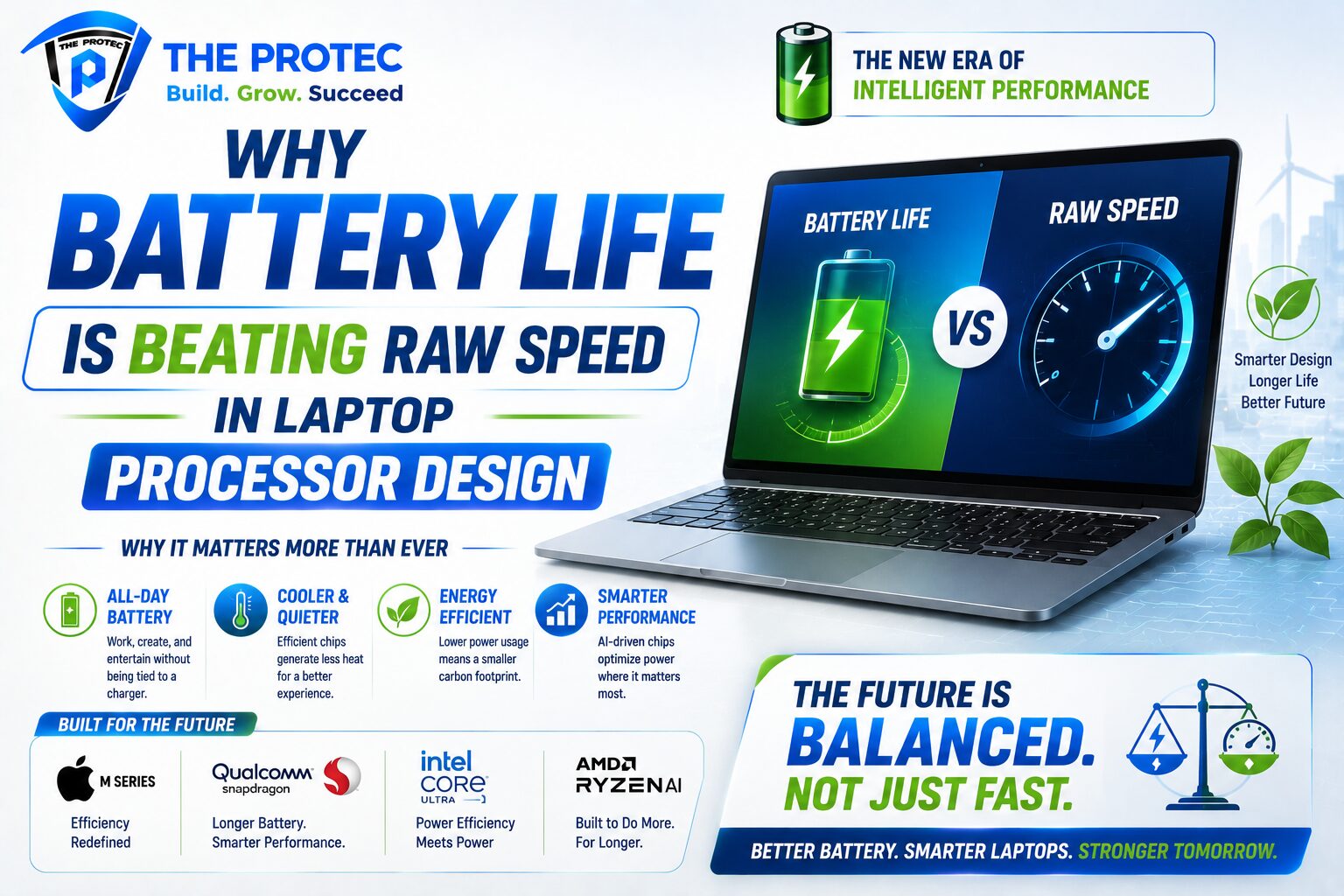
That mindset is fading. In 2026, the most important metric for many laptops is no longer peak performance, but how long the machine can stay useful away from the charger. This shift is being driven by a new generation of AI laptops, increasingly battery efficient CPUs, and workloads that reward sustained efficiency more than brief bursts of speed.
Consumers do still want power. But they want power that lasts. They want laptops that can handle video calls, browser tabs, creative apps, local AI features, and multitasking without turning into portable space heaters or draining the battery in half a workday. That is why the future of laptop processors is not about chasing the highest benchmark score. It is about delivering the best balance of performance, intelligence, and endurance.
Why Raw Speed Is No Longer the Main Selling Point
Raw speed was easy to market. It was also easy to understand. A faster processor meant faster app launches, smoother multitasking, and better responsiveness. But modern computing has changed. Most everyday tasks are not limited by peak CPU speed anymore. They are limited by thermals, battery capacity, software efficiency, and the growing number of background processes competing for resources.
In practical use, a laptop with slightly lower peak performance but far better efficiency often feels better than a faster chip that throttles aggressively or forces the fan to run constantly. That is especially true for ultraportables, work laptops, and premium notebooks used for long sessions on the move.
The modern user rarely spends all day rendering video or compiling code on battery. Instead, they spend hours in browsers, productivity suites, communication apps, cloud tools, and AI-assisted workflows. For those scenarios, the best processor is not the one with the highest maximum frequency. It is the one that can maintain a responsive experience while consuming less power.
The Rise of AI Laptops Is Rewriting Processor Priorities
One of the biggest reasons future laptop processors are changing is the rapid rise of on-device AI. AI laptops now include dedicated neural processing units, better integrated graphics, and hybrid CPU designs that can offload certain tasks from the main cores. This allows laptops to run features like local transcription, background noise removal, image enhancement, semantic search, and real-time summarization with much lower power draw than traditional CPU-only processing.
This shift matters because AI workloads are always-on by nature. They are not occasional spikes. They happen in the background, throughout the day, and on battery. A processor that can support AI features efficiently will often provide a better real-world experience than a chip that is simply faster in short bursts.
As AI becomes part of the operating system rather than just a separate app, laptop makers are designing processors around sustained efficiency. The goal is no longer to maximize the power available to every core at all times. It is to intelligently route tasks to the most efficient part of the chip at any given moment.
Why the NPU Matters More Than Ever
The neural processing unit, or NPU, has become a key differentiator in AI laptops. Unlike the CPU, which is designed for general-purpose computing, the NPU is optimized for low-power AI tasks. That means features such as live captioning, facial effects, voice enhancement, and local assistant functions can run with much less battery impact.
This is a major reason battery efficient CPUs are becoming more valuable. A chip does not need to do everything itself anymore. It needs to cooperate with specialized hardware. The more effectively a processor offloads work, the longer the battery lasts and the cooler the laptop stays.
Battery Life Has Become a Competitive Advantage
Battery life used to be a nice bonus. Now it is a primary reason people upgrade. Remote work, hybrid schedules, classrooms, travel, and mobile content creation all create situations where users need a laptop to survive a full day or more without anxiety about charging.
That demand has changed the laptop market. The most praised devices are often not the fastest, but the ones that deliver strong performance while lasting an entire workday or beyond. Reviewers and buyers alike increasingly ask the same question: how long will it last under real-world use?
This is also why battery efficient CPUs are gaining momentum across premium and mainstream segments. Better efficiency means less wasted energy, less heat, quieter operation, and longer component life. It also means manufacturers can build thinner systems without making unacceptable sacrifices in endurance.
How Efficiency Improves the User Experience
Battery life is only part of the story. Efficient processors improve the overall experience in several ways:
- Less fan noise: Cooler chips need less aggressive cooling, which makes laptops quieter.
- Better portability: Longer battery life means fewer charger-dependent moments.
- More consistent performance: Efficient chips are less likely to throttle under everyday loads.
- Improved comfort: Lower heat makes the laptop nicer to use on a lap or desk.
- Smarter power use: The system can reserve energy for demanding moments instead of wasting it on idle overhead.
These benefits matter more than a theoretical performance lead that may only appear in a benchmark run lasting a few seconds.
How Future Laptop Processors Are Being Designed
Future laptop processors are moving toward heterogeneous architectures, which means mixing different types of cores and accelerators on the same chip. Instead of treating every task as if it should run on the fastest available core, these chips assign work based on efficiency, responsiveness, and thermal limits.
This design approach is being refined across x86 and ARM ecosystems alike. The exact implementation differs by manufacturer, but the direction is consistent: better performance per watt, smarter task scheduling, and stronger integration between CPU, GPU, and AI acceleration hardware.
In modern laptops, the processor is no longer just a CPU. It is a platform. That platform must support display engines, memory controllers, media acceleration, AI inference, security functions, and power management. If one part of that system is inefficient, the whole laptop feels less advanced.
Chiplets, Advanced Nodes, and Power Efficiency
Several hardware trends are helping battery efficient CPUs improve rapidly. Advanced manufacturing nodes reduce leakage and lower power draw. Chiplet-based designs can improve flexibility and efficiency by separating different functions into optimized modules. Better packaging can also reduce latency and improve thermal behavior.
These engineering changes may sound technical, but the user-visible result is simple: laptops that stay fast without draining quickly. That is the real promise of future laptop processors. Not just higher peak numbers, but smarter performance that remains available longer.
Why Benchmarks Are Losing Influence
Benchmarks still matter, but they are becoming a less complete way to judge a laptop. A processor may score well in a short synthetic test and still disappoint in everyday use if it burns through battery or gets too hot during long sessions. Real-world value depends on sustained behavior, not just momentary peaks.
That is especially true now that many users rely on cloud services, web apps, and AI-enhanced workflows. These tasks often depend more on responsiveness, memory efficiency, and battery management than on maximum CPU frequency. A laptop that remains fast after hours of work is more useful than one that starts faster but degrades under load.
The market has begun to reflect this. Reviewers increasingly emphasize battery drain, fan noise, and sustained performance curves. Manufacturers now highlight efficiency, NPU performance, and real-world endurance alongside speed claims. In other words, the scorecard has changed.
AI Workloads Reward Efficiency Over Brute Force
Not all AI workloads are massive data-center tasks. Many are lightweight, local, and continuous. A laptop does not need a monster processor to blur a background, improve a microphone feed, or help sort files with semantic search. It needs the right balance of throughput and power draw.
This is why AI laptops are so important to the future of computing. They are not simply faster laptops with an AI label. At their best, they are more intelligent systems that know when to use the CPU, when to use the NPU, when to rely on the GPU, and when to stay in a low-power state.
That coordination is where the next generation of battery efficient CPUs will stand out. The winner will not necessarily be the fastest chip in a lab. It will be the chip that can handle AI features all day while preserving battery life for the moments that matter.
What Buyers Should Look for in Future Laptop Processors
If you are choosing a laptop today, the right processor depends on your workflow. But in general, the smartest buyers should pay attention to efficiency first and raw speed second. The strongest future laptop processors will deliver a combination of good single-core responsiveness, strong multitasking, efficient integrated graphics, and a capable NPU.
Here is what matters most:
- Battery life under real workloads: Not just video playback, but mixed use.
- AI acceleration: Look for an NPU that can handle local tasks without heavy battery drain.
- Sustained performance: Check how the chip performs after 20, 40, or 60 minutes of use.
- Thermal behavior: A cooler laptop usually means more stable performance and better comfort.
- Platform efficiency: Memory, storage, and graphics integration all affect battery life.
For many users, the best processor will be the one that feels invisible: always ready, rarely hot, and never forcing compromises in the middle of the day.
The Role of Operating Systems and Software Optimization
Processor design is only part of the equation. Operating systems and app developers now play a bigger role in battery life than ever before. Smarter scheduling, better sleep states, more efficient background task handling, and deeper AI integration all help laptop processors perform better without wasting energy.
Software optimization is especially important for AI laptops, because the same feature can behave very differently depending on whether it uses the CPU, NPU, or GPU. A well-optimized system will route tasks to the most efficient hardware available. A poorly optimized system can erase the gains of a modern chip.
That is why the future of laptop processors is also the future of software cooperation. The best experiences will come from hardware and operating systems designed together, not from raw silicon performance alone.
What This Shift Means for the Laptop Market
The shift toward battery life and AI efficiency is changing laptop categories across the board. Thin-and-light systems now compete on endurance as much as speed. Business laptops emphasize all-day operation and quieter acoustics. Creative machines are being asked to handle AI-assisted editing without becoming bulky or power-hungry. Even gaming laptops are beginning to benefit from more efficient architectures, especially for lighter use cases and hybrid workloads.
For manufacturers, this means the race is more complicated. It is no longer enough to build the fastest processor. They must build the most adaptable one. The chip must scale from idle to AI inference to productivity to media creation without wasting power at any stage.
For buyers, that is good news. It means better laptops overall. The best machines will not just be faster. They will be more practical, more portable, and more aligned with how people actually work.
Looking Ahead: The Future Is Efficient, Not Excessive
The future of laptop processors is not about abandoning performance. It is about redefining it. Speed still matters, but battery life has become the more valuable measure because it reflects real usability. A processor that can deliver strong performance for hours, support AI features intelligently, and stay cool and quiet is more useful than one that wins a benchmark by a narrow margin.
As AI laptops become mainstream and battery efficient CPUs continue to improve, the industry will keep moving toward smarter designs. Expect more dedicated AI hardware, better hybrid core structures, deeper software integration, and a stronger focus on performance per watt. That is the direction the market is already taking, and it is unlikely to reverse.
For anyone choosing a laptop now, the lesson is clear: do not ask only how fast the processor is. Ask how long it can stay fast, how efficiently it handles AI, and how much battery it saves while doing real work. In the next era of computing, endurance is the new speed.
FAQ
Why is battery life becoming more important than raw speed in laptops?
Because most everyday tasks depend more on sustained responsiveness, thermal efficiency, and long unplugged use than on short bursts of peak performance. A laptop that lasts longer and stays cool often feels better in real life.
What makes AI laptops different from regular laptops?
AI laptops include hardware such as NPUs that can handle local AI tasks more efficiently than the CPU alone. This improves battery life, reduces heat, and enables features like transcription, background effects, and smart search.
Are battery efficient CPUs slower than performance-focused chips?
Not necessarily in day-to-day use. Many battery efficient CPUs offer excellent responsiveness and strong sustained performance, especially when workloads are spread across CPU, GPU, and NPU resources intelligently.
Should I still care about CPU speed when buying a laptop?
Yes, but it should be one factor among several. For most users, battery life, thermals, AI support, and sustained performance are more important than a high peak clock speed.
For more on the broader direction of AI computing and hardware trends, see Microsoft’s AI on Windows overview and Arm’s AI solutions page.