









Contents
- 1 Kubernetes Alternatives: Are Companies Moving Beyond Kubernetes?
- 2 Why teams are rethinking Kubernetes
- 3 What “Kubernetes alternatives” really means
- 4 The strongest reasons companies are moving beyond Kubernetes
- 5 Emerging Kubernetes alternatives worth watching
- 6 Is Kubernetes still the right choice?
- 7 How to choose the right cloud native tool for your team
- 8 The future of container orchestration is more abstract
- 9 FAQ
- 9.1 Are companies actually replacing Kubernetes?
- 9.2 What are the best Kubernetes alternatives for smaller teams?
- 9.3 Is Kubernetes still worth learning in the current cloud native landscape?
- 9.4 Do Kubernetes alternatives offer the same scalability?
- 9.5 Will platform engineering make Kubernetes less visible?
- 10 Final thoughts
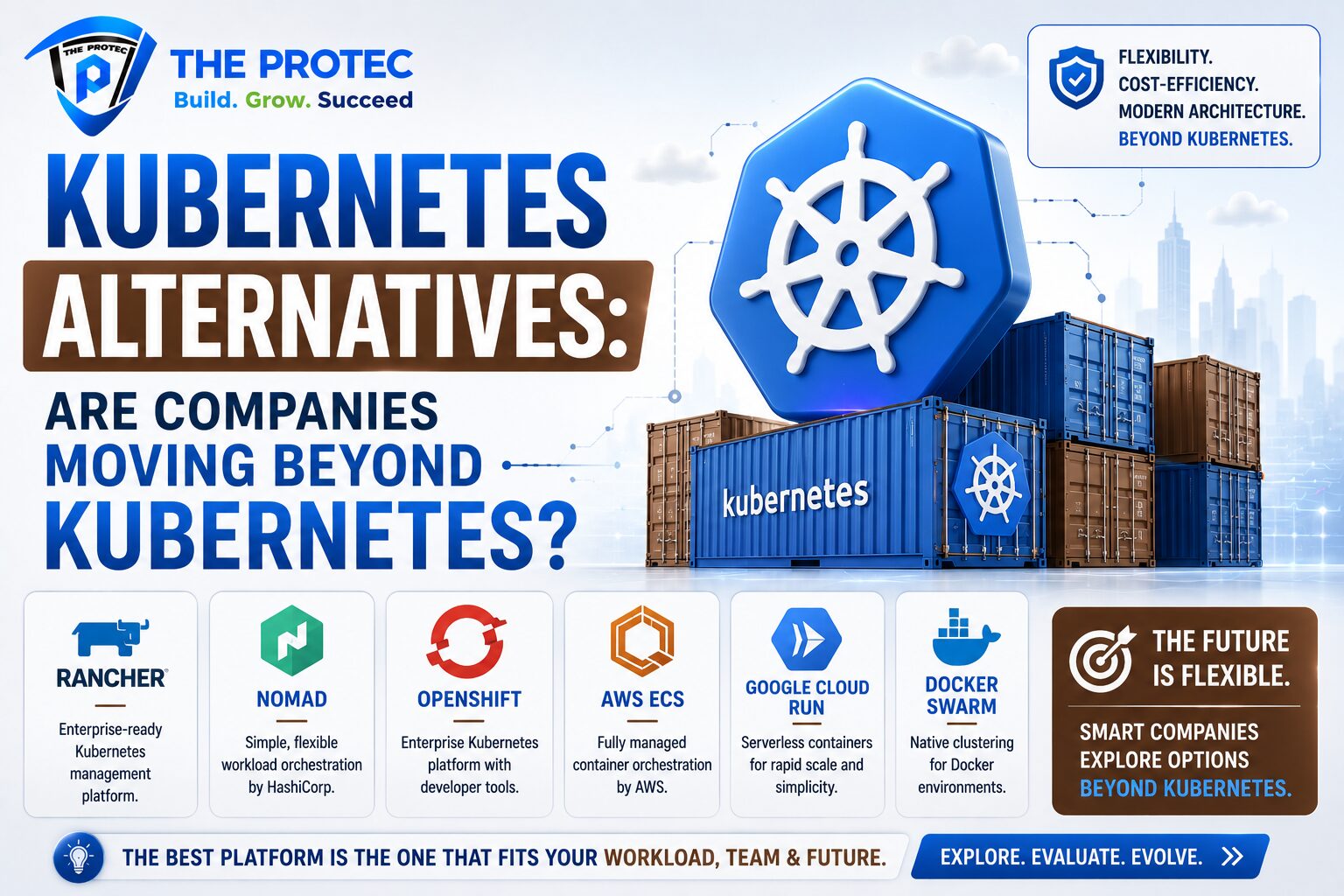
Kubernetes Alternatives: Are Companies Moving Beyond Kubernetes?
Kubernetes transformed modern infrastructure. It gave engineering teams a standard way to deploy, scale, and recover containerized applications across clouds, data centers, and edge environments. For years, it was the default answer to container orchestration. But as container platforms have matured and cloud native tools have become more capable, many companies are asking a different question: do we still need Kubernetes for every workload?
That question is not a rejection of Kubernetes. In many organizations, it remains the right choice for complex distributed systems, platform engineering initiatives, and large-scale multi-service architectures. But the practical reality in mid-2026 is that more teams are prioritizing speed, simplicity, and operational efficiency over raw flexibility. They want platforms that reduce the cognitive load on developers and platform teams without sacrificing reliability.
This is why Kubernetes alternatives are gaining traction. Some organizations are moving to managed cloud services that abstract away orchestration complexity. Others are adopting lightweight schedulers, platform-as-a-service layers, or emerging cloud native tools that simplify deployment and scaling. The trend is not about replacing Kubernetes everywhere. It is about using the right abstraction for the job.
In this article, we will explore why companies are reconsidering Kubernetes, which alternatives are gaining momentum, and how emerging platforms are changing the way teams manage containers.
Why teams are rethinking Kubernetes
Kubernetes is powerful, but power comes with trade-offs. Operating a production-grade cluster can be demanding, especially when teams must manage networking, security policies, autoscaling, observability, upgrades, and cluster lifecycle tasks at the same time. Many organizations discovered that the complexity of Kubernetes often shifts effort from application delivery to infrastructure maintenance.
The common pain points include:
Operational overhead: Even managed Kubernetes services require tuning, upgrades, node management, and policy enforcement.
Steep learning curve: Developers and operators need to understand manifests, controllers, services, ingress, storage classes, RBAC, and more.
Platform sprawl: Teams often add multiple layers of tooling to make Kubernetes usable, which can increase fragmentation.
Cost inefficiency: Overprovisioned clusters, idle capacity, and platform maintenance can drive up costs.
Slow onboarding: Smaller engineering teams can spend weeks building internal standards before shipping useful workloads.
At the same time, application delivery expectations have changed. Product teams want faster environments, simpler deployment models, and less friction between code and production. Infrastructure teams want fewer moving parts. Security teams want consistent policy enforcement without custom glue. These pressures are pushing companies toward simpler container management platforms.
What “Kubernetes alternatives” really means
The phrase Kubernetes alternatives does not always mean a direct replacement for a cluster orchestrator. In practice, it includes a broad set of container orchestration and deployment options that reduce or replace the need to manage Kubernetes directly.
These alternatives generally fall into a few categories:
Managed container platforms: Services that run containers without requiring you to manage the underlying orchestration layer.
Serverless container services: Platforms that scale containers on demand and hide the cluster entirely.
Lightweight orchestrators: Tools designed for simpler scheduling and service deployment.
Application platforms: Higher-level cloud native tools that provide deployment, scaling, and routing with less infrastructure exposure.
Open source PaaS layers: Internal developer platforms that simplify how teams ship workloads while still using container technology underneath.
In other words, the movement is not “Kubernetes versus nothing.” It is Kubernetes versus a growing ecosystem of cloud native tools that reduce complexity and accelerate delivery.
The strongest reasons companies are moving beyond Kubernetes
1. Simpler operations matter more than ever
Many teams have realized that platform engineering success is not just about orchestration features. It is about how much operational burden the platform creates. If a deployment system is technically elegant but too hard to maintain, it slows the organization down.
Managed alternatives and application platforms often remove the need to manage nodes, control planes, add-ons, and networking internals. That can free platform teams to focus on developer experience, compliance, and application reliability rather than cluster administration.
2. Developer experience is now a strategic priority
Modern engineering organizations compete on speed. If developers need to understand Kubernetes internals just to deploy a service, the platform becomes a bottleneck. Simpler tools allow teams to use familiar workflows, such as pushing code, defining a runtime policy, or deploying through a pipeline, without writing detailed orchestration manifests.
This shift has fueled demand for cloud native tools that hide infrastructure complexity behind opinionated workflows. The result is less context switching and faster delivery cycles.
3. Not every workload needs full orchestration
Kubernetes is excellent for large, distributed, highly dynamic systems. But many workloads are much simpler. Internal APIs, event processors, scheduled jobs, and stateless web services often do not need the full feature set of a cluster-centric platform.
For these cases, lightweight platforms can be a better fit. They reduce cognitive load and often improve time to production. Companies are becoming more selective about when Kubernetes is necessary and when a simpler model is sufficient.
4. Cost control is becoming a bigger concern
Container orchestration can be efficient, but only when it is actively tuned. In practice, many organizations over-allocate resources or run clusters that are larger than necessary. They also pay for the hidden cost of maintaining platform expertise.
Simpler platforms can reduce both direct infrastructure spending and indirect engineering costs. When a service can run without a dedicated cluster team or extensive add-on management, the total cost of ownership may improve significantly.
Emerging Kubernetes alternatives worth watching
Managed container platforms
Managed container platforms are one of the clearest signs that the market is moving toward abstraction. These services let teams deploy containers without handling the orchestration layer in the same way they would with Kubernetes.
Examples include platforms that automatically place workloads, handle scaling, and integrate with identity and networking systems behind the scenes. The attraction is straightforward: developers get containers, but operators get less platform maintenance.
These services are especially appealing for teams that want to modernize quickly without building a full internal Kubernetes platform. They are also useful for organizations that prefer opinionated defaults over endless configuration choices.
Serverless containers
Serverless container services continue to gain momentum because they align with how many teams want to operate today: deploy code, set a few runtime parameters, and let the platform handle the rest. With serverless containers, there is no need to think about node pools, cluster scaling, or scheduling policies in the traditional sense.
This model is particularly effective for variable traffic patterns, bursty workloads, and teams that want to pay only for actual usage. It can also be a strong fit for organizations with small platform teams or limited SRE capacity.
The trade-off is control. Serverless models usually provide less low-level customization than Kubernetes. But for many workloads, that trade-off is worth it.
Platform engineering layers and internal developer platforms
One of the most important trends in cloud native tools is the rise of internal developer platforms. These platforms do not necessarily eliminate Kubernetes, but they often make Kubernetes invisible to application teams. Developers interact with templates, self-service portals, GitOps workflows, or golden paths instead of cluster primitives.
In practice, this can feel like moving beyond Kubernetes even when the underlying runtime still uses it. The difference is that the organization no longer treats Kubernetes as the user-facing product. Instead, Kubernetes becomes one implementation detail inside a broader platform.
This approach is popular because it balances standardization and flexibility. Platform teams can enforce security and compliance while developers get a simpler path to deployment.
Lightweight orchestrators and schedulers
For some organizations, especially those with distributed computing needs or simpler service topologies, lightweight orchestrators can be attractive. These tools often have a smaller operational footprint and a narrower feature set than Kubernetes, which can be an advantage if the goal is reliability and ease of management rather than maximum extensibility.
While these options may not match Kubernetes in ecosystem size, they can excel in environments where simplicity is a stronger requirement than universal compatibility.
Application deployment platforms
There is also growing adoption of application-focused platforms that handle deployment, routing, scaling, and secrets management without exposing the complexity of infrastructure orchestration. These platforms are especially useful for product teams that want to move fast and do not want to spend time learning cluster internals.
Some of these solutions build on container technology, while others operate more like a modern PaaS. Either way, they reflect a major shift in the market: teams want outcomes, not orchestration theory.
Is Kubernetes still the right choice?
Absolutely, for many workloads. Kubernetes remains one of the most capable container orchestration systems available. It has an unmatched ecosystem, broad cloud support, and deep flexibility. If you are managing microservices at scale, running hybrid or multi-cloud infrastructure, or building a platform used by many engineering teams, Kubernetes still offers major advantages.
It is also the right choice when you need:
Advanced scheduling and placement control
Rich ecosystem integration
Highly customized networking or storage behavior
Portable workloads across environments
Strong support for multi-team platform engineering
The key point is that Kubernetes is no longer the automatic answer for every containerized application. Companies are becoming more pragmatic. They are asking whether Kubernetes is the best platform, or simply the most familiar one.
How to choose the right cloud native tool for your team
Choosing between Kubernetes and its alternatives starts with your operating model. The best platform is the one that fits your team size, application architecture, compliance requirements, and delivery goals.
Ask these questions:
How much operational ownership can our team realistically handle?
Do developers need direct access to orchestration primitives?
Are our workloads simple enough to benefit from abstraction?
Do we need multi-cloud portability, or is a single-cloud model acceptable?
How important are cost efficiency, speed, and minimal maintenance?
Will a managed or serverless approach reduce friction without creating a new layer of complexity?
If your team is small, moving quickly, or operating with limited platform resources, a managed container platform or serverless container service may be the smarter path. If your organization has mature platform engineering capabilities and needs deep control, Kubernetes may still be the better long-term foundation.
The future of container orchestration is more abstract
The direction of the market is clear: container orchestration is becoming more abstract, more opinionated, and more developer-friendly. Kubernetes is not disappearing, but it is increasingly hidden behind platforms that reduce the amount of infrastructure teams need to think about.
This is a major shift in cloud native strategy. In earlier years, the goal was often to build the most flexible platform. Today, the goal is often to build the most usable one. That change explains why Kubernetes alternatives are getting so much attention.
For many companies, the best platform is no longer the one with the most configuration options. It is the one that gets applications to production faster, keeps operational load manageable, and supports developers without forcing them to become infrastructure experts.
That does not mean Kubernetes has lost its relevance. It means the ecosystem around it has matured. Companies now have more choices, and those choices are pushing container management toward simpler, more focused platforms.
FAQ
Are companies actually replacing Kubernetes?
Some are, but many are not replacing it entirely. Instead, they are using alternatives for specific workloads, simplifying the developer experience, or hiding Kubernetes behind a higher-level platform.
What are the best Kubernetes alternatives for smaller teams?
Smaller teams often benefit from managed container platforms, serverless container services, and application platforms that reduce cluster administration. The best choice depends on how much control the team needs.
Is Kubernetes still worth learning in the current cloud native landscape?
Yes. Kubernetes remains an important skill because it is still widely used and deeply embedded in the cloud native ecosystem. Even if a team adopts alternatives, Kubernetes knowledge is valuable for understanding modern infrastructure patterns.
Do Kubernetes alternatives offer the same scalability?
Some do, especially managed and serverless platforms. However, scalability is only one part of the equation. Teams should also evaluate reliability, deployment speed, observability, and operational cost.
Will platform engineering make Kubernetes less visible?
Yes, that is already happening. Many internal developer platforms are built to give developers a simple interface while platform teams manage the underlying orchestration layer, whether that is Kubernetes or another runtime.
Final thoughts
Kubernetes alternatives are not a sign that container orchestration has failed. They are a sign that the market is maturing. As cloud native tools evolve, companies want platforms that do less exposing and more simplifying. They want to ship faster, manage less, and spend more time on product value.
For some organizations, Kubernetes will remain the best answer. For others, the best choice may be a managed container platform, serverless containers, a lightweight orchestrator, or an internal developer platform built to hide complexity. The important thing is to choose deliberately rather than defaulting to the most familiar option.
The future of container management is not about making every team a Kubernetes expert. It is about giving teams the simplest platform that still meets their operational needs.
External resources worth exploring: Kubernetes official documentation and Cloud Native Computing Foundation.