








Why Smartphone Battery Innovation Is Suddenly at the Center of Everything
Smartphones have become the most important computing devices in our lives, but one limitation still holds them back: battery performance. No matter how advanced a phone’s camera, processor, or display becomes, users still care deeply about whether the battery can last through a full day, charge quickly, and stay healthy after hundreds of cycles. That is why the future of smartphone batteries is one of the most important stories in consumer technology right now.
The next wave of battery technology is being shaped by a clear set of demands. People want faster charging without overheating, longer battery life without adding bulk, and safer batteries that can survive increasingly powerful devices. Traditional lithium-ion batteries have been refined for decades, but the industry is now pushing toward solid state batteries and other new chemistries that could change what smartphones are capable of.
This shift is not theoretical. Research labs, major battery companies, and several smartphone brands are actively testing next-generation battery technology. Some innovations are focused on replacing liquid electrolytes with solid materials. Others are improving silicon anodes, lithium-metal designs, or advanced packaging to squeeze more energy into smaller spaces. Together, these breakthroughs could redefine what future smartphone batteries look like.
What Is Holding Today’s Smartphone Batteries Back?
Before looking at the future, it helps to understand the limits of today’s batteries. Most smartphones still rely on lithium-ion cells with a graphite anode, a liquid electrolyte, and a layered cathode material. This design is reliable and relatively inexpensive, but it has well-known tradeoffs.
- Energy density limits: There is only so much energy a lithium-ion battery can store in a compact phone-sized form factor.
- Charging heat: Faster charging generates heat, and heat accelerates battery aging.
- Cycle degradation: Over time, repeated charging and discharging reduce capacity.
- Safety concerns: Liquid electrolytes are flammable, which creates a risk under damage or failure conditions.
Manufacturers have made meaningful progress through smarter battery management systems, optimized charging curves, and improved materials. Still, the basic architecture has remained largely the same. To go beyond incremental improvements, the industry needs a more fundamental leap in battery technology.
Solid State Batteries: The Most Promising Next Step
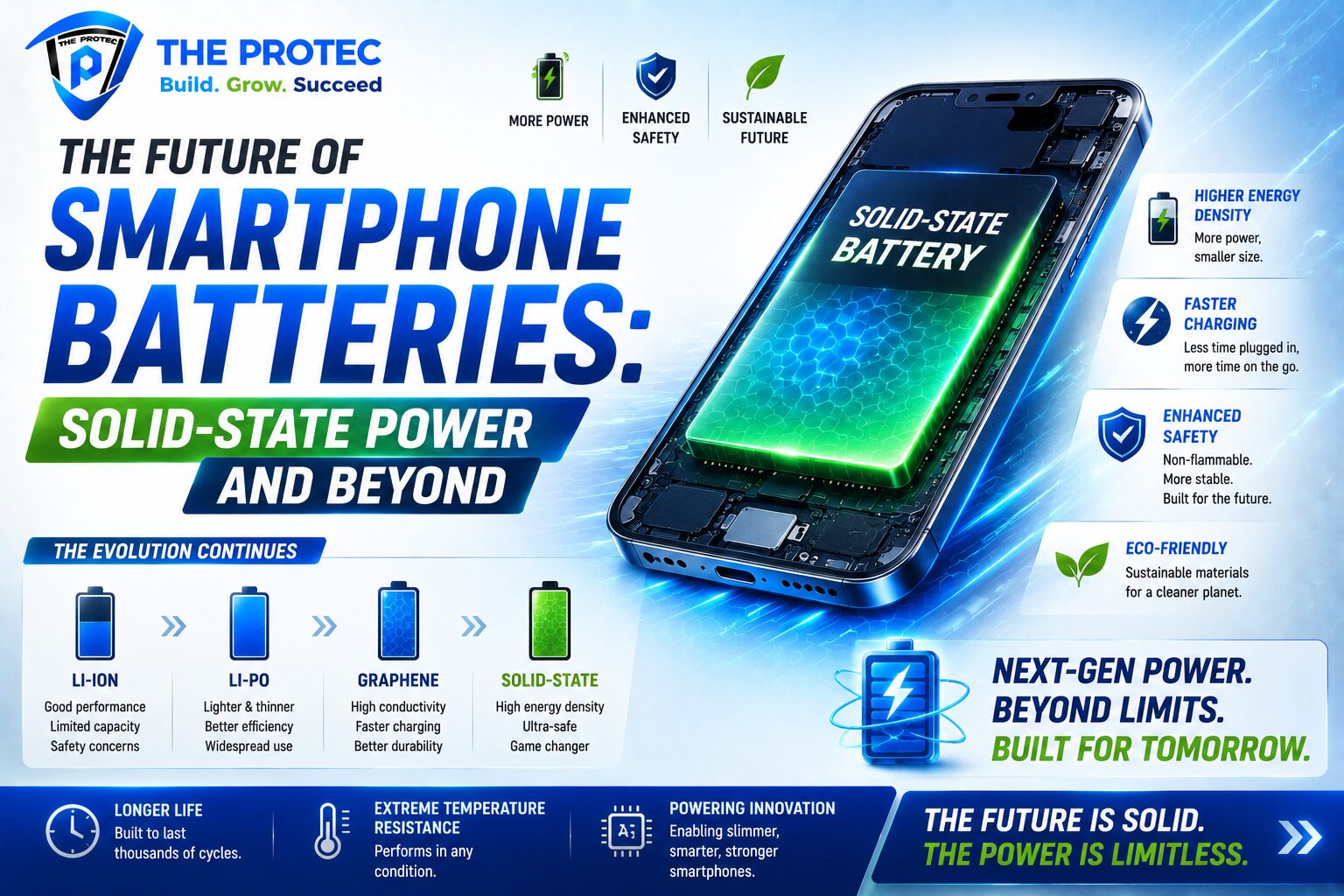
Among all future smartphone batteries, solid state batteries have captured the most attention. The concept is straightforward: replace the liquid or gel electrolyte inside a battery with a solid material. That one change has the potential to improve safety, energy density, and charging performance at the same time.
In a conventional lithium-ion battery, ions move through a liquid electrolyte between the anode and cathode. In a solid-state design, that movement happens through a solid electrolyte, such as a ceramic, sulfide, or polymer-based material. This structure can reduce the risk of leakage and thermal runaway while also allowing for new electrode combinations that store more energy.
Why solid state batteries matter for smartphones
For smartphones, the benefits are especially compelling. Solid-state cells could deliver more capacity in the same footprint, meaning a thinner phone could potentially last longer on a charge. They may also support faster charging because some solid electrolytes can tolerate higher current densities. In addition, the improved safety profile could help manufacturers design denser batteries without the same level of thermal risk.
In practical terms, a successful smartphone solid-state battery could lead to devices that:
- last more than a full day under heavy use
- charge to a useful level in just minutes
- maintain capacity better over hundreds or even thousands of cycles
- allow slimmer phone designs with less thermal compromise
That said, solid-state batteries are not yet a simple drop-in replacement. Manufacturing challenges, interface resistance, and material stability still need to be solved at scale. The science is promising, but production complexity has kept mass adoption slower than many consumers expected.
The biggest technical hurdles
One challenge is the interface between the solid electrolyte and the electrodes. In a battery, ions need a smooth pathway, and any microscopic gaps or irregularities can raise resistance. Another issue is dendrite formation, where lithium can grow into tiny structures that may short-circuit a cell. Solid electrolytes can reduce this risk, but not eliminate it in every design.
Manufacturing is another major barrier. Current lithium-ion production lines are highly optimized, and switching to solid-state formats requires new equipment, new quality-control methods, and often new supply chains. For smartphones, which require compact and cost-sensitive batteries at massive volume, that transition must be both technically and economically viable.
Beyond Solid State: The Other Battery Technologies Shaping the Future
While solid state batteries dominate headlines, they are not the only path forward. Several other battery technology trends are advancing in parallel, and some may reach smartphones sooner than fully mature solid-state cells.
Silicon anodes
Graphite anodes are reaching their practical limits, which is why many companies are exploring silicon-rich anodes. Silicon can store far more lithium than graphite, creating the possibility of higher energy density. That means a phone could hold more charge without becoming thicker.
The main challenge is that silicon expands significantly during charging, which can damage the anode structure over time. New materials and composite designs are helping manage that expansion, and silicon-enhanced batteries are already appearing in some premium consumer electronics. For future smartphone batteries, silicon is one of the most realistic near-term upgrades.
Lithium-metal batteries
Lithium-metal designs are often discussed alongside solid-state cells because they pair especially well with solid electrolytes. A lithium-metal anode can dramatically increase energy density compared with graphite. If engineers can control dendrites and stabilize the interface, lithium-metal batteries could help deliver major gains in battery life and size efficiency.
These batteries are still difficult to mass-produce safely, but they remain one of the most exciting avenues in battery research. For smartphones, lithium-metal cells could eventually make ultra-long battery life possible without pushing device size upward.
Advanced fast-charging chemistries
Not every breakthrough needs a completely new battery format. Some of the most practical advances are coming from electrolyte additives, improved cathode materials, and smarter charging algorithms. These changes can reduce internal resistance and heat, allowing devices to charge faster while preserving long-term health.
Fast-charging systems are increasingly coordinated with AI-powered battery management that learns usage patterns, delays charging near 100% when appropriate, and regulates temperature more intelligently. This is one reason future smartphone batteries may feel dramatically better even before a full solid-state transition becomes common.
How Charging Speed Is Evolving Alongside Battery Life
Consumers often talk about battery life and charging speed as separate features, but the two are tightly linked. The best future smartphone batteries will not simply hold more charge; they will also accept that charge more efficiently and safely.
Today’s fast charging often relies on high wattage, but wattage alone is not the full story. A truly advanced battery technology stack needs to balance power delivery, thermal control, and cell durability. That is where solid-state materials, silicon anodes, and improved thermal architectures become valuable.
New charging systems are also becoming more adaptive. Phones can now shift charging speed based on temperature, battery age, and current usage. That matters because a battery that charges to 100% in record time is not helpful if it loses health rapidly. The future is likely to favor charging systems that optimize for both speed and longevity.
What users can expect from next-gen charging
- Shorter charging windows during the day
- Smarter overnight charging that protects battery health
- Less heat during high-speed charging
- Better long-term capacity retention
As these technologies mature, the experience of owning a smartphone may change from “charging every night” to “charging whenever convenient.” That sounds subtle, but it would be a major shift in how people use mobile devices.
Will Solid State Batteries Actually Reach Smartphones Soon?
This is the question most readers care about, and the honest answer is that adoption will likely happen in stages. The first commercial solid-state batteries may appear in niche devices, wearables, or small electronics before becoming standard in smartphones. That rollout path makes sense because smaller devices can be easier to validate and manufacture at lower volumes.
Smartphones are a demanding use case. They need batteries that are thin, affordable, durable, and capable of handling fast charge cycles every day. A battery technology can sound promising in the lab but still struggle with yields, cost, and reliability when scaled to millions of units.
That said, the pace of development is accelerating. Several automakers and consumer electronics companies are helping drive investment in solid state batteries, which improves the odds that manufacturing will mature sooner. As production methods improve, the cost and reliability gap between solid-state and lithium-ion batteries should narrow.
For smartphones specifically, the most likely path may involve hybrid adoption. Early models could use partial solid-state components, silicon-rich anodes, or advanced electrolyte systems before moving to fully solid-state packs. This step-by-step approach is often how major battery technology transitions happen in consumer electronics.
What This Means for Smartphone Design
Battery innovation does not happen in isolation. It changes the entire design language of a phone. If future smartphone batteries become safer and more energy dense, manufacturers gain more freedom in thickness, weight, camera modules, and thermal management.
That could lead to phones that are slimmer without sacrificing runtime. It could also create more space for larger sensors, better speakers, or more advanced cooling systems. In some cases, the design benefit may not be a thinner phone at all; instead, brands may choose to use the extra room for a bigger battery in the same body size.
Another likely effect is improved durability. A battery that generates less heat and degrades more slowly helps preserve the device’s value over time. That is important because many consumers keep phones for several years, and battery health is often the first reason a device feels old before its processor does.
The Sustainability Angle: Better Batteries, Less Waste
Battery innovation is not only about convenience. It also has environmental implications. Longer-lasting batteries can reduce how often people replace phones or service them for battery issues. That can lower e-waste and extend the useful life of devices already in circulation.
Solid state batteries may also offer safety and materials advantages depending on the chemistry used. If next-generation designs improve longevity, the carbon impact of smartphone ownership could decrease over time because fewer replacement cycles are needed.
For a broader look at battery innovation and materials science, readers may find the U.S. Department of Energy’s battery research overview useful. Another helpful resource is Nature’s solid-state battery research collection, which tracks ongoing scientific developments in the field.
What to Watch Next in Battery Technology
The future of smartphone batteries will probably not be defined by one single breakthrough. Instead, it will emerge from a combination of advances: solid electrolytes, silicon and lithium-metal anodes, better thermal design, and AI-assisted charging management. Together, these improvements could finally solve the old compromise between speed, capacity, safety, and battery life.
The most important thing to understand is that battery technology is becoming more integrated. No longer is the battery just a hidden component inside the phone. It is now a core part of the device’s performance, design, and sustainability story. As smartphone makers continue to compete on experience rather than raw specs, battery innovation will remain one of the biggest differentiators.
Over the next few product generations, users should expect gradual but meaningful gains rather than a single overnight revolution. The first signs may be modest: a phone that stays cooler while charging, a battery that ages more slowly, or a device that lasts an extra few hours under demanding use. Those small improvements are often the earliest indicators of a much larger shift underway.
FAQ: The Future of Smartphone Batteries
What are solid state batteries?
Solid state batteries replace the liquid electrolyte found in traditional lithium-ion batteries with a solid material. This can improve safety, increase energy density, and potentially support faster charging and longer battery life.
Will solid state batteries make phones charge faster?
They can, but charging speed depends on the full battery design, including electrodes, thermal management, and charging electronics. Solid state batteries have the potential for faster charging, but real-world results will vary by implementation.
Are solid state batteries better than lithium-ion batteries?
In theory, yes. Solid-state designs can offer better safety and higher energy density. However, lithium-ion batteries are still more mature, cheaper to produce, and easier to manufacture at scale, which is why they remain dominant today.
When will future smartphone batteries become mainstream?
Some next-generation battery technology is already appearing in premium devices, but widespread adoption of fully solid-state batteries will likely take time. The transition may happen gradually through hybrid designs and incremental chemistry improvements first.
What battery technology is most likely to improve smartphones soon?
Silicon-rich anodes, improved charging management, and refined fast-charging chemistries are among the most likely near-term upgrades. These technologies are easier to scale than fully solid-state batteries and can still deliver noticeable improvements.
Conclusion
The future of smartphone batteries is moving toward a new balance of speed, safety, and endurance. Solid state batteries are the headline innovation, but they are part of a much larger movement in battery technology that includes silicon anodes, lithium-metal designs, and smarter charging systems. Together, these advances promise phones that charge faster, last longer, and hold up better over time.
For users, the payoff will be simple but significant: less anxiety about battery life and more freedom to use powerful devices without compromise. The next generation of smartphones may not just be smarter. They may finally be powered by batteries that keep up.