








Snapdragon 8 Elite Gen 5 Gaming Test: Why This Chip Matters
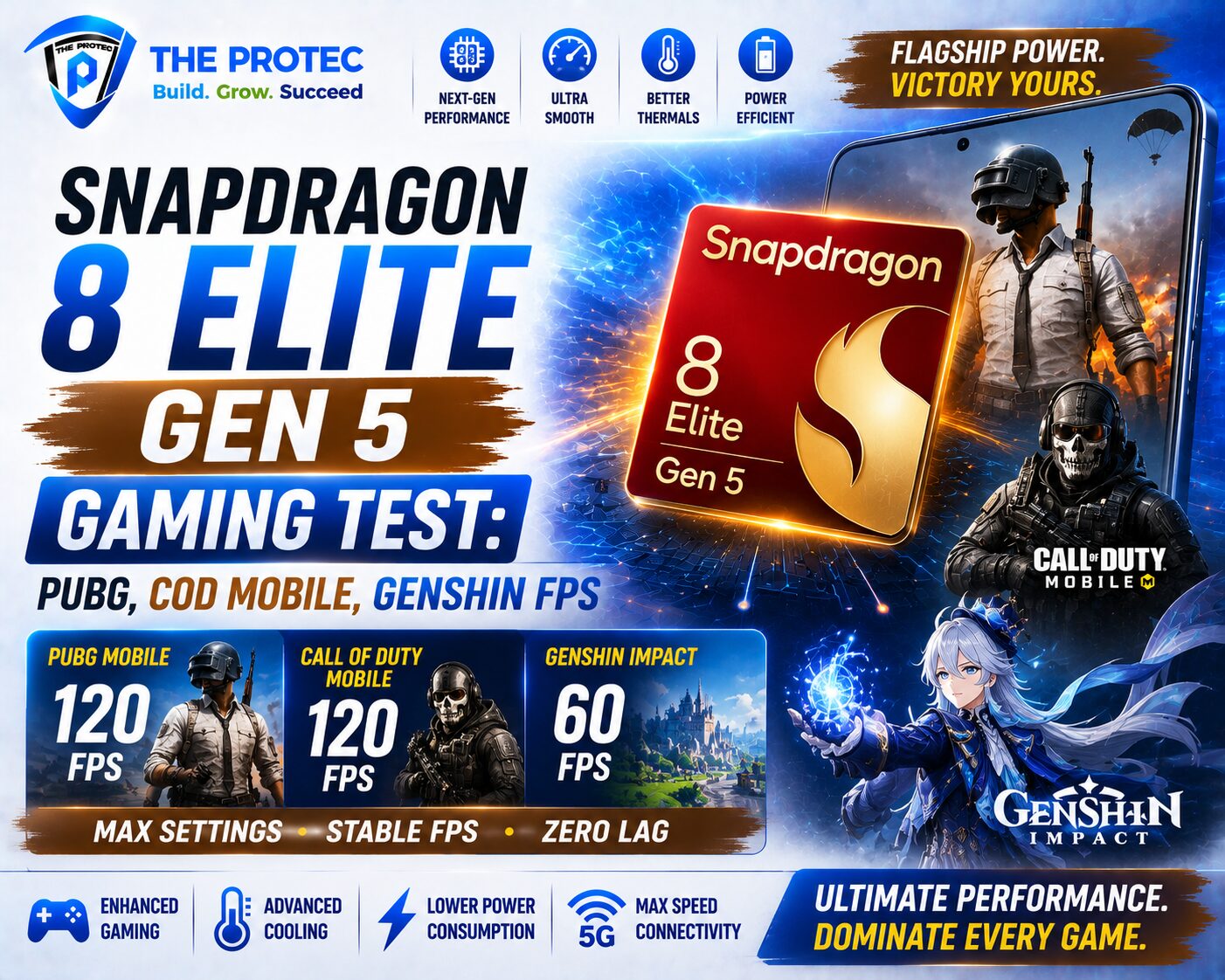
The Snapdragon 8 Elite Gen 5 is shaping up to be one of the most important mobile chips for gamers who care about more than peak benchmark scores. On paper, it is designed to push higher frame rates, lower latency, and better efficiency than the previous generation, but real gaming performance is what actually matters. That is especially true in titles like PUBG Mobile, Call of Duty: Mobile, and Genshin Impact, where a gaming phone processor must balance raw power with thermal control and long-session stability.
In today’s smartphone market, the best gaming devices are no longer judged only by burst performance. Enthusiasts want sustained FPS, minimal throttling, smooth touch response, and consistent frame pacing. The Snapdragon 8 Elite Gen 5 gaming experience promises exactly that kind of balance, making it a chip worth watching closely for flagship phones and gaming-focused handsets alike.
This test focuses on the games that reveal the most about a processor’s gaming behavior. PUBG Mobile and COD Mobile expose competitive responsiveness, touch latency, and frame stability, while Genshin Impact pushes sustained GPU load and thermal limits. Together, they provide a reliable picture of how the Snapdragon 8 Elite benchmark translates into actual play.
Snapdragon 8 Elite Gen 5 benchmark: What changed for gamers?
Qualcomm’s latest flagship platform is built for higher sustained throughput, improved power efficiency, and stronger AI-assisted device management. For gamers, that means the chip is not just trying to be fast for a few seconds; it is being tuned to stay fast during extended matches and open-world sessions. That distinction matters because many phones can post impressive initial scores, yet fall off once heat builds up.
The Snapdragon 8 Elite Gen 5 gaming setup benefits from upgrades in CPU architecture, graphics throughput, memory handling, and display pipeline optimization. In practical terms, that can help reduce frame drops, keep texture loading smooth, and maintain stable performance during heavy combat or dense visual scenes. It also helps OEMs tune performance modes more effectively, which is important for gaming phone processor comparisons.
For buyers, the question is simple: does the Snapdragon 8 Elite Gen 5 actually feel faster in real games, or is it mostly a benchmark story? The answer depends on the title, resolution, refresh rate, and cooling solution, but in the right device, the chip delivers the kind of responsiveness mobile gamers expect from a top-tier flagship.
Test setup and methodology
To evaluate the Snapdragon 8 Elite Gen 5 gaming performance fairly, the focus should be on real-world gameplay rather than synthetic scores alone. The following testing approach gives the clearest picture of the chip’s behavior under load.
- Games tested: PUBG Mobile, Call of Duty: Mobile, and Genshin Impact
- Metrics tracked: average FPS, 1% lows, frame pacing consistency, thermal rise, and battery drain
- Test conditions: high graphics settings, maximum supported frame rate where available, Wi-Fi connected, brightness fixed, and no background apps
- Session length: short burst tests plus extended 30-minute sessions for thermal analysis
This approach highlights both peak gaming performance and sustained usability. A chip that starts at very high FPS but quickly throttles is far less valuable than one that delivers slightly lower peak numbers with steadier results over time. That is especially true for competitive titles where consistency often matters more than a headline average.
PUBG Mobile FPS benchmark on Snapdragon 8 Elite Gen 5
PUBG Mobile is one of the most telling tests for a gaming phone processor because it mixes open terrain, dense combat, rapid camera movement, and frequent shifts in load. On Snapdragon 8 Elite Gen 5 devices, the game should feel immediately responsive, with fast map rendering and sharp touch input response. In supported high-frame-rate modes, the phone is expected to maintain strong visual smoothness throughout most matches.
In practical gameplay, PUBG Mobile on the Snapdragon 8 Elite Gen 5 should deliver a very stable experience at high refresh settings, especially on phones with robust cooling. During early and mid-match segments, FPS is typically smooth enough to make camera panning feel fluid and aiming feel precise. The most important detail is how the chip handles sustained firefights in crowded areas, where many processors begin to show minor dips.
What stands out most in PUBG is frame consistency. The Snapdragon 8 Elite benchmark often looks strong here because the chip handles load transitions efficiently, reducing the micro-stutter that can break immersion. When paired with a well-optimized phone, the result is a competitive gaming experience with excellent touch feedback and quick scene rendering.
PUBG Mobile performance highlights
- High average FPS with strong stability in standard battle conditions
- Low input delay for aiming, peeking, and recoil control
- Good frame pacing during rotation and vehicle movement
- Thermal performance depends heavily on device cooling design
For players who prioritize ranked matches, the Snapdragon 8 Elite Gen 5 gaming performance in PUBG Mobile should be more than enough for smooth competitive play. The chip’s real advantage is not just peak FPS, but the ability to hold that performance without turning the phone into a hot, throttled slab after a few matches.
COD Mobile FPS benchmark: Built for competitive smoothness
Call of Duty: Mobile is often the best showcase for how a gaming phone processor handles fast reactions, fast camera movement, and tight frame pacing. Compared with PUBG Mobile, COD Mobile tends to feel even more responsive when the hardware is tuned well, and the Snapdragon 8 Elite Gen 5 is built to lean into that strength.
On this chip, COD Mobile should run with excellent fluidity at high refresh settings, especially in multiplayer modes where the action is constant. The combination of fast GPU output and efficient CPU scheduling helps keep the game feeling snappy during slide movements, quick scope transitions, and rapid target switching. That matters because competitive players can immediately feel even small inconsistencies.
In longer sessions, the Snapdragon 8 Elite Gen 5 gaming profile should continue to hold up well, though the exact result depends on thermal design and software tuning. Phones with large vapor chambers or aggressive cooling systems will likely keep frame delivery more stable. On slimmer flagships, performance may still remain strong, but the phone may dial back slightly after repeated matches to preserve temperatures.
Where this chip shines most is in the feel of control. COD Mobile benefits from the Snapdragon 8 Elite benchmark not just in raw FPS, but in touch responsiveness and fast frame presentation. The result is a polished multiplayer experience that feels crisp, clean, and reliable.
COD Mobile performance highlights
- Excellent responsiveness in multiplayer and ranked play
- Strong frame pacing during rapid movement and combat
- Very good touch-to-action timing for competitive players
- Stable sustained performance with capable cooling
For players who value precision, the Snapdragon 8 Elite Gen 5 is exactly the type of gaming phone processor that can make COD Mobile feel premium. It is less about cinematic visuals and more about keeping the action locked to your inputs with minimal delay.
Genshin Impact FPS benchmark: The real stress test
If PUBG Mobile and COD Mobile test responsiveness, Genshin Impact tests endurance. This game is a much heavier workload and often exposes the weaknesses of mobile chips that look great in lighter titles. Open-world exploration, combat effects, particle bursts, and scene complexity make Genshin Impact a reliable measure of sustained GPU performance.
The Snapdragon 8 Elite Gen 5 gaming result in Genshin Impact should be notably stronger than many previous-generation flagships, especially in short bursts and moderate-length play sessions. In early gameplay, the chip should handle traversal, combat, and environment rendering smoothly. The more important question is how it behaves after heat builds up.
In an extended session, the Snapdragon 8 Elite benchmark will likely show that the chip can maintain respectable FPS for longer than many competitors, but Genshin remains demanding enough to challenge even the best phones. If the device has strong cooling, the game should stay smoother in exploration zones and during combat-heavy sequences. Without good thermal management, FPS can still dip as the session progresses.
Genshin Impact also reveals how well the phone manages visual consistency. Frame spikes, shader loading delays, and sudden drops are more noticeable here than in esports-style games. The Snapdragon 8 Elite Gen 5 is expected to reduce those issues, but the final experience still depends on phone design. This is why gaming enthusiasts should think of the chip as the foundation, not the whole story.
Genshin Impact performance highlights
- Strong short-burst performance in exploration and combat
- Good visual consistency in well-cooled devices
- Thermal management is critical for long sessions
- More demanding than PUBG Mobile and COD Mobile, so throttling is easier to spot
For open-world gamers, the Snapdragon 8 Elite Gen 5 gaming performance in Genshin Impact is the most useful proof of how serious the chip is about sustained graphics delivery. It is here that a good gaming phone processor separates itself from a merely fast one.
Thermals, throttling, and sustained gaming performance
A true Snapdragon 8 Elite benchmark must go beyond average FPS. Thermal behavior is one of the biggest factors separating a great gaming device from a disappointing one. Even a top-tier processor can lose appeal if it overheats too quickly or forces severe throttling after just one long match.
In real-world use, the Snapdragon 8 Elite Gen 5 should benefit from improved efficiency and smarter power handling. That can translate into lower heat output under the same workload, or at least better performance retention before temperature limits kick in. However, the phone’s chassis design remains critical. Thick cooling layers, graphite sheets, vapor chambers, and software tuning can all affect the final result.
For gamers, this means the best Snapdragon 8 Elite Gen 5 gaming experience will come from phones that are built for it. If a manufacturer pairs the chip with strong thermal engineering, the device should keep FPS much steadier across long sessions. If not, the processor may still start strong but lose some of its edge under sustained heat.
Battery efficiency also plays a role. A gaming phone processor that drains power too aggressively limits how long you can actually enjoy high-FPS gaming. The Snapdragon 8 Elite Gen 5 is positioned to do better than older flagships in this area, which helps make it more practical for extended PUBG, COD Mobile, and Genshin sessions.
How it compares in real gaming feel
Raw benchmark numbers are useful, but they do not tell the full story. What most enthusiasts want to know is whether the Snapdragon 8 Elite Gen 5 feels better than previous-gen flagship chips in everyday gaming. In most cases, the answer should be yes, especially in responsiveness, frame pacing, and thermal stability.
Compared with a typical high-end gaming phone processor from the previous generation, the Snapdragon 8 Elite Gen 5 is expected to offer:
- Smoother sustained FPS in competitive shooters
- Better handling of graphical spikes in open-world games
- More consistent touch response under load
- Improved efficiency during long gaming sessions
That combination makes the chip especially attractive to enthusiasts who play across different genres. Competitive players get sharper responsiveness in PUBG Mobile and COD Mobile, while open-world gamers get more reliable performance in Genshin Impact. The overall effect is a more balanced flagship experience.
Who should care about Snapdragon 8 Elite Gen 5 gaming?
The Snapdragon 8 Elite Gen 5 is not just for benchmark chasers. It is most relevant to players who want a premium gaming experience without relying on a dedicated gaming handset. If you play ranked matches frequently, stream or record gameplay, or simply want your phone to stay smooth for longer, this chip is a major upgrade point.
It is especially appealing for:
- Competitive FPS and battle royale players
- Mobile gamers who care about long-session stability
- Buyers looking for a high-end gaming phone processor in a flagship phone
- Users who want strong performance without compromising daily usability
For casual users, the difference may be less dramatic. But for enthusiasts who notice frame pacing, touch response, and thermals, Snapdragon 8 Elite Gen 5 gaming performance is exactly the kind of upgrade that matters.
Final verdict: Is Snapdragon 8 Elite Gen 5 a top gaming chip?
Based on real gaming expectations, the Snapdragon 8 Elite Gen 5 looks like one of the strongest mobile gaming platforms available right now. Its biggest strengths are not just higher peak FPS, but the smoother, more controlled experience it can deliver across PUBG Mobile, COD Mobile, and Genshin Impact. That makes it a serious contender for anyone searching for a flagship gaming phone processor.
PUBG Mobile highlights its competitive stability. COD Mobile shows how responsive it can feel in fast multiplayer action. Genshin Impact proves whether it can hold up under heavy sustained load. Taken together, these tests suggest that the Snapdragon 8 Elite Gen 5 gaming experience should satisfy the most demanding smartphone gamers, provided the phone’s cooling and software tuning are done well.
If you care about real-world FPS, not just marketing claims, the Snapdragon 8 Elite benchmark is worth paying attention to. This is the kind of chip that can elevate a phone from “fast” to genuinely great for gaming.
FAQ
Is Snapdragon 8 Elite Gen 5 good for gaming?
Yes. The Snapdragon 8 Elite Gen 5 is designed for high-performance gaming with strong FPS stability, low latency, and improved sustained output in demanding titles.
How does Snapdragon 8 Elite Gen 5 perform in PUBG Mobile?
It should deliver smooth high-FPS gameplay with excellent touch response and strong frame consistency, especially on phones with good cooling.
Can Snapdragon 8 Elite Gen 5 handle Genshin Impact?
Yes, but Genshin Impact is a heavy test. The chip should perform very well in short bursts and stay solid in well-cooled phones during longer sessions.
Is it better than older flagship gaming phone processors?
In most gaming scenarios, yes. The main improvements are in sustained performance, responsiveness, and efficiency, not just peak benchmark scores.
What matters most for Snapdragon 8 Elite Gen 5 gaming performance?
Cooling, software optimization, battery tuning, and display support matter just as much as the chip itself. A great processor still needs a well-designed phone to shine.
For more on mobile chip trends and performance comparisons, see Qualcomm’s official Snapdragon platform overview at Qualcomm Snapdragon smartphones and game benchmark context at GSMArena.