






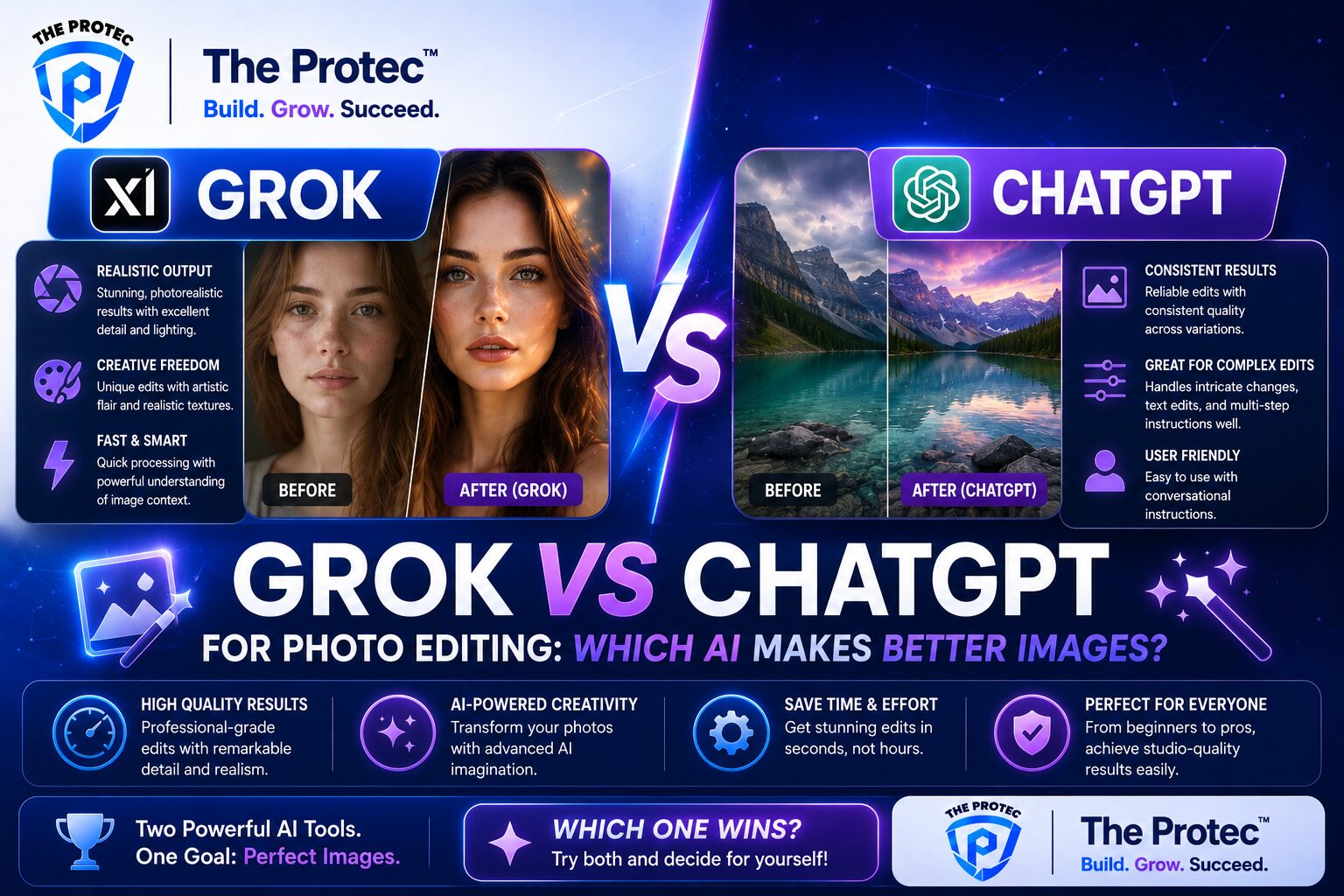
Grok vs ChatGPT for Photo Editing: Which AI Makes Better Images?
AI image tools have moved far beyond novelty. Today, they are used for social graphics, product concepts, ad mockups, editorial visuals, and quick photo edits that would have once required a designer or retoucher. Two of the most talked-about names in this space are Grok and ChatGPT, and the debate around Grok vs ChatGPT image generation has become especially relevant as both tools keep improving.
If you are trying to decide which platform is the best AI image editor for your workflow, the answer depends on what you want to create. One tool may produce more visually striking results. Another may offer more predictable edits, better prompt-following, or stronger utility for professional tasks. That is why a real AI photo editing comparison matters more than hype.
In this guide, we will compare Grok vs ChatGPT image generation across image quality, editing precision, realism, speed, usability, and practical use cases. By the end, you will know which one is better for photo editing, when to use each, and where the current strengths and tradeoffs really are.
Why This Comparison Matters Now
Image generation is no longer just about making abstract art. The latest wave of AI tools focuses on usable image editing: changing clothing colors, refining portraits, swapping backgrounds, correcting lighting, adding objects, and producing marketing-ready visuals with less manual work. As of the most recent platform updates, both Grok and ChatGPT are being used for increasingly sophisticated visual tasks, but they approach the job differently.
That difference matters because photo editing is not just about making something look impressive. It is also about consistency, control, realism, and how well the tool preserves the original subject. A beautiful image that distorts a face or changes product details is not always useful. Likewise, a technically accurate edit that looks dull may not be ideal for content creators who want a strong social media thumbnail or campaign visual.
For that reason, the best AI image editor is the one that best fits your goal. The rest of this article breaks down exactly where each tool shines.
What Grok Does Well in Image Generation
Grok has developed a reputation for fast, conversation-driven creation. Its biggest strength is the way it blends immediacy with a more playful, less rigid creative style. For users who want quick concept images, attention-grabbing edits, or visually bold outputs, Grok can be very appealing.
In practical terms, Grok often feels optimized for speed and experimentation. Users can describe a scene or edit in a natural way and get a result quickly. That makes it useful for rough mockups, social content, and idea exploration. When the goal is to generate multiple variations fast, Grok can be an efficient creative partner.
Some of Grok’s strongest use cases include:
- Social media image concepts
- Stylized portraits and creative transformations
- Fast visual brainstorming
- Memes, reaction visuals, and trend-based content
- Concept art or campaign rough drafts
That said, speed and creativity do not always translate into the most polished photo-editing output. Grok may produce images that are lively and visually interesting, but not always as precise when a user needs exact facial structure, product consistency, or subtle retouching.
What ChatGPT Does Well in Photo Editing
ChatGPT’s image generation and editing workflow is often favored for structure, instruction-following, and controlled revisions. In a photo editing context, that can be a major advantage. If you need to refine an image instead of reinventing it, ChatGPT tends to be the more deliberate tool.
This matters because a lot of real-world editing is not about creating something from scratch. It is about making targeted changes while keeping everything else intact. Whether you are adjusting a background, changing a prop, improving a portrait, or reworking a composition, ChatGPT is often better suited to careful edits with clear intent.
Common strengths include:
- Better prompt clarity and instruction handling
- More controlled edits to existing images
- Strong usefulness for business, marketing, and content work
- Better conversational refinement across multiple iterations
- More dependable output for practical visual tasks
For many creators, ChatGPT feels less like a novelty generator and more like a serious production assistant. That is why it frequently comes out ahead in an AI photo editing comparison focused on usability and reliability.
Grok vs ChatGPT Image Generation: Image Quality Comparison
Image quality is the first thing most people notice, but it is also the hardest thing to define. Quality can mean realism, detail, aesthetics, coherence, or how close the result is to the original intent. In the Grok vs ChatGPT image generation debate, the winner depends on which quality metric matters most.
Realism and Detail
ChatGPT usually has the edge when realism and image coherence matter. In portrait-style edits or product-focused work, it often produces cleaner structure, more believable object relationships, and better adherence to the intended scene. That makes it a stronger choice when the image must look credible rather than merely interesting.
Grok, on the other hand, can be more expressive and stylized. Its results sometimes have more visual energy, but they can also drift into odd proportions, inconsistent shadows, or details that feel less grounded. For creative visuals, that can be acceptable. For professional editing, it can be a drawback.
Visual Style
Grok often generates images with a punchier, more experimental feel. That can work well for social content, viral posts, or concept art where personality matters more than perfection. ChatGPT generally leans toward a steadier, more controlled style that is easier to refine into something usable for business or editorial settings.
If you want a dramatic, attention-grabbing image, Grok may feel more exciting. If you want something that looks polished and reusable, ChatGPT usually offers the safer path.
Consistency Across Edits
Consistency is one of the most important factors in AI photo editing. If you are editing a brand asset, a portrait series, or a product shot, the subject needs to stay recognizable. ChatGPT tends to preserve the original structure better across iterative edits, especially when the user gives detailed instructions.
Grok can be more variable. That variability is not always bad, but it can make precise editing more difficult. If your workflow depends on predictable outcomes, ChatGPT has a practical advantage.
AI Photo Editing Comparison: Which Tool Handles Edits Better?
Photo editing is not the same as image generation. Generating an image from a prompt is one task. Editing an existing image while preserving identity, perspective, and context is another. This distinction is where the best AI image editor often reveals itself.
Background Changes
Both tools can handle background changes, but ChatGPT usually does so with more control. If you want to replace a cluttered room with a clean studio background or move a subject outdoors while maintaining natural lighting, ChatGPT often keeps the result more believable.
Grok can produce strong background concepts too, but the transition between subject and scene may not always blend as cleanly. For casual or stylized output, that may be fine. For commercial work, it can be a problem.
Portrait Retouching
When it comes to portrait edits, the goal is usually subtle enhancement rather than transformation. Here, ChatGPT often performs better because it is more likely to preserve facial identity and avoid over-editing. It can be useful for softening a portrait, adjusting lighting, or making modest style changes without losing realism.
Grok may create eye-catching portrait variations, but it can also shift facial features in ways that are less desirable for professional use. If you are editing a headshot, profile image, or personal brand photo, that difference matters.
Object Addition and Removal
Adding or removing objects is one of the most practical AI editing tasks. ChatGPT typically handles these instructions more methodically, especially when the request is specific. If you want to remove a distracting element from a product photo or add a subtle prop to a composition, it tends to be more reliable.
Grok can handle object edits, but it may introduce more stylistic variation or scene changes than expected. That can be useful in creative work, but not ideal when precision is the goal.
Text and Graphic Elements
Neither tool should be treated as a perfect graphic-design replacement, especially when exact typography matters. Still, for simple visual mockups, ChatGPT tends to be more disciplined in following composition requests. Grok may be faster for rough ideas but less dependable for polished layouts.
Speed, Workflow, and Ease of Use
Speed is not only about how quickly an image appears. It is also about how quickly you can get from idea to acceptable result. That includes prompt writing, revision cycles, and the amount of cleanup needed afterward.
Grok often feels faster and more spontaneous. If you want to test several visual ideas in a short period of time, it can be a strong brainstorming tool. This makes it appealing for creators working on social posts, memes, or trend-responsive visuals where timing matters.
ChatGPT is often slower in spirit but more efficient in the long run. Why? Because it reduces the number of failed attempts when the task requires control. If you need a specific edit, fewer corrections can save time overall, even if the first result takes a little more guidance.
From a workflow perspective:
- Choose Grok for rapid experimentation and creative exploration
- Choose ChatGPT for structured editing and repeatable output
That is why many professionals do not treat this as an either-or decision. They use both tools for different stages of the process.
Best AI Image Editor for Different Use Cases
The best AI image editor depends on what you are making. There is no single winner for every job, but there is a clearer choice for each scenario.
For Social Media Creators
If your priority is producing eye-catching visuals that stand out in fast-moving feeds, Grok can be an excellent option. It is especially useful for trend-driven content, playful visuals, and rough concepts that need personality.
For Marketers and Brands
ChatGPT is usually the better choice for branded content, product imagery, and ad-like visuals. The ability to preserve subject integrity and make controlled edits gives it a more professional edge.
For Designers and Content Teams
ChatGPT is often the more dependable production tool. It works better when you need revisions, consistency, and image quality that can support a broader content system.
For Casual Users
Grok may feel more fun and immediate. If your goal is to explore ideas, create amusing images, or experiment without worrying too much about exactness, it can be the more enjoyable experience.
For Photo Editing Accuracy
ChatGPT is the better pick for most accuracy-focused tasks. In an AI photo editing comparison, that usually matters more than raw creativity when you need the output to be useful in real workflows.
Current Trends Shaping AI Image Editing
As AI image tools evolve, the market is shifting away from generic image generation and toward practical editing assistance. Users want tools that can understand context, preserve identity, and make specific changes without breaking the image. That trend strongly favors systems that can interpret instructions with precision.
Another major trend is multimodal workflow integration. Users are not just generating one image and stopping. They are building images as part of a broader process that includes text, planning, iteration, and reuse. ChatGPT fits that workflow well because it combines conversation and image handling in a single environment. Grok, meanwhile, stands out for more immediate, high-energy ideation.
If you want a broader look at how image-generation systems are evolving, OpenAI’s image features are documented in their help resources, and xAI continues to position Grok as a fast-moving, highly conversational tool. For background reading, see OpenAI Help Center and xAI.
Final Verdict: Grok or ChatGPT?
If your main question is which tool creates better images for photo editing, ChatGPT is the stronger all-around choice. It is generally better at preserving structure, following detailed instructions, and producing realistic edits that work in professional settings. For most users seeking the best AI image editor, that makes ChatGPT the more reliable option.
Grok is still highly valuable, especially if your goals are speed, experimentation, and stylized output. It can be the better creative playground and may outperform ChatGPT when you want something bold, playful, or trend-friendly. But when the task is serious photo editing, ChatGPT usually wins on consistency and control.
So the simplest takeaway is this:
- Choose Grok for fast ideas, creative exploration, and social-first visuals
- Choose ChatGPT for photo editing accuracy, realism, and dependable results
If you are building a content workflow, the smartest move may be using both: Grok for concept generation and ChatGPT for refinement. That combination gives you speed and control, which is often the real competitive advantage in modern AI image creation.
FAQ
Is Grok or ChatGPT better for photo editing?
ChatGPT is generally better for photo editing because it handles detailed instructions more consistently and preserves image structure more reliably. Grok is better for fast, creative exploration.
Which tool is best for realistic AI image generation?
ChatGPT usually produces more realistic and coherent results, especially for portraits, product images, and edits that need to look believable.
Can Grok replace ChatGPT as an AI image editor?
Not completely. Grok is strong for quick, expressive visuals, but ChatGPT is usually more dependable for controlled editing and professional workflows.
What is the best AI image editor for marketers?
For most marketing use cases, ChatGPT is the better choice because it is more consistent, more controllable, and better suited to branded visuals.
Should I use both Grok and ChatGPT?
Yes, if your workflow allows it. Many creators use Grok for brainstorming and ChatGPT for polishing the final image, which combines creativity with precision.