







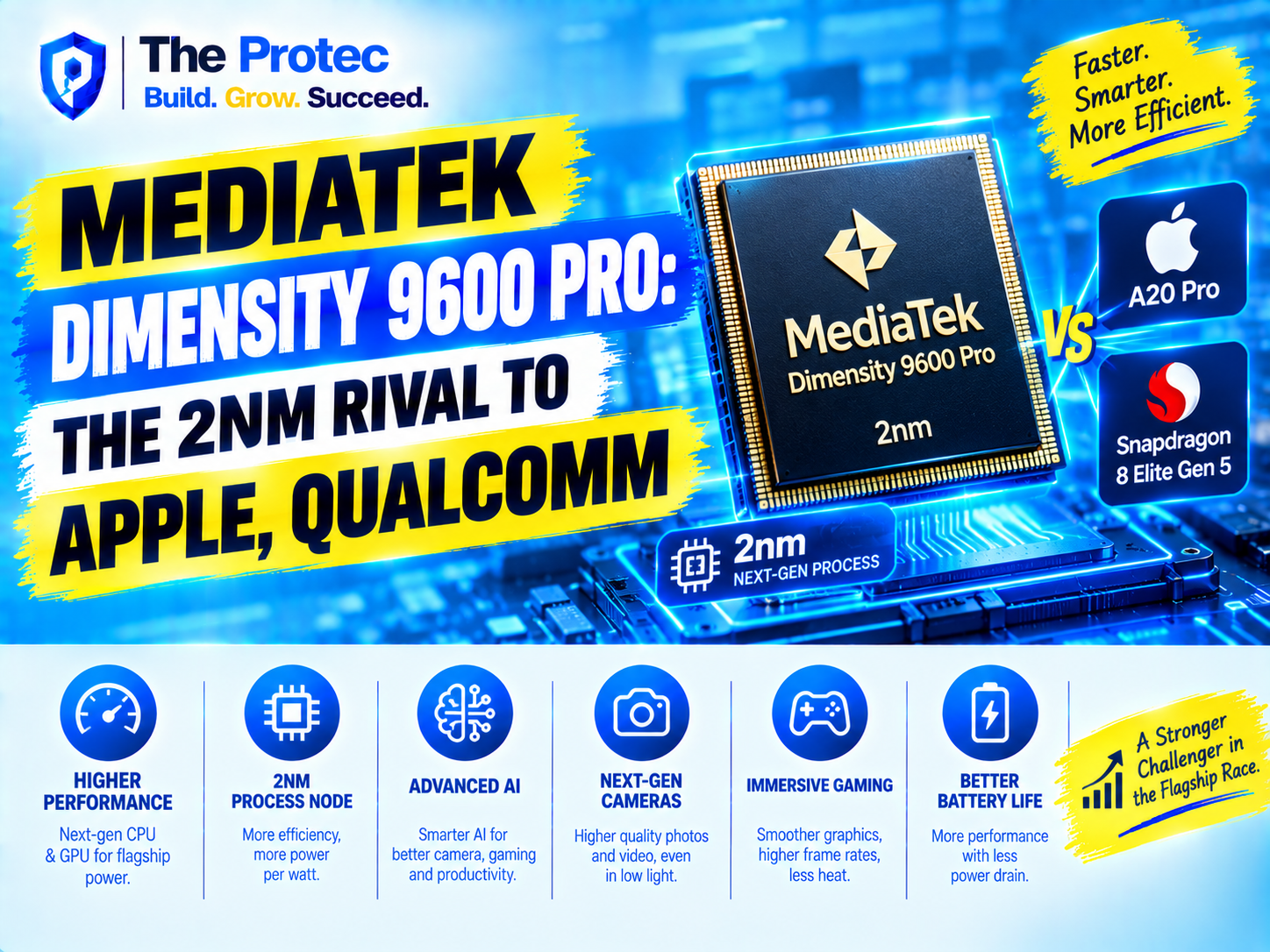
MediaTek is no longer content with being the alternative choice in premium Android phones. The MediaTek Dimensity 9600 Pro represents its clearest attempt yet to lead the next generation of smartphone chips, combining a reported TSMC 2nm manufacturing process with a high-performance CPU, upgraded flagship graphics and a more capable on-device AI engine.
The timing matters. Qualcomm is advancing its custom Snapdragon CPU strategy, while Apple continues to control the complete silicon, software and hardware stack behind the iPhone. MediaTek must therefore offer more than impressive peak benchmark scores. The Dimensity 9600 Pro needs to deliver efficient everyday performance, sustained gaming speed, responsive generative AI and dependable connectivity without creating heat or draining the battery.
As of September 2026, some implementation details and device-level results still depend on individual manufacturers. Nevertheless, the platform provides a useful look at how the 2nm smartphone processor era could reshape flagship phones—and why process technology alone will not determine the winner.
MediaTek Dimensity 9600 Pro specs at a glance
The Dimensity 9600 Pro is built around several pillars expected from a modern MediaTek flagship chip:
- A reported TSMC 2nm process using gate-all-around transistor technology
- A performance-focused, 64-bit CPU design based on the latest Arm architecture
- A new flagship GPU with hardware-accelerated ray tracing and improved efficiency
- An upgraded neural processing unit for generative and multimodal AI
- Faster memory and storage interfaces designed to prevent data bottlenecks
- 5G-Advanced, modern Wi-Fi, Bluetooth and location capabilities
- Enhanced image, video, display and camera-processing engines
Exact frequencies, cache configurations and supported features can differ between the final commercial platform and the way a phone maker configures it. Cooling, memory capacity, firmware and power limits will also have a major effect on Dimensity 9600 Pro performance.
Why the Dimensity 9600 Pro 2nm process matters
The central story is the move to TSMC 2nm. Unlike older FinFET designs, TSMC’s N2 generation adopts nanosheet gate-all-around transistors, giving the gate greater control over current flowing through each transistor. TSMC describes N2 as a platform designed to improve performance, power efficiency and transistor density compared with its previous nodes.
For a 2nm mobile chip, those gains can be spent in different ways. MediaTek could raise CPU and GPU performance within a familiar power envelope, reduce consumption at the same performance level, add more AI hardware or combine all three approaches. The most useful outcome for phone owners would not necessarily be a dramatic benchmark jump. It could instead be quicker workloads with less heat, longer gaming sessions before throttling and lower background power use.
However, “2nm” is not a guarantee of superior real-world behavior. Physical design, voltage tuning, cache, memory, software scheduling and packaging remain crucial. A poorly cooled 2nm phone can still throttle, while a mature 3nm design with excellent optimization may perform more consistently. The MediaTek 2nm chip must be judged as a complete system rather than by its process label.
Dimensity 9600 Pro CPU architecture
The Dimensity 9600 Pro CPU continues MediaTek’s aggressive flagship strategy of prioritizing powerful Arm cores rather than relying heavily on traditional low-performance efficiency cores. This approach is intended to finish demanding work quickly, then return the processor to a low-power state. It can be especially effective for application launches, web rendering, camera processing and short bursts of multitasking.
The latest Arm architecture also brings improvements beyond clock speed, including higher instructions per cycle, stronger branch prediction and more efficient handling of modern workloads. MediaTek can pair those cores with larger caches and a more capable interconnect so that data moves quickly among the CPU, GPU, memory controller and AI engine. Readers interested in the underlying instruction architecture can explore Arm’s CPU architecture overview.
The challenge is sustained power. Large cores can provide excellent responsiveness but may consume substantial energy when all are active. The benefits of the Dimensity 9600 Pro 2nm design will depend on whether MediaTek’s scheduler and voltage management can keep that performance under control during long exports, games and AI tasks.
Dimensity 9600 Pro GPU targets sustained gaming
The Dimensity 9600 Pro GPU is positioned as more than a peak-frame-rate upgrade. Its newer graphics architecture is designed to improve performance per watt, ray-tracing throughput and the efficiency of shader-heavy effects used by advanced mobile games. Better upscaling and frame-generation techniques could also help phones produce smoother visuals without rendering every frame at the panel’s native resolution.
Those features place MediaTek directly against Qualcomm’s Adreno graphics platform and Apple’s tightly integrated custom GPU. MediaTek’s opportunity lies in sustained gaming. If the 2nm process reduces power at a given workload, a Dimensity phone may hold high frame rates longer before its chassis becomes warm enough to trigger throttling.
Results will vary significantly between devices. A gaming phone with a vapor chamber, generous power limits and optimized drivers can outperform a slim handset using the same processor. Game support matters too: sophisticated ray tracing is valuable only when developers implement it and drivers remain stable.
A smartphone AI chip built for generative workloads
AI has become a central part of flagship silicon rather than a secondary feature. The Dimensity 9600 Pro includes a more advanced neural processing unit intended to run language, image, audio and multimodal models directly on the phone. Potential uses include live translation, call summaries, photo editing, semantic search, camera enhancement and assistants that understand information across text and images.
A capable mobile AI processor must balance arithmetic throughput with memory bandwidth and energy use. Large models constantly move weights and contextual data, so headline trillions-of-operations figures do not explain the entire experience. Memory capacity, compression support, developer tools and model optimization can be equally important.
On-device processing can reduce cloud dependence, improve latency and keep sensitive information local. Yet phone manufacturers decide which models and features ship. The Dimensity 9600 Pro may provide the foundation, but software support will determine whether its AI capabilities feel transformative or become a collection of rarely used tools.
Memory, storage, cameras and connectivity
A fast processor needs an equally modern data pipeline. The Dimensity 9600 Pro is designed around high-bandwidth mobile memory and faster storage technology, helping the CPU, GPU and NPU access data without unnecessary waiting. That is particularly important for large AI models, high-resolution video, complex games and rapid burst photography.
MediaTek also integrates an advanced image signal processor for computational photography. Its role includes combining exposures, reducing noise, tracking subjects and processing high-resolution video in real time. Final camera quality will still depend on sensors, lenses and each manufacturer’s imaging algorithms.
Connectivity is expected to emphasize 5G-Advanced features, efficient carrier aggregation, current-generation Wi-Fi, Bluetooth and precise positioning. Modem efficiency is especially important because cellular networking can represent a substantial share of battery consumption. Stable reception at lower power may be more meaningful than a theoretical maximum download speed available only under ideal conditions.
Dimensity 9600 Pro vs Snapdragon 8 Elite Gen 5
The Dimensity 9600 Pro vs Snapdragon 8 Elite Gen 5 contest is fundamentally a battle between two different design strategies. Qualcomm’s Snapdragon platform uses custom Oryon CPU cores and an established Adreno GPU ecosystem. MediaTek leans on leading Arm CPU and graphics intellectual property, then differentiates through cache design, power management, memory integration, AI acceleration and aggressive adoption of TSMC manufacturing.
Qualcomm may retain advantages in custom CPU tuning, graphics-driver familiarity and broad premium-device adoption. MediaTek can counter with strong multi-core throughput, competitive AI hardware and potentially favorable performance per watt from TSMC 2nm. It may also give manufacturers more flexibility when building high-end phones at different price points.
No single benchmark can settle MediaTek vs Qualcomm. Short CPU tests reveal burst speed, while repeated graphics loops expose thermal behavior. Battery tests, modem efficiency, application compatibility and camera processing provide a more realistic picture. The best Dimensity 9600 Pro vs Snapdragon comparison will use retail phones with similar displays, batteries and cooling systems.
Dimensity 9600 Pro vs Apple A20 Pro
The Dimensity 9600 Pro vs Apple A20 Pro comparison is less direct because Apple controls the chip, operating system and device. That vertical integration allows Apple to optimize its custom CPU, GPU, neural hardware and memory behavior for a narrow product range. It can also coordinate new silicon features with iOS frameworks and first-party applications.
MediaTek serves numerous Android manufacturers, giving it a broader but more fragmented environment. Its advantage is choice: the same underlying technology can appear in conventional flagships, camera-focused models, foldables and gaming phones. Android partners may also experiment more quickly with cooling, charging and on-device generative AI.
Apple is likely to remain formidable in single-core performance and software integration. MediaTek’s route to victory is not simply copying that formula. It must offer competitive sustained speed, efficient multi-core processing, flexible AI support and compelling value to manufacturers. In the wider MediaTek vs Apple contest, the quality of the complete phone will matter more than isolated chip scores.
Will 2nm improve battery life and everyday performance?
The move to 2nm can create meaningful benefits, but users should expect refinement rather than magic. Messaging, social media and light browsing already require little peak processing power. Improvements there may appear as lower standby drain, cooler operation and more consistent battery life rather than visibly faster screens.
Heavier workloads have greater potential to expose the gains. Video editing could finish sooner, local AI responses could arrive faster, and games could maintain their target frame rate for longer. More efficient image processing and connectivity could also reduce power use during photography, navigation and mobile-data sessions.
Phone makers can choose to spend efficiency gains on performance instead of endurance. A thin device with a bright display may not last longer even if its chip is more efficient. Buyers should therefore evaluate complete-device reviews rather than assuming every Dimensity 9600 Pro phone will deliver identical battery results.
What the Dimensity 9600 Pro release means for flagship phones
The Dimensity 9600 Pro release gives Android brands another credible option for ultra-premium hardware. More competition can reduce reliance on a single supplier, encourage faster AI and graphics development, and help manufacturers differentiate their flagship models. It may also push 2nm technology into a wider range of devices once production scales.
Early adoption is likely to focus on premium phones capable of supporting the cost and thermal requirements of advanced silicon. Availability will vary by region and manufacturer, and not every brand will use the same configuration. Over time, features developed for the MediaTek Dimensity 9600 may filter into more affordable chip families.
Final verdict
The MediaTek Dimensity 9600 Pro is an important statement: MediaTek intends to compete at the leading edge of mobile processing rather than follow Qualcomm and Apple. TSMC 2nm manufacturing gives it a promising foundation for faster CPU performance, stronger graphics and more efficient on-device AI.
Its real success will be measured by retail phones. If manufacturers pair the chip with effective cooling, fast memory, polished software and sensible power limits, the Dimensity 9600 Pro could deliver longer sustained gaming, responsive AI and improved battery efficiency. The 2nm transition creates the opportunity; execution will decide whether MediaTek converts it into a lasting flagship advantage.
Frequently asked questions
Is the MediaTek Dimensity 9600 Pro a 2nm chip?
The platform is reported as a TSMC 2nm design using next-generation gate-all-around transistor technology. Commercial devices and final manufacturer specifications remain the best sources for confirming the exact configuration used in each phone.
Is the Dimensity 9600 Pro faster than Snapdragon 8 Elite Gen 5?
It may lead in certain CPU, AI or efficiency tests, while Snapdragon could perform better in other workloads. Cooling, software and power settings can produce larger differences than the processor name, so comparisons should use similarly configured retail devices.
How does Dimensity 9600 Pro compare with Apple A20 Pro?
MediaTek emphasizes flexible Android integration, high multi-core performance, flagship graphics and on-device AI. Apple benefits from custom cores and deep hardware-software integration. Real-world results will depend on applications, thermal design and operating-system optimization.
Will a 2nm processor noticeably extend phone battery life?
It can improve performance per watt, but battery life also depends on the display, modem conditions, battery capacity and manufacturer tuning. Users may notice cooler operation and better endurance under demanding workloads even when total screen-on time changes only modestly.