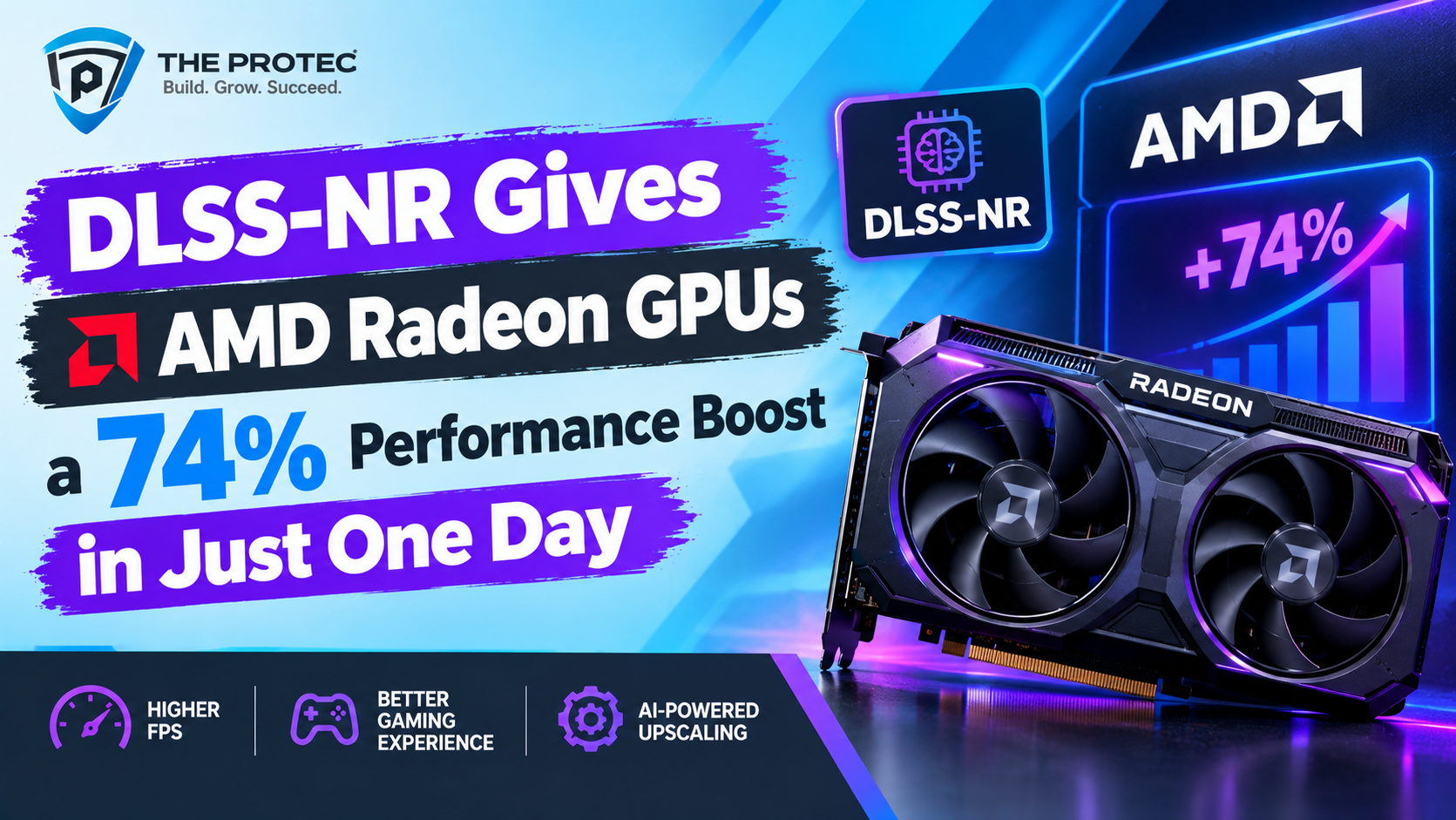







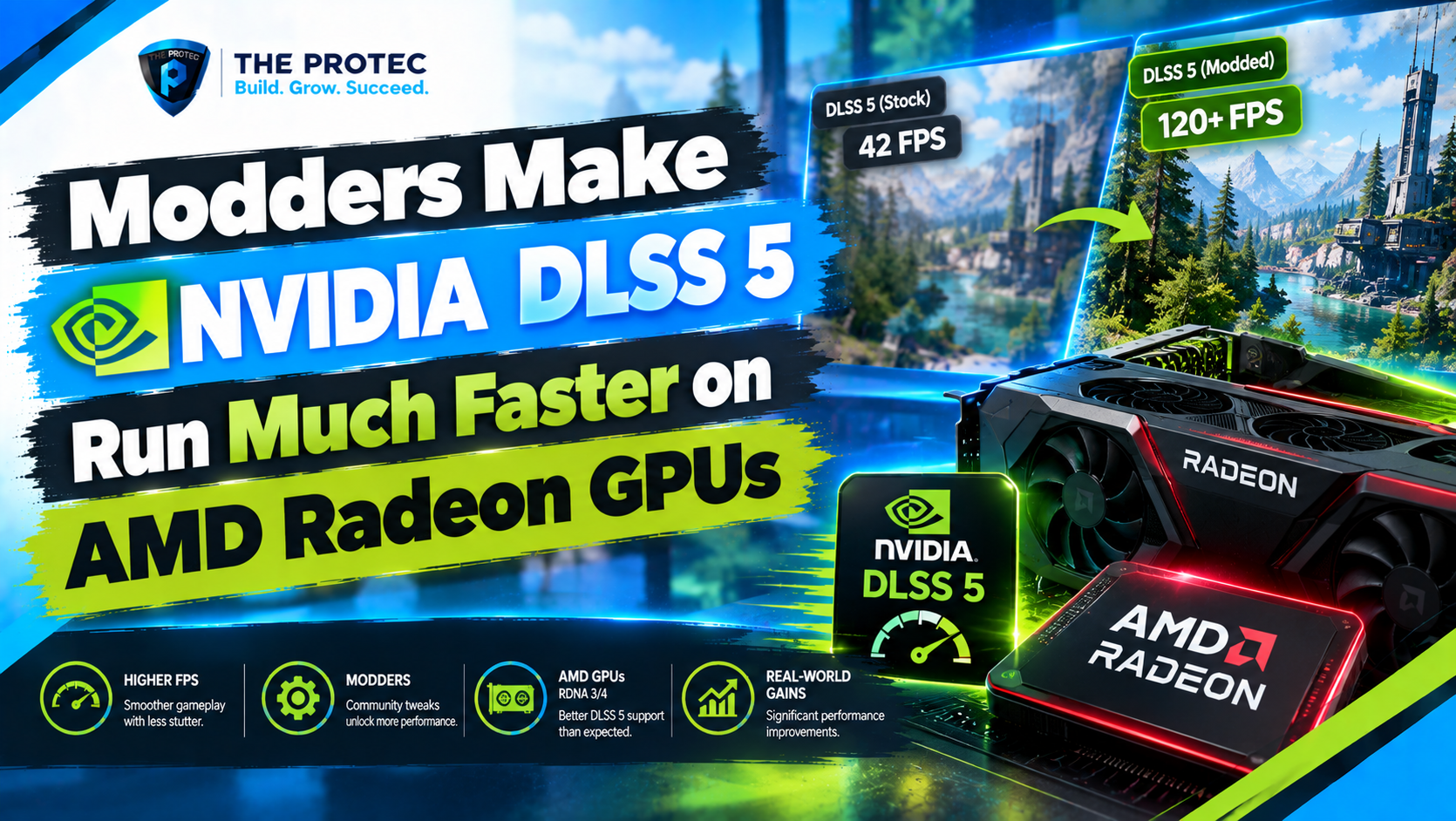
NVIDIA DLSS 5 running on an AMD Radeon graphics card sounds like the kind of experiment that should fail before a game even reaches its main menu. Yet community developers have not only demonstrated NVIDIA’s latest neural-rendering technology on competing hardware—they are making it considerably more practical.
The unofficial DLSS-NR-on-AMD project began as a technical proof of concept with steep performance costs, complicated setup requirements, and limited compatibility. Recent builds reportedly deliver substantial speed improvements through custom kernels designed specifically for AMD architectures. A companion tool called AMDNR Launcher also aims to replace much of the manual configuration with a streamlined installation and game-launch process.
This does not turn a Radeon card into a GeForce GPU, nor does it provide official DLSS 5 compatibility. The implementation remains experimental, individual results vary widely, and neither NVIDIA nor AMD supports it. Even so, the progress matters. It shows how quickly enthusiasts can adapt proprietary neural-rendering workloads—and how important cross-vendor access to advanced gaming features is becoming.
What Is DLSS-NR-on-AMD?
DLSS-NR-on-AMD is a community project intended to execute parts of NVIDIA DLSS 5 Neural Rendering on compatible AMD Radeon hardware. Instead of relying on NVIDIA’s driver stack and RTX-specific execution path, the project substitutes AMD-compatible compute code for neural-network operations that would otherwise expect NVIDIA hardware.
The distinction between DLSS as a complete platform and its neural-rendering component is important. The mod does not reproduce every proprietary NVIDIA feature or unlock universal DLSS 5 support in every game. It focuses on translating and accelerating supported neural-rendering workloads where a compatible game, model, graphics API, and injection path are available.
NVIDIA describes the broader DLSS platform on its official DLSS technology page. The modding effort operates independently of that ecosystem and should not be confused with an NVIDIA release, driver feature, or licensed AMD integration.
How Modders Got NVIDIA DLSS 5 Running on AMD GPUs
Neural rendering consists of large numbers of matrix, vector, sampling, and image-processing operations. NVIDIA normally schedules these workloads around its own GPU architecture, software libraries, drivers, and dedicated acceleration capabilities. Radeon GPUs can perform many of the underlying calculations, but they do not expose the same execution environment or behave identically when presented with code tuned for RTX hardware.
DLSS-NR-on-AMD bridges that gap by intercepting supported workloads and dispatching replacement compute kernels that Radeon hardware can execute. These kernels handle the low-level mathematical operations used by the neural model while accounting for AMD-specific details such as wave execution, register pressure, memory access, synchronization, and supported precision formats.
In simple terms, the project is not merely translating one instruction into another. It is reorganizing portions of the workload so they fit AMD GPUs more efficiently. That difference explains both the severe limitations of early releases and the sizeable DLSS 5 performance boost reported from newer builds.
Why Early DLSS 5 on AMD Was So Slow
The first demonstrations proved that DLSS 5 Neural Rendering on AMD was technically possible, but possibility did not equal playability. Generic or minimally optimized kernels left significant performance on the table. Operations designed around NVIDIA’s execution model could map poorly to Radeon compute units, creating low occupancy, excessive memory movement, and repeated format conversions.
Synchronization was another problem. A neural-rendering pipeline must exchange data with the game renderer at precise stages. Additional copies, barriers, or queue transitions can erase the benefit of an otherwise fast neural model. Shader compilation and runtime translation could introduce further delays, while inefficient dispatch sizes left sections of the GPU underused.
The result was an implementation that might produce an image but consume too much frame time to be useful during normal DLSS 5 gaming. In demanding scenes, the neural-rendering pass could negate the performance gained from reconstruction or become slower than conventional alternatives. Early versions were therefore more valuable as engineering demonstrations than everyday gaming tools.
Custom AMD Kernels Deliver the Biggest Performance Gains
Recent DLSS-NR-on-AMD updates reportedly replace more generic paths with kernels tuned for current Radeon architectures. These custom kernels can combine operations, reduce intermediate memory traffic, improve cache use, select more suitable precision modes, and arrange work around AMD’s preferred wave and matrix-processing behavior.
Fusing multiple steps is especially valuable. If one kernel can complete operations that previously required several dispatches, the GPU spends less time writing intermediate results to memory and waiting at synchronization points. Better register use and workload sizing can also keep more compute resources active.
Community reports describe the latest changes as substantial rather than marginal. In some supported combinations, the difference is large enough to move DLSS 5 AMD testing from an impractical experiment toward an implementation that can be evaluated during real gameplay. There is no single universal uplift, however. DLSS 5 performance depends on the Radeon model, resolution, quality mode, game profile, neural model, driver, and scene complexity.
These reports should not be treated as vendor-certified benchmarks. Anyone comparing builds should record frame rates, frame times, power behavior, and image quality in the same repeatable scene. An average frame-rate increase can hide shader-compilation stutter or inconsistent neural-processing times.
AMDNR Launcher Makes the DLSS 5 Mod Easier to Use
Earlier versions of the AMD DLSS 5 mod demanded considerable manual work. Users could need specific runtime files, per-game configuration, environment settings, launch arguments, or carefully selected kernels. A misplaced component or incompatible version could cause visual corruption, crashes, or failure during startup.
AMDNR Launcher is designed to simplify that process. Depending on the current project build and game profile, it can help detect the target executable, select an appropriate Radeon path, deploy required files, manage configuration, and launch the game with the necessary overrides. Centralizing those steps also makes it easier to update or remove the modification.
The launcher does not eliminate every risk. Users should obtain releases only from the project’s recognized distribution channels, back up modified files, preserve original settings, and read game-specific notes. Because injection and replacement libraries may resemble tools used for cheating, the mod should not be tested in competitive or anti-cheat-protected multiplayer environments unless the game developer explicitly permits it.
Shader caches may also need to be rebuilt after changing kernels or drivers. The first run can therefore be less representative than later sessions. Keeping a clean baseline installation is essential when troubleshooting.
Which AMD Radeon GPUs Are Supported?
Current development reportedly centers on recent Radeon generations with the instruction support and compute capabilities needed by the optimized kernels:
- Radeon RX 9000 series: RDNA 4 products are the most natural target for Radeon RX 9000 DLSS 5 testing because of their newer AI-oriented hardware and architectural improvements.
- Radeon RX 7000 series: RDNA 3 cards are included in recent Radeon RX 7000 DLSS 5 work, although performance can vary significantly by model and workload.
- Older Radeon generations: RX 6000-series and earlier GPUs should not be assumed to work. Missing instruction paths, reduced acceleration, or limited project support may make them incompatible or prohibitively slow.
Support is more specific than a GPU-generation label. A listed card can still fail with a particular game or model. Users should consult the release notes for the exact AMDNR Launcher and kernel build rather than relying on broad claims about AMD GPU DLSS 5 compatibility.
Game Compatibility Remains Limited
The DLSS 5 mod is not a universal switch that can add neural rendering to any title. A game generally needs a compatible rendering path and the expected DLSS 5 Neural Rendering integration. The project must then have a working method for intercepting or replacing the relevant workload.
DirectX version, engine updates, executable changes, frame-generation components, overlays, and other graphics modifications can all affect compatibility. A game patch may change internal behavior and temporarily break a previously working profile. Digital storefront differences can matter when executable layouts or protection systems vary.
Anti-cheat software is one of the clearest limitations. Even a benign graphics modification may trigger integrity checks because it injects libraries or changes runtime behavior. Offline and single-player testing is the safer use case. The project should be approached as experimental modding, not as a supported feature suitable for every gaming environment.
Visual-Quality Tradeoffs of DLSS 5 Neural Rendering on AMD
Faster execution is only useful if the resulting image remains acceptable. Custom kernels may use different precision choices, operation ordering, or approximations from NVIDIA’s native path. Small numerical differences can propagate through a neural model and become visible in motion.
Potential issues include ghosting, temporal instability, flickering fine detail, altered texture reconstruction, disocclusion artifacts, or inconsistent treatment of particles and transparent surfaces. Results may also change between quality modes and resolutions. A scene that looks convincing at 4K may reveal more instability at a lower internal resolution.
Performance comparisons should therefore include image-quality comparisons. Captured still frames are useful for inspecting detail, but slow-motion footage and ordinary gameplay are better for identifying temporal artifacts. Users should compare the mod against native rendering, the game’s official upscaler options, and any AMD-supported alternative.
Why DLSS 5 on AMD Could Reshape the GPU Feature Race
NVIDIA, AMD, and Intel increasingly compete through software features as much as raw rasterization performance. Upscaling, frame generation, denoising, ray reconstruction, and neural materials can influence buying decisions long after a GPU launches. Proprietary features help vendors differentiate their products, but they can also divide PC games into hardware-specific paths.
If modders can make DLSS 5 faster on AMD hardware, it demonstrates that at least some neural-rendering workloads are portable when developers invest in architecture-specific optimization. That does not mean identical results are easy, legal questions disappear, or proprietary models become open standards. It does show that the hardware boundary may be less absolute than official branding suggests.
The work may also encourage broader adoption of cross-vendor interfaces and open development resources such as AMD GPUOpen. For gamers, the ideal outcome is not dependence on an unofficial mod. It is stronger competition and more high-quality rendering options that work across multiple GPU brands.
Should Radeon Owners Try the DLSS 5 Mod?
Enthusiasts with a supported RX 9000 or RX 7000 card, a compatible single-player game, and the patience to troubleshoot may find DLSS-NR-on-AMD compelling. The latest kernels and AMDNR Launcher have reportedly removed much of the friction that defined the first experiments.
Most players should still wait for broader testing. The implementation is unofficial, unsupported, and vulnerable to game or driver updates. Crashes, regressions, incorrect output, and performance inconsistencies remain possible. NVIDIA and AMD do not provide technical support for it, and neither company guarantees that future software will preserve compatibility.
That caveat does not diminish the achievement. Transforming DLSS 5 on AMD from a painfully slow proof of concept into a faster, more approachable project is an impressive example of community engineering—and a notable development in the expanding neural-rendering race.
Frequently Asked Questions
Does NVIDIA DLSS 5 officially support AMD Radeon GPUs?
No. DLSS 5 on AMD is an unofficial community implementation. NVIDIA does not advertise Radeon support for DLSS 5, while AMD does not support or certify DLSS-NR-on-AMD, its replacement kernels, or AMDNR Launcher.
What does AMDNR Launcher do?
AMDNR Launcher simplifies setup for supported games and Radeon GPUs. It can assist with profile selection, configuration, file deployment, and launching the game with the required AMD-focused neural-rendering path. Its exact functions depend on the project release.
Is the DLSS 5 mod faster on every AMD GPU?
No. Recent custom kernels reportedly provide major gains on supported hardware, but results depend on the GPU generation, game, resolution, model, driver, and selected settings. Older Radeon cards may be unsupported or too slow.
Can the mod be used in multiplayer games?
It should not be used in anti-cheat-protected or competitive multiplayer games unless the developer explicitly allows it. Runtime injection and modified libraries can trigger integrity systems even when the mod provides no gameplay advantage.