








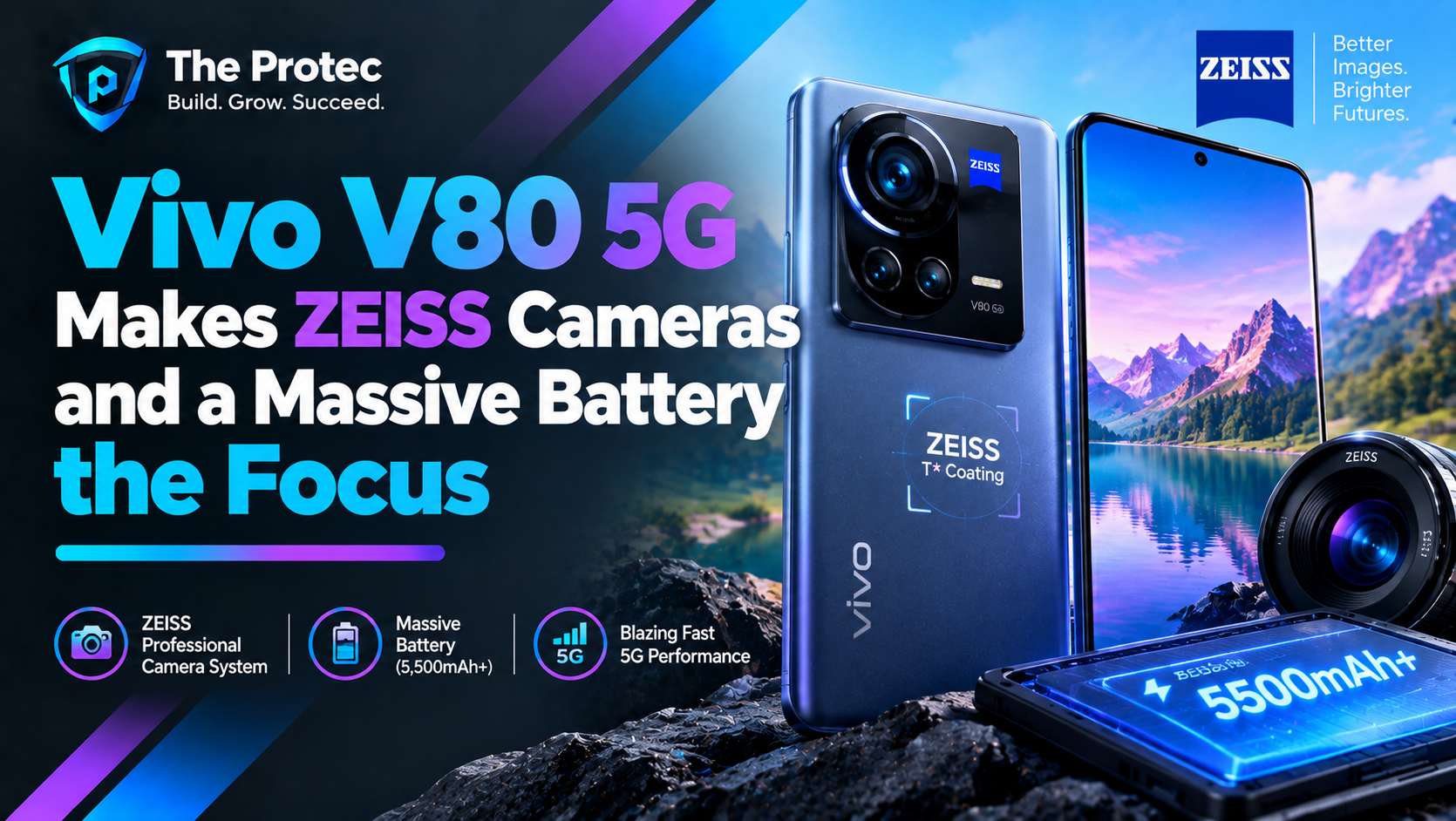
The Vivo V80 5G arrives with a clear idea of what a modern premium smartphone should prioritize. Instead of treating raw processor benchmarks as the only measure of progress, Vivo is putting photography, battery endurance and day-to-day usability at the center of its latest V Series smartphone.
Its headline combination is a ZEISS-branded camera system and a massive battery supported by fast charging. Add a high-refresh-rate display, contemporary 5G connectivity and a slim, style-conscious design, and the Vivo V80 5G appears tailored to people who want a capable camera phone that can reliably last through a demanding day.
That strategy makes sense in a market where most upper-midrange phones already feel fast. The more meaningful differences now emerge when users take portraits, shoot at night, spend hours on mobile data or discover that their battery is nearly empty before dinner. However, buyers should look beyond branding and headline numbers. Camera tuning, thermal control, charging behavior and regional configurations will ultimately determine how good the Vivo V80 is in practice.
Vivo V80 5G features focus on real-world priorities
The Vivo V80 specifications position the phone around several features with immediate practical value: versatile cameras, extended battery life, rapid charging, a bright display and efficient performance. That is a different pitch from gaming-focused devices that emphasize peak clock speeds, oversized cooling systems and record-setting benchmark results.
Vivo’s approach reflects a broader shift in smartphone technology. Processing power remains important, especially for computational photography and on-device AI, but sustained responsiveness matters more than a short benchmark run. For many buyers, a phone that captures a flattering portrait, remains readable outdoors and reaches bedtime with power left is more useful than one that leads a synthetic performance chart.
The V80 is therefore best understood as a balanced Vivo 5G smartphone with premium ambitions rather than a specialist performance handset. Its success depends on whether Vivo has integrated its hardware effectively, not simply on how impressive each component looks in isolation.
What the Vivo V80 ZEISS cameras are designed to deliver
The ZEISS smartphone camera partnership remains central to Vivo’s imaging identity. Vivo uses ZEISS input in areas such as lens characteristics, color profiles, portrait rendering and optical effects. Readers can learn more about the companies’ wider imaging work through the official Vivo website and ZEISS photography resources.
For the Vivo V80 camera phone, the practical objective is not merely to add another logo beside the lenses. The camera system must produce consistent exposure, believable skin tones, controlled highlights and reliable focus across different lighting conditions. It also needs to minimize the visual mismatch that can occur when switching between main, ultrawide and telephoto cameras.
ZEISS branding alone does not guarantee better image quality. Sensor size, lens aperture, optical stabilization, image-signal processing and Vivo’s software tuning all influence the final photograph. Independent testing will be needed to establish how the Vivo V80 camera specs translate into detail retention, motion handling and color accuracy. The partnership is valuable only when those components work together.
Portrait photography is the natural showcase
Vivo V80 photography is likely to be most distinctive in portrait mode. Vivo and ZEISS have historically emphasized simulated lens styles, subject separation and controlled background blur. A well-tuned Vivo V80 portrait camera should preserve fine hair, avoid cutting into glasses or clothing and produce gradual blur rather than an artificial-looking outline around the subject.
Focal length matters as much as software. A dedicated portrait-friendly camera or high-quality crop from the main sensor can create more natural facial proportions than a wide-angle lens held close to the subject. Buyers should also evaluate whether portrait effects remain convincing in indoor light, where slower shutter speeds and aggressive skin smoothing can reduce detail.
Low-light quality depends on more than night mode
The Vivo V80 low-light camera will need to balance brightness with realism. Multi-frame processing can reveal shadow detail, but excessive processing may create glowing skies, waxy textures or halos around signs and streetlights. Optical image stabilization can help by allowing longer exposures with less hand movement, although it cannot freeze a moving person or pet.
A strong night camera should focus quickly, retain natural color and control bright light sources without turning every scene into daylight. Video stabilization and microphone quality also matter because many low-light memories are recorded as clips rather than still photographs. These are areas where real-world comparisons will be more informative than megapixel counts.
Everyday consistency may be the biggest advantage
Most photographs are taken quickly: food at a restaurant, children moving indoors, a document, a pet or a scene viewed directly against the sun. The best Vivo V80 5G feature may therefore be consistency. Fast camera startup, minimal shutter delay and predictable processing can be more valuable than a rarely used professional mode.
Vivo must also keep AI-assisted editing under control. Object removal, reflection reduction and automatic enhancement are useful, but the phone should preserve an original-looking result and avoid inventing important visual details. Trust is becoming a key part of mobile photography as generative tools become more common.
The massive Vivo V80 battery changes the ownership experience
The Vivo V80 battery is the second pillar of the phone’s strategy. A large battery capacity can provide more than an impressive runtime estimate. It gives users additional flexibility for 5G hotspot use, navigation, video recording, social media, gaming and high-brightness outdoor use without constant power-saving compromises.
Battery capacity, however, is only one variable. Vivo V80 battery life will also depend on display resolution and brightness, modem efficiency, processor tuning, background applications and thermal management. Two phones with similar capacities can deliver noticeably different endurance. Buyers should treat controlled battery tests as more meaningful than capacity alone.
A larger cell can affect weight, thickness and internal layout. Vivo must find room for cameras, cooling hardware, speakers and charging components while keeping the device comfortable. Newer high-density battery technologies can store more energy without making a phone dramatically thicker, but buyers should confirm the battery chemistry and rated Vivo V80 battery capacity listed for their market rather than assuming every regional model is identical.
There is also a longevity benefit. A phone that ends the day with a healthy reserve may require fewer full charge cycles over time. Battery health still depends on heat, charging habits and software controls, so features such as optimized overnight charging and charge limits can be as important as the headline capacity.
Vivo V80 fast charging adds convenience, with trade-offs
Fast charging makes a large battery easier to live with. The most useful measurement is not the maximum wattage printed on a box but how much usable power the phone gains in 10, 20 or 30 minutes. Charging speed normally tapers as the battery fills to manage temperature and protect its health.
The Vivo V80 charging experience should also be judged by charger compatibility. Maximum speeds may require Vivo’s supported adapter and cable, while universal USB Power Delivery charging could operate at a lower rate. Charger inclusion may vary by market. Frequent high-power charging can generate additional heat, making intelligent thermal and battery-health controls essential.
Vivo V80 display and design must balance comfort with endurance
The Vivo V80 display is an important part of both its camera experience and power consumption. A modern OLED panel with a high refresh rate can make scrolling, animations and games appear smoother, while strong peak brightness improves outdoor visibility and helps HDR video look more convincing. Accurate color modes are particularly valuable when reviewing photographs.
Peak brightness figures do not tell the whole story. Sustained full-screen brightness, minimum nighttime brightness, pulse-width modulation behavior and automatic brightness tuning all influence comfort. An adaptive refresh system can reduce power use by lowering the refresh rate when the screen is displaying static content.
Vivo V80 design will need to accommodate its large battery and prominent camera hardware without becoming awkward. Curved rear edges can disguise thickness, although heavily curved displays may introduce reflections and accidental touches. Flat displays are often easier to protect. Materials, water resistance, button placement and camera-bump stability should all be considered alongside appearance.
A few extra grams may be a worthwhile exchange for better endurance, but weight distribution matters. A top-heavy camera phone can feel less comfortable than a slightly heavier device with balanced internals. Buyers who use a protective case should account for the added size and weight.
Vivo V80 performance is about efficiency, not benchmark dominance
The processor inside any Vivo V80 configuration has several jobs beyond opening applications. It powers image processing, AI features, high-resolution video, display rendering and 5G connectivity. Efficient performance can improve both camera responsiveness and battery life, which aligns directly with Vivo’s priorities.
For typical use, sustained speed is more important than a brief peak score. Thermal throttling can reduce performance during gaming, video recording or navigation in warm conditions. Memory capacity and storage speed also affect multitasking and large photo or video transfers. Buyers should compare the exact processor, RAM and storage configuration offered locally because Vivo V80 specifications may differ across markets.
Software support is another part of performance. Long-term operating-system upgrades, security patches and responsible background management determine how well the phone ages. Aggressive power controls can extend standby time but may delay notifications, so Vivo needs to balance endurance with reliable app behavior.
5G connectivity is useful when efficiency matches speed
The Vivo V80 5G smartphone should support fast downloads, high-quality calls and low-latency services on compatible networks, but band support can vary regionally. Buyers who travel or import devices should verify local 5G and LTE compatibility, eSIM availability and carrier features before purchasing.
Modem efficiency is especially important. Weak-signal 5G can consume substantial power, reducing the advantage of a larger battery. Strong antenna design and intelligent switching between network modes can improve real-world endurance more than headline download speeds.
Vivo V80 vs Samsung Galaxy, Google Pixel and iPhone
A Vivo V80 vs Samsung Galaxy comparison will depend on the specific Galaxy model, but Samsung generally offers mature displays, broad ecosystem integration and established update policies. Vivo’s potential advantage is a more photography-led portrait experience, faster charging and a larger battery relative to similarly positioned devices. Samsung may remain more attractive where accessory availability and long software support are priorities.
In a Vivo V80 vs Google Pixel comparison, Google’s strength is computational photography, especially quick point-and-shoot processing and AI-assisted editing. The V80 can differentiate itself with ZEISS-influenced portrait styles, charging speed and battery capacity. Pixel cameras may deliver more consistent automatic processing, while Vivo may offer greater creative control. Direct image comparisons are necessary because camera preferences are partly subjective.
A Vivo V80 vs iPhone decision extends beyond hardware. Apple combines dependable video, long software support and tight integration with its wider ecosystem. Vivo can compete with flexible portrait tools, a potentially larger battery, faster wired charging and more display customization. Buyers invested in Apple’s services may value continuity more than individual specification advantages.
These comparisons also demonstrate why price matters. A large battery and capable camera system become more compelling when the V80 undercuts flagship rivals. If its price moves too close to established premium devices, update commitments, resale value and service coverage receive greater weight.
Vivo V80 price and availability require local confirmation
Vivo V80 price, storage options, colors and bundled accessories may vary significantly by region. The same can apply to network bands, charging adapters and software features. Buyers should rely on official local listings rather than converting a launch price from another currency or assuming that every version has identical hardware.
Vivo V80 availability may also be limited to selected markets or sales channels. Importing can affect warranty service, cellular compatibility and access to region-specific features. That makes local support part of the phone’s real cost, not an afterthought.
Does Vivo’s camera-and-battery strategy create an advantage?
The Vivo V80 5G has a relevant strategy for the current smartphone market. Camera quality and dependable battery life are visible every day, whereas small benchmark differences often disappear during ordinary use. ZEISS-backed portrait tools can give Vivo a recognizable imaging identity, and a massive battery can address one of the most common smartphone frustrations.
The advantage is not automatic. The cameras must perform consistently outside ideal conditions, the large battery must not make the phone cumbersome, and fast charging must manage heat effectively. Competitive pricing and long-term software support will be equally important. If Vivo delivers on those fundamentals, the V80 can stand out as a practical photography-focused alternative to Galaxy, Pixel and iPhone devices.
Frequently asked questions
Is the Vivo V80 5G a camera-focused smartphone?
Yes. The Vivo V80 camera system and ZEISS collaboration place photography, particularly portraits and low-light shooting, near the center of the device’s identity. Final image quality should still be assessed through independent testing rather than branding alone.
How long should the Vivo V80 battery last?
Its large battery is designed for extended use, but actual endurance depends on display settings, signal quality, camera use, gaming and background applications. Standardized tests will provide a better comparison than battery capacity by itself.
Does the Vivo V80 support fast charging?
Fast charging is a core part of the V80 proposition. Maximum speed may require a compatible Vivo charger and cable, and charging rates can vary according to temperature, battery level and regional package contents.
Are Vivo V80 specifications the same worldwide?
Not necessarily. Memory, storage, network support, colors, accessories and some software functions can differ by market. Buyers should check the official specification sheet for the exact model sold in their region.
Is the Vivo V80 better than a Galaxy, Pixel or iPhone?
It depends on priorities. The V80 emphasizes portraits, battery capacity and fast charging, while rivals may lead in software support, ecosystem integration, video consistency or computational photography. Price and local support should guide the final decision.