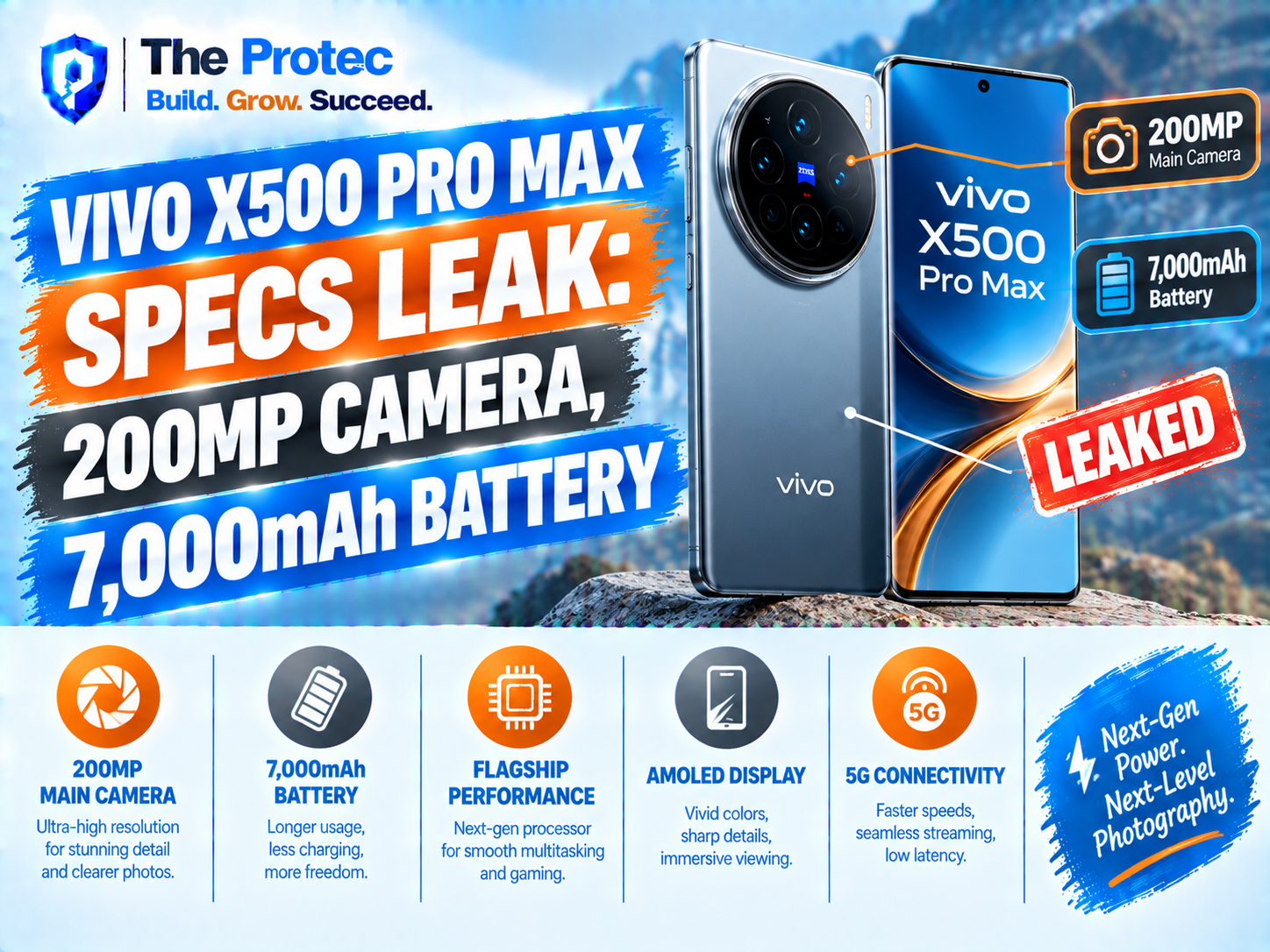









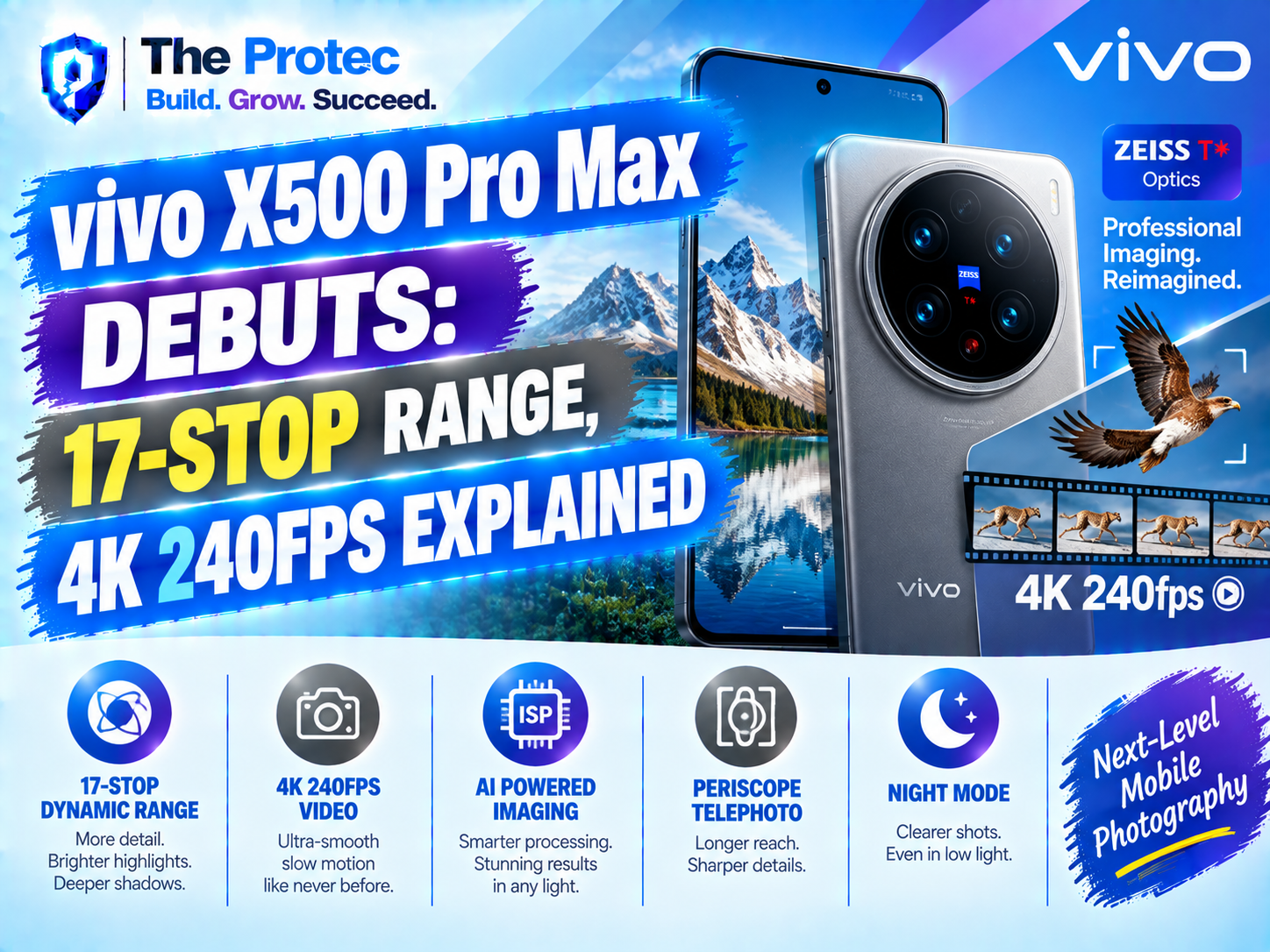
The vivo X500 Pro Max is making two unusually ambitious promises for a flagship smartphone camera: up to 17 stops of dynamic range and 4K video recording at 240 frames per second. Either feature would be notable on its own. Together, they position the phone as a direct attempt to narrow the gap between pocketable mobile cameras and dedicated filmmaking equipment.
Those headline figures also require context. Dynamic range can be measured in several ways, while extreme frame rates often involve limits on recording duration, resolution, sensor area, stabilization or HDR processing. A specification that looks revolutionary on a launch slide may behave differently once photographers begin using it outside controlled conditions.
This breakdown examines what makes the vivo X500 Pro Max camera different, how its claimed imaging capabilities could work and which details remain subject to regional confirmation or independent testing. It also separates the launch claims from assumptions about unannounced camera hardware, pricing and availability.
Why the vivo X500 Pro Max camera matters
Smartphone camera technology has recently shifted from simply increasing megapixel counts to improving sensor readout, computational photography, color processing and video performance. The vivo X500 Pro Max launch reflects that change. Its most important specifications concern how much visual information the camera can capture and how quickly it can capture it.
The claimed vivo X500 Pro Max 17-stop dynamic range targets difficult scenes containing bright highlights and deep shadows. The vivo X500 Pro Max 4K 240fps mode, meanwhile, is designed to record detailed slow-motion footage without dropping to the 1080p resolution traditionally associated with high-frame-rate phone video.
These capabilities could make the device particularly relevant to content creators, mobile filmmakers and photographers who frequently shoot concerts, cityscapes, sunsets, sports or subjects with unpredictable movement. However, image quality will depend on more than the maximum numbers. Sensor size, lens quality, bit depth, processing, thermal management and software controls will all influence the final result.
What 17 stops of dynamic range actually means
Dynamic range describes the span between the darkest usable shadow and the brightest highlight a camera can capture before detail disappears into noise or clips to pure white. Each additional stop represents a doubling of captured light. A theoretical 17-stop range therefore covers a brightness ratio of approximately 131,072:1.
In practical photography, that range could help preserve cloud texture in a bright sky while retaining details in a shaded face or dark building. It could also reduce the need to choose between exposing for a bright window and properly exposing the interior of a room.
A 17-stop dynamic range smartphone would be especially useful in situations such as:
- Backlit portraits with strong sunlight behind the subject
- Sunrise and sunset scenes containing bright skies and dark foregrounds
- Night streets with neon signs, headlights and shadowed buildings
- Indoor video recorded near windows or stage lighting
- High-contrast footage intended for HDR displays or color grading
The important qualification is that the quoted number may not represent the native, single-exposure capability of the sensor. Smartphone makers frequently combine multiple exposures or readouts to produce an expanded computational result. That approach is valid, but it is not identical to a sensor capturing the entire range in one exposure.
Native range, computational range and HDR output
There are three related ideas to distinguish when evaluating the vivo X500 Pro Max camera specs. Native sensor dynamic range is the information captured in a single readout. Computational dynamic range combines frames or exposure channels. Display dynamic range describes how the finished photograph or video is mapped onto an SDR or HDR screen.
The vivo X500 Pro Max could reach its claimed figure by combining a low-noise sensor with dual-conversion gain, staggered HDR exposures, multi-frame fusion and advanced tone mapping. The exact measurement method matters because motion between exposures can create ghosting around people, vehicles, leaves or water.
Independent testing will be needed to determine whether the 17-stop figure applies to still photography, a particular HDR video mode or a laboratory measurement of the complete imaging pipeline. Until then, it is best understood as a maximum system-level claim rather than proof that every photo contains 17 clean, editable stops.
How 4K 240fps changes smartphone slow motion
High-frame-rate recording captures more moments within every second, allowing action to be slowed without the choppy motion created by software interpolation. Footage recorded at 240fps can be played at 30fps for 8x slow motion or at 24fps for 10x slow motion.
Phones have offered 240fps and even higher frame rates before, but they commonly achieve them at 1080p or 720p. The vivo X500 Pro Max video recording claim is different because it combines 240fps capture with 4K resolution. That means each frame can retain substantially more fine detail, giving creators more flexibility to crop, stabilize or reframe footage during editing.
A genuine 4K 240fps smartphone could capture impressive sequences involving sports, splashing water, wildlife, dance, vehicles or fast product shots. It could also provide sharper individual frames than lower-resolution slow motion, although the short exposure times required at 240fps demand plenty of light.
The data load is enormous. At 3840 by 2160 pixels, the camera must process nearly two billion pixels every second before accounting for color depth, HDR data and compression. Sustained recording therefore requires an extremely fast sensor, powerful image signal processor, high-speed memory, efficient video encoding and effective heat dissipation.
Limitations to check before calling it cinema-grade
The 4K 240fps headline does not reveal every operational detail. Buyers should look for confirmation of whether the mode uses the full sensor width, introduces a crop, supports autofocus and optical stabilization, records audio or works with HDR. Maximum clip length and cooldown behavior will also be important.
Low-light quality presents another challenge. Each frame receives only a small amount of light, so noise reduction may soften textures in dim environments. The strongest results are likely to come from daylight or professionally illuminated scenes. Storage consumption could also be considerable, even with efficient HEVC compression.
Camera hardware and processing needed to deliver these features
Vivo has not provided one globally consistent technical document detailing every component behind the reported modes. Consequently, specific sensor models and processor configurations circulating outside official regional materials should be treated as early reports rather than confirmed facts. The latest verified information should be checked through the official vivo newsroom.
From an engineering perspective, several technologies are necessary for the headline vivo X500 Pro Max specs to work effectively:
- High-speed stacked image sensor: A stacked design can place processing circuitry beneath the light-sensitive layer, enabling faster readout and reducing rolling-shutter distortion.
- Dual-gain or multi-gain capture: Reading bright and dark image information at different gain levels can extend dynamic range without relying entirely on conventional exposure bracketing.
- High-throughput image processor: The ISP must handle noise reduction, demosaicing, autofocus, lens correction, HDR fusion and encoding across billions of pixels per second.
- Fast memory buffer: High-frame-rate video may initially pass through dedicated memory before being compressed and written to storage.
- Advanced cooling: A vapor chamber, graphite layers and careful processor scheduling would be essential for controlling heat during intensive recording.
- Computational tone mapping: Scene-aware processing can brighten shadows and protect highlights while attempting to keep skin tones and local contrast natural.
Optical image stabilization and rapid autofocus would further improve usability, but their availability in the most demanding recording mode requires confirmation. Some smartphones reduce stabilization or lock focus during extreme slow-motion capture to preserve processing bandwidth.
vivo X500 Pro Max specs: confirmed claims versus early reports
The two defining camera capabilities attached to the debut are the claimed 17-stop dynamic range and 4K recording at up to 240fps. Beyond those points, not every specification has been published consistently across markets.
Headline launch claims
- Camera pipeline capable of up to 17 stops of dynamic range
- 4K slow-motion video capture at up to 240fps
- Flagship positioning with a strong focus on photography and video
- Computational imaging designed to preserve highlight and shadow detail
Details still requiring regional or independent confirmation
- Exact main-camera sensor model, format and effective resolution
- Whether 17 stops applies to stills, video or a specific HDR mode
- Bit depth, codec and bitrate available at 4K 240fps
- Recording-time limits, crop factor and thermal restrictions
- Support for HDR, stabilization and continuous autofocus at 240fps
- Complete telephoto, ultrawide and front-camera specifications
This distinction is important because early specification lists may combine official teasers with supply-chain information or assumptions based on previous vivo flagship phones. Only final retail documentation and production-device testing can establish the complete feature set.
What makes the vivo X500 Pro Max different?
The phone’s distinction is not simply that it offers HDR photography or slow motion. Both are established mobile features. The difference lies in pushing the two toward professional-camera territory at the same time.
A wider capture range gives creators more freedom to adjust exposure and color without immediately losing highlight or shadow information. Higher-resolution slow motion makes footage more suitable for large displays and post-production. If both modes remain usable without severe cropping, overheating or aggressive processing artifacts, the vivo X500 camera system could set a meaningful new benchmark.
Consistency will matter more than peak specifications. A creator needs reliable autofocus, predictable color, manageable file sizes and stable performance across multiple takes. The strongest version of the vivo X500 Pro Max camera will be the one that turns its laboratory-level numbers into repeatable results with minimal setup.
vivo X500 Pro Max price, release date and availability
Following the vivo X500 Pro Max launch, a single global price and release schedule had not been confirmed across all markets at the time of publication. Regional configurations, storage capacities, taxes and launch promotions can produce substantial price differences, so unofficial currency conversions should not be treated as final retail pricing.
Prospective buyers should also avoid assuming that a domestic-market debut guarantees a worldwide release. Vivo frequently varies model names, camera features and availability by region. The most reliable vivo X500 Pro Max price and release date will be those listed by Vivo or an authorized retailer in the buyer’s country.
Until those listings appear, reported prices, preorder dates and import-store delivery estimates remain provisional. Imported units may also differ in network compatibility, warranty coverage, software services and supported video formats.
Who should consider this vivo flagship phone?
The vivo X500 Pro Max is most compelling for users who prioritize camera performance over a conventional specification race. Mobile filmmakers could benefit from detailed slow motion, while travel and street photographers may value the wider dynamic range in uncontrolled lighting.
Casual users may see less benefit if the advanced modes generate large files or require manual editing. Anyone considering the phone primarily for its camera should wait for full-resolution samples and sustained recording tests. Comparisons should examine highlight recovery, shadow noise, rolling shutter, autofocus and heat—not only launch-slide numbers.
Frequently asked questions
Does the vivo X500 Pro Max really capture 17 stops of dynamic range?
Vivo’s headline claim is up to 17 stops, but the result may involve multi-frame processing, multiple sensor gain levels and computational HDR. Independent testing is needed to establish how much clean detail is available in a single capture and which shooting modes support the maximum range.
What does 4K 240fps mean for slow-motion video?
It means the camera can record up to 240 4K frames each second. Played back at 30fps, the footage becomes 8x slow motion; at 24fps, it becomes 10x slow motion. This should deliver more detail than conventional 1080p slow motion, particularly in bright conditions.
Will 4K 240fps work continuously?
That depends on heat, storage speed, battery load and software limits. High-frame-rate modes often have maximum clip lengths or require recovery time between recordings. Vivo’s final regional documentation and independent tests should clarify sustained performance.
Has the vivo X500 Pro Max price been confirmed globally?
No single worldwide price applies across every market. Local pricing and release availability should be verified through official Vivo channels or authorized retailers. Early import prices may include markups and should not be considered official.
Is the vivo X500 Pro Max a replacement for a professional camera?
Not necessarily. Its portability and computational imaging could make it a powerful creative tool, but dedicated cameras retain advantages in lens choice, thermal endurance, manual control and large-sensor image quality. The phone’s appeal lies in bringing advanced capture options to a device that fits in a pocket.
The bottom line
The vivo X500 Pro Max combines two of the most aggressive mobile imaging claims yet: 17-stop dynamic range and 4K 240fps video recording. The first promises better control over extreme contrast, while the second could deliver unusually detailed slow motion. Together, they illustrate where flagship smartphone cameras are heading—faster sensors, heavier computation and increasingly sophisticated video tools.
The remaining question is how closely real-world performance matches the headline specifications. Measurement methods, recording limits, image processing and regional hardware details will determine whether this is a genuine camera breakthrough or a collection of impressive maximum figures. If Vivo delivers the claimed capabilities with reliable autofocus, natural HDR and manageable heat, the X500 Pro Max could become one of the most consequential mobile cameras of its generation.