





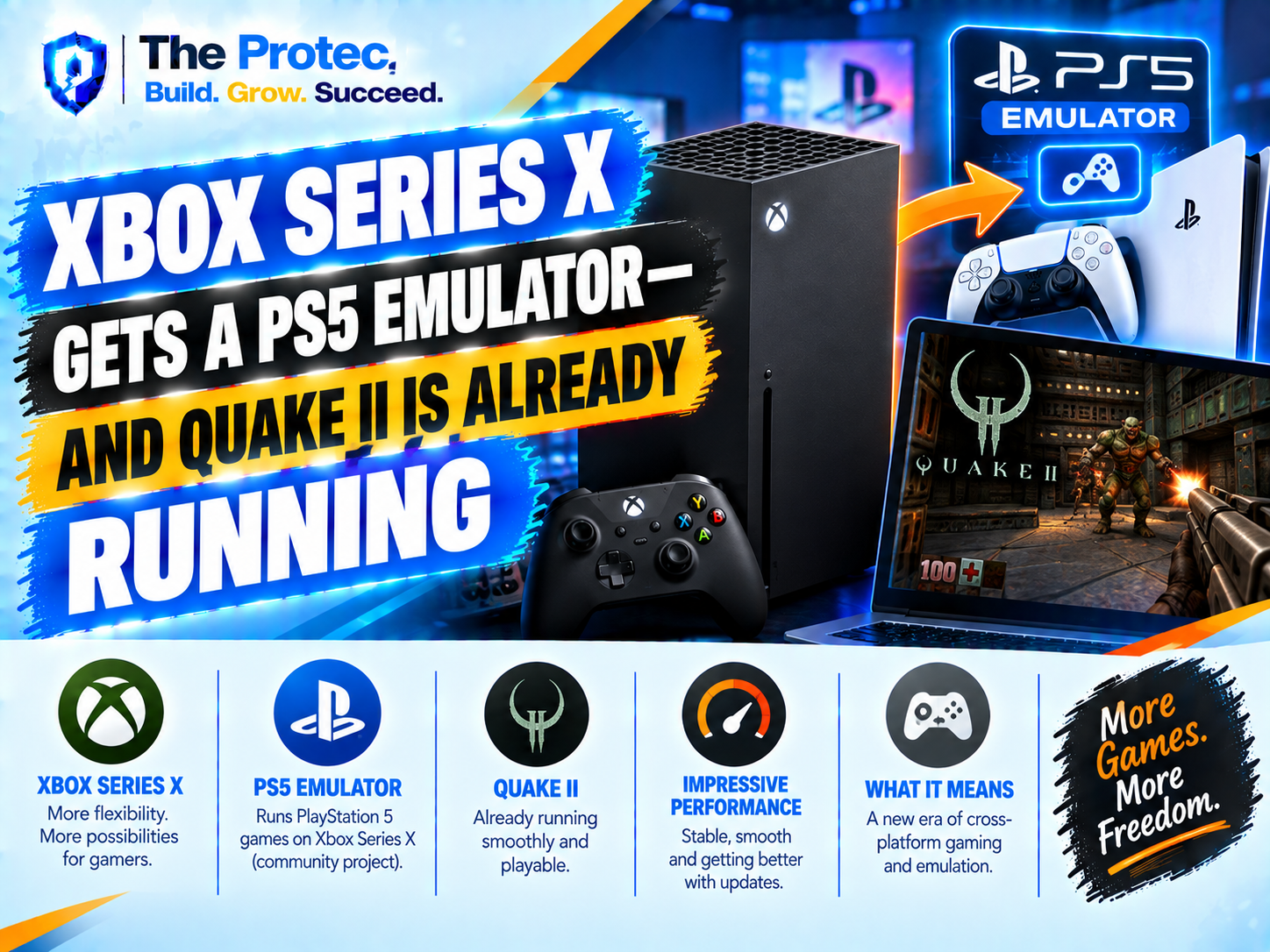
An Xbox Series X running software built for PlayStation 5 sounds like the kind of claim that demands skepticism. Yet an experimental PS5 emulator on Xbox Series X has now demonstrated Quake II, creating an intriguing milestone for modern console emulation.
The achievement does not mean Xbox owners can suddenly install a library of PS5 games. It also does not establish full compatibility with Sony’s operating system, graphics stack or security architecture. What it does show is that developers have begun translating at least part of a PS5 software environment into something Microsoft’s console can execute.
As of September 2026, the project remains a proof of concept rather than a consumer-ready emulator. Quake II is nevertheless a useful first workload: it is open, well understood and light enough to expose compatibility problems without placing the same demands on the emulator as a modern blockbuster. Here is what the Xbox Series X PS5 emulator demonstration actually proves—and what it does not.
What the Xbox Series X PS5 Emulator Demo Accomplished
The headline-grabbing result is straightforward: a PS5-targeted version of Quake II was launched through an experimental emulation layer on Xbox Series X hardware. Reaching that point requires more than opening an ordinary Xbox port. The emulator must recognize the expected executable format, provide compatible system functions and translate calls intended for Sony’s platform into operations the Xbox can perform.
That distinction matters because Quake II already has native versions for numerous systems, including current consoles. Running an Xbox build would reveal nothing about PS5 emulation. The significance comes from executing code prepared for a PlayStation environment through an Xbox PS5 emulator, even if the test software is far simpler than a typical retail release.
The demonstration should therefore be viewed as an early compatibility test. It confirms that the basic chain—from loading a compatible executable to producing graphics and accepting enough input to run—can work under controlled conditions. It does not confirm support for encrypted retail packages, PlayStation Network services, advanced controller features or the full set of PS5 system libraries.
Why Quake II Is the Ideal First Test
Quake II has remained valuable to emulator and homebrew developers because its source code is available and its behavior is extensively documented. A developer can compile or adapt the engine for a target environment, add diagnostic output and determine precisely where execution fails. That is much harder with a closed commercial game whose internal behavior cannot be legally or easily inspected.
The engine also has modest CPU, memory and graphics requirements by current standards. This helps separate foundational compatibility from performance. If the emulator mishandles memory mapping, threading, input or graphics commands, developers can identify the problem without wondering whether the Xbox Series X simply lacks enough power.
That makes Quake II PS5 emulator support meaningful, but narrow. It is closer to a successful systems test than evidence that demanding PS5 games on Xbox are around the corner.
How PS5 Emulation on Xbox Series X Can Work
Both consoles use AMD hardware based on the x86-64 instruction set, which removes one obstacle associated with emulating systems that use entirely different processor architectures. Many CPU instructions expected by PS5 software can run directly, or with relatively limited intervention, on the Xbox Series X processor.
Shared instruction-set roots do not make the consoles interchangeable. PS5 applications expect Sony-specific APIs, system modules, memory behavior, graphics interfaces and kernel services. Xbox Series X uses Microsoft’s own software stack and security model. An emulator or compatibility layer must bridge those differences.
Depending on the project’s design, that work may involve several techniques:
- Loading and mapping PS5-style executable structures into Xbox-accessible memory.
- Reimplementing system libraries called by the guest application.
- Redirecting file, timing, audio and controller functions to Xbox equivalents.
- Translating PlayStation graphics operations into commands supported by the Xbox graphics environment.
- Managing differences in threads, synchronization, memory permissions and error handling.
Because the CPUs are related, the project may behave more like a high-level compatibility layer in some areas than a traditional machine emulator. However, “emulator” remains a practical description because the software is recreating behavior expected from another console platform.
On Xbox hardware, execution is also shaped by Microsoft’s application sandbox and deployment rules. Experimental software commonly relies on Developer Mode rather than appearing as a normal retail application. Microsoft’s Xbox app development documentation explains the controlled environment available to developers, but access to that environment does not remove its memory, API or security restrictions.
Similar Hardware Does Not Guarantee PS5 Compatibility
Xbox Series X and PS5 both pair AMD Zen 2-era CPU technology with RDNA 2-derived graphics, but each platform was designed as an integrated system. Differences extend beyond headline specifications.
Sony’s console has its own I/O architecture, shader pipeline, storage APIs, audio systems and operating-system behavior. Games may be optimized around those characteristics. A title can also depend on specific firmware libraries, unusual synchronization behavior or features exposed through Sony’s SDK.
The Xbox Series X cannot simply impersonate those components because its security and operating systems prevent unrestricted hardware access. The emulator must work within an approved or sandboxed execution environment while translating behavior quickly enough to preserve correct timing. Every additional translation can consume CPU time, memory and graphics resources.
This is why an Xbox Series X may be powerful enough to render a game yet still fail to emulate it correctly. Raw performance is only one part of compatibility; software accuracy is often the larger challenge.
What Is Working and What Remains Experimental
The Quake II Xbox Series X result suggests that the project has crossed several important thresholds. It can load at least one suitable PS5-targeted program, satisfy a useful subset of its dependencies and deliver enough graphics, input and runtime support for visible execution.
That is a promising foundation, but users should not mistake a controlled demo for a finished PS5 emulator. Major unknowns or incomplete areas may include:
- Compatibility with encrypted and legally dumped retail applications.
- Coverage of the extensive PS5 system API and firmware libraries.
- Complex GPU shaders, asynchronous compute and modern rendering effects.
- Multichannel audio, networking, storage streaming and save-data behavior.
- DualSense-specific features such as adaptive triggers and advanced haptics.
- Stability across long sessions and applications with multiple processes.
- Performance under the restrictions of the Xbox development sandbox.
There is also a major difference between reaching a title screen, rendering a scene and completing an entire game without serious defects. Emulator compatibility is normally measured per title because one game may rely on a small, common set of functions while another exercises obscure features that have not been implemented.
For now, the responsible description is “early proof of concept.” Claims that the emulator already turns Xbox Series X into a general-purpose PS5 would go far beyond the available result.
Could More Demanding PS5 Games Eventually Run?
Technically, broader compatibility is possible. The consoles’ related CPU architectures provide a more favorable starting point than emulating an entirely different class of processor. Continued work on library reimplementation, graphics translation and debugging could allow additional homebrew applications and less demanding games to start.
Modern first-party PS5 releases are a much taller order. They can use sophisticated shaders, rapid asset streaming, large memory allocations, complex job systems and platform-specific optimizations. Translating those workloads within the Xbox environment could produce severe performance penalties even when the underlying hardware appears comparable.
Firmware dependencies present another obstacle. Emulator developers generally need clean-room implementations of system behavior rather than distributing Sony’s copyrighted software. Recreating thousands of functions accurately takes years, and every PS5 system update can introduce new behavior.
The likely progression is incremental: more test applications, more homebrew, simple commercial-style workloads and eventually a small selection of playable titles if legal dumping and technical compatibility are solved. Near-universal PS5 emulation on Xbox Series X should not be treated as an imminent outcome.
Legal Limits of an Xbox PS5 Emulator
Console emulation is not automatically illegal in many jurisdictions, but the surrounding activity can create legal risks. Emulator code developed through clean-room reverse engineering is different from distributing copyrighted firmware, encryption keys, SDK files or games.
Users must also consider licensing agreements and anti-circumvention laws. Sony’s PS5 system software terms place restrictions on copying, modifying and reverse engineering system software. The enforceability and legal exceptions involved vary by country, so a technically possible method is not necessarily an authorized one.
Microsoft’s platform policies add another layer. Developer Mode is intended for creating and testing applications, not bypassing content protections or distributing unauthorized material. An emulator could also be removed from retail channels even if its underlying code were lawful.
A legitimate project should avoid bundling Sony firmware, keys, proprietary libraries or game data. Users should not download game packages from unlicensed sources. Owning a disc or digital purchase does not automatically make every extraction or circumvention method legal in every region.
Why the Quake II Milestone Matters
The most important lesson is not that Xbox Series X has suddenly gained a PS5 library. It is that modern consoles with related hardware can still be separated by enormous software, security and platform-specific barriers—and that determined developers can begin mapping those barriers.
Quake II provides a measurable first step for Xbox Series X emulation. Future progress will depend less on spectacular one-off demos and more on repeatable compatibility, transparent development, lawful testing and accurate implementation of increasingly complex PS5 behavior.
Frequently Asked Questions
Can the Xbox Series X PS5 emulator play retail PS5 games?
There is no evidence of broad retail compatibility. The demonstrated Quake II workload is a controlled, comparatively simple case. Commercial PS5 games may require encryption support, firmware functions and advanced graphics features that remain unavailable or incomplete.
Is this the same as the native Xbox version of Quake II?
No. The significance of the demo is that a PS5-targeted workload was handled through an experimental emulation or compatibility layer. Running the existing native Xbox release would not demonstrate PS5 emulation.
Can Xbox owners download the PS5 emulator from the Microsoft Store?
It should not be treated as a normal retail application. Experimental emulators of this kind generally require a controlled development setup, and Microsoft’s store policies can restrict software associated with unauthorized content or platform circumvention.
Will PS5 exclusives eventually run well on Xbox Series X?
It is theoretically possible that individual titles could become playable, but there is no reliable timetable. Demanding games depend on far more than a shared CPU architecture, including Sony-specific APIs, graphics behavior, firmware services and storage systems.
Is PS5 emulation on Xbox legal?
The legality depends on how the emulator was created, what files it includes and how users obtain software. Clean-room emulation may be lawful in some regions, while distributing copyrighted firmware, keys or unauthorized game copies can violate licenses or local law.