







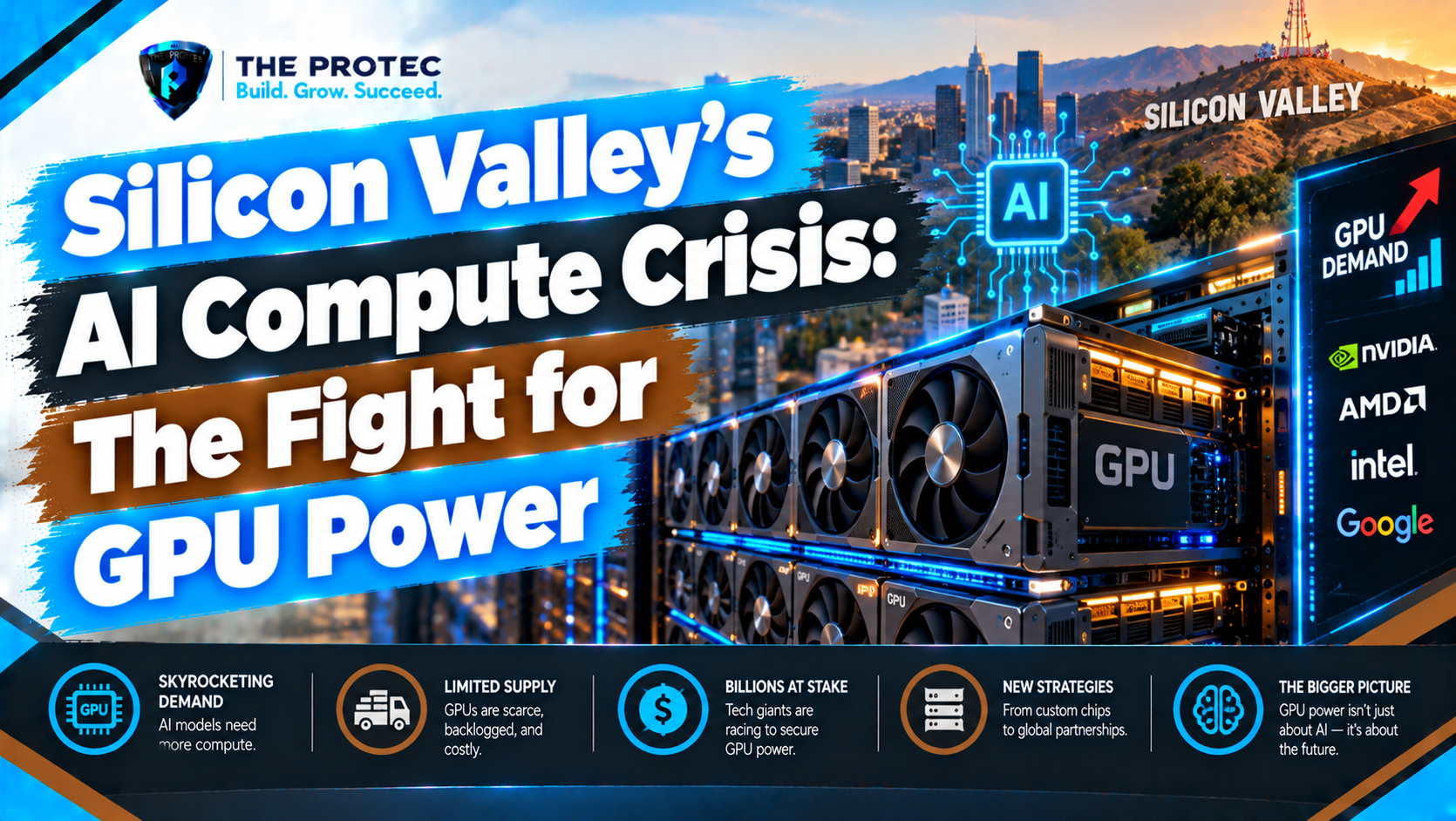
Silicon Valley’s most consequential shortage is not engineering talent or venture capital. It is dependable access to computing power. Startups can raise hundreds of millions of dollars, recruit respected researchers and still discover that their product roadmap depends on scarce accelerators, electricity, networking capacity and data-center space.
This Silicon Valley AI computing crisis is more nuanced than a universal lack of GPUs. Older accelerators and short-term cloud instances may be readily available, while the newest high-memory systems, large contiguous clusters and power-backed long-term capacity remain difficult or expensive to secure. That distinction matters: an AI company does not simply need chips. It needs the right hardware, in the right location, connected by the right network, for the right duration and price.
As model training, reasoning-heavy inference and autonomous agents consume more resources, AI compute access and competition are becoming strategic issues. Infrastructure choices now influence which companies can run experiments, release models and serve customers at sustainable margins.
Why the AI Computing Power Shortage Is a Strategic Bottleneck
Traditional software startups could launch with modest cloud bills and add servers as demand grew. Generative AI reverses that pattern. A company may incur substantial AI startup infrastructure costs before it knows whether a model will work. Frontier training requires thousands of accelerators operating together, while a successful product can create an even larger recurring inference bill.
The phrase “AI GPU shortage 2026” can be misleading if it implies that every accelerator is unavailable. Capacity differs by chip, region, cloud provider and contract. Nvidia H100 availability has improved in portions of the rental market as H200 and Blackwell-class systems have expanded, but tightly interconnected clusters of newer accelerators remain constrained. Demand also concentrates around hardware with sufficient high-bandwidth memory for large models and long contexts.
This makes compute a scheduling problem as much as a purchasing problem. If a startup cannot reserve enough identical GPUs simultaneously, a training run may be delayed or redesigned. If it accepts a multi-year commitment, it risks paying for unused capacity when its architecture or customer demand changes.
Training, Inference and AI Agents Are Driving Demand
Large-scale model training
Training remains the most visible source of AI data center demand. Bigger runs require accelerators, high-bandwidth memory and fast communication between machines. Failures are costly because idle GPUs still consume reserved capacity, while checkpoint recovery and synchronization reduce useful utilization. AI model training costs therefore include experimentation, unsuccessful runs and engineering time—not merely the final training cycle.
Inference at production scale
AI inference computing costs are less dramatic per request but repeat continuously. Long context windows, multimodal inputs, generated video and reasoning models can require more memory and computation than a simple chatbot response. A viral application can turn inference into a larger expense than training, particularly when customers expect low latency around the clock.
Autonomous agents
AI agent computing demand adds another multiplier. An agent may call a model repeatedly to plan, use tools, inspect results and correct mistakes. One customer task can become dozens of inference passes, database lookups and code-execution jobs. Test-time computation may improve answer quality, but it also makes unit economics harder to predict. Companies must measure cost per completed task rather than cost per prompt.
Why Buying More Nvidia GPUs Does Not Solve the Crisis
Nvidia AI GPU demand receives most of the attention, yet chips are only one layer of AI compute infrastructure. A working cluster also depends on:
- Electricity: Dense accelerator racks need substantial, continuous power. A data center may have floor space without enough utility capacity to energize new equipment.
- Cooling: High-density systems increasingly require advanced liquid-cooling designs, upgraded plumbing and specialized maintenance.
- Networking: Large training jobs need high-speed interconnects, switches, optical components and carefully designed network topologies. Weak networking can leave expensive GPUs waiting for data.
- Memory and storage: High-bandwidth memory, system memory and fast storage pipelines can all become constraints. Models and checkpoints must move quickly enough to keep accelerators busy.
- Construction time: AI data center construction delays can result from permitting, utility interconnections, transformers, generators and cooling equipment—not just building work.
- Operational expertise: Clusters require scheduling, failure recovery, security and performance tuning. Poor utilization can erase the value of a favorable hardware price.
These dependencies explain why AI data center capacity is commonly measured in megawatts or gigawatts as well as GPU counts. They also explain why AI chip supply constraints can ease while the broader AI compute shortage persists. A delivered accelerator is not useful until an entire system is ready to support it.
What Nvidia H100 GPU Prices and Rental Rates Really Show
Nvidia H100 GPU prices are often summarized with a single purchase figure, frequently based on historical estimates in the tens of thousands of dollars per chip. That number is not a reliable infrastructure budget. Transaction prices are usually private, and an eight-GPU server includes CPUs, memory, networking and support. The cost of a functioning cluster is higher still.
AI GPU rental prices also resist simple comparison. Advertised specialist-cloud rates for an H100 have commonly fallen within the low-single-digit dollars per GPU-hour, while effective on-demand prices from large clouds can be higher depending on the machine, region and required services. Eight-GPU nodes can consequently cost tens of dollars per hour before storage, data transfer and support. Reserved commitments and negotiated contracts may reduce the rate but transfer utilization risk to the customer.
Because listings change frequently, buyers should confirm the machine configuration and current rate on an official source such as Google Cloud’s GPU pricing page. They should also distinguish a readily available single instance from hundreds of colocated GPUs guaranteed for months. The latter is far more valuable for distributed training.
AI cloud computing costs must therefore be evaluated through total cost per useful workload. A cheaper GPU that runs poorly optimized code, suffers interruptions or has limited network bandwidth may cost more per trained token or completed inference request.
How Major AI Companies Use Infrastructure Partnerships
The AI infrastructure race is increasingly built around contracts rather than spot purchases. OpenAI’s computing infrastructure has long relied heavily on Microsoft Azure, while its Stargate initiative broadened the discussion to large-scale infrastructure involving partners including Oracle, SoftBank and MGX. The project’s announced investment ambitions are not equivalent to immediately operational capacity; data centers still require sites, power, hardware and phased deployment. The original Stargate announcement illustrates how access to infrastructure has become part of corporate strategy.
Anthropic compute capacity follows a multi-cloud pattern. Amazon expanded its investment in Anthropic to a reported total of $8 billion and positioned AWS as the company’s primary training partner, including the use of Trainium accelerators. Google has also invested in Anthropic and supplied cloud infrastructure. These relationships give Anthropic capital and specialized hardware while giving cloud providers a major model developer for their platforms.
Google AI infrastructure presents a different advantage: vertical integration. Google can combine internally designed TPUs, data centers, networking systems and cloud services. It still faces power, construction and allocation decisions, but it has more control over the hardware-software stack than a startup renting isolated GPU instances.
Emerging AI startups often receive cloud credits or accelerator access through venture programs and provider partnerships. Credits can make prototypes affordable, but they are temporary and may encourage dependence on one platform. When credits expire, migration costs and minimum commitments can become material. The strongest agreement is not necessarily the largest headline allocation; it is the one that matches the company’s workload, financing horizon and expected utilization.
Cloud GPUs, Dedicated Clusters or Smaller Models?
There is no single answer for GPU cloud computing for startups. Each approach trades flexibility against cost and control.
- On-demand cloud GPUs: Best for prototypes, irregular experiments and uncertain demand. They require little capital but carry higher unit prices and possible capacity limits.
- Reserved or dedicated infrastructure: Better for predictable, sustained workloads. Leasing a cluster can improve availability and economics, but long contracts create financial risk and may lock a company into aging hardware.
- Smaller or open-weight models: Fine-tuned compact models can outperform larger general models on narrow tasks. They reduce memory needs, latency and dependence on scarce high-end accelerators.
- Optimized inference: Quantization, batching, caching, speculative decoding, efficient attention and routing requests among models can lower cost without visibly reducing quality.
- Local and edge execution: PCs, workstations and mobile devices can handle privacy-sensitive or latency-critical workloads. Local AI is not a replacement for frontier training, but it can remove repetitive inference from the cloud.
Startups should benchmark several chips rather than treating Nvidia GPU availability as the only variable. Alternative accelerators may offer attractive economics when frameworks support them. Portability has value: software that can run across multiple clouds or accelerator types gives a company leverage during contract negotiations.
How Startups Can Control AI Computing Costs
Compute-rich companies can run more experiments, gather feedback faster and absorb failed research. That advantage may widen the gap between major labs and smaller competitors. However, infrastructure discipline can offset part of the imbalance.
- Track cost per trained token, generated token and completed customer task.
- Profile workloads before reserving hardware; low utilization can matter more than the hourly price.
- Separate bursty research needs from predictable production inference.
- Use model routing so simple requests do not reach the most expensive model.
- Negotiate portability, capacity guarantees and exit terms alongside headline discounts.
- Design products around proprietary data, workflow integration or distribution instead of competing solely on model size.
Cloud credits should be treated as runway, not permanent economics. Startups also need to include networking charges, storage, observability, idle reservations and engineering labor when calculating AI startup computing costs. A realistic forecast should model both rapid growth and slower adoption.
Is the AI Compute Crunch Temporary or Permanent?
Parts of the shortage will ease. Chip output expands, rental markets become more competitive and software makes each accelerator more productive. The H100 has already shifted from an exotic asset toward a widely quoted benchmark as newer systems attract frontier demand.
But the deeper constraint is likely to endure. Better and cheaper compute creates new uses, while agents, video generation and reasoning consume the efficiency gains. Power projects and data centers also move more slowly than software demand. The lasting competitive advantage will not belong simply to whoever owns the most GPUs. It will belong to companies that secure power-backed capacity, operate it efficiently and convert computation into products customers will pay for.
Frequently Asked Questions
Is there still an AI GPU shortage?
There is no universal shortage. Some older GPUs and individual cloud instances are readily available. Scarcity is concentrated in newer high-memory accelerators, large contiguous clusters, favorable regions and capacity backed by sufficient power and networking.
How much does it cost to rent an Nvidia H100?
Rates vary by provider, region, contract and machine configuration. Advertised specialist-cloud prices have often been in the low-single-digit dollars per GPU-hour, while large-cloud on-demand configurations may cost more. Storage, networking, support and idle time raise the effective rate.
Should an AI startup buy GPUs or use the cloud?
Most early startups benefit from cloud flexibility. Buying or leasing dedicated hardware becomes more attractive when workloads are stable and utilization will remain high. A hybrid strategy can reserve baseline capacity while using on-demand resources for peaks.
Can smaller models reduce dependence on scarce compute?
Yes. Distillation, fine-tuning, quantization and task-specific open-weight models can cut training and inference requirements substantially. They are especially effective when a product solves a defined business problem rather than pursuing frontier-scale general intelligence.