






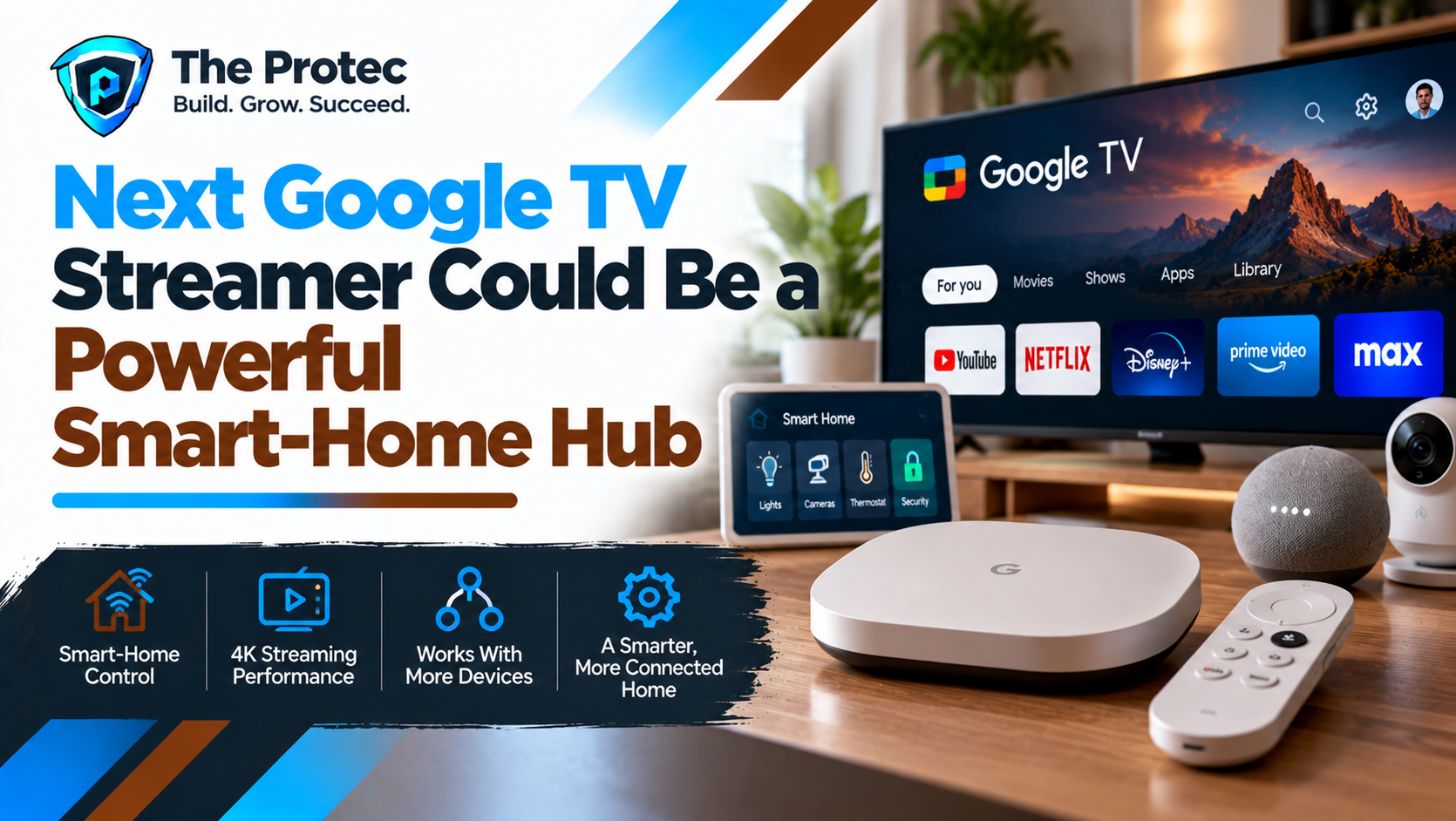
Google’s next streaming device may be designed to do much more than play movies and organize apps. Reports surrounding a possible next-gen Google TV Streamer suggest Google is considering built-in microphones, presence sensing, upgraded hardware, expanded storage, and a redesigned remote. Together, those additions could turn the television into a more useful Google TV smart home hub.
That would be a meaningful shift. The current Google TV Streamer already combines 4K entertainment with Google Home controls, Matter compatibility, and a Thread border router. However, it remains a conventional streaming box in several important ways: voice interactions generally begin with the remote, its processor is adequate rather than class-leading, and its smart-home information appears primarily when someone intentionally opens the relevant controls.
A future model with Google TV far-field microphones and presence detection features could behave more like a smart display. It might accept Google TV hands-free voice commands from across the room, display relevant information when someone approaches, and provide quicker access to cameras, lighting, climate controls, and household routines.
None of these upgrades has been officially announced. As of October 2026, Google has not confirmed a new model, specifications, pricing, availability, or a Google TV Streamer release date. The features discussed below should therefore be treated as rumors and reported development clues—not promises about a finished retail product.
Where the next-gen Google TV Streamer rumors come from
The rumored hardware refresh has been discussed through reporting based on references found in Google software, code-level discoveries, and information associated with devices under development. Android Authority has been among the publications connected to detailed reporting about unreleased Google hardware and software features, while 9to5Google has separately tracked changes across Google TV, Google Home, and Gemini.
There is not yet a public Google specification sheet tying every reported feature to one finalized device. Some references could relate to prototypes, test hardware, or features that Google ultimately postpones or removes. Technology companies frequently evaluate multiple configurations before deciding what to manufacture.
Searches for terms such as “new Google TV Streamer 2026” and “Google TV Streamer 2026 features” can also create the impression that a launch is guaranteed. It is not. The most responsible interpretation is that Google appears interested in making television hardware a more active part of its smart-home platform, but the exact product plan remains uncertain.
Built-in far-field microphones could transform TV control
The most consequential rumored addition is an array of Google TV Streamer built-in microphones. Far-field microphones are designed to recognize speech from across a room while accounting for distance, background noise, and audio playing through speakers.
Today, the current Streamer’s remote includes a microphone, but users must pick it up and press the voice button. Built-in Google TV far-field microphones could eliminate that step. Someone cooking nearby might ask Google to pause a program, turn on captions, lower the volume, show a doorbell camera, or switch off downstairs lights without locating the remote.
This would make everyday television control more accessible for people with limited mobility and more convenient in busy households. It could also help Google compete with voice-enabled televisions and smart speakers that already respond without a handheld controller.
Gemini is another part of the equation. A future Google TV Streamer Gemini AI experience could potentially handle more conversational searches, answer follow-up questions, summarize programs, or coordinate smart-home actions expressed in natural language. Google has been expanding Gemini throughout its product ecosystem, but the company has not confirmed which Gemini models, features, or subscriptions an unreleased Streamer would support.
Google TV presence sensing may create an ambient display
Reported Google TV presence sensing is potentially more ambitious than a microphone upgrade. Presence sensing can use technologies such as radar, ultrasound, Bluetooth proximity, microphones, or other sensors to determine whether someone is near a device. The exact sensing method for Google’s rumored hardware is unknown.
If implemented thoughtfully, Google TV presence detection features could allow the television to surface contextual information when a person enters the room. Instead of showing a blank screen, generic screensaver, or static recommendations, it could present Google TV ambient information such as the time, weather, calendar events, package alerts, camera notifications, commute conditions, or smart-home status.
The system might also reduce unnecessary screen activity when nobody is nearby. For example, it could dim ambient content, pause a photo slideshow, or avoid displaying private notifications in an empty room. Household recognition would be a more advanced possibility, but no reliable report has established that the device could identify individual people.
This concept positions the television as a Google Home smart display alternative, particularly in living rooms where a large screen is already the visual center of the space. Unlike a Nest Hub, however, a television consumes substantially more power and may not be appropriate as an always-on display. Google would need careful power-management settings to make ambient features practical.
Faster processing and expanded storage are overdue
A Google TV Streamer faster processor would address one of the most common weaknesses across streaming hardware: interface lag. Streaming quality depends heavily on network speed and service compression, but processor performance affects app launches, menu animations, content recommendations, voice-response times, and multitasking.
The current Google TV Streamer has 4GB of memory and 32GB of storage. Google said its processor was 22% faster than the Chromecast with Google TV, making it a clear improvement over the dongle it replaced. Even so, demanding users may notice that premium competitors open apps, navigate menus, and process commands more quickly.
A next-generation Google TV device could benefit from newer CPU and graphics cores, improved efficiency, and stronger on-device AI capabilities. Faster hardware would be especially important if Google expects the product to process microphone input, run presence-based features, display live camera feeds, and deliver Gemini interactions alongside 4K streaming.
A Google TV Streamer storage upgrade would be equally welcome. The current 32GB capacity is generous compared with older Chromecast devices, but space can disappear quickly when users install games, media players, fitness services, smart-home apps, and large streaming applications. Google TV Streamer expanded storage of 64GB or more would provide breathing room, although no capacity has been confirmed.
A new remote may prioritize shortcuts
Rumors also point to a Google TV Streamer new remote with additional controls. The current voice remote has a customizable button, volume controls, a directional pad, and branded service shortcuts. The Streamer itself includes a button that can make the remote ring when it is lost.
Extra Google TV remote shortcut buttons could offer faster access to the Google Home panel, live television, profiles, inputs, accessibility options, or Gemini. A dedicated smart-home key would make sense if Google wants the device to function as a central household controller.
The risk is clutter. Streaming remotes are popular partly because they are simple, and additional buttons only help when their purpose is clear. Customizable keys are generally more valuable than permanent buttons tied to services a household may not use. Google would also benefit from retaining Find My Remote functionality and making button remapping more flexible.
How it could improve Google TV smart home controls
The existing Streamer can display compatible cameras, adjust lights and thermostats, and access a Google Home panel. It also functions as a Thread border router and supports the broader Matter ecosystem, helping compatible devices communicate across platforms.
Rumored microphones and sensing could make these Google TV smart home controls proactive rather than buried behind menus. Potential everyday benefits include:
- Showing a doorbell feed automatically when someone rings.
- Using hands-free commands to dim lights before a film.
- Displaying a thermostat or security status when someone approaches.
- Starting a household routine through a natural-language request.
- Providing visible confirmation when a lock, light, or plug changes state.
- Bringing camera feeds to the television without finding the remote.
Google TV Streamer Matter support will remain important because a smart-home hub is only useful when it works reliably with devices from multiple manufacturers. The current model’s Thread hardware gives Google a strong foundation. The bigger challenge is creating an interface that is fast, understandable, and dependable enough for daily home control.
Google TV Streamer vs Apple TV 4K
Any Google TV Streamer hardware refresh will inevitably be compared with the Apple TV 4K. Apple’s streaming box has traditionally emphasized fast performance, polished software, strong ecosystem integration, and generous storage. Its A-series processor provides substantial headroom for responsive navigation, gaming, and long-term software support.
The current Apple TV 4K is offered with 64GB or 128GB of storage, while Google’s current Streamer provides 32GB. Both platforms support major 4K formats and immersive audio, although actual Dolby Vision, HDR, and Dolby Atmos availability depends on the television, sound system, app, and content.
Apple TV also acts as an Apple Home hub, and the Ethernet-equipped 128GB configuration includes Thread support. Siri voice input is available through the remote, but the box does not operate like a room-scale smart speaker with always-listening far-field microphones. If Google ships hands-free control and useful presence sensing, it could offer a distinct smart-home advantage.
Apple would likely retain the performance edge unless Google selects a substantially stronger processor. Google’s potential advantages are broader conversational AI, deeper integration with Google services, and a lower entry price. Apple’s strengths include speed, privacy positioning, ecosystem consistency, and tight integration with iPhone, AirPods, and Apple Home.
Privacy questions Google must answer
Microphones and presence sensing introduce legitimate privacy concerns. A streaming box sits in a shared room, often near personal conversations, family photos, camera feeds, and account information. Buyers should not assume that every sensing feature is processed locally or disabled by default.
If the rumored hardware reaches stores, users should verify:
- Whether there is a physical microphone mute switch.
- Whether a visible indicator appears whenever microphones are active.
- Which presence data is processed locally and what reaches Google’s servers.
- How long voice recordings, sensor events, and activity history are retained.
- Whether presence sensing and ambient information can be disabled separately.
- How guest voices, children’s accounts, and personalized results are handled.
- Whether private notifications can be hidden from the ambient screen.
Granular permissions will matter. Owners should be able to use streaming, Matter, and remote-based voice input without enabling continuous room sensing. A hardware microphone disconnect would provide more confidence than a software toggle alone.
Price, release date, and specifications remain unknown
There is no confirmed Google TV Streamer price for a next-generation model. The current device launched at $99.99 in the United States, establishing Google in a higher tier than its older Chromecast products while remaining below some premium competitors.
Far-field microphones, new sensors, expanded storage, and a faster chip could increase manufacturing costs. Google might keep the price near $100 to maintain value, introduce a more expensive hub-focused version, or sell current and premium models side by side. All three possibilities are speculation.
Likewise, no dependable Google TV Streamer release date has been announced. Certification filings, retailer listings, official teasers, or a Google Store product page would offer stronger evidence than code references alone. Until those appear, claims about launch windows and regional availability should be viewed cautiously.
Should you buy the current model or wait?
Buy the current Google TV Streamer if you need a reliable 4K box now, use Google Home, want Ethernet and Thread support, or are replacing an aging Chromecast. Its 32GB storage, improved memory, Matter integration, and capable remote make it a practical mainstream option, especially when discounted.
Waiting makes more sense if your existing device still performs well, you want hands-free voice control, or you expect premium speed and larger storage. People particularly interested in presence sensing, ambient information, and Gemini should avoid buying solely on rumors, but they may prefer to see Google’s next announcement before committing.
The reported Google TV Streamer upgrade could become one of the best streaming devices by combining entertainment with meaningful smart-home functions. Its success will depend less on the number of sensors than on speed, privacy controls, software reliability, and price. Until Google confirms the product, the current Streamer remains the known quantity—and the rumored model remains an intriguing glimpse at where television hardware may be heading.
Frequently asked questions
Has Google officially announced a new Google TV Streamer?
No. Google has not officially confirmed the rumored microphones, presence sensing, upgraded processor, expanded storage, redesigned remote, price, or release date. These features are based on reporting and development clues and may change before launch.
Could the next Streamer replace a Google Home smart display?
Potentially, but not completely. Presence-aware ambient information, camera feeds, voice commands, and home controls could provide many smart-display functions. A television uses more power, however, and may not be suitable for continuous operation.
Will built-in microphones always listen?
That is unknown. Far-field voice systems typically monitor locally for a wake phrase, but implementation and data handling vary. Buyers should check for a physical mute control, activity indicators, recording settings, and clear options to disable hands-free listening.
Is the current Google TV Streamer still worth buying?
Yes, for buyers who need a device now. It offers 4K streaming, 32GB of storage, Google Home controls, Ethernet, Matter compatibility, and Thread border-router functionality. Those with a working streamer who prioritize faster performance or rumored sensing features may prefer to wait.