






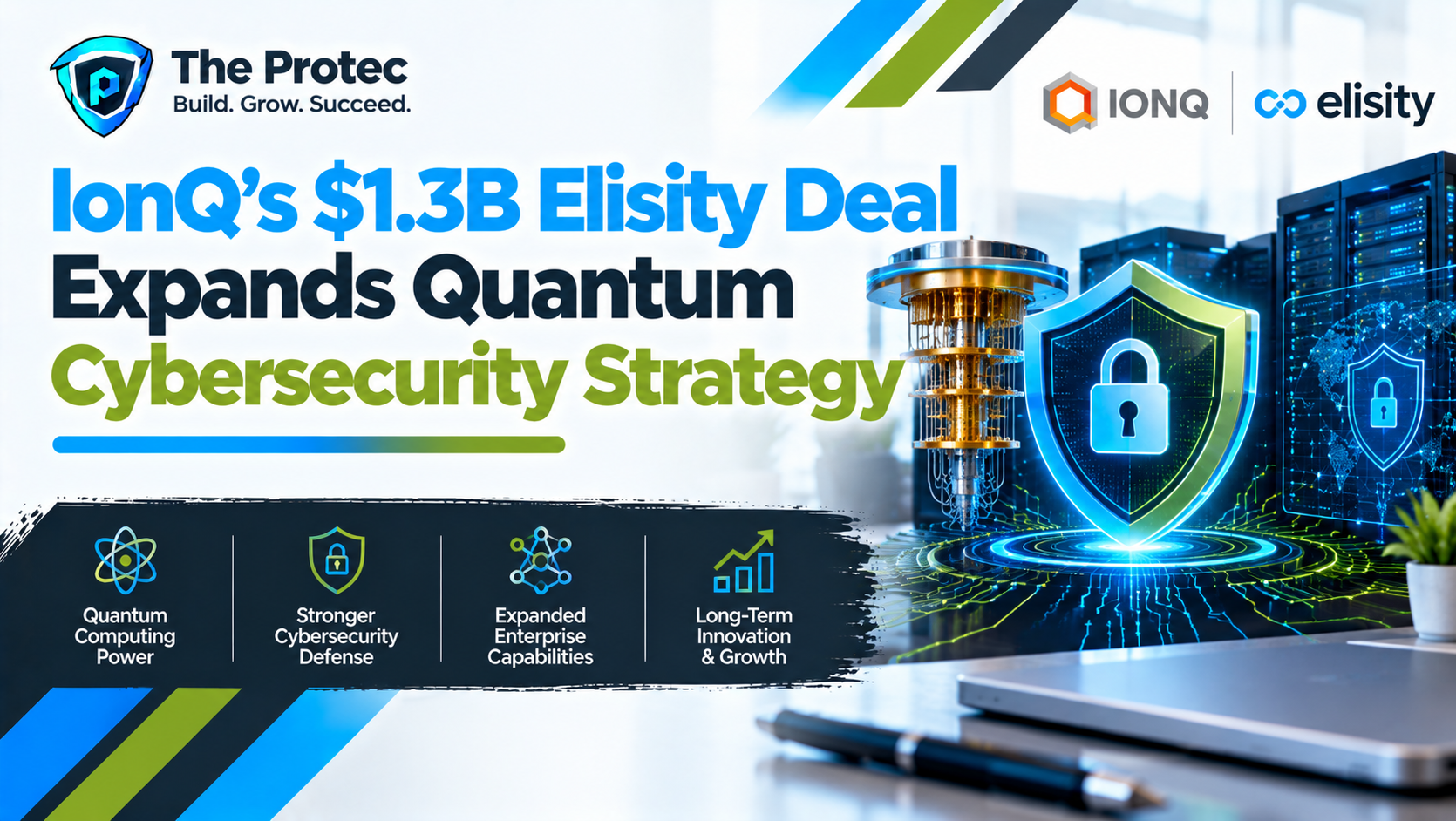
IonQ’s agreement to acquire cybersecurity firm Elisity for up to $1.3 billion marks a significant expansion beyond the company’s core quantum computing business. Structured as an all-stock transaction, the proposed deal would give IonQ an enterprise security platform designed to control network access for users, devices, workloads and increasingly important artificial intelligence agents.
The IonQ Elisity acquisition is not simply another cybersecurity merger. It reflects a broader convergence between conventional enterprise defense, identity-based network controls and technologies intended to protect data from future quantum computers. If completed, the transaction could allow IonQ to combine Elisity’s Zero Trust security capabilities with its post-quantum cryptography and quantum key distribution offerings.
That combination may appeal to enterprises and government agencies seeking protection against both immediate network threats and longer-term cryptographic risks. However, the distinction between an announced agreement and a completed acquisition is essential: as of October 2026, IonQ has agreed to acquire Elisity, but the deal remains subject to applicable approvals and customary closing conditions.
IonQ Elisity Acquisition Deal Details
Under the announced agreement, IonQ plans to acquire Elisity in an all-stock transaction valued at up to $1.3 billion. An all-stock acquisition means IonQ would use its shares, rather than paying the entire consideration in cash, to complete the purchase. This can preserve cash for research, product development and other strategic investments, but it also exposes the transaction’s ultimate value to changes in IonQ’s share price.
The phrase “up to $1.3 billion” is equally important. It describes the potential maximum value of the Elisity acquisition rather than necessarily representing a fixed amount delivered at closing. The final consideration may depend on the definitive transaction terms, applicable performance provisions, the value of the shares issued and other conditions disclosed through official company filings.
Investors and customers should therefore avoid treating the headline valuation as a guaranteed cash purchase price. IonQ’s investor relations materials and regulatory disclosures remain the authoritative sources for updated information about consideration, approvals and closing status.
The expected IonQ Elisity deal closing remains dependent on the required review process and customary conditions. Until those conditions are satisfied and the companies formally announce completion, IonQ and Elisity continue to operate as separate businesses. Product roadmaps, customer contracts and corporate control do not automatically merge when an acquisition agreement is signed.
What the Elisity IdentityGraph Platform Does
Elisity focuses on identity-based microsegmentation and Zero Trust network security. Its platform is designed to discover assets, understand relationships and enforce access policies without relying solely on traditional network boundaries such as locations, subnets or virtual local area networks.
At the center of the company’s approach is the Elisity IdentityGraph platform. It builds context around the identities and behavior of entities communicating across an organization’s environment. Those entities can include:
- Employees, contractors and privileged users
- Managed and unmanaged endpoint devices
- Internet of Things and operational technology equipment
- Applications, cloud services and enterprise workloads
- Automated software processes and AI agents
This context helps security teams define which resources an entity should be permitted to reach. Instead of assuming that anything inside a corporate network is trustworthy, Elisity’s Zero Trust security model evaluates identity and policy before allowing access. The platform can then restrict unnecessary communication paths and reduce opportunities for an attacker to move laterally after compromising an account or device.
That capability has become more relevant as infrastructure has grown decentralized. Hybrid work, cloud applications, connected equipment and AI-driven automation have made perimeter-based security less effective. An AI agent, for example, may need access to a particular data source and application programming interface, but it should not automatically receive broad access to an entire environment. Identity-aware policies can place tighter limits around what that agent is authorized to do.
Why IonQ Is Expanding Into Cybersecurity
IonQ is best known for trapped-ion quantum computing, but quantum technology has important security implications. Powerful future quantum computers could undermine widely used public-key cryptographic systems that protect software updates, digital signatures, financial transactions and confidential communications.
No one needs to wait for a cryptographically relevant quantum computer to begin preparing. Sensitive encrypted information can be collected today and retained until future technology can decrypt it, an approach commonly called “harvest now, decrypt later.” Organizations with long-lived government, healthcare, financial or intellectual-property data have a strong reason to start planning migration before quantum attacks become practical.
IonQ’s cybersecurity expansion positions the company to address that transition through multiple layers. Post-quantum cryptography uses algorithms intended to resist attacks from conventional and quantum computers. Quantum key distribution uses quantum properties to establish or exchange encryption keys while making interception detectable under appropriate implementations.
These technologies solve different problems, and neither eliminates the need for conventional security controls. Post-quantum security solutions protect cryptographic operations, while Elisity enterprise security governs which identities can communicate with which resources. Combining them could give IonQ a broader platform spanning access control, segmentation, encryption modernization and secure key distribution.
How Zero Trust and Quantum-Safe Security Could Work Together
The strategic logic behind IonQ acquiring Elisity rests on defense in depth. Quantum-safe encryption technology can help protect data and communications, but encryption alone cannot prevent a compromised identity from accessing information it is authorized to decrypt. Similarly, microsegmentation can limit network access, but it does not automatically replace cryptographic algorithms that may become vulnerable over time.
A combined architecture could apply Elisity IdentityGraph policies to determine whether a user, device, workload or AI agent may connect to a protected service. Post-quantum cryptography could then secure authentication, key exchange or digital signatures associated with that connection. In selected high-value environments, quantum key distribution could provide an additional method for distributing encryption keys.
Potential use cases include:
- Restricting administrative access to systems holding long-lived sensitive data
- Segmenting operational technology from general corporate networks
- Limiting AI agents to approved data sets, services and workflows
- Applying quantum-resistant authentication to high-value communications
- Protecting government networks that require long confidentiality periods
- Reducing lateral movement while organizations migrate cryptographic assets
This layered approach also aligns with crypto-agility, the ability to identify, replace and manage cryptographic components without rebuilding an entire system. The transition to standardized post-quantum algorithms will take years for many organizations because cryptography is embedded in applications, devices, certificates and third-party services. The National Institute of Standards and Technology’s post-quantum cryptography program provides an important foundation for that migration.
Potential Benefits for Enterprise and Government Customers
IonQ enterprise customers could gain access to a more integrated security portfolio if the transaction closes and the products are successfully combined. Security teams often manage separate tools for asset discovery, identity, segmentation, certificate management, encryption and network monitoring. Better coordination among those systems could simplify policy enforcement and improve visibility.
Elisity may also benefit from IonQ’s commercial reach, capital resources and relationships with research institutions, large enterprises and public-sector organizations. IonQ government cybersecurity opportunities could be especially meaningful because agencies must protect sensitive information, modernize legacy infrastructure and comply with evolving requirements for Zero Trust and post-quantum readiness.
For government environments, the ability to restrict communication among users, devices and workloads can reduce exposure during a cryptographic transition. Agencies cannot replace every vulnerable algorithm or legacy device at once. Segmentation can help isolate higher-risk systems while upgrades proceed, although it should not be treated as a substitute for replacing vulnerable cryptography.
Enterprises may see similar advantages in regulated industries such as banking, healthcare, telecommunications, aerospace and energy. These sectors operate complex networks, retain sensitive data for long periods and often depend on equipment that cannot be rapidly replaced. A coordinated roadmap for Zero Trust access and quantum-safe protection could make modernization more manageable.
What Could Challenge the IonQ Cybersecurity Strategy?
The strategic potential does not guarantee straightforward execution. Cybersecurity mergers and acquisitions frequently encounter difficulties integrating technology, sales teams, engineering processes and customer support. IonQ will need to preserve Elisity’s security expertise while connecting its platform to a broader quantum cybersecurity portfolio.
Technical integration will also require careful design. Quantum key distribution is not suitable for every network, and post-quantum cryptography can introduce performance, compatibility and implementation considerations. Organizations need risk-based deployments rather than applying emerging technology indiscriminately.
Competition is another factor. Zero Trust network security is a crowded market that includes established security vendors and specialized microsegmentation providers. IonQ must demonstrate that combining Elisity’s platform with quantum-safe services produces practical value today, not merely protection against a theoretical future risk.
The all-stock structure creates financial considerations as well. Share-price volatility can change the economic value of the proposed consideration, while issuing shares may dilute existing shareholders. Regulatory review, transaction conditions and integration costs could also affect the timing or expected benefits of the deal.
What Organizations Should Watch Next
Customers should monitor formal confirmation of the transaction’s closing rather than assuming the announced agreement has already transferred ownership. Other key developments include product integration plans, support commitments, pricing changes and details about how Elisity policies will connect with IonQ post-quantum cryptography or quantum key distribution services.
Security leaders do not need to postpone quantum-readiness work while waiting for the deal. They can begin by inventorying cryptographic assets, identifying data that requires long-term confidentiality, mapping network communication paths and limiting unnecessary access. These steps support both present-day cyber resilience and future quantum computing cybersecurity requirements.
If completed successfully, the Elisity acquisition could move IonQ closer to becoming a full-spectrum security provider rather than a company focused only on quantum hardware. Its strongest proposition would be the ability to connect identity-aware network enforcement with cryptographic modernization—protecting who and what can gain access while also strengthening how sensitive communications are secured.
Frequently Asked Questions
Has IonQ completed the acquisition of Elisity?
No. IonQ has announced an agreement to acquire Elisity, but an announced agreement is not the same as a completed transaction. The acquisition remains subject to applicable approvals and customary closing conditions until the companies formally confirm that closing has occurred.
How much is the Elisity acquisition worth?
The IonQ all-stock acquisition is valued at up to $1.3 billion. “Up to” indicates a maximum potential value, not necessarily a fixed cash-equivalent payment. The ultimate value can depend on transaction terms, share-price movements and any applicable conditions.
What does Elisity’s Zero Trust platform protect?
Elisity restricts network access according to identity and policy. Its technology can apply controls to users, managed or unmanaged devices, enterprise workloads, connected equipment and AI agents. The goal is to reduce excessive access and prevent unauthorized lateral movement across networks.
How could Elisity complement IonQ’s quantum security products?
Elisity can control which identities and systems are permitted to communicate, while IonQ’s post-quantum cryptography and quantum key distribution offerings can strengthen how those communications and encryption keys are protected. Together, the technologies could support a layered security architecture.
Does the acquisition mean quantum computers are already breaking encryption?
No. There is no public evidence that today’s quantum computers can break widely deployed public-key encryption at operational scale. The concern is that future systems may gain that capability. Organizations are preparing early because replacing cryptography across complex infrastructure can take many years.
Why does this deal matter for AI security?
AI agents increasingly connect to applications, databases and infrastructure without continuous human involvement. Elisity’s identity-based controls could help restrict each agent to approved resources and actions, reducing the risk created by excessive permissions, compromised credentials or unintended autonomous behavior.