









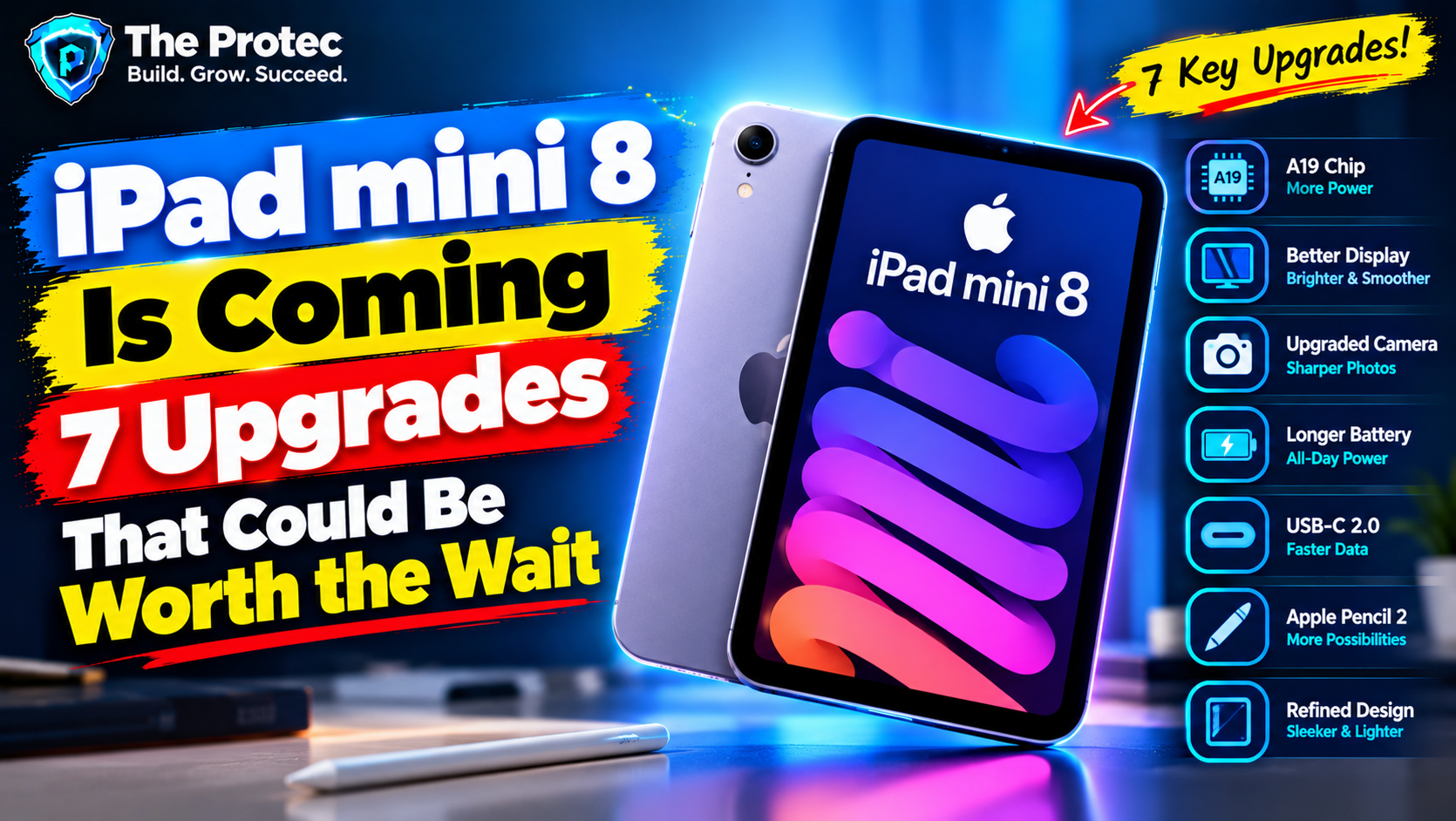
The next iPad mini may be far more interesting than a routine chip refresh. Reports point to a possible OLED display, a next-generation processor, revised speakers and even better resistance to water—changes that could meaningfully improve how Apple’s smallest tablet looks, performs and holds up in daily use.
There is an important caveat: Apple has not officially announced a product named iPad mini 8. Its specifications, launch date and price remain unconfirmed as of October 24, 2026. Even if Apple holds an October event or unveils new hardware through press releases, there is no guarantee that a new iPad mini will be included. Everything below should therefore be treated as a rumor-based preview rather than a description of finished hardware.
With a potential announcement window approaching, however, anyone considering Apple’s current compact tablet has a practical decision to make. Here are the seven rumored iPad mini 8 features that could make waiting worthwhile—and the reasons some buyers should still choose the existing model.
1. The new iPad mini release date could be close
The current iPad mini was announced on October 15, 2024, before reaching customers later that month. That timing makes another fall introduction plausible, particularly if Apple wants to refresh the device on an approximately two-year cycle. This is one reason searches for an iPad mini 2026 release have accelerated.
An October launch opportunity is credible, but it should not be confused with a confirmed iPad mini announcement. Apple sometimes introduces products during a streamed presentation and sometimes publishes individual newsroom announcements without a traditional event. A rumored Apple October event only becomes official when Apple lists it through its own channels.
At the time of writing, Apple has not publicly confirmed the iPad mini 8 itself. Shoppers should monitor the company’s official announcements rather than relying on countdowns or invitation graphics shared by unofficial accounts. If the tablet is announced, preorders could begin quickly, but no preorder or shipping date should be considered final until Apple provides it.
For buyers, the timing matters more than the exact format. If a purchase can wait a few days or weeks, delaying the decision may prevent paying full price for a model that is about to be replaced. If no new mini appears during the fall hardware cycle, the wait could extend considerably longer.
2. An OLED iPad mini may deliver the biggest visual upgrade
The most consequential rumor concerns the display. Supply-chain discussion and reporting tracked by outlets including Bloomberg’s Mark Gurman have connected a future iPad mini with OLED technology. Apple already uses OLED in recent iPhone models and its premium iPad Pro line, so expanding the technology to smaller tablets would fit the company’s broader display transition.
An OLED iPad mini could produce much deeper black levels because individual pixels can switch off instead of relying on an always-on backlight. That can improve perceived contrast when watching movies, reading in dark mode or playing games with shadow-heavy scenes. OLED can also provide stronger HDR presentation, especially where bright highlights appear beside dark areas.
Those benefits do not automatically mean the iPad mini 8 will receive every display feature found on an iPad Pro. In particular, OLED and 120Hz ProMotion are separate technologies. OLED describes how the panel produces light; ProMotion refers to Apple’s adaptive high-refresh-rate system. A device can use an OLED panel while remaining limited to 60Hz.
No dependable confirmation currently establishes 120Hz support for the next mini. Buyers hoping for smoother scrolling should not assume that OLED guarantees it. Panel size, brightness, tandem-OLED construction and refresh rate also remain unknown. The safest expectation is that OLED could improve contrast and black levels, while ProMotion remains a separate and less certain possibility.
3. A possible A20 Pro chip could raise performance and AI headroom
The iPad mini A20 Pro rumor is attention-grabbing, but it is also among the claims requiring the most caution. Apple has not confirmed the processor, and the company could select a different chip based on cost, thermal limits and where it wants the mini to sit within the iPad lineup.
If an A20 Pro is used, it would likely provide faster CPU and graphics performance than the A17 Pro inside the current model. That could benefit demanding games, photo editing, illustration apps and multitasking. A newer chip might also improve efficiency, allowing Apple to increase performance without significantly shortening battery life.
On-device AI is another potential advantage. The current iPad mini already supports Apple Intelligence where features and languages are available, so AI compatibility alone would not be new. A later-generation Neural Engine, additional memory or improved accelerators could nevertheless help future models run more advanced tasks locally. These might include language processing, image creation and contextual assistance without sending every request to the cloud.
It is too early to attach credible benchmark scores, memory capacities or performance percentages to the rumor. Pre-release benchmark estimates are often based on assumptions rather than retail hardware. The sensible conclusion is simply that an A20 Pro-class chip could give the compact tablet more performance headroom and a longer useful software life.
4. Water resistance could make the mini more versatile
Unlike current iPhones, the existing iPad mini does not carry a published IP rating for water or dust resistance. That limits confidence when using it near a pool, in a kitchen, on a boat or in unpredictable outdoor conditions.
Credible reporting has suggested that Apple has explored a more water-resistant design for a future iPad mini. If that work reaches production, it could make the device more useful as an e-reader, travel companion, field notebook or navigation display. It would also address a longstanding gap between Apple’s tablets and its water-resistant phones.
This remains speculative. “Water-resistant” can describe many levels of protection, and Apple has not announced an IP rating, test depth or exposure duration for an iPad mini 8. Even a rated device would not be waterproof, and liquid damage might still fall outside standard warranty coverage.
Buyers should therefore avoid treating water resistance as guaranteed until Apple publishes an exact rating. If confirmed, it could be one of the most practical upgrades; if omitted, the new model would still require the same care around liquids as today’s tablet.
5. Redesigned speakers may support a cleaner enclosure
The speaker rumor appears closely connected to the discussion of water resistance. Reports have indicated that Apple has investigated a vibration-based audio system that could reduce or remove conventional speaker openings. Fewer openings could make it easier to seal the chassis against liquid intrusion.
That does not confirm louder speakers, stronger bass or a specific number of audio channels. It also does not establish that Apple will ship the experimental design. Hardware tested during development can be modified or abandoned before mass production.
If the redesigned speakers arrive, their value will depend on real-world audio quality. The iPad mini is frequently used for video, games, podcasts and calls without headphones, making clear stereo separation and balanced sound more important than an invisible engineering change. Apple’s final technical specifications—and independent listening tests—will be needed before calling the system an upgrade.
6. A landscape front camera could improve video calls
A landscape-positioned front camera would be a smaller change than OLED, but it could noticeably improve everyday use. The current mini’s camera position is better suited to holding the tablet vertically. When the device is horizontal, the camera sits off to one side, which can make the user’s gaze look less natural during calls.
Moving the front camera to the long edge would align it more closely with the user’s face when the iPad is mounted in a keyboard case, placed on a stand or held in landscape orientation. That could benefit FaceTime, Zoom, remote learning and workplace meetings. It would also bring the mini’s design closer to other recent iPads that have adopted landscape-oriented cameras.
The change has not been confirmed, and the mini’s compact internal layout may complicate camera placement around display components and Apple Pencil charging hardware. Resolution, Center Stage support and sensor specifications are also unknown. Still, for people who frequently use a tablet for video calls, positioning can matter more than an increase in megapixels.
7. The iPad mini price may increase
The current U.S. iPad mini starts at $499 with 128GB of storage, according to Apple’s current iPad mini listing. Higher-capacity and cellular configurations cost more.
OLED panels and substantial enclosure changes could increase manufacturing costs. Reporting around Apple’s OLED plans has raised the possibility of a price increase of as much as $100, which would place an entry configuration near $599 if Apple applied the full amount to today’s starting price. That figure is a reported possibility, not a confirmed price or a prediction that every configuration will rise equally.
Apple could absorb part of the added cost, change storage tiers or reserve certain features for a more expensive configuration. Currency and regional tax differences would also affect prices outside the United States. Until the company announces the product, the only firm comparison is the current model’s official $499 starting price.
A higher price would change the buying calculation. OLED, improved durability and a faster chip could justify a premium for frequent users, but $599 would move the mini closer to larger and sometimes discounted iPads. Value will depend on which rumored upgrades actually ship.
iPad mini 7 vs. iPad mini 8: Confirmed facts and rumors
The following comparison separates current specifications from unconfirmed next-generation claims:
- Display: The current iPad mini has an 8.3-inch Liquid Retina LCD. The iPad mini 8 is rumored to use OLED, but its size, refresh rate and brightness are unconfirmed.
- Processor: The current model uses Apple’s A17 Pro. An A20 Pro has been discussed for the next model, but Apple has not verified that chip choice.
- Refresh rate: The current display runs at 60Hz. No reliable confirmation establishes 120Hz ProMotion for the rumored OLED model.
- Storage: The current mini starts at 128GB. Future capacities have not been announced.
- Camera position: The current front camera is positioned for portrait use. A landscape camera is possible but unconfirmed.
- Water resistance: The current model has no published IP rating. Better sealing is rumored for its successor, although no rating is known.
- Speakers: The current model has landscape stereo speakers. A new vibration-based design has been reported as a possibility.
- Price: The current U.S. starting price is $499. A future increase of up to $100 has been reported as possible, not certain.
Should you buy the current iPad mini or wait?
Buy the current iPad mini if you need it now
The present model remains a capable compact tablet. Its A17 Pro chip supports demanding apps and Apple Intelligence, while the 8.3-inch design is easy to carry. It also supports Apple Pencil Pro, starts with 128GB of storage and offers faster wireless connectivity than older minis.
Buying now makes sense if you need a tablet immediately for travel, reading, note-taking, work or school. It becomes especially attractive when reputable retailers discount it below Apple’s list price. A meaningful sale can offset the risk that a newer model appears shortly afterward.
Wait if OLED or durability would change your experience
Consider waiting if your purchase is flexible and an OLED screen would materially improve how you watch HDR video, read at night or play visually rich games. Waiting also makes sense if water resistance, a landscape camera or longer performance headroom are priorities.
Do not wait solely because every rumored feature sounds appealing. Apple may announce only some of them, and the iPad mini price could rise. The strongest strategy is to wait through the immediate announcement window, compare confirmed specifications and then evaluate discounts on the outgoing model.
Frequently asked questions
Has Apple confirmed the iPad mini 8 release date?
No. Apple has not officially announced the iPad mini 8 or provided a release date. An October introduction is plausible based on reporting and Apple’s previous launch timing, but it remains unconfirmed.
Will the iPad mini 8 have OLED and 120Hz ProMotion?
OLED has been the subject of credible reporting, but Apple has not confirmed it. A 120Hz ProMotion refresh rate is a separate feature and should not be assumed merely because an OLED panel may be used.
Is the iPad mini A20 Pro rumor reliable?
The A20 Pro is a possible processor choice rather than a verified specification. It could improve gaming, efficiency and on-device AI performance, but benchmark numbers and exact capabilities are unknown until Apple announces and ships the hardware.
Could the next iPad mini cost $599?
It could, if Apple raises the current $499 starting price by the reported maximum of $100. However, $599 is only a scenario based on reported pricing discussion. Apple has not announced the new model’s price.
Is the iPad mini 7 still worth buying?
Yes, particularly if you need a compact tablet now or find it at a significant discount. Buyers who strongly value OLED, possible water resistance or a newer processor should consider waiting until Apple’s next hardware announcements are complete.
The bottom line
The iPad mini 8 could become the most substantial update to Apple’s smallest tablet in years, particularly if OLED, improved sealing and redesigned audio all make it into the final product. A newer chip and landscape front camera would strengthen the package further.
None of those upgrades is guaranteed, and OLED alone would not establish 120Hz support. With a potential announcement window close, flexible shoppers should wait for confirmed details before paying full price. This article should be updated immediately following any Apple announcement to reflect the official release timing, specifications, pricing and revised buying recommendation.