






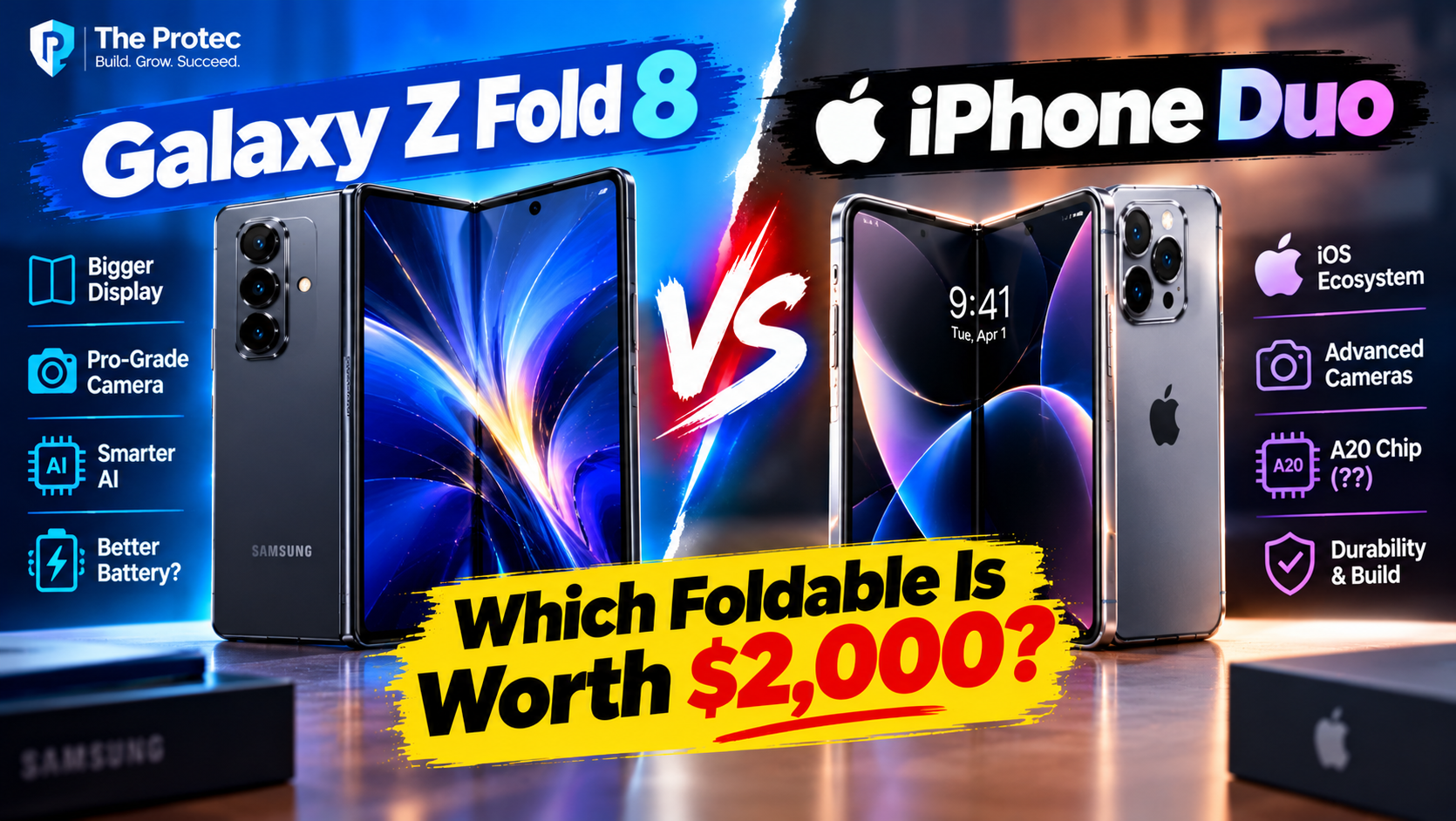
Quick verdict: The Samsung Galaxy Z Fold 8 is the better pick if you want a lighter foldable, a more practical cover-screen experience, stronger zoom flexibility and mature Android multitasking. The Apple iPhone Duo is compelling if you want iOS on a foldable, deeper Apple ecosystem integration, better water-and-dust protection and—according to one direct camera comparison—more consistent everyday photos. Apple’s first foldable is now on sale, so this is a real buying decision rather than a pre-launch speculation piece.
The iPhone Duo became available on October 23, 2026, with U.S. pricing starting at $1,999 for 256GB. Samsung’s Galaxy Z Fold 8 launched earlier and starts at $1,899.99 for 256GB in the U.S. That makes the entry-level price gap about $100, but the bigger differences are weight, cameras, durability, battery results and how well each phone’s software uses its large inner display. See Apple’s official iPhone Duo announcement and Samsung’s Galaxy Z Fold 8 product page for current regional availability and offers.
Neither phone is automatically the right choice for everyone. Samsung’s foldable is considerably lighter, while Apple’s device has a strong display-and-camera feature set and can work naturally with Apple services. The comparison below uses published specifications and early independent testing available after launch; battery and camera results can vary by test method and software version.
Galaxy Z Fold 8 vs iPhone Duo: comparison at a glance
| Feature | Samsung Galaxy Z Fold 8 | Apple iPhone Duo |
|---|---|---|
| U.S. starting price | $1,899.99 | $1,999 |
| Base storage | 256GB | 256GB |
| Maximum listed storage | 1TB | 2TB |
| Cover display | 5.5 inches | 5.4 inches |
| Inner display | 7.6 inches | 7.6 inches |
| Weight | 201g | 254g |
| Rear cameras | 50MP main + 50MP ultrawide | 48MP main + 48MP ultrawide |
| Telephoto camera | No dedicated telephoto; stronger long-range digital zoom in some tests | No dedicated telephoto camera |
| Battery capacity | 4,800mAh | 4,883mAh |
| Wired charging | Up to 45W | Up to 60W with compatible charger and cable |
| Water/dust rating | IP48 | IP68 |
| Best reason to buy | Lighter design, multitasking and zoom flexibility | iOS, Apple integration, durability rating and strong main-camera results |
Specifications and prices are based on manufacturer listings and published launch coverage available on October 24, 2026. Retail promotions, storage options and regional versions may differ. Battery test results are discussed separately because published results for the Fold 8 have varied between test runs.
Price and storage: Samsung starts lower, Apple offers more capacity
The Galaxy Z Fold 8 starts at $1,899.99 with 256GB of storage, while the iPhone Duo starts at $1,999 with the same base capacity. Samsung’s entry price is therefore about $100 lower. Apple offers 512GB, 1TB and 2TB configurations, while Samsung’s listed Fold 8 range goes up to 1TB.
That extra 2TB option could matter if you keep large video projects, offline media or years of photos on your phone. On the other hand, Samsung frequently advertises trade-in credits and launch promotions, so the effective price may be lower than its list price. Compare the same storage tier, sales tax, insurance, case and financing terms before deciding which is cheaper. Carrier credits paid over several years are not the same as an immediate discount.
Design and everyday comfort: the Fold 8 has a major weight advantage
The most obvious physical difference is weight. Samsung’s Galaxy Z Fold 8 weighs about 201 grams, compared with 254 grams for the iPhone Duo. That is a 53-gram difference—noticeable when holding a phone for reading, video calls or extended one-handed use. Apple’s device unfolds to a very thin 5.2mm body, but its overall weight means thinness alone does not make it the lighter phone to carry.
Both phones have a 7.6-inch inner display and similarly sized outer displays: 5.5 inches on Samsung and 5.4 inches on Apple. Their proportions and software matter more than the small diagonal difference. Reviews have found the iPhone Duo’s passport-like shape can feel cramped for some cover-screen tasks, while Samsung’s outer screen and keyboard are more practical for quick replies and conventional phone use. Try typing a message, using maps and scrolling a long page on each device if you can.
Apple’s inner display uses a matte, nano-texture finish that can reduce reflections and make the crease less visually distracting. The trade-off noted in reviews is that the display can look less vivid than a glossy OLED panel, with less punchy blacks and colors. Samsung’s display presentation may appeal more to users who prefer conventional OLED contrast and saturation. This is partly a matter of taste, so hands-on viewing is valuable.
Displays and productivity: Samsung has the more established foldable workflow
A 7.6-inch screen is useful only when apps take advantage of it. Samsung has years of experience building foldable features into Android, including split-screen layouts, app pairs and floating windows. These tools make it easier to keep a document beside a browser, check messages while watching a video or move between work apps without constantly switching screens.
The iPhone Duo brings iOS to a foldable form factor and supports Apple Pencil USB-C, giving it an extra option for handwriting, markups and sketches. Apple’s software and ecosystem integration will be attractive to people already using a Mac, iPad, AirPods or Apple services. However, early reviews report that app optimization is uneven: some third-party apps do not yet make ideal use of the expanded screen, and some layouts still feel like enlarged phone interfaces rather than purpose-built tablet experiences.
For productivity, think about your actual workflow rather than the number of features in a demo. If you routinely use two apps side by side, Samsung’s established multitasking is a strong reason to choose the Fold 8. If your work is built around iCloud, FaceTime, AirDrop, Apple Notes and a Mac, the iPhone Duo may fit more naturally—provided your essential apps behave well on the inner display.
Cameras: iPhone Duo wins more everyday photo categories, Fold 8 has zoom strengths
Both phones use dual rear-camera systems, but megapixel counts alone do not predict image quality. Apple equips the iPhone Duo with 48MP main and 48MP ultrawide cameras. Samsung lists 50MP main and 50MP ultrawide cameras. Neither has a dedicated rear telephoto lens, so both rely on cropping and computational processing for longer zoom ranges.
In Tom’s Guide’s 10-round photo comparison, the iPhone Duo won seven categories, including daylight, dynamic range, color, portraits and low-light photography. The ultrawide comparison was a tie, while the Galaxy Z Fold 8 performed better in macro and 10x digital zoom in that test. The result suggests Apple is the stronger choice for consistent point-and-shoot photos, while Samsung may suit people who value macro shots, zoom flexibility and more manual camera controls. These findings reflect one publication’s test, not a guarantee that every scene will produce the same winner.
Video creators should also compare stabilization, focus transitions, microphone quality, heat and recording options—not just still photos. Apple advertises 4K video recording at up to 120 frames per second in Dolby Vision on the main camera. If video is central to your purchase, test the exact modes you plan to use and consider storage needs, because high-resolution footage can fill a phone quickly.
Read the published iPhone Duo vs Galaxy Z Fold 8 camera comparison for example shots and the methodology behind the verdict.
Battery life: iPhone Duo leads in one direct test, but results need context
The iPhone Duo has a listed 4,883mAh battery, compared with 4,800mAh in the Galaxy Z Fold 8. That is a small capacity difference, so real-world endurance depends heavily on display efficiency, software, signal conditions and how often you use the inner screen.
In a Tom’s Guide web-browsing test run with the phones side by side over 5G at a set screen brightness, the iPhone Duo lasted 13 hours and 20 minutes, while a newer retest of the Galaxy Z Fold 8 lasted 10 hours and 6 minutes. However, Tom’s Guide reported that its earlier Fold 8 test had lasted 12 hours and 19 minutes. That variation is important: the latest same-session comparison favors Apple, but the Fold 8’s result has not been consistent across test runs.
Charging speed slightly favors Samsung in the cited charging test. The Fold 8 reached 70% after 30 minutes, while the iPhone Duo reached 66% under the test conditions. Apple supports up to 60W wired charging with a compatible power adapter and cable; Samsung supports up to 45W. Actual charging depends on the adapter, cable, temperature and battery level, and the required power accessories may be sold separately.
The practical verdict: early testing gives the iPhone Duo an endurance advantage in one direct comparison, but do not assume every owner will see a three-hour gap. Heavy gaming, cellular reception, brightness, camera use and app behavior can change battery life considerably.
Source: Tom’s Guide’s iPhone Duo battery test.
Durability: iPhone Duo has the stronger official resistance rating
Apple rates the iPhone Duo IP68 for splash, water and dust resistance under controlled laboratory conditions. Samsung rates the Galaxy Z Fold 8 IP48. These ratings are not interchangeable: IP68 provides a higher dust-protection rating than IP48, while both ratings indicate water resistance under defined test conditions. Neither means a foldable is waterproof, immune to damage or safe from every kind of debris.
Foldable durability also depends on the hinge, flexible inner panel, frame and repair process. Apple’s higher IP rating is a meaningful advantage on paper, but it does not prove the iPhone Duo will survive every drop or last longer over several years. Check the warranty, accidental-damage coverage, inner-screen replacement cost and local repair availability before spending close to $2,000. Water or liquid damage may not be covered by the standard warranty even when a device has an IP rating.
Software and ecosystem: iOS versus Android is still the deciding factor
The iPhone Duo runs iOS 27.1, according to Apple’s launch information, and integrates with services such as iMessage, FaceTime, iCloud, AirDrop and Apple Watch. It is the more natural choice for people who already rely on those services and do not want to move their digital life to Android.
The Galaxy Z Fold 8 runs Samsung’s Android-based software and brings the flexibility of Android defaults, Samsung’s multitasking tools and integration with Galaxy devices and Windows PCs. It is the better fit for people who prefer customizing their phone, using split-screen workflows or switching between a broader range of Android services.
AI features should be judged by availability, not just launch-stage demonstrations. Confirm which features work in your country and language, whether they require cloud processing, and whether they are free. Also compare each manufacturer’s published update policy and service options in your market. A feature announced for a later software update should not be treated as available today.
Which foldable should you buy?
- Choose the Galaxy Z Fold 8 if: you want a much lighter device, a practical cover screen, established Android multitasking, faster charging in the cited test, or stronger macro and long-zoom results.
- Choose the iPhone Duo if: you want to stay in iOS, depend on Apple services, prefer its matte inner display, want the higher IP68 resistance rating, or prioritize consistent everyday photos based on the published camera comparison.
- For battery life: the iPhone Duo won the latest same-session test cited above, but the Fold 8’s different published test results make this a qualified rather than absolute verdict.
- For productivity: Samsung is the safer choice for mature split-screen workflows; Apple is attractive if your work already revolves around Apple devices and your key apps are optimized for the larger display.
- For value: Samsung starts about $100 lower in the U.S. and weighs less. Apple’s 2TB option and IP68 rating may justify its premium for some buyers, but neither feature makes it the best value for everyone.
Final verdict: The Galaxy Z Fold 8 is the more practical choice for buyers who prioritize low weight, Android multitasking and zoom versatility. The iPhone Duo is a credible first-generation alternative—not merely a device to wait for—with compelling Apple integration, an impressive inner display and strong results in an early camera comparison. Its main trade-offs are the extra weight, lack of a dedicated telephoto camera, uneven third-party app optimization and a $100 higher starting price. If possible, handle both phones in person and test the apps you use every day before choosing.
Frequently asked questions
Is the iPhone Duo available to buy now?
Yes. Apple announced availability beginning October 23, 2026, in its initial launch markets. Availability, delivery dates and storage options vary by country, so check Apple’s regional store or an authorized retailer.
Is the Galaxy Z Fold 8 cheaper than the iPhone Duo?
In the U.S., Samsung lists the Galaxy Z Fold 8 from $1,899.99 and Apple lists the iPhone Duo from $1,999. The starting-price difference is about $100 before taxes, trade-ins, carrier credits and promotions.
Which phone has the better camera?
In Tom’s Guide’s 10-round comparison, the iPhone Duo won seven categories, while the Fold 8 did better in macro and 10x digital zoom. Apple is the stronger pick for consistent everyday photography in that test; Samsung may appeal more to users who value zoom and manual controls.
Which foldable lasts longer on a charge?
In a recent same-session web-browsing test, the iPhone Duo lasted 13 hours and 20 minutes and the Galaxy Z Fold 8 lasted 10 hours and 6 minutes. The Fold 8 had previously recorded 12 hours and 19 minutes in an earlier test, so treat the direct result as useful evidence rather than a guarantee of every user’s battery life.
Is the iPhone Duo more water-resistant?
Apple lists an IP68 rating for the iPhone Duo, while Samsung lists IP48 for the Galaxy Z Fold 8. The iPhone has the higher dust-protection rating, but neither phone is waterproof, and resistance can decline with wear. Liquid damage may not be covered by the standard warranty.
Which phone is better for multitasking?
The Galaxy Z Fold 8 is the safer recommendation for established split-screen and floating-window workflows. The iPhone Duo’s large display and Apple Pencil support are useful, but app optimization is still uneven according to early reviews.
Should I buy the iPhone Duo or Galaxy Z Fold 8?
Choose Samsung for lower weight, Android flexibility and established multitasking. Choose Apple if iOS and the Apple ecosystem are essential to you and you value its IP68 rating and camera results. At this price, try both in person if possible and check repair coverage before buying.
Sources and further reading
- Apple: iPhone Duo announcement, specifications and availability
- Apple Support: iPhone Duo technical specifications
- Samsung: Galaxy Z Fold 8 product details and U.S. pricing
- Tom’s Guide: iPhone Duo vs Galaxy Z Fold 8 camera comparison
- Tom’s Guide: iPhone Duo battery-life test
- The Verge: iPhone Duo review and real-world trade-offs