








Artificial intelligence is changing what employers expect from entry-level talent, but it is not eliminating the need for capable people. The most useful way to understand Sam Altman advice to young workers is not as a prediction that AI will make success automatic. It is an invitation to learn the tools early, notice emerging opportunities, and become unusually effective at solving real problems.
For students, recent graduates, and early-career professionals, that distinction matters. AI can accelerate research, analysis, writing, coding, design, and experimentation. It can also produce confident errors, expose sensitive data, and encourage shallow work when used without judgment. The goal is therefore not to outsource your thinking. It is to combine AI capabilities with foundational knowledge, domain expertise, creativity, reliability, and the ability to work well with other people.
What did Sam Altman actually tell young workers?
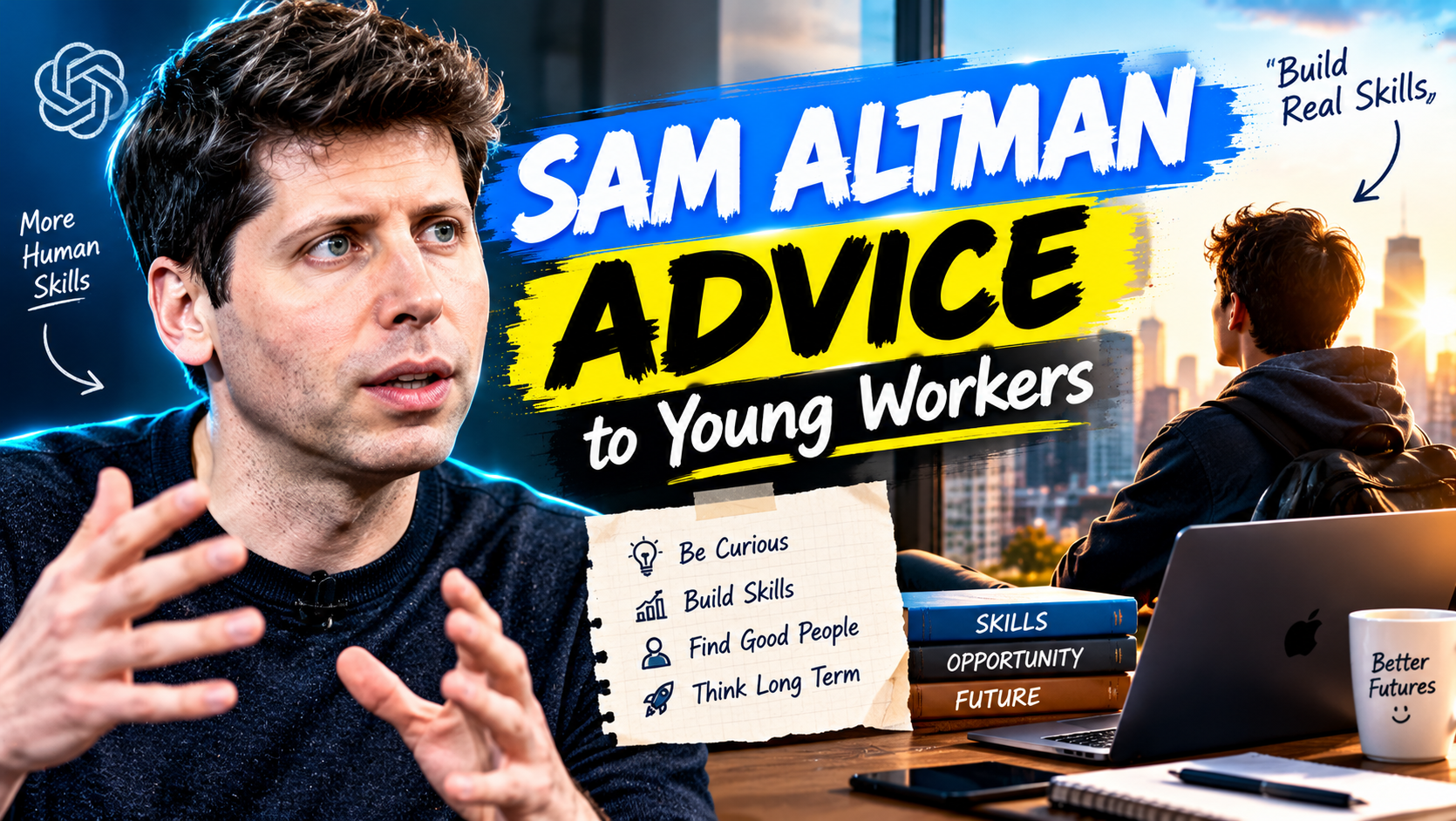
The primary source is Altman’s June 2025 appearance on his brother Jack Altman’s Uncapped interview, “Sam Altman on AGI, GPT-5, and What’s Next”. Discussing graduates entering an AI-shaped economy, the OpenAI CEO said that if he were 22 and graduating, he would feel like “the luckiest kid in all of history.” His reasoning was that young people can use powerful new tools to attempt work and create products that previously required much larger organizations.
Altman also advised young people to become highly proficient with AI tools and emphasized the importance of finding useful things that other people are not doing. His remarks were optimistic, but they were not a guarantee of wealth, employment, or a successful startup. Nor did he present the seven-item list below.
The following framework is our practical interpretation of his verified themes, combined with durable career principles. It clearly separates Altman’s direct message—learn the tools, adapt, and pursue overlooked opportunities—from additional recommendations for navigating the future of work responsibly.
Sam Altman advice to young workers, turned into seven skills
1. Become proficient with AI tools—and integrate them into real work
Occasional chatbot use is not the same as AI proficiency. Valuable users know how to define a task, provide relevant context, evaluate the output, and fit the tool into a repeatable workflow. They also recognize when AI is the wrong choice.
A university student might use AI to map competing theories before reading the original papers. A marketer could classify customer feedback, while a software developer could generate test cases and inspect each one before committing code. Designers can explore concepts, and researchers can use AI to suggest search terms without treating generated citations as trustworthy.
Protect confidential information: do not paste private employer data, customer records, unpublished research, or proprietary code into an unapproved service. Check workplace policies, verify important claims against primary materials, and respect copyright, licenses, and intellectual property.
Action this week: Choose one recurring, low-risk task and compare your normal process with an AI-assisted version. Record the time saved, errors found, and human review still required.
2. Strengthen problem-solving, critical thinking, and judgment
As plausible answers become inexpensive, deciding which answer is correct and appropriate becomes more valuable. AI can overlook constraints, invent sources, reproduce bias, or solve the wrong problem. Foundational knowledge lets you detect those failures.
Imagine an entry-level analyst asking AI why customer retention fell. The model may produce five polished explanations, but the analyst must inspect the data, question missing variables, and distinguish correlation from causation. Similarly, a developer must understand security and architecture rather than accepting generated code because it runs.
Action this week: For one AI-generated answer, write down its assumptions, request counterarguments, and verify three consequential claims independently before using it.
3. Recognize underserved needs and overlooked opportunities
One of the clearest themes in Altman’s career advice is the value of noticing what others have not yet attempted. AI career opportunities often appear where a group has a costly, repetitive, or confusing problem—not wherever the most fashionable technology is being discussed.
An aspiring entrepreneur might discover that local clinics spend hours converting intake notes into a standard format. A student could notice that classmates struggle to locate accessible campus resources. The opportunity begins with understanding users, constraints, and existing alternatives, not with declaring that an AI app will fix everything.
Action this week: Interview three people in a field you understand. Ask what wastes their time, where errors occur, and which tasks they avoid. Look for repeated pain rather than pitching a solution immediately.
4. Build useful projects and demonstrate real outcomes
Certificates can show effort, but completed work gives employers and customers stronger evidence. A small project reveals whether you can define a problem, make trade-offs, handle setbacks, and deliver something usable.
A recent graduate could create a searchable guide from public municipal documents, citing every answer to its source. A designer might prototype an accessible onboarding flow and test it with users. A junior marketer could analyze publicly available reviews and present a carefully checked messaging brief. The outcome need not be a startup; it needs to be useful and honestly documented.
Action this week: Select a project that can be finished in ten hours. Define one user, one problem, one deliverable, and one measurable sign of improvement.
5. Communicate clearly with people and AI systems
Clear communication is among the most durable skills for the AI era. Working with AI requires precise instructions, relevant context, examples, and criteria for success. Working with people requires listening, explaining trade-offs, resolving ambiguity, and accepting feedback without becoming defensive.
For example, a researcher can ask an AI system to compare studies using specified inclusion criteria, then explain the limitations to colleagues in plain language. An entry-level employee can turn a vague request into a written brief that confirms the audience, deadline, data source, and expected format.
Action this week: Rewrite one unclear assignment as a short brief containing the objective, audience, constraints, inputs, output format, quality checks, and owner.
6. Develop adaptability and learn continuously
Specific tools, interfaces, and job requirements will keep changing. Adaptability does not mean chasing every release. It means building a reliable process for learning: understand the fundamentals, test new capabilities, seek feedback, and update your methods when evidence changes.
A developer who understands data structures, testing, and system design can evaluate new coding assistants more effectively. A marketer grounded in customer research and experimentation can adopt new content tools without confusing higher output with better results. Domain expertise provides the structure into which new AI skills fit.
Action this week: Reserve two recurring 30-minute sessions for deliberate learning. Use one to study a core concept and the other to test how an AI tool affects a real task.
7. Understand how businesses create value
Technical fluency becomes more powerful when paired with commercial understanding. Organizations create value by solving customer problems in a way that is useful, reliable, sustainable, and worth paying for. A clever demonstration is not automatically a viable product.
Suppose a young entrepreneur builds an AI scheduling assistant. The important questions include who experiences the scheduling problem, how often it occurs, what mistakes cost, who controls the budget, what data must be protected, and why users would switch from existing software. These questions apply equally to internal projects: an employee proposing automation should explain its benefits, risks, maintenance needs, and effect on colleagues.
Action this week: Write a one-page value proposition for your project covering the customer, problem, current alternative, proposed benefit, risks, and evidence you need to collect.
How to use AI at work without weakening your skills
AI is particularly useful for exploring unfamiliar subjects, summarizing material you have permission to use, generating questions, automating repetitive formatting, prototyping interfaces, analyzing non-sensitive information, and producing a first draft for human revision. Treat outputs as working material—not authority.
- Ask for sources, then open and verify the original sources yourself.
- Use approved enterprise tools and follow data-retention policies.
- Do not represent generated work as entirely your own when disclosure is required.
- Check code, calculations, quotations, citations, and high-impact decisions.
- Keep a human accountable for quality, fairness, safety, and final approval.
Reliability is a competitive advantage. The colleague who delivers checked, understandable work will usually be more valuable than someone who generates a greater volume of unverified material.
A balanced view of AI and the future of work
No honest career plan can promise complete protection from technological change. Some tasks will be automated, some occupations may contract, and many roles will be redesigned. New products, specialties, and businesses may also emerge. The pace and distribution of those effects will vary by industry, region, regulation, infrastructure, and experience level.
In May 2025, the International Labour Organization reported that one in four jobs worldwide had some exposure to generative AI, while emphasizing that job transformation was more likely than outright replacement. Exposure is not the same as a confirmed job loss, and global estimates cannot predict what will happen to a particular worker.
That uncertainty is why claims about an entirely “AI-proof” career are misleading. Better AI-proof career skills are relative, not absolute: judgment, deep domain knowledge, creativity, trustworthiness, relationship-building, and accountability can make a person more resilient, but no skill guarantees permanent security.
A practical 30-day action plan
- Days 1–5: Choose one tool. Learn its privacy settings, limitations, acceptable-use rules, and basic workflow. Avoid switching between several products.
- Days 6–10: Identify a real problem. Speak with potential users and define a narrow pain point. Establish what success would look like before building.
- Days 11–18: Build a small project. Create the simplest useful version. Keep humans in the loop and use non-sensitive, properly licensed data.
- Days 19–23: Collect feedback. Watch at least three people use the result. Ask where they hesitated, what failed, and whether it saved time or improved quality.
- Days 24–27: Document the outcome. Explain the problem, process, AI’s role, your contribution, safeguards, limitations, and measurable result.
- Days 28–30: Improve and share. Fix the most important weakness and turn the work into a concise portfolio case study, demonstration, or workplace proposal.
Skills for the AI era: a concise checklist
- Use AI tools proficiently and responsibly.
- Verify information and exercise independent judgment.
- Find overlooked, meaningful customer problems.
- Build projects that produce observable outcomes.
- Communicate with clarity and collaborate well.
- Learn continuously without chasing every trend.
- Understand customers, costs, risks, and value creation.
Frequently asked questions
Does Sam Altman say young people should skip college?
Not in the cited Uncapped remarks. His message was that young people are entering the workforce when unusually capable tools are becoming available. Whether college is worthwhile depends on the field, costs, learning environment, credential requirements, and alternatives. Education remains especially important where deep knowledge, supervised practice, or professional licensing is required.
Which AI skill should a beginner learn first?
Start with task definition and verification. Learn to describe the desired outcome, provide appropriate context, set constraints, and test the response. Tool-specific shortcuts are useful, but the ability to frame and evaluate work transfers more easily when products change.
Will learning AI guarantee a job?
No. AI fluency can improve productivity and expand the work you can attempt, but employment also depends on economic conditions, location, experience, relationships, domain knowledge, and employer needs. A portfolio showing responsible use and measurable results is stronger than unsupported claims of expertise.
Can nontechnical professionals benefit from AI career opportunities?
Yes. Designers, marketers, researchers, operations staff, educators, and entrepreneurs can use AI to explore information, analyze patterns, prototype ideas, or reduce administrative work. They still need subject knowledge and must follow applicable privacy, intellectual-property, and professional standards.
Focus on value, not the appearance of expertise
The enduring lesson is not to collect as many AI certificates as possible. Learn one tool, apply it to a genuine problem, check the work, and show what improved. Young professionals who consistently create measurable value—and can explain their decisions—will be better prepared for an uncertain, AI-driven future.