








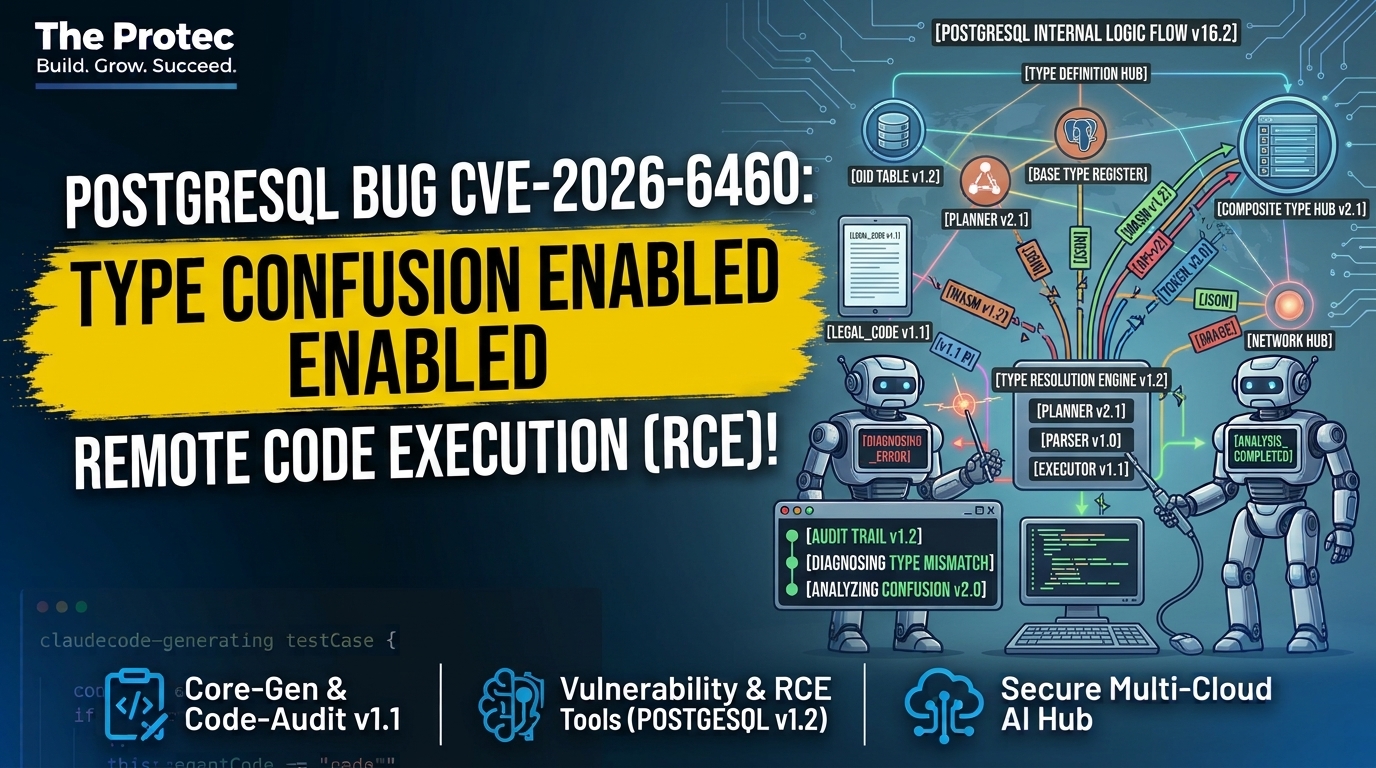
A flaw can remain hidden in mature software for decades before someone discovers a path from an old design assumption to full system compromise. PostgreSQL Bug CVE-2026-6460 is a striking example: a type-confusion weakness described by security researcher Mehmet Ince as originating in 22-year-old code could be transformed into remote code execution (RCE) by a low-privileged database user. The vulnerability carries a CVSS 3.1 score of 8.8 and should be treated as an urgent patching priority, although it is not an unauthenticated attack.
The issue affected supported PostgreSQL branches before releases 18.7, 17.12, 16.16, 15.20 and 14.25. Successful exploitation could allow an authenticated attacker to execute arbitrary code as the operating-system account running the PostgreSQL service. That usually means the dedicated postgres account rather than root, but it still puts databases, credentials, application data and connected infrastructure at serious risk.
What Is PostgreSQL CVE-2026-6460?
CVE-2026-6460 is a high-severity PostgreSQL type-confusion vulnerability. At its core, PostgreSQL did not always maintain enough information to determine whether an internally stored value still matched the data type associated with its current location. Under particular schema-changing operations, a value produced under one type definition could remain behind and later be treated as though it belonged to another.
According to the PostgreSQL security advisory, the weakness can affect typed values in data dictionary entries, PL/pgSQL variables and other internal locations. The problem is therefore broader than one SQL function or procedural-language feature. It concerns how the database tracks the relationship between a value, its representation and its declared type while objects change.
Type confusion is dangerous because PostgreSQL relies on type-specific routines to parse, copy, display and operate on values. If the server applies the wrong routine to stale or incompatible data, the result can go beyond an incorrect query result. In the vulnerable conditions identified for CVE-2026-6460, an attacker could turn that mismatch into arbitrary native-code execution.
How Did a 22-Year-Old Bug Become Remote Code Execution?
Old code is not automatically insecure. The deeper problem is that long-standing assumptions may be safe only within the environment in which they were created. Over time, new data types, procedural features, extension interfaces and more complex DDL workflows can make an overlooked invariant reachable in ways the original developers did not anticipate.
Ince’s technical account of the discovery traces the PostgreSQL 22-year-old bug from a type-confusion primitive to RCE. The critical insight was not merely that stale data could survive a type change. It was that an attacker able to influence database objects and type-related operations could shape the conditions under which PostgreSQL consumed that stale value.
The resulting PostgreSQL RCE runs in the database server process context. It does not inherently grant kernel-level or root access, but the PostgreSQL operating-system user commonly has access to database files, configuration material, local sockets, backups and sensitive application records. Code execution at that boundary can also provide a foothold for lateral movement or additional privilege escalation if the host is poorly segmented or misconfigured.
How Does the PostgreSQL Type-Confusion Vulnerability Work?
PostgreSQL has a rich type system. A value is meaningful only when the server knows both its stored representation and the functions associated with its type. Database objects can also evolve: administrators and authorized users can create types, replace functions and alter table columns.
Operations such as ALTER ... SET DATA TYPE can force PostgreSQL to reconcile existing values and metadata with a new type. The vulnerable code did not adequately track every typed value across these transitions. In certain internal locations, a stale value could therefore appear under metadata indicating a different type.
A conceptual attack chain looks like this:
- An attacker authenticates to a reachable PostgreSQL server using a role with limited but relevant object or DDL privileges.
- The attacker creates or manipulates database objects and initiates a type-changing DDL operation.
- A value associated with the previous type survives in a catalog entry, PL/pgSQL variable or another affected internal location.
- PostgreSQL later handles that stale value using logic associated with the new type.
- The type mismatch is shaped into memory corruption and ultimately arbitrary code execution within the server process.
This overview intentionally omits exploit construction details. Administrators do not need a working payload to understand the risk: schema-changing privileges can cross a boundary from database-level control to operating-system-level code execution when internal type safety fails.
Which PostgreSQL Versions Are Affected?
The vulnerability affects the following version ranges. Administrators should upgrade to the listed fixed release or any later release in the same supported branch:
- PostgreSQL 18 before PostgreSQL 18.7
- PostgreSQL 17 before PostgreSQL 17.12
- PostgreSQL 16 before PostgreSQL 16.16
- PostgreSQL 15 before PostgreSQL 15.20
- PostgreSQL 14 before PostgreSQL 14.25
PostgreSQL’s November 12 security update addresses CVE-2026-6460 along with dozens of other vulnerabilities. Deploying the complete maintenance release is therefore important even where administrators believe permissions or network controls make this particular exploit difficult.
Does CVE-2026-6460 Allow Unauthenticated Attacks?
No. CVE-2026-6460 is not an unauthenticated, connection-only compromise. The CVSS 3.1 assessment reflects a network-reachable attack with low privileges, meaning an attacker needs valid database access and sufficient permissions to reach the vulnerable object and DDL behavior.
That distinction matters, but it should not be interpreted as low risk. Application credentials are frequently exposed through source repositories, environment files, compromised web applications or secrets-management mistakes. Multi-tenant platforms may also intentionally give customers limited database access. A low-privileged role that appears safely contained inside PostgreSQL could potentially use this vulnerability to escape that boundary.
Exact exploitability depends on role memberships, ownership, schema privileges and the ability to create or modify relevant objects. Removing public internet exposure helps, but network filtering alone does not protect a server from compromised applications, malicious insiders or attackers already present on an internal network.
How to Patch PostgreSQL Against CVE-2026-6460
1. Identify every server and its actual runtime version
Connect to each database instance and run SELECT version(); or SHOW server_version;. Check primary servers, replicas, development systems, managed instances and disaster-recovery environments. The version reported by pg_config or a client utility may describe installed client files rather than the server process receiving connections.
Container users should verify the running image digest and query the live database. Package inventories can miss an old container, an manually compiled installation or a service that has not restarted since packages were updated.
2. Install the fixed maintenance release promptly
Upgrade each affected branch to PostgreSQL 18.7, 17.12, 16.16, 15.20 or 14.25, as applicable. Follow operating-system vendor or PostgreSQL package instructions, then restart the database processes so they load the corrected binaries. Confirm the runtime version again after maintenance.
Minor PostgreSQL updates normally preserve the on-disk data format, but administrators should still follow change documentation and test critical workloads. Managed-service customers should review provider advisories and maintenance schedules rather than assuming automatic patching has already occurred.
3. Review privileges that increase exposure
Inventory login roles, inherited memberships, object ownership and permissions to create objects in shared schemas. Pay particular attention to roles that can create types, functions, procedures or tables, or alter objects they own. Remove dormant accounts and privileges that applications do not require.
Avoid granting broad DDL capabilities to routine application accounts. Separate migration roles from runtime roles, protect migration credentials and restrict when those credentials can connect. Do not rely on revoking one specific SQL command as a permanent substitute for the PostgreSQL patch.
4. Reduce database reachability
Restrict PostgreSQL listeners and firewall rules to approved application hosts, administration networks and monitoring systems. Review pg_hba.conf, enforce strong authentication and require encrypted connections where appropriate. Direct public access should be eliminated unless there is a documented operational need and compensating protection.
5. Validate backups and monitor for anomalies
Ensure recent backups are available, protected from modification and covered by a tested restoration procedure before maintenance. Backups do not remove the vulnerability, but they reduce operational risk if an update exposes an unrelated compatibility issue.
Review logs for unexpected DDL, newly created functions or types, unusual role changes and unexplained server-process crashes. These signs do not prove exploitation, and their absence does not prove safety. If compromise is suspected, preserve evidence, isolate the server and rotate database and application secrets as part of incident response.
Why PostgreSQL 14 Users Need to Upgrade
PostgreSQL 14.25 is the final release of the PostgreSQL 14 branch because version 14 has reached end of life. Installing 14.25 closes CVE-2026-6460 and provides the branch’s final corrections, but it does not restore ongoing support.
Organizations still using PostgreSQL 14 should treat 14.25 as an immediate security update and a bridge to a supported major version. Plan the major upgrade, test extensions and application compatibility, verify replication and backup tooling, and set a firm migration deadline. Remaining on an end-of-life database means newly discovered PostgreSQL security vulnerabilities may receive no PostgreSQL 14 patch.
What This Incident Teaches Database Maintainers
CVE-2026-6460 shows why internal type safety is a security boundary rather than merely a correctness feature. Mature database engines process long-lived state while schemas, functions and metadata change around it. Every stored value needs an unambiguous relationship to the type and operations that govern its interpretation.
Security testing should therefore cover object-lifecycle transitions, not only isolated SQL statements. Altering types, replacing dependent objects, crossing procedural-language boundaries and retaining values across DDL operations are valuable targets for fuzzing and invariant checks. Explicit type metadata, aggressive invalidation of stale state and defensive validation before dispatching type-specific functions can make old assumptions easier to detect.
The age of this bug also reinforces the value of independent research. Code that has survived for decades may be stable under ordinary workloads while still containing a primitive that becomes exploitable when combined with newer features.
Frequently Asked Questions
What privileges are required to exploit CVE-2026-6460?
An attacker needs authenticated database access and low-level privileges sufficient to manipulate relevant objects or DDL operations. It is not an anonymous attack. The precise permissions depend on object ownership, schema access, role inheritance and database configuration.
Does patching PostgreSQL require a major-version migration?
No. Administrators on supported branches can install the corrected minor release for their existing major version. PostgreSQL 14 users should install 14.25 immediately, but they must also migrate because version 14 is now end of life.
Is restricting ALTER privileges enough?
No. Tightening DDL permissions can reduce exposure, but it is only a temporary risk-reduction measure. The weakness affects internal typed-value handling, and administrators should not attempt to predict every reachable path. Installing the official security update is the reliable remediation.
Does successful exploitation give an attacker root access?
Not automatically. Code executes as the operating-system user running PostgreSQL, commonly postgres. That account should be unprivileged, but it still controls valuable database resources. Host misconfiguration or a separate local vulnerability could enable further PostgreSQL privilege escalation.
Patch First, Then Reduce Future Exposure
The PostgreSQL Bug CVE-2026-6460 turns an obscure type-tracking failure into a serious database server security issue. Inventory exposed systems, deploy the fixed releases, restart and verify every server, then review roles, DDL permissions and network access. For PostgreSQL 14, the response must also include migration to a supported branch. Defense in depth matters, but only the PostgreSQL security update corrects the underlying flaw.