








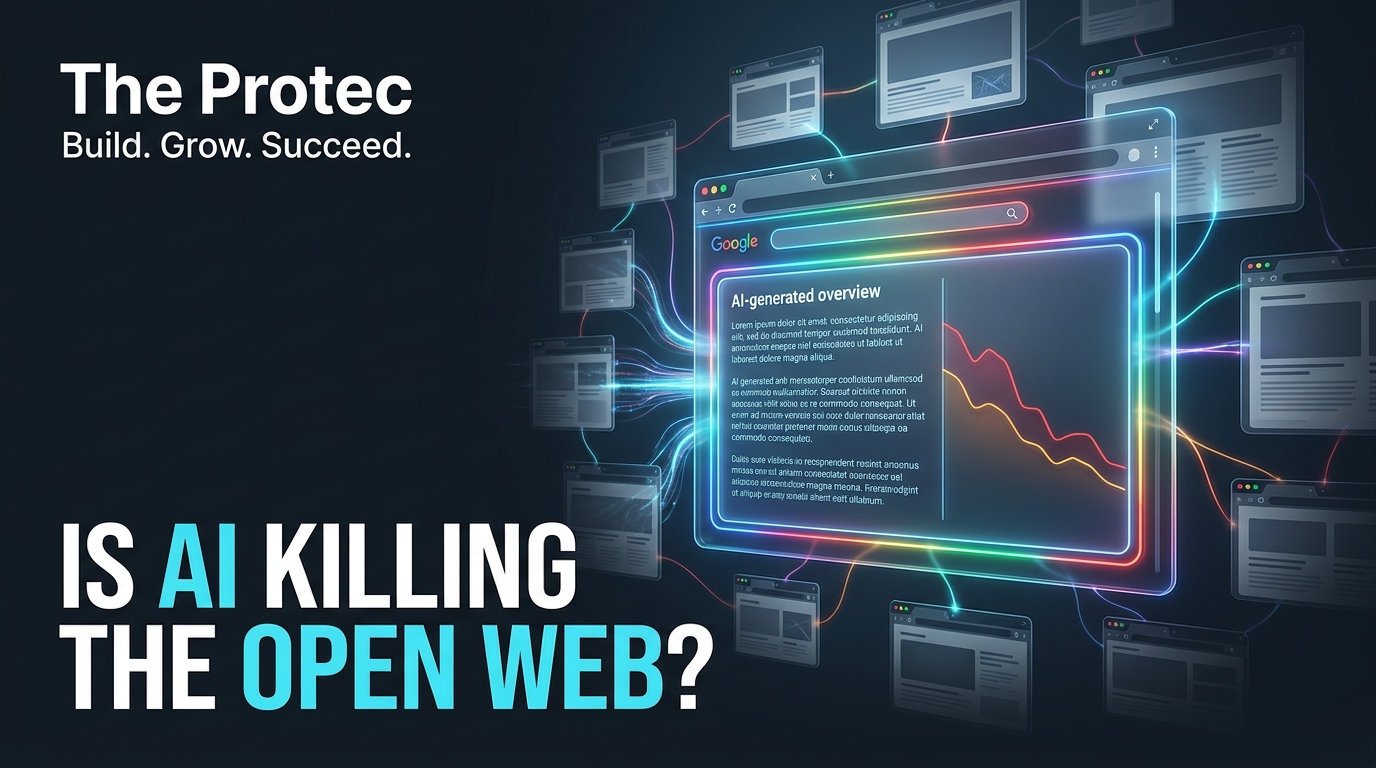
Google built its search ecosystem on a familiar exchange: websites supplied useful information, Google organized it, and users clicked through to the sources. Google AI search traffic is disrupting that exchange. AI Overviews can now answer an informational query directly on the results page, leaving publishers cited but unvisited—and raising a difficult question about who will finance the next generation of open-web content.
The strongest evidence does not show that every website has suddenly lost 40% of its total traffic. It shows something more specific: when Google AI Overviews appeared in a randomized field experiment published in 2026, outbound organic clicks for those searches fell by 39.8%, while zero-click searches increased by 34.5%. The effect is substantial, but it must be interpreted at the query level rather than applied indiscriminately to every site.
What the 39.8% decline actually measures
The field experiment, conducted by researchers from the Indian School of Business and Carnegie Mellon University, is central to understanding the AI search impact on publishers. Because the study randomized exposure to AI Overviews, it offered stronger evidence of causation than a simple before-and-after traffic comparison.
For searches where an AI Overview appeared, outbound organic clicks declined 39.8%. The probability of a zero-click search increased 34.5%. In practical terms, users who received a synthesized answer were considerably less likely to continue to a publisher’s page.
That does not mean Google AI search caused a universal 40% website traffic loss. Total site performance depends on how frequently AI Overviews appear for its queries, where its links are displayed, query intent, brand recognition, rankings, geography and numerous other factors. A retailer focused on product purchases may see a different result from a health, travel or technology publisher answering broad questions.
Still, portfolio-level evidence points in the same direction. Define Media Group reported that organic search clicks across 64 publisher websites were 42% below the pre-AI Overviews baseline by the fourth quarter of 2025. Search Engine Land’s coverage has similarly emphasized that rising Google usage does not necessarily translate into more organic search clicks for publishers.
Why AI-generated search results produce fewer clicks
Traditional results offered snippets designed to help people choose a page. Google AI Overviews instead combine information from multiple sources into a self-contained response. For straightforward informational searches—definitions, summaries, troubleshooting steps or basic comparisons—the answer may remove the need to open any result.
Citations do not fully solve the problem. A source link inside an AI summary may provide attribution and AI search visibility, but users can consume the extracted fact without clicking it. Citations can also be less prominent than the generated response, and one publisher may compete with several cited sources for a small number of follow-up visits.
This creates an economic imbalance. Google can make its result more useful by synthesizing publisher material, while the source may receive only an impression rather than a monetizable visit. Being cited is valuable for authority and discovery, but it is not a guaranteed substitute for traffic.
The broader rise of zero-click searches
AI Overviews accelerate a trend that began with featured snippets, knowledge panels, local packs, calculators and other direct-answer features. The difference is their breadth: generative systems can construct responses for complex questions that previously required users to visit several pages.
Pew Research Center analyzed browsing behavior and found that users clicked a traditional search result during 8% of visits when an AI summary appeared, compared with 15% when one did not. Links within AI summaries attracted clicks during only about 1% of visits.
Those findings reinforce the experiment’s direction, although the methodologies differ. They also explain how Google search queries can keep growing while individual publishers receive less traffic. Search volume measures activity on Google; publisher traffic measures how often that activity leaves Google.
How fewer visits weaken publisher economics
A Google search traffic decline affects more than page-view charts. Each lost visit can remove several potential revenue or audience-building events:
- Display advertising: Fewer page views mean fewer ad impressions and lower publisher ad revenue.
- Affiliate marketing: A user who never reaches a review or comparison cannot click a merchant link or complete a referred purchase.
- Newsletter growth: Reduced discovery shrinks the pool of readers who might join an email list.
- SaaS leads: Technology sites lose opportunities to send qualified prospects to software trials, demos or referral partners.
- Subscriptions and memberships: Fewer first-time visitors enter the path from casual reader to paying supporter.
The result can become circular. Lower content publisher revenue leads to smaller editorial budgets, fewer original investigations and greater reliance on inexpensive commodity content—the category most easily summarized by AI.
Where organic traffic opportunities remain
Google SEO changes do not make every search equally vulnerable. AI Overviews are strongest when a query can be satisfied with a concise synthesis. Opportunities remain where users need freshness, trust, detail, action or direct experience.
Breaking news and Google Discover traffic
Fast-moving stories can generate demand before AI systems have a stable answer. Google Discover can also expose timely, visually compelling reporting to readers who did not enter a query. Discover is volatile and should not replace search, but it can broaden distribution.
Branded and transactional searches
People looking for a specific publication, company, product page, download or purchase often still need to visit a website. Building a recognizable brand therefore becomes an SEO strategy as well as a marketing objective.
Specialized technical content
Detailed tutorials, benchmark tests, original datasets, code examples and compatibility findings are difficult to compress into a generic answer. Readers often need complete steps, screenshots, files, caveats or ongoing updates. Comparisons based on first-hand testing can also attract high-intent visitors and affiliate conversions.
A practical response for publishers and WordPress owners
- Diagnose losses at query and page level. Use the Google Search Console performance report to compare clicks, impressions, average position and click-through rate across equivalent periods. Segment by query, page, country and device. If impressions hold steady or rise while clicks and CTR fall, the result-page experience may be intercepting demand. Account for seasonality and ranking changes before blaming AI Overviews.
- Find vulnerable informational articles. Flag pages answering questions that can be resolved in a few sentences. These are likely candidates for declining AI Overviews click-through rates. Do not merely lengthen them; add material that creates a reason to visit.
- Prioritize information AI cannot easily reproduce. Publish original research, surveys, experiments, hands-on reviews and first-hand testing. Record methodology, sample sizes, dates, limitations and results. Useful technical tutorials should include tested steps, troubleshooting branches and real screenshots rather than rewritten documentation.
- Strengthen topical authority. Build coherent coverage around subjects where the publication has genuine expertise. Update important articles, identify authors and support claims with primary sources. Strong internal linking should connect introductory pages with deeper guides, comparisons and relevant commercial content.
- Build direct audiences. Treat every qualified visit as an opportunity to earn a repeat relationship through email newsletters, browser notifications, social channels, communities, YouTube or direct bookmarks. An email subscriber is less dependent on the next Google algorithm change.
- Diversify website monetization. AdSense can remain useful, but publishers should consider relevant affiliate programs, sponsorships, memberships, digital products, consulting or SaaS partnerships. The appropriate mix depends on audience trust and intent; irrelevant promotions can damage both.
GEO vs SEO: optimization without guaranteed clicks
Generative Engine Optimization, or GEO, aims to make content understandable and citable by AI-generated search results. AI search engine optimization complements traditional SEO rather than replacing it.
Publishers can improve machine comprehension with clear headings, concise definitions, descriptive tables, consistent terminology, author information and structured data that accurately reflects visible content. Original statistics should identify their source and methodology. Important answers should appear in crawlable HTML rather than only in images, videos or scripts.
However, GEO has an unavoidable limitation: successful citation may increase brand exposure without producing a visit. Publishers should track citations and assisted conversions where possible, but they should not assume AI visibility has the same economic value as an organic click.
What this means for The Protec’s publishing model
For a technology blog such as The Protec, relying exclusively on Google organic traffic would be especially risky. Technology explainers are attractive inputs for AI summaries, while the site’s advertising, affiliate links and software referrals generally require readers to reach the page.
A stronger model combines durable search engine optimization with Google Discover, YouTube demonstrations, newsletters, direct visits and carefully selected affiliate or SaaS partnerships. Search can still introduce readers to the brand, but direct distribution and diversified income reduce the damage when Google answers a question itself.
Is the open web losing its traffic?
The evidence as of November 2026 supports a balanced answer: informational publishers face a measurable loss of clicks when AI Overviews appear, but the effect varies widely by query, industry, site and citation placement. Google search can continue expanding while sending a smaller share of attention outward.
The open web is not disappearing, but its old traffic bargain is weakening. Publishers that produce distinctive information, cultivate direct audiences and diversify revenue will be better positioned than those built around interchangeable answers and search impressions alone.
Frequently asked questions
Do Google AI Overviews reduce every website’s traffic by 40%?
No. The 39.8% figure measures the decline in outbound organic clicks on searches where AI Overviews appeared in the randomized field experiment. A site’s total decline depends on its query mix, rankings, audience and exposure to AI results.
Can Google Search Console identify AI Overview traffic?
Search Console can reveal query-level patterns in impressions, clicks, position and CTR. Depending on the reporting options available to a property, publishers may not be able to isolate every AI Overview appearance cleanly, so they should combine Search Console trends with manual result checks and analytics.
Will Generative Engine Optimization replace SEO?
No. GEO helps AI systems understand and potentially cite content, while SEO addresses crawling, indexing, relevance, user experience and traditional rankings. Publishers need both, but neither guarantees clicks from an AI-generated answer.
Which content is most resilient to AI search?
Original research, breaking news, first-hand reviews, specialized technical tutorials, branded resources and transactional pages are relatively resilient because users often need detail, proof, freshness or an action that cannot be completed inside a summary.