








Contents
Understanding Zero Trust for Web Applications
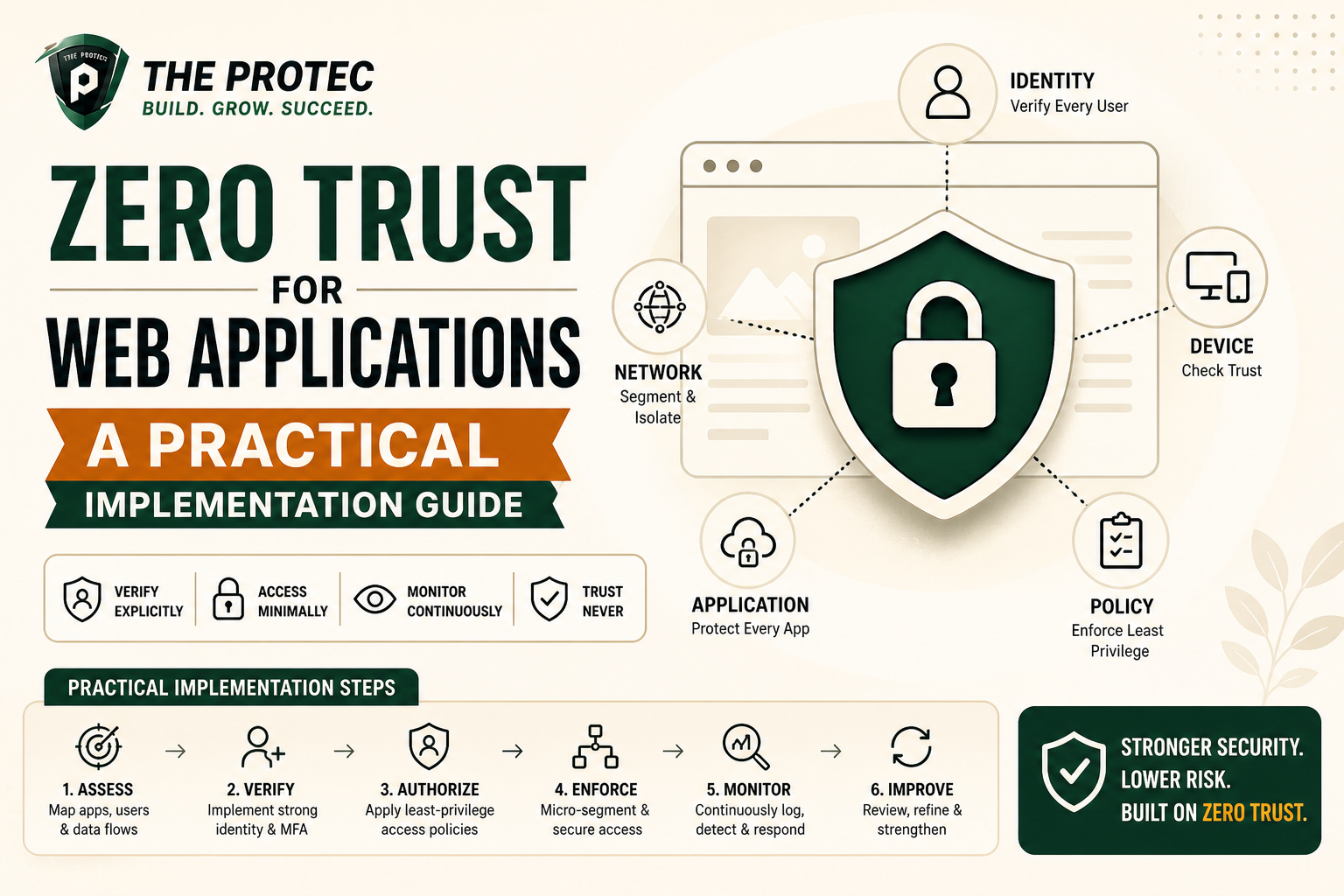
In today’s evolving cybersecurity landscape, traditional perimeter-based security models no longer suffice, especially for web applications that serve as gateways to critical business data. Zero trust is a security approach that demands stringent verification for every user and device, regardless of their network location. Applying zero trust principles to web applications transforms how organizations protect sensitive assets, focusing on continuous authentication, granular access control, and minimizing implicit trust.
Core Principles of Zero Trust in Web Apps
The zero trust model pivots security around three main tenets:
- Verify Explicitly: Every access request must be authenticated and authorized through dynamic policy evaluation.
- Use Least Privilege Access: Users and devices gain access only to resources necessary for their role, limiting lateral movement within the network.
- Assume Breach: Design security architecture to detect and respond to anomalies rapidly, assuming attacks can happen anytime.
For web applications, these principles translate into comprehensive authentication security, continuous risk assessment, and fine-grained web access control.
Why Implement Zero Trust for Web Applications?
Web applications are high-value targets, often accessible over public networks and integrated with a variety of services and APIs. Without zero trust:
- Attackers exploiting a single compromised credential can move laterally inside systems.
- Legacy authentication mechanisms may fail to detect sophisticated breaches.
- Overprivileged access increases risk exposure.
Zero trust reduces these risks by enforcing strict authentication policies and minimizing trust regardless of network origin.
Step-by-Step Guide to Implementing Zero Trust Web Apps
1. Architect for Zero Trust from the Ground Up
Incorporate zero trust concepts early in your web application design process to avoid retrofitting complex security controls later. The architecture should segment resources, strongly isolate services, and facilitate granular access controls.
- Micro-Segmentation: Break down your app infrastructure into smaller, isolated zones to contain potential breaches.
- Service Mesh Integration: Use a service mesh to establish secure, encrypted communication between services with embedded access policies.
- Identity-Driven Architecture: Centralize identity management and use it as the core trust anchor for all actions.
2. Enhance Authentication Security
Strong authentication is the foundation of zero trust. Implement multi-factor authentication (MFA), adaptive authentication, and continuous session validation.
- Multi-Factor Authentication (MFA): Require a second factor (TOTP apps, hardware tokens, biometrics) to validate user identities.
- Adaptive Authentication: Adjust authentication strength dynamically based on risk factors such as IP reputation, device posture, and geolocation.
- Continuous Authentication: Use behavioral analytics and session monitoring to detect anomalies post-login.
Integrating identity providers (IdPs) that support modern protocols like OpenID Connect or SAML can streamline these processes.
3. Implement Fine-Grained Web Access Control
Zero trust demands precise control over who can access what within web applications.
- Role-Based Access Control (RBAC): Assign permissions based on defined roles and responsibilities.
- Attribute-Based Access Control (ABAC): Base decisions on attributes such as user location, device type, or behavior.
- Policy Enforcement Points (PEPs): Place enforcement controls close to resources such as APIs, microservices, and front-end interfaces.
This granular approach limits exposure and ensures users only have access aligned with their current context.
4. Secure API Access and Communication
Modern web apps heavily rely on APIs that can be gateways for attack if poorly protected.
- Authenticate and Authorize API Calls: Enforce tokens (JWT or OAuth 2.0) validated per request.
- Encrypt Traffic: Always use TLS 1.3 or higher to protect data in transit.
- Rate Limiting and Throttling: Prevent abuse through request throttling and anomaly detection.
Tools like API gateways or service meshes can help enforce these controls consistently.
5. Continuous Monitoring and Automated Response
Zero trust is about an ongoing security posture rather than a one-time check. Incorporate robust monitoring and rapid response mechanisms:
- Behavioral Analytics: Use machine learning to identify unusual user or application activities.
- Security Information and Event Management (SIEM): Centralize logs and events for correlation and automated alerting.
- Automated Incident Response: Trigger containment actions automatically upon detecting threats to minimize damage.
This continuous feedback loop helps maintain a hardened security stance over time.
Challenges and Considerations
Transitioning to a zero trust web app environment is complex and requires thoughtful planning:
- User Experience: Balancing security with seamless access is critical to avoid user frustration.
- Legacy Systems: Integrating older applications may require custom connectors or partial zero trust adoption.
- Scalability: Ensure your zero trust controls scale with growth without excessive latency.
- Policy Management: Maintain clear, manageable access policies to avoid configuration errors.
Addressing these challenges upfront ensures a more successful deployment.
Recommended Tools and Frameworks
The following tools facilitate zero trust implementation for web applications:
- Identity Providers: Okta, Azure AD, Ping Identity for strong, centralized authentication.
- Service Mesh: Istio, Linkerd for managing secure service-to-service communications.
- API Management: Kong, Apigee, or AWS API Gateway provide granular access control and security features.
- Security Analytics: Splunk, Sumo Logic for real-time monitoring and threat detection.
Adopting standardized frameworks like NIST SP 800-207 (Zero Trust Architecture) can guide the overall strategy and compliance efforts.
Conclusion
Implementing zero trust for web applications is not just a security trend but a necessity for safeguarding digital assets in an interconnected world. By architecting zero trust from the ground up, enhancing authentication security, applying fine-grained web access control, securing APIs, and continuously monitoring threats, organizations can significantly reduce risk and enhance resilience. The practical steps outlined here provide a roadmap to build robust, zero trust-enabled web applications that protect users and data without compromising usability.
FAQ
What distinguishes zero trust web apps from traditional secured apps?
Zero trust web apps continuously verify every user and device before granting access, irrespective of network location, unlike traditional models which assume trust within a network perimeter. This reduces risk by minimizing implicit trust and enforcing granular access controls.
How does zero trust improve authentication security?
Zero trust enhances authentication by requiring multi-factor and adaptive authentication methods, continuously validating sessions, and integrating behavior-based analytics to promptly detect compromised credentials or suspicious activity.
Can zero trust be applied to legacy web applications?
Yes, but it often requires additional layers such as proxy gateways, VPN replacements, or identity federation to retrofit zero trust controls around legacy apps, since these applications might lack native support for modern authentication or access controls.
For further reading on zero trust architectures, refer to the NIST Zero Trust Architecture guide.