








Contents
- 1 Unlocking Productivity: Why AI Content Automation Tools Matter
- 2 1. Jasper AI: Creativity Meets Speed
- 3 2. Copy.ai: Effortless Content Generation for Marketing
- 4 3. Writesonic: Versatile Automation with AI Writing Assistants
- 5 4. ContentBot: Customizable AI Writing for Niche Content
- 6 5. Rytr: Streamlined AI Writing with Affordable Plans
- 7 Choosing the Right AI Content Automation Tools
- 8 Maximizing Productivity with AI Writing Tools
- 9 Frequently Asked Questions (FAQ)
- 10 Conclusion
Unlocking Productivity: Why AI Content Automation Tools Matter
In today’s fast-paced digital landscape, content creators and marketers face increasing demands to produce high-quality materials at an unprecedented rate. The evolution of AI writing tools has transformed this challenge into an opportunity, enabling professionals to automate content creation, enhance consistency, and maximize productivity.
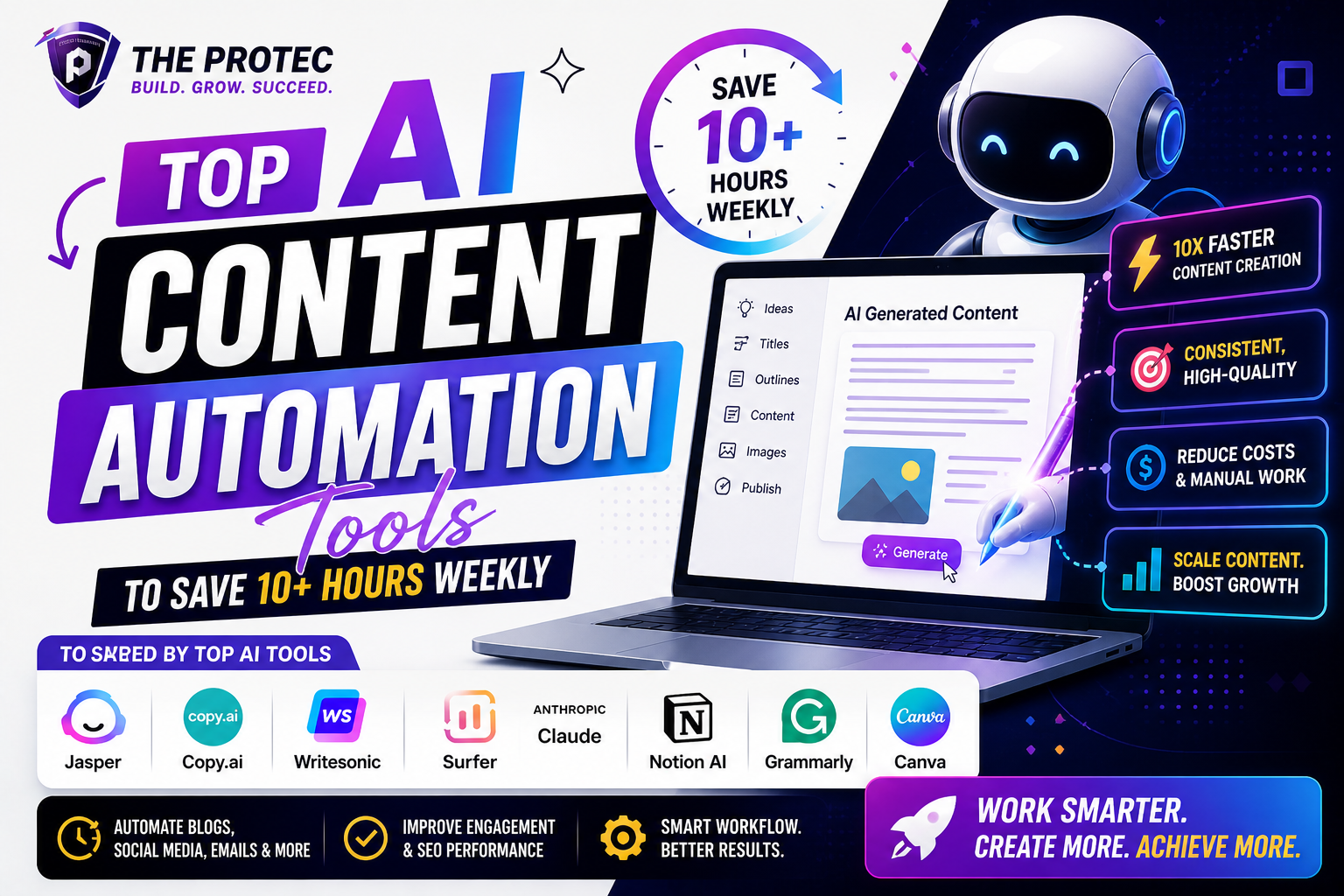
This article dives into the best AI content automation tools available now, focusing on real-world productivity benchmarks and use cases. Whether you’re a solo entrepreneur or part of a larger team, these solutions can boost your output, streamline workflows, and save you 10+ hours every week.
1. Jasper AI: Creativity Meets Speed
Overview: Jasper AI (formerly Jarvis) has become a dominant name in AI writing tools, known for its versatility across blog posts, marketing copy, emails, and more. It leverages GPT-4-based models and offers templates fine-tuned for different content types.
Key Features:
- Long-form content generation with minimal input
- Content style customization with tone and voice options
- SEO mode that integrates with popular tools like SurferSEO
- Collaboration features suitable for teams
Productivity Benchmark:
Users report Jasper AI can reduce the time to draft high-quality blog posts by up to 60% compared to manual writing. On average, content teams save 12+ hours weekly when incorporating Jasper into their editorial process.
Real-World Use Case:
A mid-sized digital marketing agency used Jasper to automate client content drafts, reducing manual writing time from 5 hours per article to under 2 hours for first drafts. This freed creative staff to focus on nuanced editing and strategy, improving overall client satisfaction and output volume.
2. Copy.ai: Effortless Content Generation for Marketing
Overview: Copy.ai focuses on generating engaging marketing copies quickly, including ads, social media posts, product descriptions, and email campaigns. Its intuitive interface and wide variety of templates simplify automation for non-technical users.
Key Features:
- Over 90+ content templates tailored for marketing
- AI-generated brainstorming ideas and headlines
- Multi-language content support
- Fast generation with a simple user experience
Productivity Benchmark:
Marketing teams integrating Copy.ai reported saving approximately 10-15 hours weekly by automating social media calendar creation and multiple ad copy variations, accelerating campaign deployment without compromising creativity.
Real-World Use Case:
An e-commerce brand utilized Copy.ai to generate hundreds of unique product descriptions within days, a process that previously took weeks. This direct impact shortened their time-to-market and improved SEO due to more consistent and optimized content.
3. Writesonic: Versatile Automation with AI Writing Assistants
Overview: Writesonic offers a powerful suite of AI writing tools for blogs, landing pages, emails, and even video scripts. Its differentiator lies in the AI assistant mode, which allows step-by-step content refinement alongside automation.
Key Features:
- Assistant tool for guided content creation and iterative improvements
- AI-powered SEO optimizer integration
- Automatic content expansion and summarization
- API access to embed automation in custom workflows
Productivity Benchmark:
On average, content teams observed a 50% boost in completion speed for campaigns by using Writesonic’s automation combined with human editing workflows, translating to 10-12 hours saved weekly.
Real-World Use Case:
A SaaS business uses Writesonic’s AI assistant to generate technical blog posts and onboarding guides. The tool’s ability to expand brief notes into full articles saved the content team upwards of 15 hours weekly, accelerating knowledge base growth.
4. ContentBot: Customizable AI Writing for Niche Content
Overview: ContentBot shines in generating niche and technical content with a strong focus on customizable output. Its suite is ideal for specialists requiring detailed content automation with deeper control.
Key Features:
- Advanced prompts for technical and specific content needs
- Integration with WordPress for seamless publishing
- Multiple tone and style configurations
- Content rewriting and optimization tools
Productivity Benchmark:
Specialist writers and content teams report saving up to 14 hours per week by automating repetitive writing tasks while updating complex documentation through ContentBot.
Real-World Use Case:
A healthcare consultancy employs ContentBot to automate generation of compliance reports and blog articles with rich industry terminology. This reduces manual research and drafting substantially and improves client deliverable turnarounds.
5. Rytr: Streamlined AI Writing with Affordable Plans
Overview: Rytr offers a budget-friendly, easy-to-use AI writing tool catering to freelancers and small teams. Though simpler than some competitors, it delivers consistent quality for standard marketing and blog content.
Key Features:
- Multiple writing tones and languages
- Instant content generation for various formats
- Chrome extension for quick access
- Character count limits ideal for social media
Productivity Benchmark:
Freelancers using Rytr highlight time savings of 8-10 hours per week by streamlining drafts and overcoming writer’s block quickly, especially for short-form content.
Real-World Use Case:
Independent content creators rely on Rytr for daily social media posts and occasional blog drafts. The tool’s simplicity and affordability enable rapid content cycles without complicated setups.
Choosing the Right AI Content Automation Tools
While each tool showcased offers distinct advantages, selection depends on your specific workflow, content type, and team size. Key considerations include integration capabilities, content quality requirements, and budget constraints.
For large teams and complex content, Jasper or Writesonic excel with robust features and SEO integration. Copy.ai and Rytr serve marketing-focused and smaller-scale needs with speed and simplicity. ContentBot is ideal when niche customization and technical accuracy are priorities.
Maximizing Productivity with AI Writing Tools
To realize the full potential of AI content automation tools, consider these strategies:
- Blend AI and human creativity: Use AI for drafting and idea generation, but ensure human editing to preserve brand voice and accuracy.
- Establish clear workflows: Integrate AI tools within existing processes to avoid duplication and confusion.
- Train your teams: Familiarize staff with tool capabilities to unlock advanced features and efficiency gains.
- Monitor performance: Regularly assess content quality and time savings to refine usage further.
Frequently Asked Questions (FAQ)
Are AI content automation tools suitable for all types of content?
AI tools are highly effective for marketing copy, blogs, social media posts, and even technical writing with the right configurations. However, content requiring deep expertise or sensitive contexts should still involve human oversight to ensure accuracy and nuance.
How do AI writing tools impact SEO?
Many AI content automation tools come with SEO integrations enabling keyword optimizations and content structuring aligned with search best practices. This can improve organic traffic if combined with strategic human editing.
What are the best practices to avoid AI-generated content sounding robotic?
Use AI content as a base and customize tone, style, and phrasing manually. Incorporate examples, storytelling, and personal insights. Also, adjust AI parameters where possible to generate more vibrant, human-like text.
Conclusion
The rapid advancement of AI content automation tools offers unparalleled opportunities to streamline the content creation process and achieve significant time savings. By selecting tools aligned to your needs and combining them with expert human input, you can enhance productivity, scale output, and keep competitive in a demanding content landscape.
Explore the options presented here and start integrating AI-powered automation into your workflow to reclaim 10+ hours every week for creative and strategic priorities.
For further insights on AI advancements and content strategies, consider industry resources like Content Marketing Institute.