








Why Grok Prompts for Students Are Becoming Essential
Students are under more pressure than ever to learn faster, manage more material, and produce stronger assignments with less time. That is why Grok prompts for students are becoming such a practical tool. When used well, Grok can help break down dense readings, simplify complex concepts, generate study plans, improve outlines, and support clearer writing without doing the thinking for you.
The real value of AI study prompts is not in replacing study habits, but in making them more efficient. Instead of spending 40 minutes trying to extract the main idea from a chapter, you can ask Grok to summarize key points in a specific format. Instead of staring at a blank document, you can use assignment writing AI prompts to build an outline, refine a thesis, or identify weak arguments. The result is faster progress with better structure.
As academic workflows evolve, students are increasingly using AI as a study partner. The best use cases are practical, ethical, and focused on learning. Grok is especially useful because it can respond quickly, adapt to tone and format instructions, and help students move from confusion to clarity. Below, you will find 20 high-quality prompts you can use for studying, research, drafting, revision, and exam preparation.
Before using any AI tool, remember to follow your school’s academic integrity policy. Use these prompts to understand material better, organize your thoughts, and improve your writing, not to submit work you do not understand.
How to Use Grok Prompts Effectively
Good prompts are specific. If you ask a vague question, you will usually get a vague answer. The strongest Grok prompts for students include four elements: the subject, the task, the desired format, and the level of detail. For example, asking Grok to “summarize photosynthesis” is less effective than asking it to “explain photosynthesis for a first-year biology student in simple bullet points with one real-world example.”
To get the best results from AI study prompts, try these practices:
- Specify your class level, such as high school, undergraduate, or graduate.
- Ask for a format, like bullets, tables, flashcards, or step-by-step explanations.
- Request active learning support, such as quizzes or self-test questions.
- Use the output as a draft, then review and improve it yourself.
- Combine prompts for studying, outlining, and editing to build a complete workflow.
When used this way, assignment writing AI becomes a study accelerator rather than a shortcut. It can help you think more clearly, write more confidently, and work more efficiently.
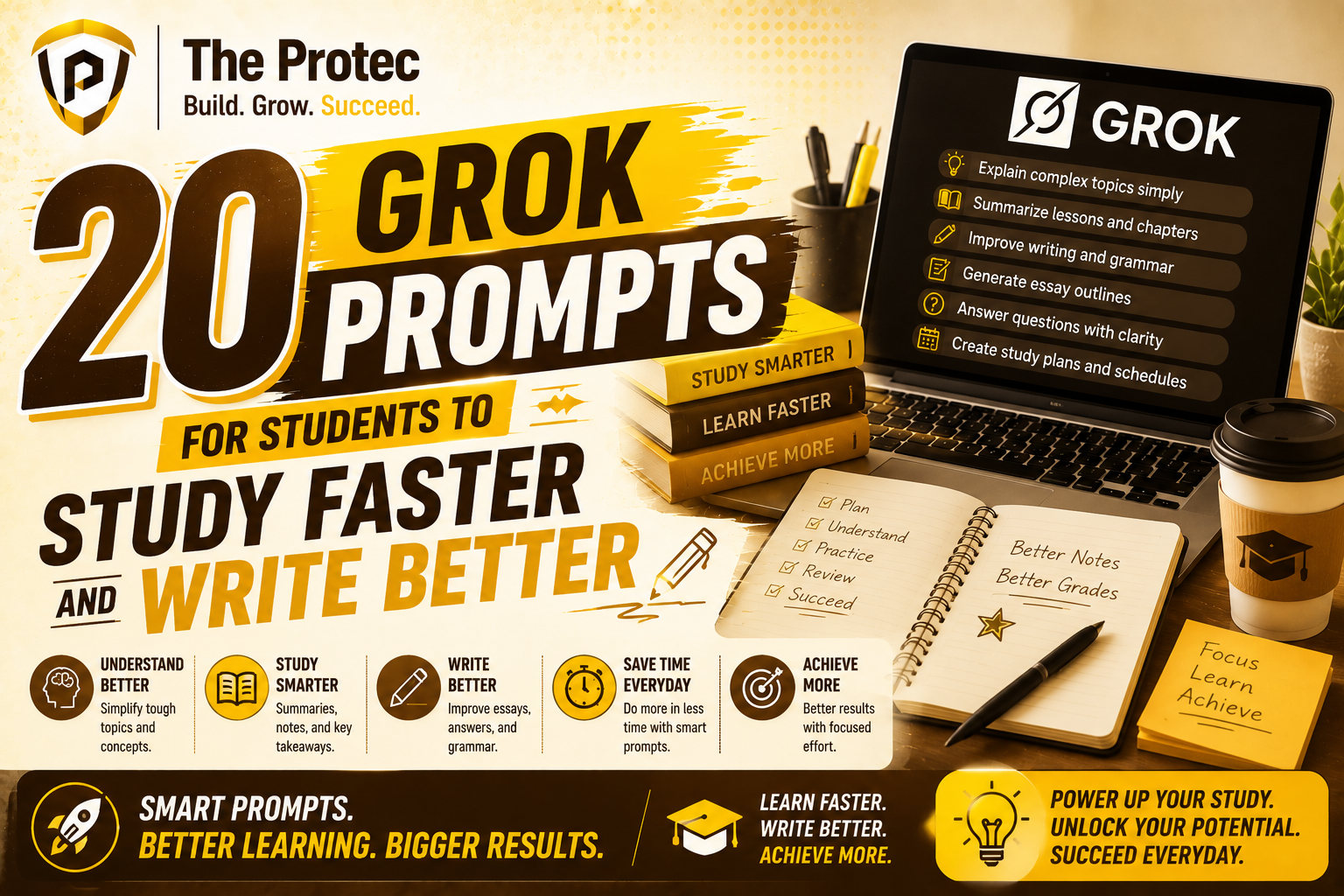
20 Grok Prompts for Students to Study Faster and Write Better Assignments
1. Summarize a chapter in simple language
Prompt: “Summarize this chapter in simple language for a college student. Include the main idea, 5 key points, and 3 terms I should remember.”
This prompt is ideal when you are facing long readings and need a fast way to identify what matters most. It helps you turn dense text into manageable study notes.
2. Turn lecture notes into organized study points
Prompt: “Convert these lecture notes into a clean study guide with headings, bullet points, and short explanations under each heading.”
Many students have scattered notes that are hard to review later. This prompt reorganizes information into a format that is easier to revise before quizzes and exams.
3. Explain a difficult concept in plain English
Prompt: “Explain [topic] like I am new to the subject. Avoid jargon, use plain English, and give one everyday example.”
This is one of the most useful AI study prompts for subjects like economics, chemistry, law, statistics, and philosophy. It helps you move from confusion to basic understanding quickly.
4. Create flashcards from class material
Prompt: “Create 15 flashcards from this material. Format them as question and answer pairs that focus on definitions, key facts, and common exam points.”
Flashcards are a proven study method because they support active recall. Grok can generate a strong first draft that you can review and customize.
5. Generate a weekly study plan
Prompt: “Build a 7-day study plan for my [subject] exam. I have [number] hours per day. Include review sessions, practice questions, and buffer time.”
This prompt is useful when you are overwhelmed and need structure. A study plan helps you prioritize tasks and avoid last-minute cramming.
6. Quiz me on a topic
Prompt: “Test my understanding of [topic] with 10 questions, starting easy and becoming more difficult. Wait for my answer before showing the next question.”
Interactive quizzing is one of the best ways to study faster because it forces retrieval, not just reading. Grok can act like a tutor and keep you engaged.
7. Compare two theories or ideas
Prompt: “Compare and contrast [theory A] and [theory B] in a table. Include similarities, differences, strengths, weaknesses, and best use cases.”
This is especially helpful for subjects that require analysis rather than memorization. A table format makes it easier to study and write comparative essays.
8. Build an essay outline
Prompt: “Create a detailed outline for an essay on [topic]. Include an introduction, thesis statement ideas, 3 body sections, evidence suggestions, and a conclusion plan.”
This is one of the most effective assignment writing AI prompts because it gives structure before you start drafting. A strong outline saves time and improves coherence.
9. Improve my thesis statement
Prompt: “Review this thesis statement and make it clearer, more specific, and more arguable: [paste thesis]. Give me 3 improved versions.”
Students often lose marks because their thesis is too broad or too weak. Grok can help sharpen your argument so your assignment has a stronger academic foundation.
10. Find gaps in my argument
Prompt: “Read my argument below and identify weaknesses, missing evidence, logical gaps, or unclear claims. Suggest how to strengthen it.”
This prompt is excellent for revision. It helps you think like an editor and improve the quality of your work before submission.
11. Reword text to sound more academic
Prompt: “Rewrite this paragraph in a more academic tone while keeping the meaning the same. Make it concise, clear, and formal.”
Sometimes students know what they want to say but struggle with tone. This prompt can help you upgrade your writing without making it sound unnatural.
12. Simplify complex academic wording
Prompt: “Simplify this academic paragraph so it is easier to understand, while keeping the original meaning accurate.”
Use this when your source material or your own draft becomes too dense. Simplifying language often makes your arguments more readable and persuasive.
13. Generate examples for an assignment
Prompt: “Give me 5 relevant examples that could support an assignment about [topic]. Briefly explain how each example connects to the argument.”
Examples make essays more convincing. This prompt helps you brainstorm possibilities you can then verify and refine with your own research.
14. Create practice exam questions
Prompt: “Create a set of practice exam questions on [topic]. Include short-answer, essay, and multiple-choice formats with answer hints.”
Practice questions help you prepare for different exam styles. They also show you where your weak areas are before the actual test.
15. Turn readings into revision notes
Prompt: “Turn this reading into revision notes with the most important definitions, concepts, dates, and arguments in a compact format.”
This prompt is useful when you need quick review sheets. It is a time-saver for subjects with a lot of factual material.
16. Suggest a better essay structure
Prompt: “Review this essay structure and suggest a more logical order for the points. Explain why each section should come where it does.”
Strong structure is often what separates average essays from excellent ones. Grok can help you identify whether your ideas flow logically.
17. Help me brainstorm a topic
Prompt: “Give me 10 assignment topic ideas for [course]. Make them specific, researchable, and suitable for a strong academic paper.”
When you are stuck choosing a topic, this prompt can save time and spark better ideas. It is especially helpful early in the assignment process.
18. Check for unclear writing
Prompt: “Highlight any sentences in this draft that are unclear, repetitive, or awkward. Suggest improvements without changing my voice too much.”
This is a smart editing prompt because it focuses on clarity. Good writing is not just about sounding smart; it is about being understood easily.
19. Create a source comparison table
Prompt: “Compare these sources on credibility, relevance, key claims, and how each could be used in my assignment. Present the results in a table.”
This is especially helpful for research-heavy papers. It can help you evaluate sources more efficiently and choose the best ones for your argument.
20. Generate self-reflection questions after studying
Prompt: “After reviewing this topic, ask me 10 reflection questions that test my understanding and help me explain the ideas in my own words.”
Self-reflection deepens learning because it pushes you beyond memorization. It also helps you prepare for oral exams, class discussions, and essays.
Best Practices for Using Assignment Writing AI Responsibly
AI can be a strong support tool, but students should use it carefully. The most responsible approach is to treat Grok as a helper, not a replacement for your own reasoning. Always verify facts, especially if the prompt asks for examples, statistics, or citations. AI models can sound confident even when they are wrong.
It is also important to keep your assignments authentic. Use Grok to brainstorm, outline, clarify, and revise. Do not submit unreviewed AI-generated text as if it were fully your own work. If your institution allows AI assistance, follow the guidelines closely and disclose usage when required.
For research and fact-checking, use trusted academic sources alongside AI. If you need authoritative information, review resources from institutions such as U.S. Department of Education and writing guidance from universities such as UNC Writing Center. These sources can help you keep your work accurate, ethical, and academically sound.
How Grok Fits Into Modern Student Workflows
Students today often juggle classes, part-time jobs, extracurriculars, and deadlines across multiple platforms. That is why AI study prompts are so useful in modern academic workflows. Instead of treating studying, note-taking, drafting, and editing as separate tasks, Grok can help connect them into one smoother process.
A practical workflow might look like this: use Grok to summarize your reading, turn the summary into flashcards, generate quiz questions, build an essay outline, draft a thesis, and then review the final text for clarity. This approach saves time while keeping you actively involved in the work.
The best results come when students combine AI efficiency with human judgment. Grok can speed up the process, but you still need to understand the material, judge the quality of ideas, and shape the final submission. That combination is what leads to better academic performance.
FAQ: Grok Prompts for Students
Are Grok prompts for students useful for all subjects?
Yes. Grok prompts can help across many subjects, including science, humanities, business, law, and social sciences. They work especially well for summarizing readings, generating practice questions, improving outlines, and clarifying difficult concepts.
Can AI study prompts help me study faster without lowering quality?
They can, if you use them correctly. The key is to use AI for support tasks like organizing, explaining, and quizzing, while still reviewing the material yourself. That way, you save time without sacrificing understanding.
Is assignment writing AI safe to use for schoolwork?
It can be safe and helpful when used responsibly. Always check your school’s AI policy, verify facts, and make sure the final work reflects your own understanding. AI should support learning, not replace it.
What makes a good Grok prompt for studying?
A good prompt is specific, clear, and role-based. It should tell Grok what to do, what format you want, and how detailed the response should be. The more context you provide, the better the output usually becomes.
Final Thoughts
Grok prompts for students are more than a productivity hack. Used well, they can help you study faster, write stronger assignments, and build better academic habits. The most effective prompts are specific, practical, and focused on understanding rather than shortcutting the learning process.
If you are trying to manage a heavy workload, start with just a few prompts from this list. Use one to summarize readings, one to build a study plan, and one to improve your writing. Over time, you will develop a repeatable workflow that saves time and improves results. In a world where students need both speed and quality, the right AI study prompts can make a real difference.