







The AI Boom Is Hitting a Hard Limit: Power
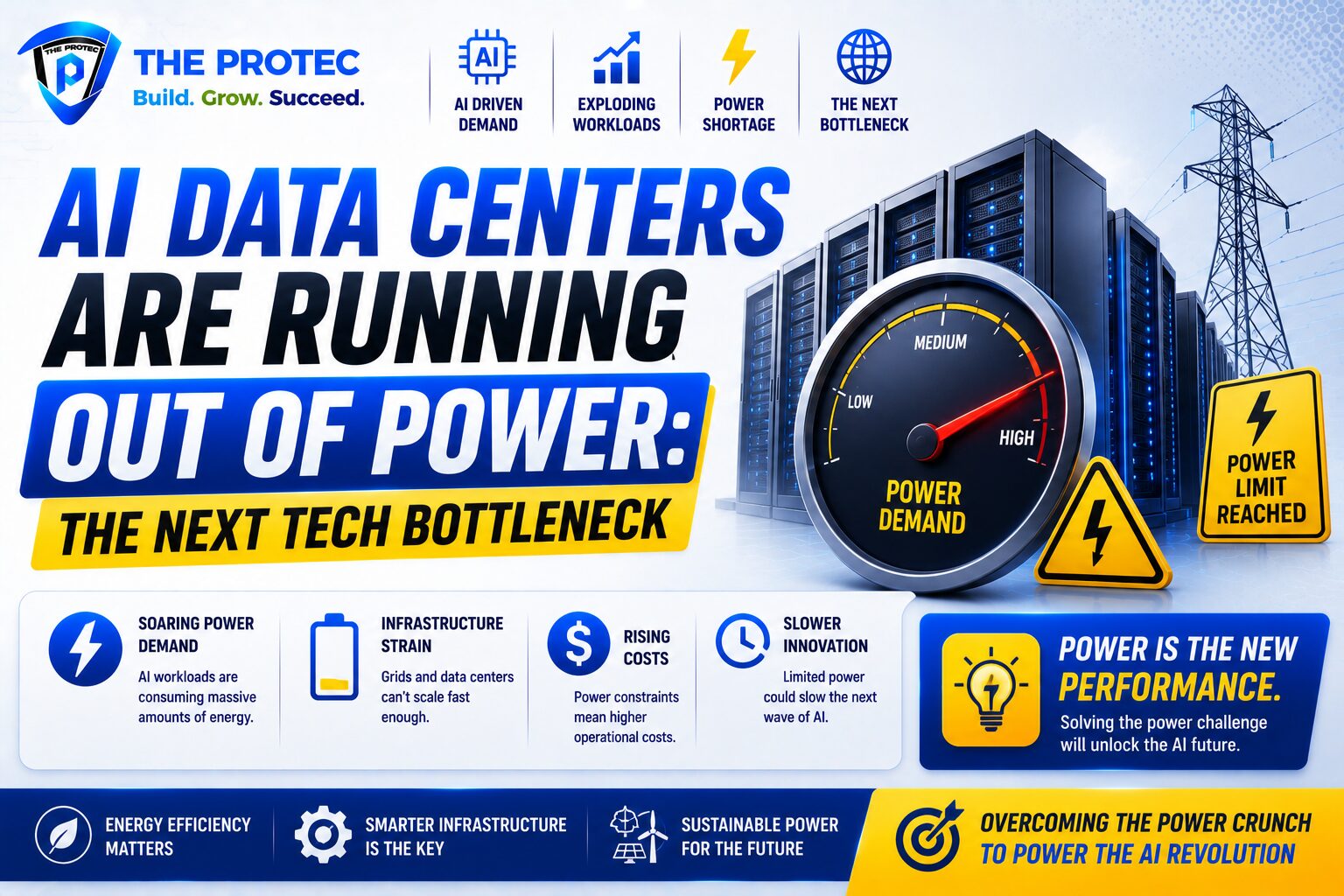
Artificial intelligence is no longer just a software story. It is an infrastructure story, and increasingly, an energy story. The explosive growth of model training, inference, cloud AI services, and GPU-intensive workloads is pushing data center electricity demand to levels the grid was never designed to handle. Across major technology hubs, operators are discovering that the limiting factor is no longer chips, servers, or even real estate. It is power.
This shift is redefining what it means to build and run an AI-ready facility. The conversation has moved beyond compute density and latency to include substation capacity, transmission bottlenecks, water usage, cooling architecture, and long-term access to clean energy. In other words, AI data center energy has become one of the most important strategic issues in tech.
What makes this challenge urgent is the pace of change. AI power consumption is growing faster than utility planning cycles, faster than permitting timelines, and in some regions faster than the grid can expand. As a result, hyperscalers, colocation providers, utilities, and policymakers are all being forced to rethink how digital infrastructure is powered. The result is a new wave of investment in advanced cooling, nuclear energy, and renewable power designed to keep the AI economy running.
Why AI Data Center Energy Demand Is Surging
Traditional data centers were built around predictable enterprise workloads: storage, databases, websites, and virtualization. AI workloads are different. Training large models requires enormous bursts of GPU and accelerator activity, while inference at scale creates constant, distributed demand that can run around the clock. That means more electricity is required not just for processing, but also for cooling and power conditioning.
The hardware itself is a major driver. Modern AI servers pack far more compute into a single rack than conventional enterprise infrastructure. That raises rack power densities dramatically. What used to be a 5 to 10 kilowatt rack can now be several times that, and the newest AI clusters push much higher. Every increase in density compounds the need for stronger electrical distribution, more robust backup systems, and thermal solutions that can keep equipment within safe operating limits.
At the same time, the scale of AI deployment is accelerating. Cloud providers are adding AI capacity across multiple regions. Enterprises are building private AI clusters. Startups are renting high-density GPU space. And model sizes, context windows, and throughput demands keep growing. The result is a steep rise in data center electricity demand that is challenging even the most advanced markets.
How Much Power Does AI Actually Use?
There is no single number that captures AI power consumption, because the energy profile varies widely depending on model size, workload type, hardware efficiency, and facility design. Still, the trend is unmistakable: AI systems consume significantly more power than many traditional digital services, especially when they are trained or served at scale.
Training frontier models can require vast electricity inputs over long periods, while inference can create persistent load that scales with user demand. Unlike a typical business application that sees moderate peaks, AI platforms often operate as always-on services with highly concentrated compute loads. That makes them especially difficult to fit into older data center footprints.
Industry researchers and grid operators are increasingly warning that AI data center energy consumption could become a material share of total electricity demand in some regions. For utilities, that means planning not only for growth, but for a kind of growth that is lumpy, uncertain, and highly concentrated. A single AI campus can require as much electricity as a small city, and multiple projects in the same region can overwhelm local capacity.
For a closer look at the broader energy implications of digital infrastructure, the U.S. Department of Energy has been studying data center efficiency and grid integration challenges here: U.S. Department of Energy.
Why the Grid Is Struggling to Keep Up
Electric grids are designed with long lead times. Generating capacity, transmission lines, substations, transformers, and interconnection studies all take years to plan and execute. AI demand, by contrast, can scale in months. That mismatch is at the heart of the current bottleneck.
In many markets, the problem is not simply that electricity is unavailable. It is that the physical infrastructure to deliver it to a specific site does not exist yet. Transmission congestion, transformer shortages, land-use restrictions, and lengthy permitting processes can delay new projects even when generation capacity is available somewhere on the grid.
Utilities are also dealing with uncertainty. They need to know whether a proposed AI campus will actually be built, how much load it will draw, and whether it will stay in operation long enough to justify upgrades. That makes it harder to commit billions of dollars to infrastructure in advance. The result is a slow-moving system trying to serve a fast-moving industry.
This is why the phrase AI data center energy has become so central. It is not just about the cost of electricity. It is about the ability of entire regions to support next-generation digital infrastructure without destabilizing the broader power system.
Advanced Cooling Is Now a Power Strategy
Cooling has always been essential to data centers, but AI has turned it into a strategic differentiator. As rack densities rise, traditional air cooling alone is often no longer enough. Operators are investing heavily in liquid cooling, direct-to-chip cooling, rear-door heat exchangers, and other advanced thermal systems that can remove heat more efficiently.
Why does cooling matter so much to energy use? Because heat is wasted power. The more efficiently a facility removes heat, the less overhead it needs to maintain safe operating conditions. That lowers total energy consumption and can improve the performance and lifespan of expensive AI hardware.
Liquid cooling is gaining momentum because it handles higher thermal loads with less energy than conventional air-based systems. It also makes it possible to deploy denser AI clusters in spaces that would otherwise be limited by temperature or airflow constraints. For operators, that can mean more compute per square foot and better power utilization.
But advanced cooling is not a silver bullet. It requires redesigning facility plumbing, integrating with IT hardware, and often changing maintenance workflows. It also introduces new costs and engineering complexity. Still, in a world where AI power consumption keeps climbing, cooling is no longer a back-end concern. It is part of the core energy solution.
Nuclear Energy Is Back in the Tech Conversation
One of the most notable shifts in the energy debate is the return of nuclear power as a serious option for AI infrastructure. Once viewed as too slow or politically difficult for mainstream tech planning, nuclear is now being discussed as a reliable source of 24/7 carbon-free electricity for high-demand digital facilities.
The attraction is obvious. AI workloads need constant, dependable power. Nuclear plants provide firm capacity that does not depend on weather, and they can help stabilize a grid increasingly shaped by variable renewables. For hyperscalers and large data center developers, the promise of long-duration, low-carbon baseload power is especially appealing.
There are two parallel trends here. First, some technology companies are signing long-term agreements to support existing nuclear plants or help finance restarts and life extensions. Second, smaller modular reactor concepts are being watched closely as a potential future fit for energy-intensive campuses. While commercial deployment at scale is still limited, the strategic interest is real.
For readers following the broader nuclear revival, the International Energy Agency has been publishing ongoing analysis on nuclear’s role in electricity systems: International Energy Agency.
Nuclear energy will not solve the AI power problem overnight, but it is increasingly part of the long-term answer for regions seeking stable, low-carbon supply.
Renewable Power Is Scaling, But It Needs Support
Renewables remain central to the future of AI data center energy, especially for companies under pressure to decarbonize. Solar and wind are now among the cheapest forms of new generation in many markets, and they are increasingly paired with storage and power purchase agreements to supply digital infrastructure.
However, the challenge is matching renewable generation with AI’s round-the-clock load profile. A data center cannot run only when the sun is shining or the wind is strong. That means renewable power must be combined with grid flexibility, battery storage, demand response, or firm backup generation to ensure reliability.
As a result, the most practical models are hybrid. Large operators are signing clean energy contracts while also investing in storage, on-site backup, and grid upgrades. Some are colocating facilities near strong renewable resources, while others are focusing on market structures that allow them to access cleaner electricity at scale.
There is also growing interest in behind-the-meter generation and energy microgrids. These systems can help reduce strain on the public grid and improve resilience, especially where interconnection queues are long. The future of AI infrastructure is likely to involve a portfolio approach rather than a single energy source.
What This Means for Data Center Design
The energy challenge is changing the physical design of modern data centers. Facilities built for AI need more than just server rooms. They need higher-capacity power trains, stronger electrical redundancy, smarter thermal architecture, and better visibility into real-time load management.
Design teams are increasingly considering:
- Higher-voltage distribution to reduce losses and support denser loads
- Modular electrical blocks that can scale with demand
- Liquid and hybrid cooling systems for high-performance GPU clusters
- On-site energy storage to smooth peaks and support grid interaction
- Advanced monitoring to optimize utilization and prevent thermal throttling
These changes matter because AI data center energy efficiency is no longer just an operational metric. It affects site selection, capital expenditure, uptime, sustainability reporting, and long-term competitiveness. The facilities that can deliver the most compute per watt will have a major advantage.
The Business Risk of Ignoring Power Constraints
For cloud providers, colocation companies, and enterprises building private AI infrastructure, power availability is now a business risk. A site with cheap land and strong fiber access may still fail if the grid cannot support the load. Delays in power delivery can push back product launches, limit customer growth, and increase construction costs.
There is also reputational pressure. Customers, investors, and regulators are paying closer attention to how AI systems are powered. Companies that expand aggressively without a credible energy strategy may face criticism over emissions, water use, or grid impacts. That is why many organizations are now treating energy procurement as a board-level issue rather than a facilities matter.
In practice, the most successful operators will be those that integrate energy planning into AI roadmap planning. That means aligning infrastructure expansion with utility timelines, pairing compute growth with clean power sourcing, and selecting sites based on long-term energy resilience rather than short-term convenience.
What Comes Next for AI Power Consumption
AI power consumption is unlikely to slow anytime soon. If anything, the next wave of growth may be even more demanding as multimodal models, agentic systems, real-time inference, and enterprise AI adoption expand the total amount of compute required. That means the industry must prepare for sustained pressure on grid capacity and energy costs.
The good news is that the response is already underway. Advanced cooling is improving efficiency. Nuclear energy is re-entering strategic planning. Renewable power is scaling with storage and grid integration. Utilities are modernizing forecasting and interconnection processes. And data center designers are building for much higher density than ever before.
Still, the core issue remains: AI is transforming electricity demand faster than the energy system can adapt. The companies that understand this early will be better positioned to scale. Those that do not may find that the real constraint on AI growth is not compute availability, but power.
Conclusion: Energy Is the New Competitive Edge
The race to build AI infrastructure is quickly becoming a race to secure reliable electricity. In the near term, AI data center energy will shape where new campuses are built, how they are cooled, and which technologies are deployed to support them. Over the longer term, it will influence utility planning, grid modernization, and the future mix of generation sources.
That is why energy is emerging as the next big tech challenge. Not because AI is slowing down, but because its success depends on something far less glamorous than algorithms: watts, wires, and the ability to keep the lights on.
For the AI industry, the next breakthrough may not be a larger model or a faster chip. It may be a smarter way to power the machines that make AI possible.
FAQ
Why are AI data centers using so much electricity?
AI data centers run high-density GPU and accelerator workloads that require far more power than traditional enterprise applications. Training and inference both create heavy, continuous electricity demand, and cooling adds even more overhead.
What is the biggest challenge with AI power consumption?
The biggest challenge is matching rapidly growing AI loads with the slower pace of grid expansion. Utilities, substations, transmission, and permitting all take time, while AI infrastructure can scale very quickly.
How are operators reducing data center electricity demand?
Operators are using advanced cooling, more efficient power distribution, better workload scheduling, and site designs that reduce energy losses. Some are also adding storage, on-site generation, and cleaner electricity contracts.
Is nuclear energy really becoming important for AI infrastructure?
Yes. Nuclear is attracting renewed interest because it can provide dependable 24/7 low-carbon power. It is especially appealing for AI facilities that need firm capacity and long-term energy stability.
Will renewable power be enough for AI data centers?
Renewables will be a major part of the solution, but they usually need to be paired with storage, grid upgrades, or backup generation. AI workloads require constant power, so a hybrid energy strategy is often the most practical approach.