






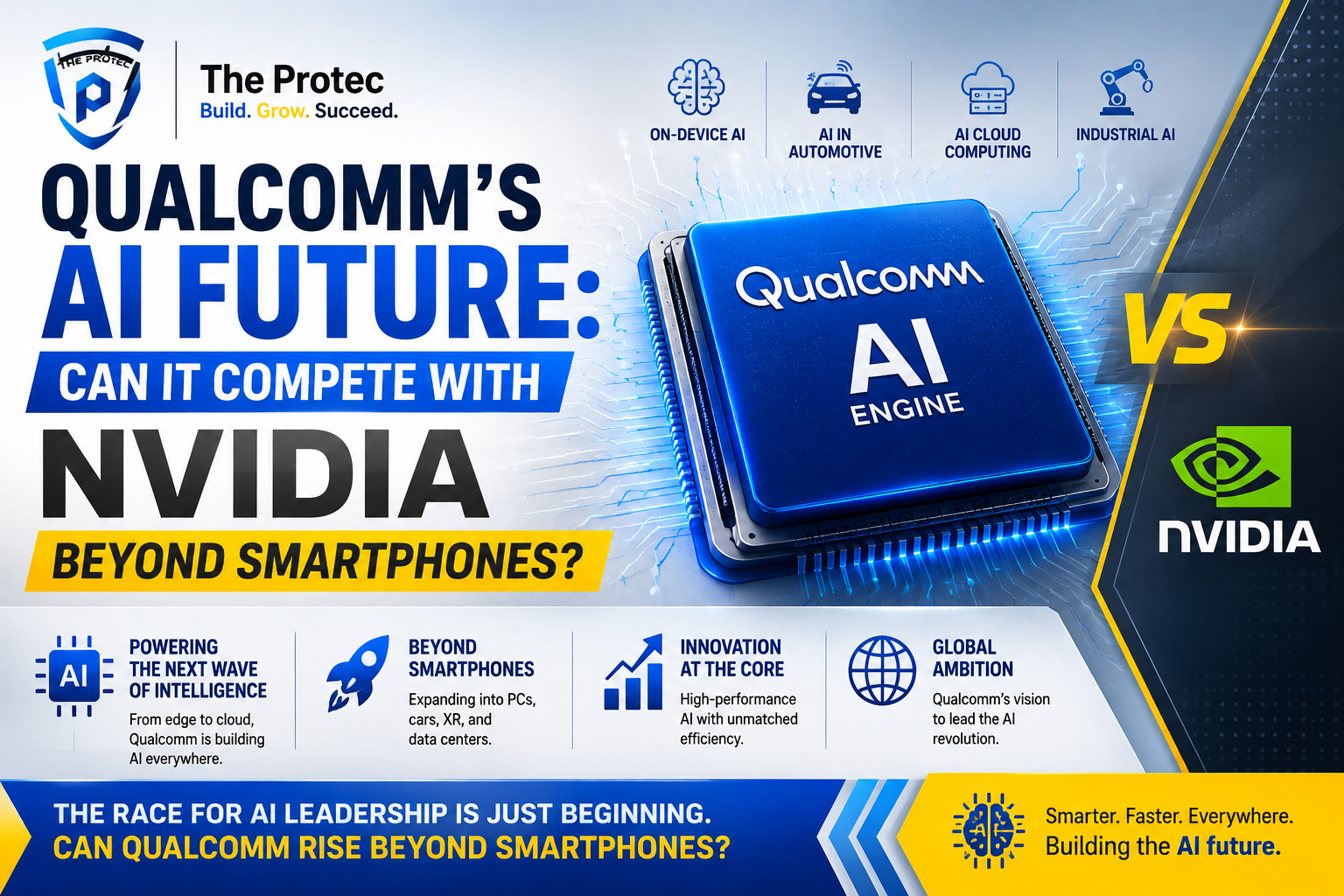
Qualcomm’s AI Ambition Is Bigger Than the Smartphone Market
For years, Qualcomm has been known as the company that powers smartphones. Its Snapdragon platform shaped the mobile era, and its modem leadership made it a foundational force in wireless connectivity. But the next wave of computing is not being defined by phones alone. It is being driven by AI workloads, edge inference, automotive systems, PCs, and data centers. That shift is forcing a new question: can Qualcomm AI evolve into a serious competitor to NVIDIA beyond smartphones?
The answer is not simple. NVIDIA remains the dominant force in AI acceleration, especially in data centers where training large models is the most valuable and strategically important segment of the market. Yet Qualcomm is no longer a one-market company. Its recent investments in AI processors, on-device inference, heterogeneous compute, and cloud partnerships show a clear intent to move upstream. The company is betting that the next generation of AI will not run only in giant GPU clusters, but across distributed devices, edge servers, and power-efficient environments where Qualcomm’s strengths may matter more than NVIDIA’s scale.
To understand whether Qualcomm can truly compete, it helps to look at where the company is investing, how its AI chips differ from NVIDIA’s, and which markets could reward a different kind of architecture. This is not just a semiconductor rivalry. It is a battle over what AI computing should look like in the years ahead.
Why Qualcomm’s AI Strategy Looks Different From NVIDIA’s
Qualcomm vs NVIDIA is not a straightforward head-to-head matchup. NVIDIA built its empire around GPUs, first for graphics and then for parallel compute. That architecture became the backbone of AI training and high-performance inference. Qualcomm, by contrast, comes from a system-on-chip mindset. Its chips are designed to combine CPU, GPU, NPU, modem, ISP, and other accelerators into a single power-efficient platform.
This difference matters. Qualcomm AI chips are not trying to copy NVIDIA’s data center dominance block for block. Instead, Qualcomm is pursuing a distributed AI strategy centered on three themes:
- On-device AI for phones, PCs, wearables, and automotive systems
- Edge AI for low-latency inference closer to where data is generated
- Selective data center expansion where efficiency and total cost of ownership can create an opening
That makes Qualcomm’s position both narrower and potentially more durable. It does not need to beat NVIDIA everywhere. It needs to win enough high-growth workloads where power efficiency, integration, and connectivity are more important than raw training throughput.
Qualcomm AI Chips: Built for Efficiency, Not Just Scale
One of Qualcomm’s biggest advantages has always been energy efficiency. In mobile, that was the difference between a practical product and a battery-draining disappointment. In the AI era, the same principle is becoming more valuable. As companies push AI into laptops, vehicles, cameras, industrial devices, and personal assistants, the cost of moving data to a remote cloud becomes harder to justify.
Qualcomm AI chips are designed with this shift in mind. The company has invested heavily in neural processing units and heterogeneous architectures that can handle local inference without relying on massive power budgets. This is especially relevant for AI PCs and mobile devices, where users increasingly expect generative AI features to run smoothly on-device.
In practical terms, Qualcomm’s approach offers several advantages:
- Lower power consumption for always-on AI features
- Reduced latency for real-time responses
- Improved privacy because more data stays on the device
- Lower cloud costs for OEMs and enterprises
This matters because AI is not only about training giant models. It is increasingly about inference at scale. The more AI becomes embedded in daily devices and workflows, the more attractive Qualcomm’s efficiency-first architecture becomes.
The Data Center Question: Can Qualcomm Build Real Momentum?
The biggest challenge for Qualcomm AI is not technical ambition. It is credibility in the data center. NVIDIA’s lead in this segment is immense, and its CUDA ecosystem remains a major moat. Data center buyers do not just purchase chips; they purchase software, tooling, developer support, and a proven path to deployment. That is a difficult stack to displace.
Still, Qualcomm has been signaling that it wants a seat at the table. The company’s recent data center ambitions have focused on AI inference rather than the full training market. That is a smart entry point. Training the largest frontier models requires enormous capital, mature software support, and hyperscale deployment relationships. Inference, however, is broader and more fragmented. It spans cloud, edge, telecom, enterprise, and specialized verticals.
There are a few reasons Qualcomm could find an opening here:
- Inference demand is exploding as companies deploy AI features at scale
- Power and cooling constraints are making efficiency more valuable
- Custom AI deployments may favor specialized silicon over general-purpose GPUs
- Edge-to-cloud architectures can benefit from Qualcomm’s connectivity expertise
But momentum in the data center is hard to build without software support. Qualcomm must prove that its AI stack can deliver strong performance, manageable deployment complexity, and a compelling return on investment. That means more than announcing silicon. It means earning trust from cloud providers, enterprise buyers, and software developers.
Where Qualcomm Could Win Against NVIDIA
The smartest way to evaluate Qualcomm vs NVIDIA is to ask where each company is strongest. NVIDIA dominates training and high-end AI infrastructure. Qualcomm may never need to match that. Instead, it can focus on the segments where NVIDIA’s strengths are less decisive.
1. AI PCs and Personal Computing
AI PCs are one of the clearest opportunities for Qualcomm. As operating systems and productivity software embed generative features, users want local acceleration that does not hammer battery life. Qualcomm’s Snapdragon X platform has already made AI-capable PCs a strategic priority. If OEM adoption continues to grow, Qualcomm could become a major supplier for the next generation of AI laptops and ultra-portable devices.
This is a market where the combination of CPU, NPU, GPU, and modem integration could matter more than raw benchmark bragging rights. Consumers want long battery life, instant responsiveness, and offline-capable AI features. That is a natural fit for Qualcomm AI chips.
2. Automotive AI
Automotive is another area where Qualcomm has a real chance to scale. Modern vehicles increasingly depend on AI for infotainment, driver assistance, sensor fusion, cockpit experiences, and eventual autonomy-related workloads. The industry values long product lifecycles, thermal efficiency, and system integration. Qualcomm has spent years building relationships across automotive OEMs and Tier 1 suppliers, and that foundation could translate into deeper AI deployment.
In vehicles, NVIDIA has a strong presence as well, especially in higher-end compute platforms. But the market is broad. Qualcomm does not need to win every vehicle program. It needs to own enough of the mid-tier and premium segments where efficient, integrated AI compute is a selling point.
3. Edge AI and Industrial Use Cases
Industrial cameras, retail analytics, robotics, smart infrastructure, and connected devices are all moving toward edge inference. These workloads often need fast local processing, secure connectivity, and predictable power usage. Qualcomm’s heritage in connected silicon gives it a strategic advantage, especially where AI is one piece of a broader device platform.
For these markets, the question is not whether a chip can train a frontier model. It is whether it can run vision, language, and sensor workloads reliably and efficiently at scale. That is a more favorable battleground for Qualcomm AI.
What Qualcomm Still Needs to Prove
Despite its strengths, Qualcomm faces serious obstacles. The company’s AI future depends on more than product launches and investor optimism. It needs to solve several strategic problems at once.
Software Ecosystem Depth
NVIDIA’s biggest advantage is not just hardware. It is software, developer tooling, libraries, and ecosystem lock-in. CUDA, TensorRT, and related tools create enormous switching costs. For Qualcomm to compete meaningfully, it must continue improving the developer experience across AI PCs, edge systems, and data center deployments. If developers cannot easily optimize workloads for Qualcomm AI chips, hardware advantages will be hard to monetize.
Data Center Credibility
Qualcomm cannot enter the data center with a marketing story alone. It needs reference customers, real deployments, and proof of performance under production conditions. Buyers want evidence that chips can integrate into existing orchestration stacks, support modern AI frameworks, and deliver stable economics at scale.
Execution Across Multiple Markets
Qualcomm’s opportunity is broad, but broad strategies can become diluted. The company is pursuing smartphones, PCs, automotive, IoT, and data center AI at the same time. That creates potential, but also execution risk. Qualcomm must avoid overextending itself while still building enough momentum in each segment to matter.
The Role of Partnerships and Acquisitions
Qualcomm’s AI strategy is unlikely to succeed through silicon alone. Partnerships will be critical. The company needs alliances with cloud providers, OEMs, enterprise software vendors, and model developers. Those relationships can help validate Qualcomm AI chips in real deployments and accelerate adoption in markets where trust matters.
Acquisitions may also play a role, especially in software, systems optimization, and AI tooling. Semiconductor hardware without software support is rarely enough in the AI economy. The companies that win tend to control the stack or at least integrate deeply enough to make deployment simple. Qualcomm knows this from the mobile era, where partnerships with handset makers and carriers were essential to its success.
For a useful industry comparison, NVIDIA’s platform strategy has been documented in its own ecosystem materials, and Qualcomm’s challenge is to build something similarly sticky in a different segment of the market. NVIDIA’s own developer and platform approach remains a benchmark for what ecosystem leadership looks like: NVIDIA AI platform.
Can Qualcomm Really Compete Beyond Smartphones?
Yes, but not by trying to become a direct NVIDIA clone. That would be the wrong battle. NVIDIA is optimized for large-scale AI training and high-performance data center acceleration. Qualcomm’s path is to become indispensable in the places where AI is becoming distributed: devices, vehicles, edge systems, and selective inference workloads in the cloud.
That is a credible strategy because the AI market is diversifying. Not every model will run in a hyperscale GPU cluster. Many will run on user devices, in office hardware, in cars, and at the edge of industrial networks. As AI becomes more personal and more localized, Qualcomm’s strengths in integration, efficiency, and connectivity become harder to ignore.
Still, the company is at an inflection point. If it can prove that Qualcomm AI chips deliver meaningful performance with lower power, better economics, and easier deployment, it could carve out a durable role in the AI ecosystem. If it cannot, NVIDIA will continue to set the pace while Qualcomm remains a powerful but secondary player in the broader compute landscape.
What to Watch Next in Qualcomm’s AI Strategy
Investors, OEMs, and enterprise buyers should watch a few signals closely. These will reveal whether Qualcomm’s AI ambitions are translating into business traction:
- More AI PC wins across major laptop and enterprise OEMs
- Concrete data center deployments or pilot programs beyond announcements
- Expanded automotive design wins with AI-heavy cockpit and inference platforms
- Developer tooling improvements that reduce friction for AI workloads
- Partnerships with model and cloud providers that validate the stack
Each of these would strengthen Qualcomm’s position and make its AI strategy easier to believe. Without them, the company risks being seen as a strong edge-compute vendor with limited reach in the most valuable part of the AI market.
Conclusion: Qualcomm’s AI Future Is Real, But It Is Not NVIDIA’s Mirror Image
Qualcomm AI has genuine strategic momentum. The company is investing in AI chips, pushing into data centers, and expanding its footprint in PCs and automotive systems. That makes it one of the more important semiconductor stories in the AI era. But the question is not whether Qualcomm can become the next NVIDIA. It is whether Qualcomm can build a differentiated AI platform that wins where efficiency, integration, and distributed intelligence matter most.
In that sense, Qualcomm’s future looks promising. Its strengths align with a world where AI is everywhere, not just in giant server farms. The company may never dominate the same way NVIDIA does in training infrastructure, but it does not need to. If Qualcomm can own enough of the device, edge, and inference layers of the AI stack, it could become one of the most relevant AI semiconductor players beyond smartphones.
The battle ahead will be defined by execution, ecosystem depth, and the ability to turn technical advantages into real-world adoption. That is a difficult path. But for Qualcomm, it may also be the right one.
FAQ
Is Qualcomm a real competitor to NVIDIA in AI?
Qualcomm is a competitor in some AI segments, but not a direct replacement for NVIDIA. NVIDIA leads in AI training and data center GPUs, while Qualcomm is stronger in on-device AI, edge inference, and power-efficient integrated platforms.
What are Qualcomm AI chips best suited for?
Qualcomm AI chips are best suited for smartphones, AI PCs, automotive systems, edge devices, and inference workloads where power efficiency and integration are more important than maximum training throughput.
Can Qualcomm succeed in the data center?
Qualcomm can potentially succeed in specific data center inference markets, especially where energy efficiency and lower total cost of ownership matter. However, it still needs stronger software support and proven deployments to compete meaningfully at scale.
Why is Qualcomm focusing on AI beyond smartphones?
Smartphone growth is mature, while AI demand is expanding across PCs, cars, industrial devices, and cloud infrastructure. Qualcomm is diversifying to capture more of the value created by AI computing across these markets.
What is the biggest challenge for Qualcomm vs NVIDIA?
The biggest challenge is NVIDIA’s software ecosystem and entrenched data center leadership. Qualcomm must build a compelling developer and deployment story to make its AI hardware easier to adopt.