








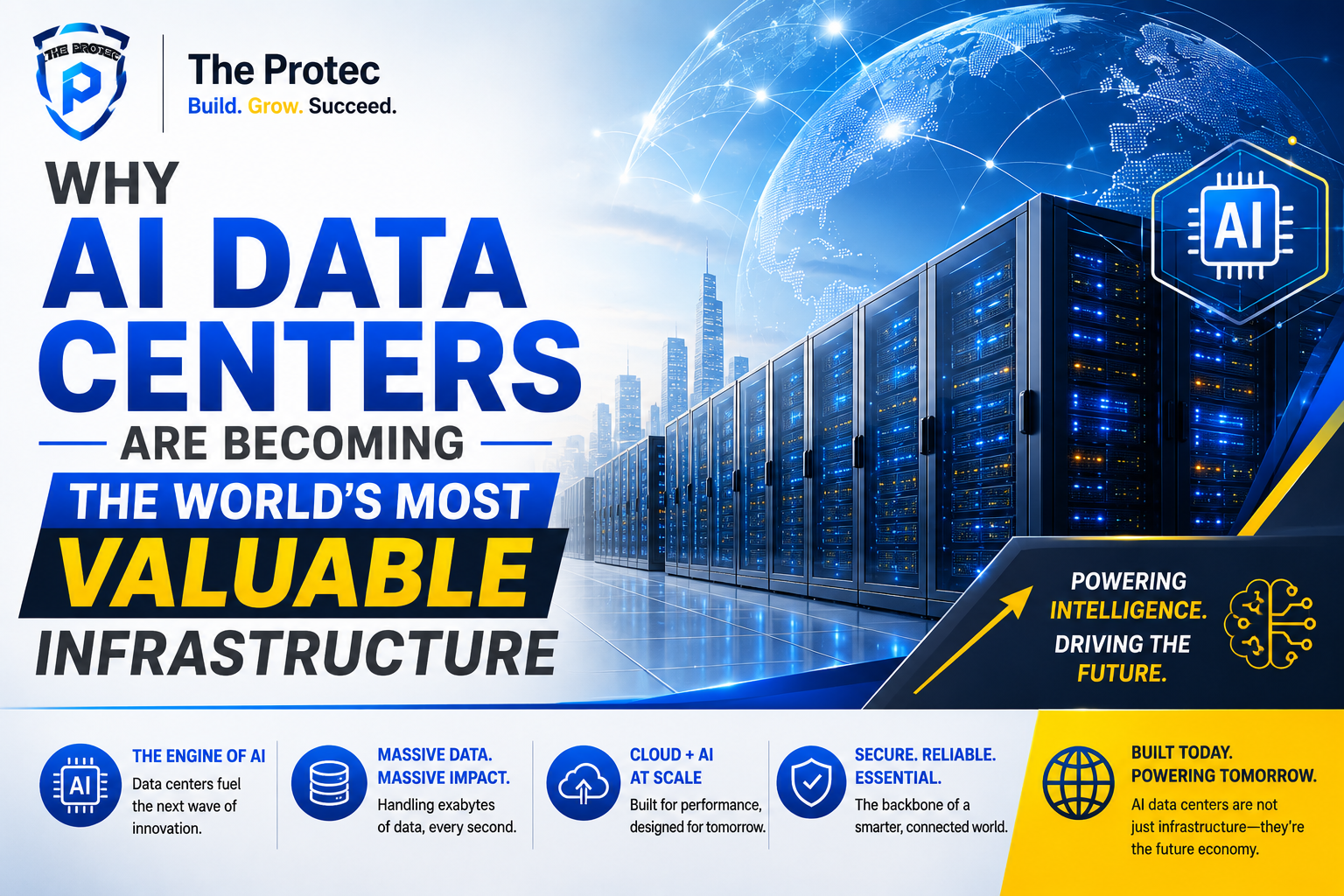
Why AI Data Centers Are Becoming the World’s Most Valuable Infrastructure
AI is no longer just a software story. It is a physical infrastructure story, and the center of that story is the AI data center. These facilities are rapidly becoming the most strategically valuable assets in the digital economy because they power the models, services, and applications that businesses and governments now depend on. Every major leap in generative AI, agentic workflows, scientific computing, and enterprise automation increases demand for specialized compute, storage, networking, power, and cooling. That demand is transforming data centers from a back-end utility into the foundation of national competitiveness.
What makes AI data centers different is not just scale, but intensity. A traditional enterprise workload can often run on general-purpose infrastructure. AI workloads, especially training and high-throughput inference, require dense clusters of accelerators, ultra-low-latency networking, advanced power distribution, and thermal systems that can support extreme loads. The result is an infrastructure category that is not only expensive to build, but difficult to replicate quickly. That scarcity is one reason governments and cloud providers are investing billions into AI infrastructure. Another is simple economics: whoever controls the compute controls the pace of innovation.
For businesses, this shift is already changing how products are built, how teams operate, and how competitive advantage is measured. Access to an AI cloud is becoming as important as access to reliable electricity, broadband, or logistics. The companies that understand this early will be better positioned to scale automation, personalize services, reduce costs, and deploy AI safely at production scale.
What Makes AI Data Centers So Valuable
AI data centers are valuable because they sit at the intersection of three scarce resources: compute, power, and connectivity. Unlike conventional facilities, they are engineered for high-density AI infrastructure that can support thousands of GPUs, specialized accelerators, and fast interconnects. The demand is not just for raw server count. It is for tightly integrated systems that can move massive volumes of data with minimal delay while keeping energy use and heat under control.
The value of an AI data center also comes from its ability to support both training and inference. Training large models requires enormous bursts of compute over sustained periods, while inference requires reliable, efficient, always-on capacity at the edge of business operations. That dual role makes AI cloud platforms especially important. Cloud providers can aggregate demand across many customers, optimize utilization, and offer managed services that simplify deployment. For organizations, this reduces the need to build everything in-house while still giving access to world-class infrastructure.
Another reason these facilities matter is that AI performance is increasingly constrained by physical realities. Model size, data throughput, latency, and energy availability all shape what is possible. In practice, the most advanced AI systems depend on the quality of the underlying infrastructure as much as the quality of the model architecture. That is why the conversation is shifting from “Which model is best?” to “Which infrastructure can deliver the model reliably, securely, and economically?”
Why Governments Are Investing Billions in AI Infrastructure
Governments are treating AI data centers as strategic assets because they influence national security, economic growth, and technological sovereignty. In an era where AI is shaping defense systems, public services, industrial productivity, and digital commerce, countries do not want to rely entirely on foreign infrastructure or overseas compute supply. Building domestic AI infrastructure helps protect data, support local industries, and reduce dependency on external providers.
This is also about competitiveness. Countries that can offer abundant AI cloud capacity are more likely to attract startups, research institutions, multinational enterprises, and advanced manufacturing. The presence of robust AI infrastructure can create a flywheel effect: more compute attracts more innovation, which attracts more capital, which justifies further infrastructure investment. Governments recognize that this can become a decisive advantage in sectors such as healthcare, logistics, financial services, energy, and public administration.
Policy is moving in the same direction. Around the world, national programs are supporting data center expansion, grid upgrades, high-voltage transmission, permitting reform, semiconductor supply chains, and water-efficient cooling systems. In many cases, these are not isolated technology decisions but economic development strategies. The goal is to ensure that AI infrastructure can scale without being bottlenecked by power availability, land access, or regulatory delays.
For a useful global reference on digital infrastructure trends, the International Energy Agency has highlighted the rising electricity demands of data centers and AI workloads: https://www.iea.org/.
Why Cloud Providers Are Racing to Build AI Cloud Capacity
Cloud providers are in a race because AI infrastructure has become a core competitive moat. In the past, cloud differentiation centered on storage, compute, and managed databases. Today, the most important battleground is AI cloud capacity: access to accelerators, optimized networking, model hosting, vector databases, fine-tuning environments, and enterprise-grade AI services.
The providers that can offer reliable AI cloud services at scale gain more than revenue from compute rental. They earn sticky customer relationships across model development, deployment, observability, governance, and security. Once a business integrates with a cloud provider’s AI stack, switching becomes more complex. That makes AI data centers not just a capital expense, but a long-term platform strategy.
Cloud providers are also under pressure to secure supply. Demand for advanced chips, high-bandwidth memory, and power-dense rack configurations has been intense, and supply chains remain tight. To stay ahead, cloud operators are signing multi-year power agreements, developing dedicated campuses, and redesigning facilities for liquid cooling and higher rack densities. This is one reason the largest hyperscalers continue to announce major capital expenditure plans. They are not merely keeping up with demand; they are trying to shape the market.
For businesses, that means AI cloud offerings are likely to become more specialized. Instead of generic access to compute, organizations will increasingly choose infrastructure optimized for training, inference, retrieval-augmented generation, multimodal workloads, or edge deployment. The companies that understand their workload profile will be able to select the right environment and control costs more effectively.
The Infrastructure Stack Behind Modern AI
AI data centers are much more than rows of servers. They are integrated systems with several layers of infrastructure working together:
- Accelerated compute: GPUs, specialized AI accelerators, and high-memory architectures designed for parallel processing.
- High-speed networking: InfiniBand, advanced Ethernet fabrics, and low-latency interconnects that move data between nodes quickly.
- Storage systems: High-throughput storage for training datasets, model checkpoints, logs, and embeddings.
- Power delivery: Utility-scale electrical capacity, backup systems, and intelligent distribution capable of supporting dense racks.
- Cooling: Liquid cooling, rear-door heat exchangers, and advanced airflow design to manage extreme thermal loads.
- Security and compliance: Physical security, workload isolation, identity controls, and governance tools for regulated workloads.
Each layer adds cost, complexity, and strategic value. The reason AI infrastructure is expensive is that every part of the stack must be optimized for performance and resilience. A failure in one layer can disrupt the entire system. That is especially true for large-scale models and enterprise AI services that run continuously and serve multiple teams or customers at once.
These requirements are accelerating a broader redesign of the data center industry. Operators are moving toward modular builds, prefabricated components, direct-to-chip cooling, and power-aware scheduling. In effect, AI data centers are redefining what a modern facility looks like.
What This Means for Businesses
For businesses, the rise of AI data centers changes both opportunity and risk. On the opportunity side, AI cloud services make advanced capabilities accessible to organizations that would never build their own infrastructure. Companies can now deploy copilots, automate workflows, analyze unstructured data, and personalize customer experiences without owning a hyperscale data center. This lowers the barrier to AI adoption and shortens the path from pilot to production.
But the new environment also introduces strategic considerations. Costs can rise quickly if workloads are not governed properly. Latency and data locality matter more when AI is embedded in customer-facing systems. Compliance requirements may limit where data can be processed. And as AI becomes business-critical, outages or capacity shortages can have real operational consequences.
That means infrastructure strategy is now part of AI strategy. Businesses should think carefully about:
- Which workloads belong in public AI cloud environments
- Which workloads require private or hybrid infrastructure
- How to control inference costs as usage scales
- How to secure sensitive data and model outputs
- How to avoid vendor lock-in while still moving quickly
Organizations that treat infrastructure as an afterthought may find themselves limited by cost overruns, performance bottlenecks, or compliance issues. Those that plan for scale early can turn AI into a durable operational advantage.
AI Data Centers, Energy Demand, and Grid Pressure
One of the biggest reasons AI data centers are now viewed as critical infrastructure is their impact on energy systems. AI workloads consume more power than many traditional digital services, and the expansion of AI cloud capacity is placing pressure on utilities, transmission networks, and local permitting systems. In some regions, the availability of electricity is now the main constraint on AI expansion, not demand.
This is prompting new kinds of investment. Data center operators are signing long-term power purchase agreements, exploring on-site generation, and working with utilities to upgrade substations and transmission links. Some are also adopting more efficient chip architectures and cooling technologies to reduce total energy use per workload. Sustainability has become a practical issue, not just a branding one.
For businesses, this matters because energy constraints can affect pricing, capacity, and service reliability. The economics of AI cloud services will increasingly reflect power availability and regional infrastructure quality. Companies that deploy globally will need to consider not only latency and regulation, but also energy mix and resilience.
How AI Infrastructure Is Reshaping Competitive Advantage
In the past, competitive advantage often came from software, distribution, or brand. Those still matter, but AI infrastructure has become a new source of leverage. The organizations that can access abundant compute, move quickly, and operationalize AI at scale can outlearn, out-automate, and out-serve their competitors.
This is especially true in industries where decision speed matters. Financial services, e-commerce, manufacturing, logistics, and healthcare are all using AI infrastructure to support forecasting, fraud detection, supply chain optimization, product recommendations, and clinical workflows. As these use cases mature, companies with better infrastructure will be able to experiment more rapidly and deploy more confidently.
There is also a talent dimension. Top engineers, data scientists, and applied AI teams want to work with robust tools and reliable infrastructure. A company that can provide a strong AI cloud environment is more likely to attract and retain the talent needed to turn models into business outcomes. Infrastructure, in other words, is now part of the employee experience as well as the customer experience.
The Next Phase: From AI Data Centers to AI Factories
The conversation is moving beyond traditional data centers toward what some industry leaders call AI factories: highly optimized production environments designed to continuously turn power, data, and compute into intelligence. This framing is powerful because it captures the industrial nature of modern AI. These facilities are not passive storage sites. They are active engines of value creation.
As model usage expands, the most advanced operators will combine private infrastructure, cloud capacity, edge deployment, and orchestration software into a hybrid AI architecture. That will allow workloads to run where they are most efficient and secure. Businesses will not need to choose one single model or one single provider. Instead, they will assemble the right infrastructure mix for each use case.
This evolution will likely bring more specialization. Some AI data centers will focus on training frontier models. Others will specialize in inference at scale. Some will support regulated industries with strict compliance requirements. Others will be designed for low-latency edge applications. The market is fragmenting in a productive way, and that is a sign of maturity.
How Businesses Should Respond Now
The businesses that benefit most from the rise of AI data centers will not wait for infrastructure to become cheaper or simpler. They will align their technology plans with the realities of AI infrastructure today. That means understanding workload patterns, defining governance rules, and selecting cloud partners that can scale responsibly.
Practical steps include:
- Audit current AI use cases and estimate future compute demand
- Separate training, fine-tuning, and inference workloads
- Evaluate AI cloud providers on performance, security, and cost transparency
- Plan for data residency, compliance, and model governance early
- Design systems that can support hybrid and multi-cloud deployment
- Monitor energy, latency, and utilization as core operating metrics
In many organizations, the biggest mistake is assuming that AI adoption is primarily a software procurement decision. It is not. It is an infrastructure decision with operational, financial, and strategic consequences. The companies that recognize this now will be better prepared for the next wave of AI-driven competition.
Conclusion
AI data centers are becoming the world’s most valuable infrastructure because they power the systems that increasingly shape economic growth, national security, and business performance. Governments are investing to secure sovereignty and competitiveness. Cloud providers are investing to capture demand and build long-term platform advantage. Businesses are investing because AI cloud access is now essential to modern operations.
The message is clear: AI infrastructure is no longer a supporting layer under the digital economy. It is the engine of it. As demand grows, the organizations that can secure reliable access to compute, power, and connectivity will define the pace of innovation in their industries. For every business leader, the question is no longer whether AI data centers matter. It is how quickly your organization can build a strategy around them.
FAQ
What is an AI data center?
An AI data center is a specialized facility designed to support AI workloads such as model training, inference, and large-scale data processing. It uses high-density compute, advanced networking, and enhanced cooling and power systems.
Why are governments investing so much in AI infrastructure?
Governments see AI infrastructure as strategic because it affects national security, economic growth, technological independence, and access to critical digital capabilities. Domestic AI capacity can also attract investment and innovation.
How is an AI cloud different from traditional cloud computing?
An AI cloud is optimized for machine learning and generative AI workloads. It typically offers access to accelerators, model hosting tools, vector search, and infrastructure tuned for training and inference performance.
What should businesses consider before adopting AI cloud services?
Businesses should evaluate workload type, cost, security, compliance, latency, data residency, and long-term scalability. The right AI cloud strategy depends on whether workloads are training-heavy, inference-heavy, or hybrid.
Will AI data centers replace traditional data centers?
Not entirely. Traditional data centers will still serve many enterprise workloads, but AI data centers are becoming the dominant infrastructure for high-performance AI and are reshaping how new facilities are designed and built.