







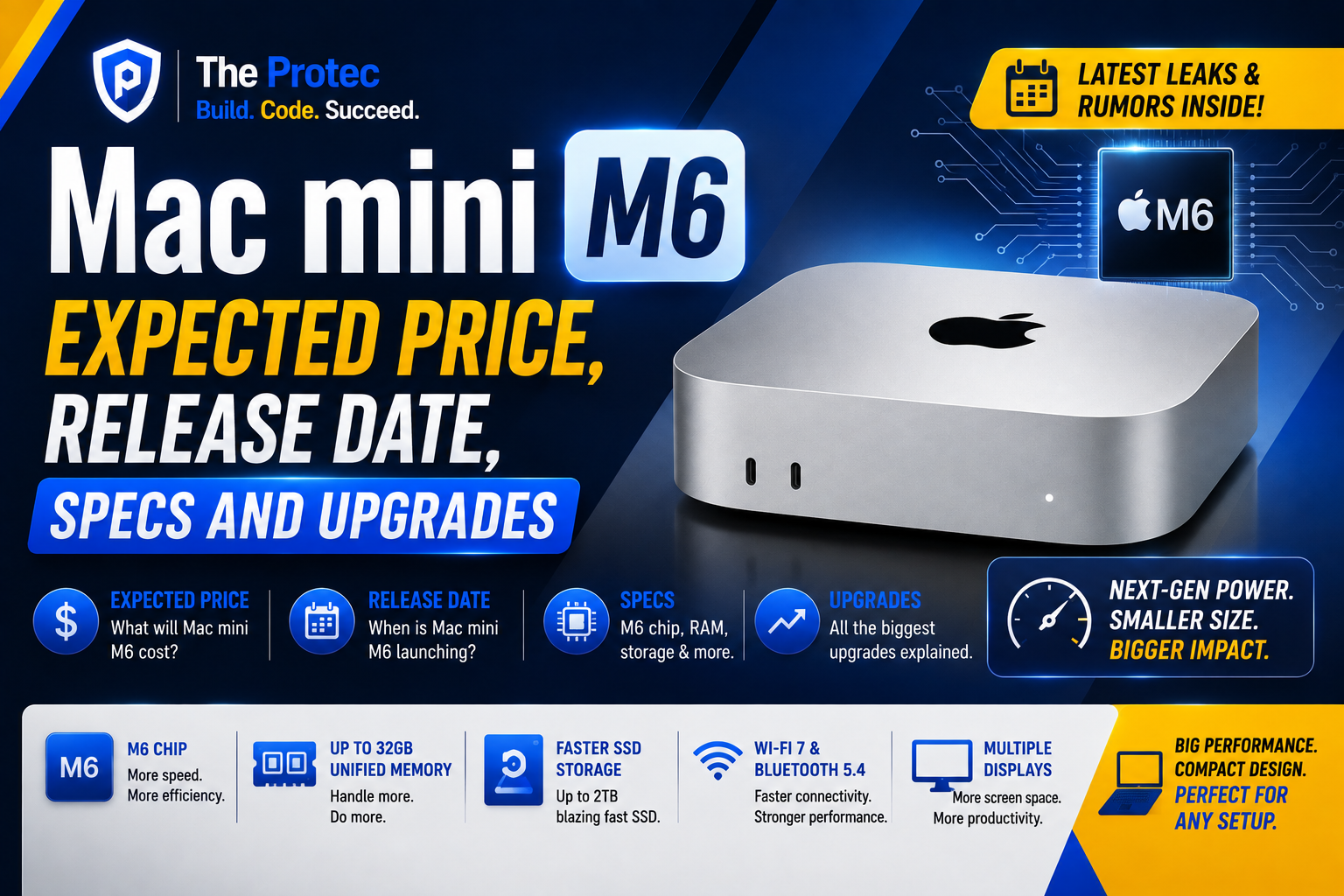
The Mac mini has evolved from Apple’s entry-level desktop into a remarkably capable workstation that fits almost anywhere. Following the major redesign introduced with the M4 generation, attention is now turning to the Mac mini M6 and the improvements Apple could deliver with its next major silicon upgrade.
As of August 2026, Apple has not announced the Mac mini M6 or confirmed its release schedule. Details about the processor, pricing and hardware configurations therefore remain projections based on Apple’s chip roadmap, Mac mini update history and broader industry developments. Even so, there are strong reasons to expect better CPU and GPU performance, faster on-device AI processing, higher memory bandwidth and more advanced connectivity.
This guide covers the expected Mac mini M6 release date, likely price, potential specifications and the biggest upgrades over the current M4-based model.
Mac mini M6 expectations at a glance
- Release window: Most likely sometime in 2027, although a late-2026 introduction cannot be ruled out.
- Expected starting price: Around $599 to $699 in the United States.
- Processor options: M6 and a higher-performance M6 Pro configuration.
- Memory: At least 16GB on the base model, with larger unified memory options expected.
- Storage: Likely to start at 256GB, with configurations extending into multiple terabytes.
- Key upgrades: Faster graphics, stronger AI acceleration, improved efficiency, higher memory bandwidth and possible Wi-Fi 7 support.
When is the Mac mini M6 release date?
The most realistic Mac mini M6 release date is in 2027. Apple does not refresh the Mac mini every year, and the company has often allowed more than one chip generation to pass between updates. The M1 Mac mini arrived in November 2020, the M2 version followed in January 2023 and the redesigned M4 model launched in late 2024.
That irregular schedule means the Mac mini may not receive an M6 processor immediately after the chip debuts in another product. Apple commonly introduces a new silicon generation through an iPad Pro or MacBook Pro before expanding it across the wider Mac range. A late-2026 M6 reveal could therefore be followed by a Mac mini update several months later.
There is also a possibility that Apple will release an M5 Mac mini first, pushing the M6 model further into the future. Alternatively, Apple could skip the M5 generation for this desktop and move directly from M4 to M6. Until Apple sends invitations or reliable supply-chain evidence emerges, any exact launch month should be treated cautiously.
How much could the Mac mini M6 cost?
The expected Mac mini M6 price starts at approximately $599 in the US, matching the launch price of the base M4 model. Maintaining that price would keep the Mac mini attractive to first-time Mac buyers, developers, students and businesses that already own displays and accessories.
A modest increase to $649 or $699 is possible if newer manufacturing technology, memory costs or other component expenses rise. The M6 Pro version will be considerably more expensive and could begin near the current M4 Pro model’s $1,399 starting point. More unified memory, additional storage and 10Gb Ethernet would increase the final price significantly.
Apple’s pricing varies by region because of taxes, currency changes and import costs, so international buyers should not rely on a direct conversion from the US figure. The official Apple Mac mini page remains the best source for current configurations and regional prices.
Expected Mac mini M6 specs and chip performance
The M6 will be the defining feature of the new Mac mini. Industry expectations have connected Apple’s future chip roadmap with more advanced process technology, potentially including a transition from 3-nanometer manufacturing to a 2-nanometer-class process. A smaller process can allow Apple to fit more transistors into a chip while balancing speed, power consumption and heat output. However, the final manufacturing node and architecture have not been confirmed.
Mac mini M6 performance should improve across single-core and multi-core CPU tasks. Everyday activities such as launching applications and browsing complex websites may feel only incrementally faster because the current model is already responsive. More demanding workloads—including code compilation, large photo exports, music production, data analysis and video encoding—should show clearer gains.
Graphics could receive an equally important boost. Apple has steadily expanded features such as hardware-accelerated ray tracing, mesh shading and dynamic memory allocation across its silicon. An upgraded M6 GPU could improve 3D rendering, game performance, visual effects and professional video workflows without dramatically increasing power consumption.
The M6 Pro should offer more CPU and GPU cores, greater memory bandwidth and better support for sustained workloads. It would remain the more appropriate option for developers, editors and creators who routinely push the system for long periods.
Memory and storage options
Apple is expected to keep 16GB of unified memory as the minimum Mac mini M6 configuration. Unified memory is shared by the CPU, GPU and Neural Engine, reducing the need to copy data between separate memory pools. Higher bandwidth could be as important as increased capacity, especially for local AI models, high-resolution video and graphics-intensive projects.
Likely upgrades include 24GB and 32GB options for the standard M6, while the M6 Pro could support 48GB, 64GB or more. Exact limits will depend on the chip’s memory architecture.
Storage may still begin at 256GB on the entry model, although 512GB would be a welcome upgrade. Buyers should choose carefully because the internal SSD is not user-upgradeable. External Thunderbolt storage remains a practical alternative for large media libraries, backups and project files.
Ports, displays and connectivity
The redesigned Mac mini already offers a useful mix of front and rear connections. Apple is unlikely to reverse its decision to remove USB-A, so the Mac mini M6 should continue using USB-C and Thunderbolt as its primary expansion standards. HDMI, Ethernet and a headphone jack are also likely to remain.
The standard M6 model could retain Thunderbolt 4 or move to Thunderbolt 5, while an M6 Pro configuration is highly likely to feature Thunderbolt 5. The newer standard offers substantially more bandwidth for fast storage, docking stations, capture hardware and high-resolution monitors. Display support may also improve through more capable media and display engines.
Wi-Fi 7 is one of the most plausible Mac mini M6 upgrades. It can deliver lower latency, wider channels and better performance on compatible networks, although real-world speed depends on the router and internet connection. A newer Bluetooth version could improve efficiency and wireless accessory reliability. Gigabit Ethernet should remain standard, with 10Gb Ethernet available as an optional configuration.
Will the Mac mini M6 have a new design?
A second major redesign is unlikely. The current Mac mini introduced a much smaller enclosure, front-facing ports and a thermal layout built around Apple silicon. Apple generally keeps Mac designs for several generations, making an internal update more probable than another visual overhaul.
The Mac mini M6 should therefore retain a compact aluminum body and separate power cable, keyboard, mouse and monitor. Apple could make smaller refinements to port placement, cooling or the power button, but there is no solid evidence of a dramatic exterior change. Additional finishes are possible, though silver remains the safest prediction.
AI capabilities and Apple Intelligence
Artificial intelligence is likely to be one of the most heavily promoted aspects of the M6 generation. A faster Neural Engine, improved matrix-processing hardware and greater memory bandwidth could allow the Mac mini to run more sophisticated models locally. That matters for privacy, response time and features that must work without sending every request to a remote server.
Potential benefits include faster image processing, transcription, language tools, subject recognition, intelligent search and AI-assisted creative workflows. Developers may also gain better performance when testing machine-learning applications through Apple frameworks. Apple’s existing approach to personal AI can be reviewed on the official Apple Intelligence overview.
Not every AI feature will be exclusive to the M6, but newer hardware should complete supported tasks more quickly and handle larger local models. The combination of a stronger Neural Engine and expanded unified memory may prove more meaningful than raw CPU gains for some users.
Biggest Mac mini M6 upgrades over the current model
- Next-generation Apple silicon: The M6 should deliver better CPU performance per watt and more capable integrated graphics.
- Faster AI processing: Neural Engine improvements could accelerate local generative AI, transcription and media analysis.
- Higher memory bandwidth: Faster access to unified memory would benefit graphics, AI models and professional applications.
- More advanced connectivity: Wi-Fi 7 and broader Thunderbolt 5 availability are among the most likely improvements.
- Better sustained performance: Efficiency gains could help the compact desktop maintain higher speeds while controlling heat and fan noise.
- Improved display support: Updated display engines may provide more flexibility for multi-monitor and high-refresh-rate setups.
The scale of the upgrade will depend on which Mac mini a buyer currently owns. Users moving from an Intel, M1 or M2 model should notice a substantial improvement. Owners of the M4 Mac mini may find the differences less transformative unless they need stronger graphics, AI acceleration or connectivity.
Should you wait for the Mac mini M6?
Waiting makes sense if your current computer still meets your needs and you want the longest possible useful life from a new desktop. The M6 generation should provide newer connectivity and more headroom for AI-heavy software.
However, buyers who need a computer now should not postpone essential work for an unannounced product. The current Mac mini already provides excellent performance in a compact design. Because the M6 release timing remains uncertain, waiting could mean delaying a purchase for many months.
Mac mini M6 FAQ
Has Apple announced the Mac mini M6?
No. As of August 2026, Apple has not officially announced an M6 Mac mini, its specifications or a release date. Current details are informed estimates rather than confirmed product information.
Will there be a Mac mini M6 Pro?
An M6 Pro model is likely because Apple currently offers standard and Pro chip configurations. It should provide additional CPU and GPU cores, higher memory bandwidth, more memory capacity and stronger performance for professional workloads.
Could the Mac mini skip the M5 chip?
Yes. Apple has not followed an annual Mac mini upgrade cycle, so it could skip a generation. An M5 refresh is also possible, however, and would likely affect when the M6 version reaches stores.
Will the Mac mini M6 support gaming?
It should run supported Mac games better than earlier models, particularly if Apple improves GPU performance and ray tracing. The size of the Mac game library, developer support and title optimization will still matter as much as hardware speed.
Will the Mac mini M6 include a keyboard or monitor?
Probably not. Apple traditionally sells the Mac mini as a standalone desktop. Buyers should expect to provide their own display, keyboard and pointing device or purchase them separately.
Final outlook
The Mac mini M6 is shaping up as an evolution of Apple’s compact desktop rather than another complete redesign. Its most important improvements should come from faster silicon, stronger AI acceleration, modern connectivity and higher memory performance. Price and timing remain uncertain, but the M6 could be a compelling upgrade for owners of older Intel and early Apple silicon Macs.