






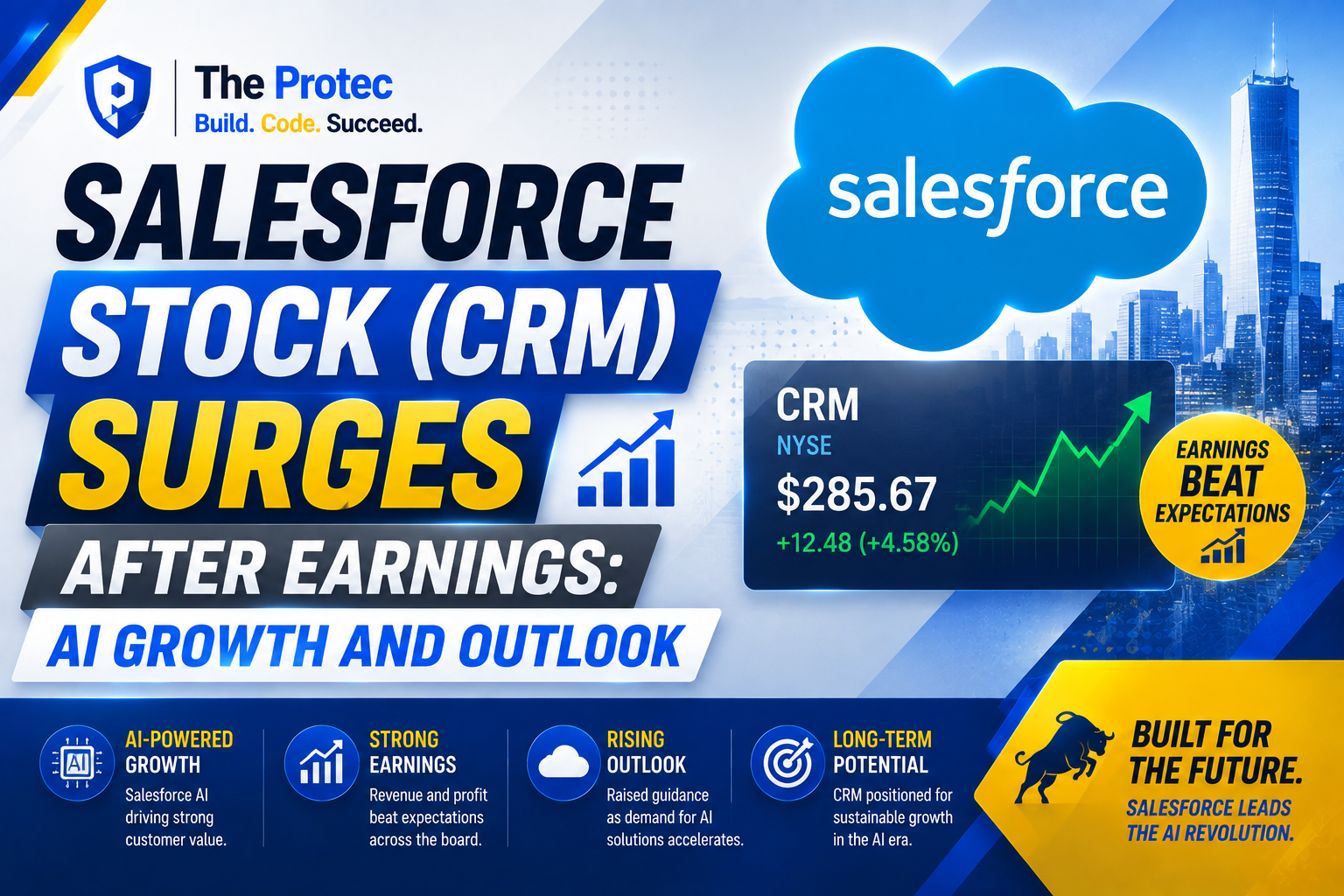
Salesforce stock moved sharply higher after the company’s latest earnings update gave investors fresh reasons to believe its artificial intelligence strategy can support durable growth. The reaction was not simply about one quarter’s revenue or adjusted profit. It reflected a broader reassessment of Salesforce, its Agentforce platform and the possibility that AI agents could become a meaningful expansion engine across the company’s enormous customer base.
The earnings-driven move also arrived as investors were examining Salesforce’s work with Anthropic and growing interest in Claudeforce, the shorthand associated with bringing Anthropic’s Claude models into Salesforce-centric workflows. Together, these developments strengthened the argument that Salesforce can serve as an enterprise AI distribution platform rather than merely another software company adding generative features to existing products.
That does not make the outlook risk-free. Salesforce still needs to convert AI experimentation into recurring revenue, defend its margins and prove that Agentforce adoption can scale beyond pilot programs. Here is what the latest Salesforce Q2 earnings signal, why CRM stock responded positively and what investors may watch next.
Why Salesforce Stock Surged After Earnings
The rally in Salesforce stock was driven by a combination of financial performance, guidance and improving confidence in the company’s AI narrative. Markets often punish mature software companies when growth slows, even if earnings remain healthy. Salesforce’s report instead offered evidence that disciplined spending and investment in AI can coexist.
The most important takeaway was that reported quarterly performance compared favorably with the expectations embedded in the Salesforce stock price before the announcement. Subscription and support revenue remained the foundation of the business, while profitability and cash generation reinforced Salesforce’s ability to fund AI development, acquisitions and shareholder returns.
Investors also focused on management’s forward-looking commentary. A solid quarter can produce only a temporary stock bounce if guidance suggests demand is weakening. In this case, the outlook was viewed as sufficiently constructive to support expectations for continued expansion, even as enterprise customers scrutinize software budgets and demand measurable returns from AI projects.
Three factors helped shape the positive reaction:
- Revenue resilience: Salesforce continued to benefit from a broad portfolio spanning sales, service, marketing, data, analytics, integration and collaboration.
- AI monetization potential: Agentforce adoption provided evidence that customers are moving from generative AI demonstrations toward operational deployments.
- Execution and margins: Cost discipline made the growth story more credible because investors did not have to assume unlimited spending to support AI development.
Short-term price movements can also be amplified by options positioning, short covering and algorithmic trading. The size of an earnings-day surge should therefore not be treated as a direct measurement of long-term business value. The more durable question is whether future revenue, remaining performance obligations and cash flow validate the enthusiasm.
Salesforce Q2 Earnings: Reported Results Versus Expectations
It is important to distinguish three different categories when interpreting Salesforce earnings: reported financial results, analyst expectations and company projections.
Reported results describe what Salesforce actually generated during the completed fiscal quarter. These include revenue, subscription and support sales, operating margin, earnings per share, cash flow and remaining performance obligations. They are historical figures, although some measures may be presented on both generally accepted accounting principles and non-GAAP bases.
Analyst expectations are estimates compiled before the release. A company can report year-over-year growth and still disappoint if results fall below consensus. Conversely, modest growth can trigger a rally when revenue, margins or earnings exceed what the market had priced into CRM stock. Consensus figures can differ slightly among financial data providers, which is why investors should check the basis and timing of any comparison.
Company guidance is management’s projection for a future quarter or fiscal year. It is not guaranteed revenue. Guidance depends on assumptions involving customer demand, foreign exchange rates, acquisition contributions, contract timing, hiring and macroeconomic conditions.
The latest Salesforce earnings were interpreted positively because the combination of reported performance and management’s outlook was stronger than many investors had feared. The result reduced immediate concern that generative AI competitors would weaken Salesforce’s position before Agentforce could contribute meaningfully.
Readers seeking the exact reported figures and official guidance ranges should use the company’s investor relations materials and Salesforce filings available through the U.S. Securities and Exchange Commission. Those primary sources should take precedence over rounded numbers in market commentary.
Agentforce Is Central to the Salesforce AI Growth Story
Salesforce Agentforce is designed to let organizations create and deploy autonomous or semi-autonomous AI agents using customer data, business rules and connected workflows. An agent can answer questions, qualify sales opportunities, assist service teams or complete approved tasks while escalating sensitive decisions to a person.
This matters because Salesforce already sits close to critical business processes. Its software contains customer histories, service cases, sales pipelines and marketing interactions. When combined with Data Cloud, MuleSoft integrations and governance controls, that position can give Agentforce access to the context required for useful enterprise automation.
Agentforce adoption should be evaluated on more than customer announcements. The indicators that could eventually affect Salesforce stock include:
- The number of customers progressing from trials to production deployments.
- Agent conversations, actions or other consumption-based activity.
- Expansion rates after an initial Agentforce implementation.
- Demand for related Data Cloud, integration and security capabilities.
- The amount of AI revenue that is recurring rather than tied to short-term services.
Salesforce AI could lift revenue through direct Agentforce consumption, premium editions and cross-selling. It could also improve retention by making Salesforce data and workflows more valuable. However, customer productivity gains could reduce the number of human software seats required in some departments. Management must demonstrate that consumption and platform revenue can more than offset any pressure on traditional per-user licensing.
Salesforce, Anthropic and the Claudeforce Opportunity
The Salesforce-Anthropic relationship adds another layer to the AI thesis. Anthropic’s Claude family is known for advanced language capabilities and an emphasis on enterprise safety. Integrating those models with Salesforce’s data, permissions and workflow infrastructure could help companies deploy AI without moving every process into a separate environment.
Claudeforce is best understood as an emerging Salesforce-and-Claude ecosystem rather than automatically assuming it is a single, separately reported product line. The idea is to combine Claude’s reasoning and language abilities with Salesforce’s customer context and enterprise controls. Potential applications include drafting account plans, summarizing complicated service histories, preparing sales representatives for meetings and helping developers work with Salesforce code or configurations.
The partnership is strategically useful for both companies. Anthropic gains access to Salesforce’s enterprise distribution, while Salesforce can offer model choice instead of relying on one AI provider. That flexibility matters because large customers increasingly want to select models based on accuracy, latency, cost, data residency and risk requirements.
Investors should nevertheless avoid counting every Anthropic integration as immediate Salesforce revenue. A partnership announcement is a strategic development. Revenue is recognized only when customers purchase and consume Salesforce offerings under applicable contract terms. Claudeforce interest may strengthen the sales pipeline, but financial impact must be confirmed through future disclosures.
Revenue Quality, Guidance and the Metrics That Matter
Headline revenue growth is only one part of the Salesforce earnings 2026 discussion. The quality and visibility of that growth are equally important. Subscription software companies are often valued according to their ability to produce recurring revenue and predictable cash flow.
Remaining performance obligations can help show the value of contracted business that has not yet been recognized as revenue. Current remaining performance obligations focus on amounts expected to be recognized in the nearer term. Neither measure is identical to future revenue growth, but both can provide information about demand and contract visibility.
Operating margin is another crucial metric. Salesforce has spent recent years balancing expansion with greater efficiency. If the company can fund Agentforce development, computing capacity and sales incentives while protecting margins, the market may assign CRM stock a higher valuation. If AI infrastructure costs rise faster than AI revenue, the opposite could occur.
Guidance should also be separated into organic and acquisition-related contributions when Salesforce provides enough information to do so. Acquired businesses can increase reported revenue without proving that the core platform is accelerating. Currency movements may also raise or lower reported growth even when underlying demand is unchanged.
For the next earnings report, investors should compare the official outlook with actual performance in these areas:
- Total revenue and subscription growth.
- Current remaining performance obligations.
- GAAP and non-GAAP operating margins.
- Operating cash flow and free cash flow.
- Agentforce production deployments and consumption trends.
- Data Cloud adoption and AI-related cross-selling.
Investor Sentiment Toward CRM Stock Is Improving
Before the earnings surge, sentiment toward CRM stock reflected competing narratives. Bulls saw a highly profitable enterprise platform with substantial cash generation and underappreciated AI distribution. Bears questioned whether Salesforce could reaccelerate after reaching massive scale and whether Agentforce would become a significant business before competitors captured customer budgets.
The latest report shifted that balance toward the bullish view, at least temporarily. Better-than-feared execution can be particularly powerful when expectations are restrained. Investors do not need Salesforce to become the fastest-growing AI company; they need evidence that AI can stabilize growth, support pricing and increase the value of its installed base.
Valuation remains important after a rally. A higher Salesforce stock price increases the amount of future growth already reflected in the shares. If the market begins assuming rapid Agentforce monetization, even a solid subsequent quarter could disappoint. Investors should examine forward earnings and free-cash-flow expectations rather than relying on the percentage size of the post-earnings move.
Salesforce Stock Forecast: Bull, Base and Bear Cases
No credible Salesforce stock forecast can promise a specific future price. CRM shares will respond to earnings, interest rates, enterprise technology spending and broader market conditions. A scenario framework is more useful than a single target.
Bull Case
In a bullish outcome, Agentforce becomes a major automation layer across Sales Cloud, Service Cloud and industry products. Customers increase usage, Data Cloud gains momentum and Anthropic integrations improve the platform’s appeal. Revenue growth strengthens while operating margins remain healthy. That combination could support higher earnings estimates and a premium valuation.
Base Case
In the base case, Salesforce maintains steady subscription growth and gradually monetizes AI. Agentforce contributes, but adoption varies by industry because companies need time to prepare data, establish controls and redesign workflows. Margins and cash flow remain dependable, allowing CRM stock to advance broadly with earnings rather than through a dramatic valuation expansion.
Bear Case
In a bearish scenario, customers experiment with agents but delay large deployments, AI computing costs pressure margins or competing platforms weaken Salesforce’s pricing power. Traditional seat growth could slow before consumption revenue becomes material. A weak bookings trend or reduced guidance would likely challenge the post-earnings optimism.
What Comes Next for Salesforce Stock?
The next phase will be about proof rather than promises. Management has established Agentforce as the centerpiece of the Salesforce AI strategy. Investors will now look for repeatable deployments, rising consumption and measurable contribution to revenue.
Product execution will matter as much as model capability. Enterprise buyers need accuracy, identity controls, auditability and predictable costs. Salesforce’s advantage is its ability to connect AI agents with trusted customer records and established workflows. Its challenge is making deployment simple enough to generate broad usage without compromising security or governance.
CRM stock could remain volatile as the market recalibrates expectations after the earnings surge. Continued upside will likely require a combination of stable core demand, improving AI monetization and disciplined spending. The quarter strengthened the case for Salesforce, but future results must show that Agentforce and Claudeforce are becoming economic drivers rather than compelling demonstrations alone.
Frequently Asked Questions
Why did Salesforce stock rise after earnings?
Salesforce stock rose because investors viewed the combination of reported performance, profitability, guidance and AI commentary as stronger than expected. Growing confidence in Agentforce adoption and the company’s enterprise AI position also supported sentiment.
Is Agentforce generating meaningful revenue for Salesforce?
Agentforce is becoming more important to Salesforce’s growth narrative, but investors should distinguish customer interest and usage from recognized revenue. Production deployments, consumption, contract expansion and related Data Cloud sales will provide better evidence of material financial impact.
What is Claudeforce?
Claudeforce refers to the emerging combination of Anthropic’s Claude technology with Salesforce data, applications and workflows. It highlights the strategic Salesforce-Anthropic relationship, although investors should not automatically treat it as a separately reported revenue segment.
Is CRM stock a buy after the earnings surge?
That depends on an investor’s valuation assumptions, time horizon and risk tolerance. The earnings report improved the fundamental narrative, but a higher share price may already reflect some expected Agentforce success. Revenue growth, AI monetization, margins and guidance remain the key variables to monitor.
What could move the Salesforce stock price next?
The largest potential catalysts include future earnings, changes to revenue guidance, Agentforce adoption metrics, remaining performance obligations, Anthropic-related product announcements and broader enterprise software spending. Interest rates and overall technology-market sentiment can also influence the valuation of CRM stock.