








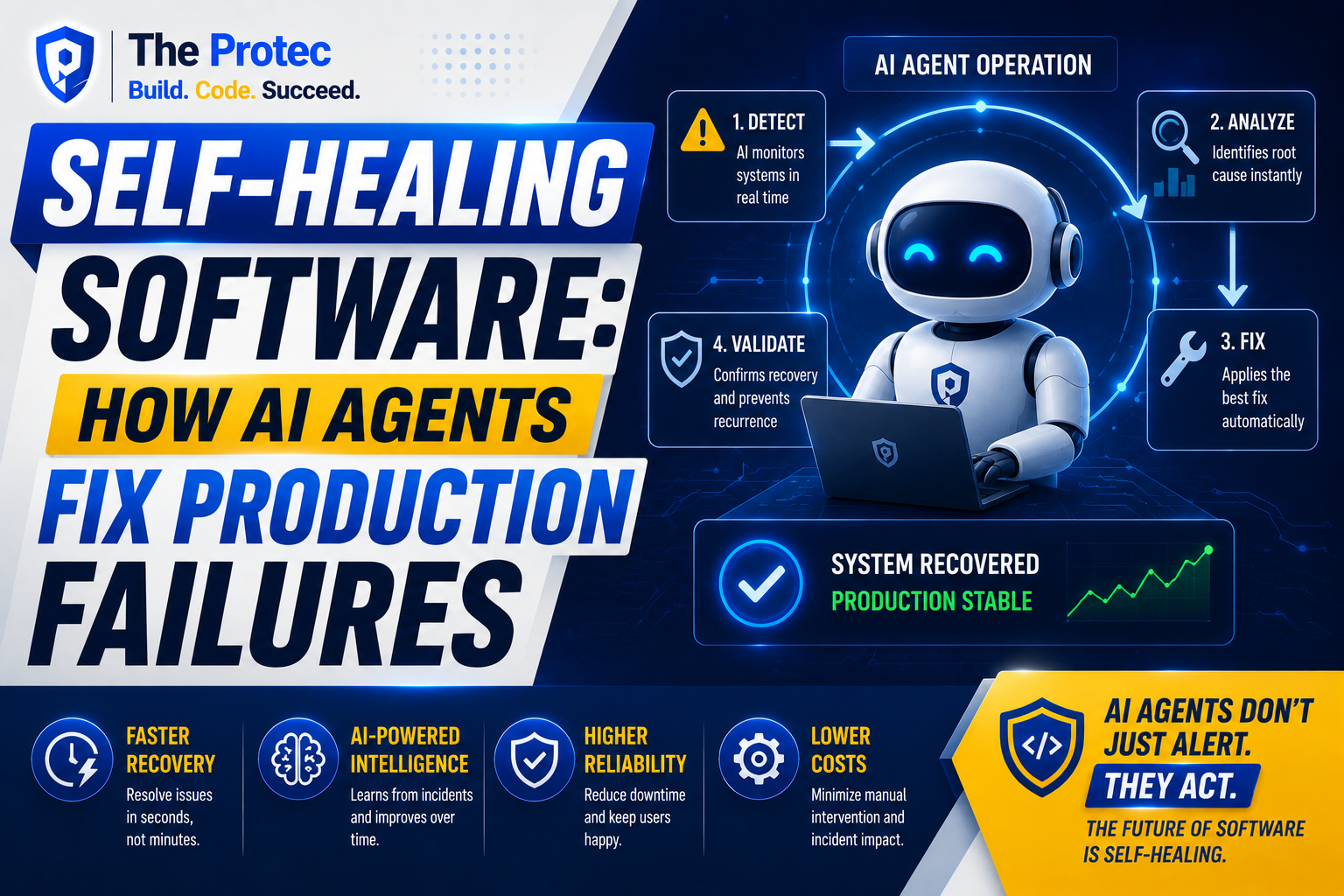
Production systems have long been able to detect when something is wrong. The harder problem is deciding what the signals mean, identifying the safest response, and restoring service before a small failure becomes a customer-facing outage. That is where self-healing software is beginning to change incident management.
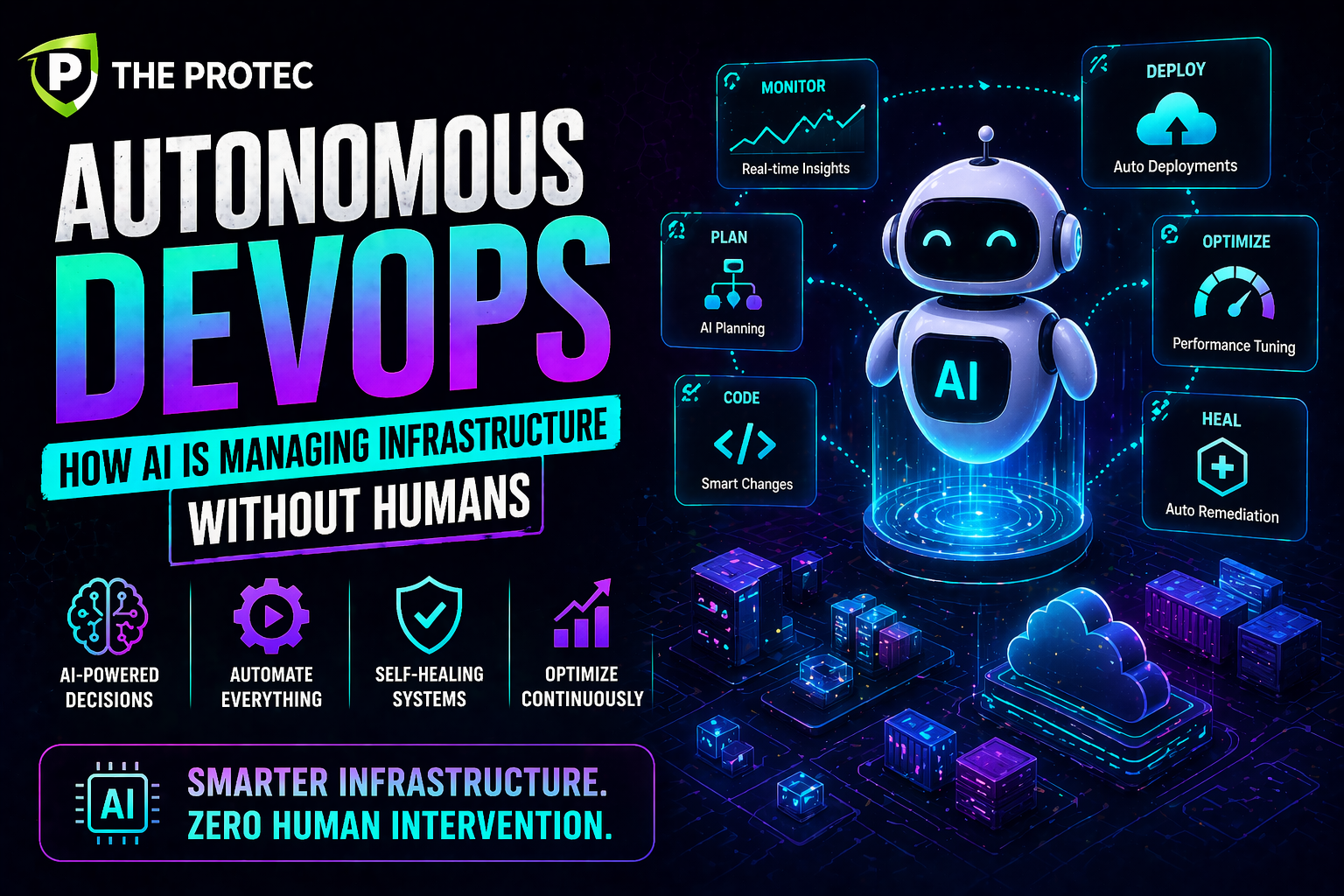
Modern AI agents can consume telemetry, correlate alerts with deployments, investigate dependencies, retrieve operational knowledge, and propose or execute remediation steps. Instead of functioning as another chatbot beside an observability dashboard, these agents can participate directly in the incident response loop. They gather evidence, use tools, test hypotheses, and verify whether an intervention actually worked.
This does not make operations fully autonomous or eliminate the need for experienced engineers. It creates a new operating model in which routine diagnosis and recovery can be automated while people retain authority over risky, ambiguous, or business-critical decisions. The result is faster recovery, less alert fatigue, and a more consistent approach to production reliability.
What Is Self-Healing Software?
Self-healing software is a system that can detect abnormal behavior, determine an appropriate response, apply or recommend a correction, and confirm that normal operation has returned. Traditional automation handles predefined conditions through static rules. For example, an orchestrator may restart a failed container or add replicas when CPU utilization crosses a threshold.
AI-driven self-healing goes further. An agent can examine several possible causes, choose among available tools, and adapt its investigation as new evidence appears. It might determine that elevated latency is not a capacity problem but the result of a recent configuration change, a saturated connection pool, or a failing downstream dependency.
The most useful systems combine deterministic automation with probabilistic reasoning. Policies, runbooks, deployment controls, and infrastructure APIs provide reliable execution. AI agents supply context gathering, hypothesis generation, and decision support. Together, they can address incidents that are too variable for a single hard-coded workflow.
How AI Incident Response Works
Effective AI incident response follows a closed loop: observe, diagnose, plan, act, and verify. Each stage requires access to trustworthy data and clearly constrained tools.
1. Detect and Prioritize Abnormal Behavior
The process starts with telemetry such as metrics, logs, traces, events, profiles, user-impact signals, and cloud-provider health data. Open standards such as OpenTelemetry help teams collect and correlate this information across services without tying the entire workflow to one vendor.
An AI agent can group related alerts, identify unusual patterns, and compare current behavior with historical baselines. It can also prioritize incidents using service criticality, error-budget consumption, affected customers, and the likelihood of cascading failure. This reduces duplicate notifications and gives responders a clearer description of the actual operational problem.
2. Build an Incident Timeline
Once an incident is identified, the agent reconstructs what changed. It can inspect recent deployments, feature-flag updates, infrastructure modifications, schema migrations, certificate events, dependency failures, and access-policy changes. A precise timeline often reveals more than an isolated error message.
For example, if checkout errors began three minutes after a configuration rollout, the agent can compare affected and unaffected instances, inspect the configuration diff, and determine whether the timing and symptoms support rollback. This evidence-driven approach is more dependable than treating the latest deployment as the cause by default.
3. Diagnose the Likely Root Cause
Diagnosis is where AI agents DevOps platforms differ most from conventional alerting systems. An agent can query multiple observability tools, inspect a service catalog, follow a distributed trace, search prior incidents, and map symptoms across a dependency graph. It can develop several hypotheses and gather evidence for or against each one.
A capable agent should expose that reasoning as a concise evidence trail: what it observed, which systems it checked, which hypotheses it rejected, and how confident it is in the leading diagnosis. Engineers need inspectable conclusions, not unexplained recommendations.
4. Select and Execute a Remediation
After identifying a probable cause, the agent selects a response from approved actions. Low-risk options may include restarting an unhealthy workload, scaling a service, clearing a safe cache, rotating traffic to a healthy region, disabling a problematic feature flag, or rolling back a verified deployment.
Higher-risk actions should require human approval. Database changes, security-policy modifications, broad traffic shifts, and destructive infrastructure operations can have consequences beyond the initial incident. Mature systems assign each tool a risk level and enforce different approval requirements according to environment, service tier, and incident severity.
5. Verify Recovery and Learn
Execution is not the end of the workflow. The agent must verify that service-level indicators recover, error rates fall, dependencies stabilize, and no new regression appears. A rollback that stops one error while doubling latency is not a successful repair.
The agent can then document the incident timeline, actions, evidence, and outcomes for the post-incident review. Confirmed resolutions can improve runbooks and future recommendations, but they should not automatically become unrestricted permissions. Learning and authorization are separate concerns.
Integrating AI Agents Into Modern DevOps Workflows
Self-healing capabilities are most effective when integrated with the tools engineers already use. Agents need controlled access to observability platforms, source repositories, CI/CD pipelines, Kubernetes clusters, cloud APIs, feature-flag systems, service catalogs, incident channels, and ticketing platforms.
In a GitOps workflow, an agent may propose a configuration correction as a pull request rather than changing production directly. Existing tests, policy checks, reviews, and deployment controllers then remain the system of record. During an urgent incident, the same agent might trigger a preapproved rollback through the deployment platform while recording every action.
Platform engineering teams are increasingly well positioned to provide these capabilities as shared services. They can publish standardized remediation tools, define permissions, maintain service metadata, and offer reusable incident workflows. Application teams gain faster automation without giving a general-purpose model uncontrolled access to production.
Emerging tool protocols also make it easier for agents to connect with operational systems through structured interfaces. The important design principle is to expose narrow, validated operations such as “restart this workload” or “retrieve deployment diff,” rather than unrestricted shell or administrative access.
The Architecture Behind Self-Healing Software Systems
A production-ready design usually includes more than one agent or model. A coordinator manages the incident state, while specialized components handle telemetry retrieval, deployment analysis, dependency mapping, remediation planning, and verification. Deterministic workflow engines can enforce the order of operations even when AI is used to interpret evidence.
- Context layer: Live telemetry, service ownership, architecture maps, runbooks, change history, and previous incidents.
- Reasoning layer: Models or agents that correlate evidence, rank hypotheses, and choose an approved workflow.
- Action layer: Typed tools for deployment, orchestration, traffic management, feature flags, and communications.
- Policy layer: Identity controls, approval gates, budgets, maintenance windows, and service-specific restrictions.
- Evaluation layer: Checks that measure recovery, detect unintended effects, and record the complete audit trail.
This separation matters. Models can change, but production controls must remain consistent. An organization should be able to replace a reasoning model without redesigning authorization, audit logging, or rollback safeguards.
Guardrails for Safe Autonomous Remediation
The biggest barrier to self healing software is not whether an agent can call an API. It is whether the organization can trust the agent to act within a defined operational boundary. Safe automation begins with least-privilege access and explicit limits.
Each action should use a dedicated identity, produce an immutable audit record, and be reversible where possible. Agents should be prevented from expanding their own permissions, altering audit logs, or bypassing deployment policy. Credentials and sensitive production data must be filtered from model prompts and stored context.
Teams also need progressive autonomy. An agent can initially operate in read-only mode and summarize incidents. It can then recommend actions for approval, execute low-risk runbooks under supervision, and eventually handle well-understood scenarios autonomously. Promotion between levels should depend on measured performance, not novelty or anecdotal success.
Evaluation must cover false diagnoses, unsafe tool selection, incomplete verification, prompt injection through logs or tickets, and behavior during partial telemetry loss. Red-team exercises and incident simulations can expose failure modes before production access is granted. Governance frameworks such as the NIST AI Risk Management Framework can help organizations structure oversight and risk controls.
Where AI Agents Deliver the Most Value
The best early use cases are frequent, measurable, reversible, and supported by high-quality runbooks. Common examples include unhealthy workload recovery, deployment regression analysis, safe rollback recommendations, queue backlog mitigation, certificate renewal failures, disk-pressure remediation, and noisy-alert consolidation.
Agents are also valuable during complex incidents even when they cannot execute a fix. They can maintain the timeline, gather diagnostics, identify service owners, summarize status for stakeholders, and prevent multiple responders from repeating the same investigation. This reduces cognitive load while leaving consequential decisions with the incident commander.
Not every failure is a good candidate for autonomy. Novel security events, data corruption, unclear compliance implications, and incidents involving several conflicting business priorities generally require human judgment. Self-healing should narrow the operational search space, not conceal uncertainty.
A Practical Adoption Roadmap
Start by improving observability and service metadata. An agent cannot diagnose a distributed system if telemetry lacks consistent identifiers, deployment events are unavailable, or ownership information is stale. Standardized instrumentation and reliable change records create the foundation.
Next, select a small number of high-volume incidents with proven manual resolutions. Convert their runbooks into structured operations with clear prerequisites, success criteria, timeouts, and rollback steps. Run the agent in shadow mode and compare its conclusions with those of human responders.
After accuracy is established, enable recommendation mode. Track diagnosis quality, approval rates, time saved, false positives, and whether proposed actions resolve the underlying symptom. Only then should low-risk execution be introduced, preferably through canaries or a limited set of noncritical services.
Finally, measure operational outcomes rather than the number of automated actions. Useful indicators include mean time to acknowledge, mean time to restore, recurrence rate, responder workload, change failure rate, and the percentage of remediations successfully verified. An agent that acts frequently but creates follow-up incidents is not improving reliability.
The Direction of AI Agents in DevOps
The current shift is from conversational assistants toward persistent, tool-using operational agents. Better telemetry correlation, structured tool interfaces, smaller specialized models, and policy-aware orchestration are making AI incident response more practical. The likely destination is not a single autonomous operator but a controlled system of agents working with engineers and deterministic automation.
As these systems mature, competitive advantage will come from operational context and disciplined controls. A model available to every company becomes far more useful when it understands accurate service relationships, trusted runbooks, deployment history, and organization-specific risk boundaries.
Frequently Asked Questions
Is self healing software the same as traditional automation?
No. Traditional automation usually follows a fixed trigger and predefined action. AI-driven self-healing can gather context, compare multiple hypotheses, select among approved responses, and verify the outcome. Deterministic automation still performs many of the actual production changes.
Can AI agents safely fix production incidents without approval?
They can safely handle selected low-risk scenarios when permissions, validation, rollback, and verification are carefully designed. High-impact or ambiguous actions should continue to require human approval. Autonomy should be granted incrementally based on demonstrated reliability.
Will AI incident response replace DevOps and SRE teams?
No. It can reduce repetitive investigation and automate routine recovery, but engineers remain responsible for architecture, reliability priorities, security, governance, and unfamiliar failures. The role shifts toward designing resilient systems and supervising higher-leverage automation.
What is needed before adopting AI agents for DevOps?
Teams need dependable telemetry, accurate service ownership, accessible change history, structured runbooks, secure tool interfaces, and clear approval policies. Starting with a narrow, reversible incident type is safer and more measurable than attempting broad production autonomy immediately.