







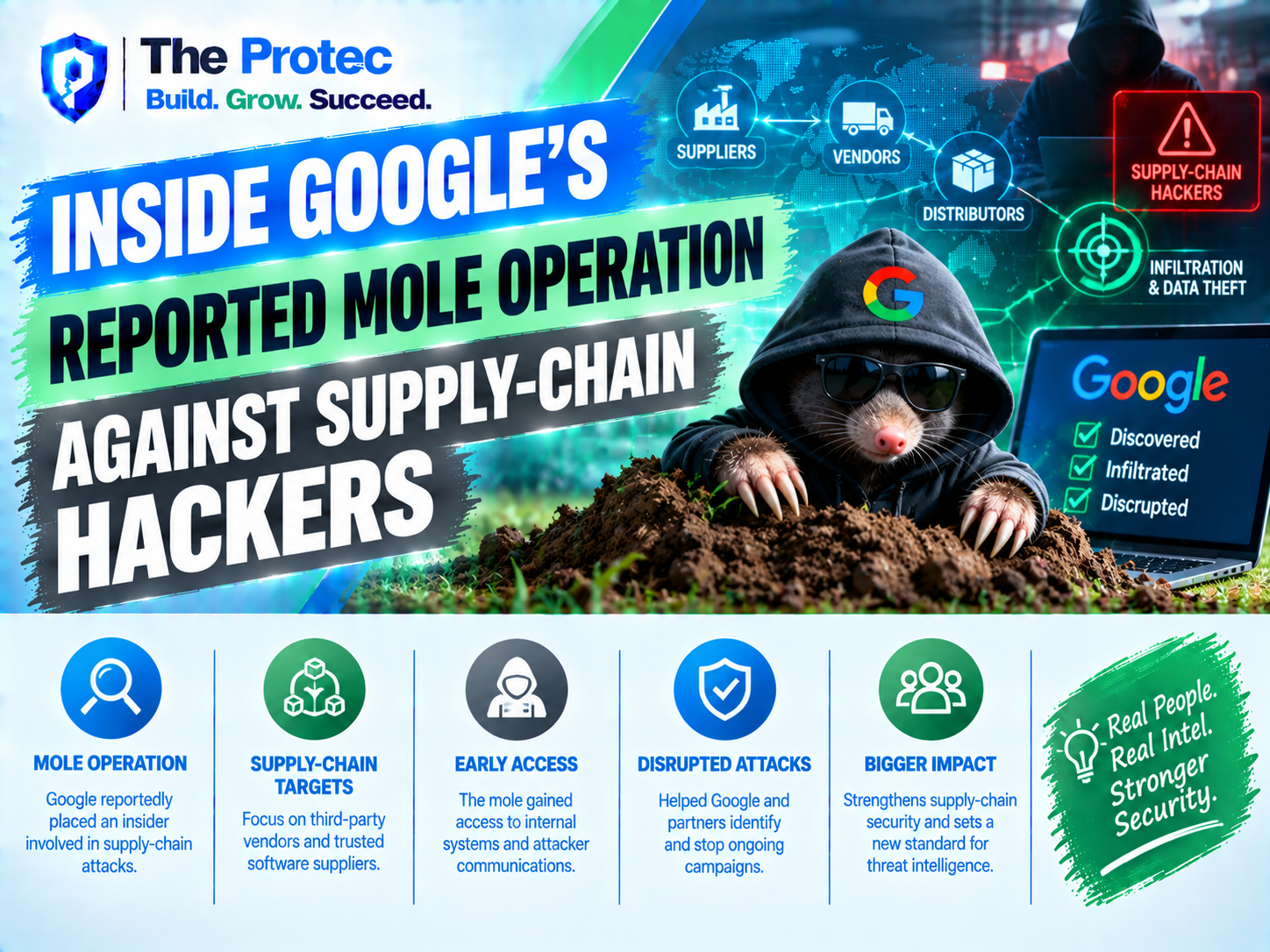
A defender watching a cyberattack from the outside can see compromised accounts, malicious software packages, suspicious network traffic, and stolen credentials. But the Google Mole Operation offered something far more valuable: visibility inside the responsible hacker group, where defenders could potentially see attackers choosing targets, testing code, assigning roles, discussing mistakes, and preparing their next move.
That distinction is at the center of reports that Google gained inside visibility into the hacker group associated with a massive supply-chain attack. The story has frequently been summarized as Google having a “mole” in the group. That description is compelling, but it also demands caution. Public reporting does not establish every operational detail, and Google has not disclosed enough information to confirm whether the access came from a recruited human source, an undercover identity, compromised criminal infrastructure, monitored communications, or a combination of techniques.
What is clear is that the episode illustrates a major evolution in Google cybersecurity operations. Threat intelligence is no longer limited to collecting malware samples after an incident. Advanced teams increasingly seek behavioral intelligence from the environments where attackers organize, develop tools, trade access, and coordinate campaigns. In a software supply chain attack, that early visibility can mean the difference between containing several malicious packages and responding after thousands of downstream systems have trusted them.
What Is Confirmed—and What Remains a Reported Claim?
The most important starting point is separating confirmed findings from reported claims. Google operates mature security and threat intelligence teams that investigate financially motivated criminals, state-backed operators, credential thieves, and groups targeting software ecosystems. Its researchers routinely connect infrastructure, malware, online personas, and attack techniques across multiple incidents.
It is also well established that sophisticated cyberattack investigations can involve access to closed forums, invitation-only chat channels, criminal marketplaces, or other attacker-controlled spaces. Investigators may monitor these environments directly, work with trusted sources, collaborate with law enforcement, or obtain intelligence from compromised infrastructure.
The narrower claim—that a Google hacker group mole was physically or personally embedded as a trusted member of the organization—has not been fully substantiated in public technical disclosures. “Mole” may be journalistic shorthand for persistent inside access rather than confirmation that Google recruited a real-world hacker group insider. Google has understandable reasons to withhold the identity of a source and the collection method. Revealing either could end the access, endanger a person, compromise an investigation, or teach criminals how to identify future infiltration.
Readers should therefore treat the following points differently:
- Confirmed in the broader public record: Google conducts extensive threat intelligence operations and tracks sophisticated criminal groups, malicious infrastructure, package abuse, and software supply-chain activity.
- Credibly reported: Investigators connected to Google obtained unusually close visibility into the group associated with a major campaign.
- Not publicly established: The exact identity of the source, whether the source was human, how long the access lasted, and which private conversations directly influenced defensive action.
This distinction does not make the intelligence unimportant. It prevents a dramatic label from being mistaken for a complete account of an operation that remains intentionally secretive.
Why the Massive Supply-Chain Attack Was So Significant
A conventional intrusion targets one organization. A cybersecurity supply chain attack targets something that many organizations already trust: a software package, update mechanism, developer account, build service, plug-in, integration, or code repository. One compromise can consequently reach hundreds or thousands of downstream environments.
The reported campaign drew attention because it abused the development ecosystem rather than relying only on direct attacks against individual victims. Malicious software packages or compromised package versions can imitate legitimate tools, inherit the reputation of a trusted maintainer, and execute during installation or application builds. Once loaded, malicious code may collect environment variables, authentication tokens, cloud credentials, repository secrets, and other data available to the developer or automated build process.
That access can create a dangerous feedback loop. Stolen maintainer credentials may be used to publish more compromised packages. Exposed tokens can provide entry into additional repositories. Secrets taken from a continuous integration environment can help attackers tamper with builds or access production infrastructure. A single infected dependency may therefore become a launch point for broader propagation.
Scale is not the only reason a software supply chain attack is serious. The trust relationships involved make detection difficult. Security teams expect approved build servers to download dependencies. Developers routinely run installation scripts. Applications legitimately communicate with package registries and cloud services. Attackers hide inside those normal workflows, forcing defenders to distinguish malicious behavior from expected engineering activity.
The episode also underscored a structural problem: modern applications may rely on hundreds or thousands of direct and transitive dependencies. An organization can review its own source code carefully while still inheriting risk from maintainers, registries, plug-ins, and build tools beyond its control.
How Hacker Group Infiltration Can Work
Hacker group infiltration does not always resemble a spy joining a criminal organization under a false name. Threat intelligence teams have several ways to gain internal visibility, and more than one may be used during the same operation.
Undercover identities and trusted personas
An investigator can build a credible online identity, enter communities used by threat actors, and gradually gain access to private discussions. Establishing trust may require demonstrating technical knowledge, understanding criminal jargon, and maintaining a believable history. This approach is slow and risky, but it can expose relationships that are invisible in malware telemetry.
Human sources inside criminal networks
A participant may cooperate voluntarily, provide information after an arrest, or become disillusioned by internal disputes. Financial disagreements are common in loosely organized cybercrime groups. Developers, access brokers, infrastructure operators, and money launderers may all possess different pieces of the operation.
Access to attacker infrastructure
Investigators may obtain server logs, administrative panels, repositories, bot databases, or communication archives through legal seizure, security mistakes, or collaboration with another organization. This can create the functional equivalent of an insider view without a human mole.
Long-term identity correlation
Google threat intelligence analysts can connect aliases by comparing coding habits, active hours, language patterns, reused domains, cryptocurrency activity, malware configurations, and operational mistakes. A criminal who appears anonymous in one channel may expose a known identity elsewhere.
These possibilities explain why the phrase “Google hacker group mole” should not automatically be interpreted literally. From a defender’s perspective, the result matters most: reliable insight into intent, capability, organization, and timing.
What an Insider Could Reveal About the Attackers
Technical indicators such as file hashes and IP addresses are useful, but criminals can replace them quickly. A hacker group insider can reveal durable behaviors that are harder to change.
The most valuable intelligence could include:
- Target selection: Which package maintainers, registries, cloud platforms, or development teams the group considers valuable.
- Initial-access methods: Whether the attackers use phishing, stolen session cookies, fake support requests, malicious dependencies, or compromised developer accounts.
- Roles and hierarchy: Who writes malicious code, manages infrastructure, negotiates access, steals data, or monetizes the intrusion.
- Operational timelines: When a package will be published, when credentials will be tested, or when stolen data will be moved.
- Unreleased tools: Malware, scripts, domains, and package names being prepared for future campaigns.
- Successes and failures: Which security controls interrupted the attack and which techniques remained effective.
- Attribution evidence: Connections among aliases, infrastructure, prior attacks, and affiliated criminal services.
For a Google supply chain attack investigation, advance knowledge of intended package names or developer targets could enable rapid warnings, registry intervention, account protection, and detection engineering. Even intelligence received during an active campaign could reduce the number of affected systems.
Behavioral Intelligence Can Detect What Indicators Miss
Indicators of compromise remain important, but they are often retrospective. A hash generally identifies a file that has already been observed. An attacker-controlled domain can be abandoned within hours. Behavioral intelligence instead asks how the adversary operates.
Suppose investigators learn that a group typically takes over dormant maintainer accounts, publishes a minor version update, executes an obfuscated installation script, and searches for cloud tokens in environment variables. Defenders can hunt for that sequence even when the package name, server, and payload are new.
Behavioral detection might flag an established package suddenly publishing from an unfamiliar location, an unexpected maintainer change, a release containing a new install hook, or a build process attempting to read secrets it has never accessed before. Registry operators can combine these signals with account age, authentication events, code similarity, and download patterns.
Inside visibility improves this work because it adds intent. An isolated anomaly may look harmless. If threat intelligence shows that attackers are actively testing the same technique, defenders can prioritize it immediately. This is how cybersecurity threat intelligence becomes operational security rather than a report read after the incident.
Google’s broad telemetry can also help connect behaviors across email, browsers, cloud services, endpoints, and software infrastructure. That does not make attribution automatic; conclusions still require evidence and careful analysis. It does, however, give investigators more opportunities to identify recurring attacker tradecraft.
Lessons for Modern Supply Chain Security
The incident offers practical lessons for organizations shaping their cybersecurity 2026 agenda. First, a software bill of materials is useful only when paired with continuous monitoring. Knowing which dependencies exist helps responders, but organizations must also detect when a trusted component changes behavior.
Second, developer identities deserve the same protection as privileged production accounts. Phishing-resistant multifactor authentication, short-lived credentials, protected release workflows, and hardware-backed signing can make account takeover more difficult. Publishing a package should require stronger verification than signing in to a routine collaboration tool.
Third, build environments should expose as few secrets as possible. Tokens must be narrowly scoped, rotated frequently, and prevented from reaching jobs that do not need them. Network egress controls can also stop an unexpected installation script from sending credentials to an external server.
Fourth, organizations should preserve dependency and build telemetry. Teams need to know what was downloaded, who approved a release, which scripts executed, and what network connections occurred. Without that evidence, a fast-moving cyberattack investigation becomes guesswork.
Finally, threat intelligence must be integrated with engineering and incident response. A warning about a malicious package family is valuable only if teams can search repositories, lock affected accounts, rebuild clean artifacts, and revoke exposed credentials quickly. Guidance from the Cybersecurity and Infrastructure Security Agency can help organizations structure broader supply chain risk programs, while the Google Threat Intelligence resource center provides research into evolving adversary activity.
Why Visibility Inside Criminal Networks Will Matter More
Attackers increasingly collaborate through fluid, service-based ecosystems. One actor steals credentials, another sells access, a developer creates malware, and an affiliate deploys it. Group names may describe a temporary coalition rather than a stable organization. Traditional attribution becomes harder when participants move between channels and campaigns.
Persistent access to those communities can expose relationships that technical artifacts alone cannot. It can reveal that two apparently separate attacks share a developer, that a package compromise was preparation for cloud extortion, or that a group is rebranding after being exposed.
There are also limits. Criminals may feed false information to a suspected source. A mole may see only one part of the operation. Intelligence can become stale, and acting on it too visibly may reveal that communications are monitored. Effective teams corroborate human or inside reporting with telemetry, malware analysis, victim evidence, and infrastructure data.
The larger lesson is not that every company needs its own undercover operative. Most organizations should consume trusted intelligence, harden development workflows, and prepare to act on behavioral warnings. Specialized teams at major technology companies, security vendors, and government agencies can conduct the more sensitive infiltration work.
Frequently Asked Questions
Did Google confirm that it had a human mole in the hacker group?
No complete public confirmation establishes that a Google employee or recruited human source joined the group. Reports indicate unusually close internal visibility, but “mole” could refer to a human source, undercover account, monitored criminal channel, compromised infrastructure, or another sensitive collection method.
Why are software supply-chain attacks difficult to stop?
They exploit trusted relationships. Malicious code can arrive through an approved dependency, update, developer tool, or integration and then execute as part of a normal workflow. The number of downstream users also allows one compromise to affect many organizations.
How does insider intelligence help defenders?
It can reveal targets, timelines, tools, aliases, access methods, and future plans. Defenders can convert that information into behavioral detections, warnings, account protections, package removals, and infrastructure blocks before an attack reaches its full scale.
What should organizations do after discovering a malicious package?
Removing the package is only the first step. Teams should identify every affected build, revoke exposed credentials, inspect developer accounts, review outbound traffic, rebuild artifacts from a trusted state, and determine whether stolen tokens enabled access to other systems.
The Real Significance of the Reported Google Operation
The most consequential part of this story is not the spy-like language surrounding a reported mole. It is the shift from observing cybercriminals after an attack to understanding them while they plan and operate.
Supply-chain attackers exploit trust at scale. Defeating them requires equally scalable visibility across identities, code, infrastructure, and behavior. If Google’s investigators did maintain an inside view of the group, that access could have supplied context no malware sample could provide: who was involved, what they intended to compromise, and how their operation might evolve.
Some operational details may never become public, and unverified claims should not be presented as fact. Even with that uncertainty, the case demonstrates why modern supply chain security depends on more than scanning code. It requires intelligence capable of exposing the people and processes behind malicious software—and defenders prepared to act before trusted systems become distribution channels for the next attack.