






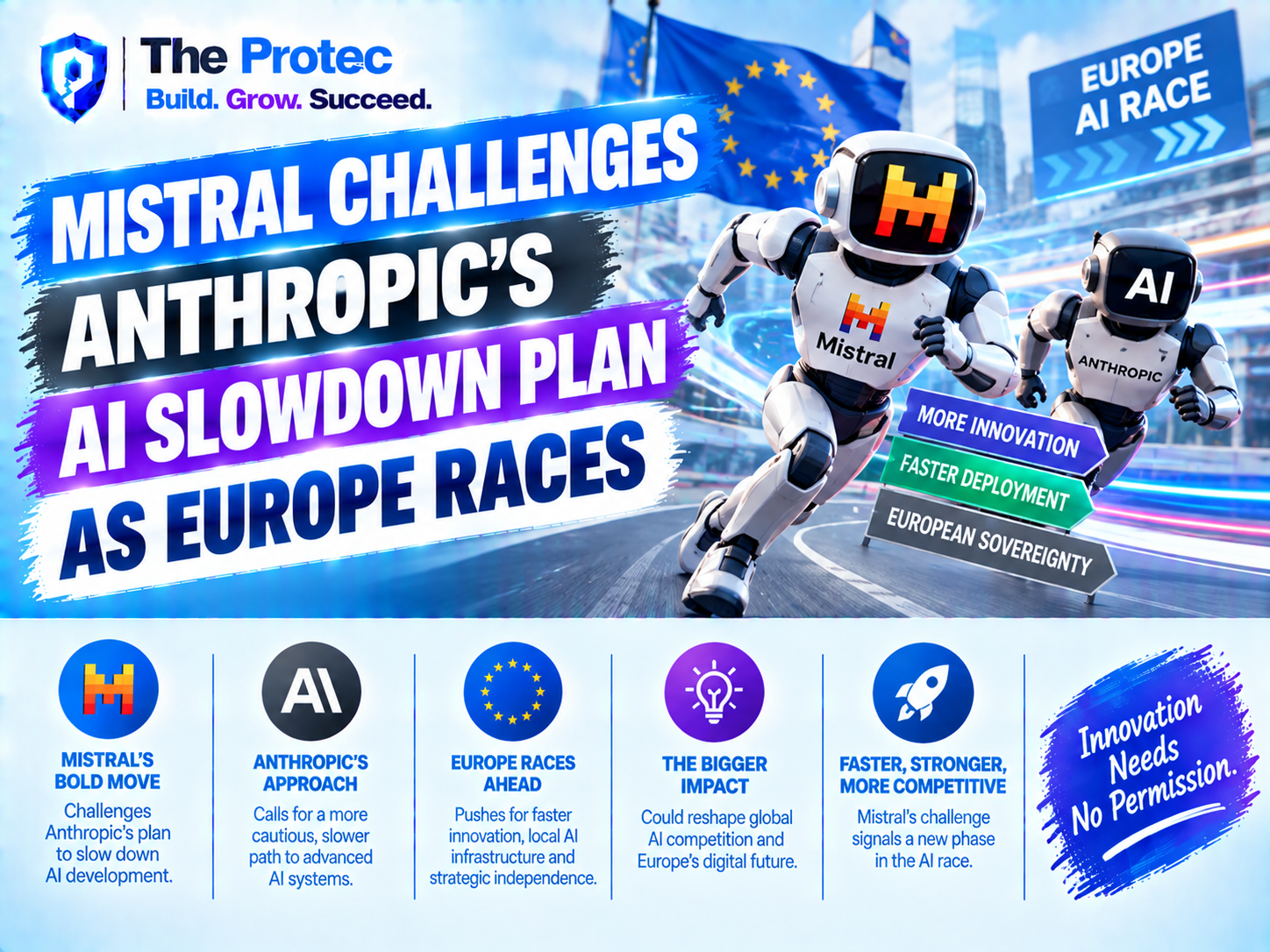
Europe’s artificial intelligence ambitions have reached a defining moment. Mistral AI, the Paris-based model developer that has become a symbol of European technological sovereignty, is pushing for faster development, more regional computing capacity and rules that do not leave local companies permanently behind their better-funded American rivals. Across the Atlantic, Anthropic AI has built its identity around a different priority: controlling the risks created by increasingly capable systems before those systems become difficult to manage.
The resulting Mistral vs Anthropic divide is often presented as a simple argument between acceleration and restraint. The reality is more nuanced. Mistral does not advocate abandoning safety, and Anthropic has not proposed stopping all AI research. Their disagreement is primarily about how quickly frontier systems should advance, which safeguards should be mandatory, and whether restrictions imposed before Europe has developed competitive infrastructure could entrench U.S. dominance.
As of September 2026, that debate carries consequences well beyond two companies. It touches the future of European AI startups, access to advanced chips, sovereign cloud infrastructure, the enforcement of the EU AI Act and Europe’s ability to compete in a market increasingly shaped by enormous computing budgets. It also raises an urgent question: can Europe protect society from powerful AI without regulating itself out of the global race?
Mistral AI and Anthropic Represent Two Competing Priorities
Mistral AI was founded in France by researchers with experience at major U.S. technology laboratories. It quickly gained attention through efficient language models, open-weight releases and commercial products designed to give businesses and public institutions alternatives to American platforms. Its strategy combines selective openness with proprietary services, including enterprise deployments and the Le Chat assistant.
That approach reflects a broader European concern. If the continent depends entirely on foreign models, chips and cloud platforms, it may have limited control over the systems embedded in government, defense, healthcare and industrial operations. Mistral AI Europe has therefore become more than a startup success story. It is increasingly treated as part of a potential European AI infrastructure layer.
Anthropic AI emerged from a different institutional tradition. Founded by former OpenAI researchers, it has made safety research, model evaluation and Constitutional AI central to its public positioning. Its Responsible Scaling Policy links stronger safeguards to evidence that models are approaching dangerous capabilities. The framework covers risks such as assistance with biological threats, advanced cyber operations and the potential for systems to act with greater autonomy.
Anthropic’s documented position is not a blanket demand to halt artificial intelligence. Its policy is better understood as a conditional framework: when capabilities cross specified thresholds, security and deployment protections should become more demanding. The company’s evolving Responsible Scaling Policy provides the clearest primary source for that approach.
The phrase “AI slowdown plan” is consequently shorthand for a wider safety-first agenda, not the title of a universal moratorium proposed by Anthropic. That distinction matters because public debate can easily turn a technical dispute about thresholds, testing and deployment controls into a misleading choice between progress and paralysis.
Why Mistral Resists an AI Development Slowdown
Mistral’s resistance to broad restrictions is rooted in Europe’s competitive position. The largest U.S. AI companies have access to deeper capital markets, hyperscale cloud infrastructure, extensive distribution channels and enormous supplies of advanced accelerators. European AI companies generally operate with smaller funding rounds and a more fragmented customer market.
A slowdown applied unevenly would not freeze that gap. It could widen it. If European developers face higher compliance costs while foreign companies continue training more capable systems, Europe may become primarily a buyer of AI rather than a producer. Even rules that apply formally to every provider can affect smaller companies more severely because documentation, evaluations, legal reviews and security controls impose substantial fixed costs.
Mistral’s answer has been to argue for proportionate regulation and faster investment in the foundations of AI development. That includes computing clusters, energy supply, data centers, research talent and procurement programs capable of turning European models into widely used products. Its announced work on domestic computing infrastructure, including projects involving NVIDIA technology, supports an effort to reduce reliance on non-European cloud capacity.
The company also emphasizes efficiency. Smaller models, mixture-of-experts architectures and specialized systems can reduce the cost of training and inference. This matters because the Europe AI race is not necessarily won by reproducing every U.S. hyperscaler. Europe could compete through efficient models, industrial specialization, multilingual performance and deployments that satisfy regional privacy and security requirements.
From this perspective, an AI development slowdown introduced before Europe builds those capabilities would be strategically mistimed. It could preserve the lead of companies that already control the largest models, richest datasets and most mature distribution networks.
Anthropic’s AI Safety Case Is Harder to Dismiss
Anthropic’s position responds to a different asymmetry: technical capabilities may improve faster than governments and safety institutions can adapt. Advanced models are becoming better at software development, tool use, scientific analysis, long-horizon tasks and autonomous operation. Agentic systems can now perform sequences of actions rather than merely generate text, increasing both their economic value and their potential impact.
Anthropic AI safety policies focus on preparing for capabilities that could make cyberattacks, biological misuse or loss-of-control scenarios more plausible. The company favors evaluations, stronger information security, deployment restrictions and governance measures that escalate with model capability. It has also invested in interpretability research intended to reveal how models form internal representations and produce decisions.
Critics sometimes interpret this approach as an attempt by a well-funded U.S. company to raise barriers for smaller competitors. That is a reasonable competition-policy question, particularly when expensive safety standards could favor laboratories with billions in backing. It is not, however, proof that the underlying risks are imaginary. Both claims can be considered at once: frontier safeguards may be necessary, and badly designed safeguards may consolidate the market.
Anthropic’s strongest argument is that waiting for clear evidence of catastrophic harm could be too late. Safety measures for highly capable systems may require years of research, infrastructure and institutional preparation. Under that view, voluntary promises made after dangerous capabilities appear would be inadequate.
AI Safety vs Innovation Is Not a Binary Choice
The central policy challenge is to separate high-risk frontier development from ordinary AI adoption. A compact model used to translate customer support messages does not present the same risk profile as a frontier system capable of advanced cyber operations or autonomous scientific work. Treating both as equivalent would waste regulatory resources and discourage useful deployment.
A credible middle ground would place the greatest obligations on capabilities and uses that can cause the most harm. It could include independent evaluations for frontier models, incident reporting, cybersecurity requirements, controlled access to especially dangerous functions and transparent criteria for escalating safeguards. Smaller systems and low-risk applications could face lighter obligations.
This distinction supports innovation without assuming every new capability is harmless. It also avoids using company size alone as a proxy for risk. A well-funded provider should not escape scrutiny simply because it has a sophisticated safety team, while a European startup should not be burdened with frontier-level requirements for a narrow industrial model.
Competition policy must be part of the framework. Safety rules should use measurable capability thresholds where possible, offer shared testing resources and prevent dominant companies from defining standards that only they can afford to satisfy. Publicly supported evaluation centers could help European AI startups demonstrate compliance without constructing expensive testing operations independently.
How AI Regulation in Europe Shapes the Divide
The EU AI Act creates the world’s most developed cross-sector framework for artificial intelligence. Its risk-based structure includes prohibited practices, obligations for high-risk systems, transparency rules and a separate regime for general-purpose AI models. By September 2026, major portions of the phased framework have begun applying, making implementation rather than legislative theory the immediate concern.
General-purpose model providers can face documentation, copyright-policy and transparency requirements. Providers of models considered capable of creating systemic risk have additional duties related to evaluations, incident reporting, cybersecurity and risk mitigation. The European Commission’s official AI Act overview explains the framework and its implementation schedule.
For Anthropic, capability-based obligations resemble elements of responsible scaling: stronger systems warrant stronger controls. For Mistral, the crucial questions are proportionality, predictability and administrative burden. If definitions remain unclear or compliance becomes excessively costly, European developers may spend scarce resources on legal processes rather than models, products and infrastructure.
Enforcement will therefore determine whether AI regulation in Europe becomes a competitive asset or a drag on growth. Clear standards could help trusted European systems win adoption in regulated sectors. Fragmented interpretation across member states, by contrast, could force companies to navigate multiple practical rulebooks inside what is supposed to be a single market.
Europe’s Infrastructure Gap Is as Important as Regulation
Policy debates often focus on rules while underestimating physical constraints. Frontier AI depends on advanced chips, data-center construction, reliable electricity, cooling systems, networking equipment and technical talent. Europe has world-class research institutions and a critical semiconductor equipment industry, but it remains dependent on foreign suppliers for much of the AI computing stack.
Mistral’s push for European computing capacity addresses that weakness directly. Sovereign infrastructure can give governments and companies more control over data residency, operational resilience and model availability. It can also create a regional customer base for European software, cloud and semiconductor companies.
Yet sovereign AI cannot mean isolation. Training and serving competitive models require international supply chains and partnerships. Europe’s practical goal is better described as strategic capacity: maintaining enough domestic capability to avoid complete dependence while continuing to work with global hardware and cloud providers.
The funding gap remains formidable. American laboratories benefit from strategic relationships with Amazon, Google, Microsoft and other infrastructure giants. European initiatives must combine private capital, EU programs, national investment and customer procurement. Grants alone will not create a durable European AI industry if local companies cannot convert research into recurring commercial demand.
What the Competing Approaches Mean for Europe’s AI Ecosystem
If Mistral’s acceleration argument prevails without adequate safeguards, Europe could gain speed but expose itself to preventable failures. Security incidents, deceptive model behavior or harmful deployments could damage public trust and provoke a harsher regulatory response later. Moving fast is sustainable only when testing and accountability improve alongside capability.
If Anthropic’s precautionary logic is applied too broadly, Europe could lock in an unfavorable market structure. Compliance-heavy development may push talent and investment toward the United States, while European customers rely on foreign models delivered through foreign clouds. Safety rules would then govern consumption without creating meaningful technological sovereignty.
The better outcome combines Mistral’s urgency with Anthropic’s capability-sensitive safeguards. Europe needs rapid investment in compute, energy, skills and commercialization, paired with serious frontier evaluations and security standards. It also needs rules that distinguish speculative concerns from measurable risks and frontier laboratories from ordinary application developers.
This balance could become a European advantage. The continent has strong industrial companies, public research institutions, multilingual markets and experience regulating safety-critical sectors. If it builds infrastructure and simplifies responsible deployment, it can specialize in trustworthy AI for manufacturing, healthcare, energy, finance and public administration rather than competing only on model size.
The Real Stakes in the Mistral vs Anthropic Debate
The disagreement is ultimately about sequencing. Mistral’s implicit warning is that Europe must build before it can meaningfully govern a technology it otherwise imports. Anthropic’s warning is that governance cannot wait until systems become powerful enough to create irreversible problems.
Both arguments identify genuine risks. Dependence on foreign AI infrastructure can weaken Europe’s economic and political autonomy. Uncontrolled frontier development can create security and societal dangers that conventional product regulation is poorly equipped to handle.
Europe’s task is not to choose acceleration or safety as an absolute. It is to ensure that safeguards rise with demonstrated capability while investment rises fast enough to keep European companies in the race. The success of that strategy will depend less on slogans about moving fast or slowing down than on execution: accessible compute, clear thresholds, credible evaluations, coordinated enforcement and customers willing to buy European technology.
Frequently Asked Questions
Has Anthropic called for a complete halt to AI development?
No. Anthropic has promoted responsible scaling, capability evaluations and stronger safeguards for increasingly powerful models. Describing this as an AI slowdown plan is convenient shorthand, but it should not be confused with a universal ban or permanent moratorium on artificial intelligence research.
Why does Mistral AI oppose broad development restrictions?
Mistral argues from Europe’s position as a challenger. Broad or costly restrictions could make it harder for European AI companies to close the gap with better-funded U.S. competitors. The company favors faster infrastructure investment and proportionate rules that focus on actual risks rather than imposing identical obligations on every model.
How does the EU AI Act affect Mistral and Anthropic?
Both companies must consider EU requirements when offering general-purpose models in the European market. Obligations can include technical documentation, transparency, copyright policies and additional risk-management measures for models classified as presenting systemic risk. The practical burden depends on model capabilities, distribution and how regulators enforce the rules.
Can Europe compete with the United States in artificial intelligence?
Europe faces disadvantages in capital, cloud scale and access to computing infrastructure, but it retains strengths in research, industrial applications, multilingual technology and regulated markets. Competing effectively will require more compute, coordinated investment, simpler commercialization and safety rules that do not unintentionally protect established foreign providers.
Which approach is better for the European AI industry?
Neither approach is sufficient alone. Mistral’s emphasis on speed and sovereignty addresses Europe’s competitive gap, while Anthropic’s safety framework addresses risks from frontier capabilities. Europe’s strongest strategy is accelerated investment combined with targeted, capability-based safeguards and affordable compliance for smaller developers.