





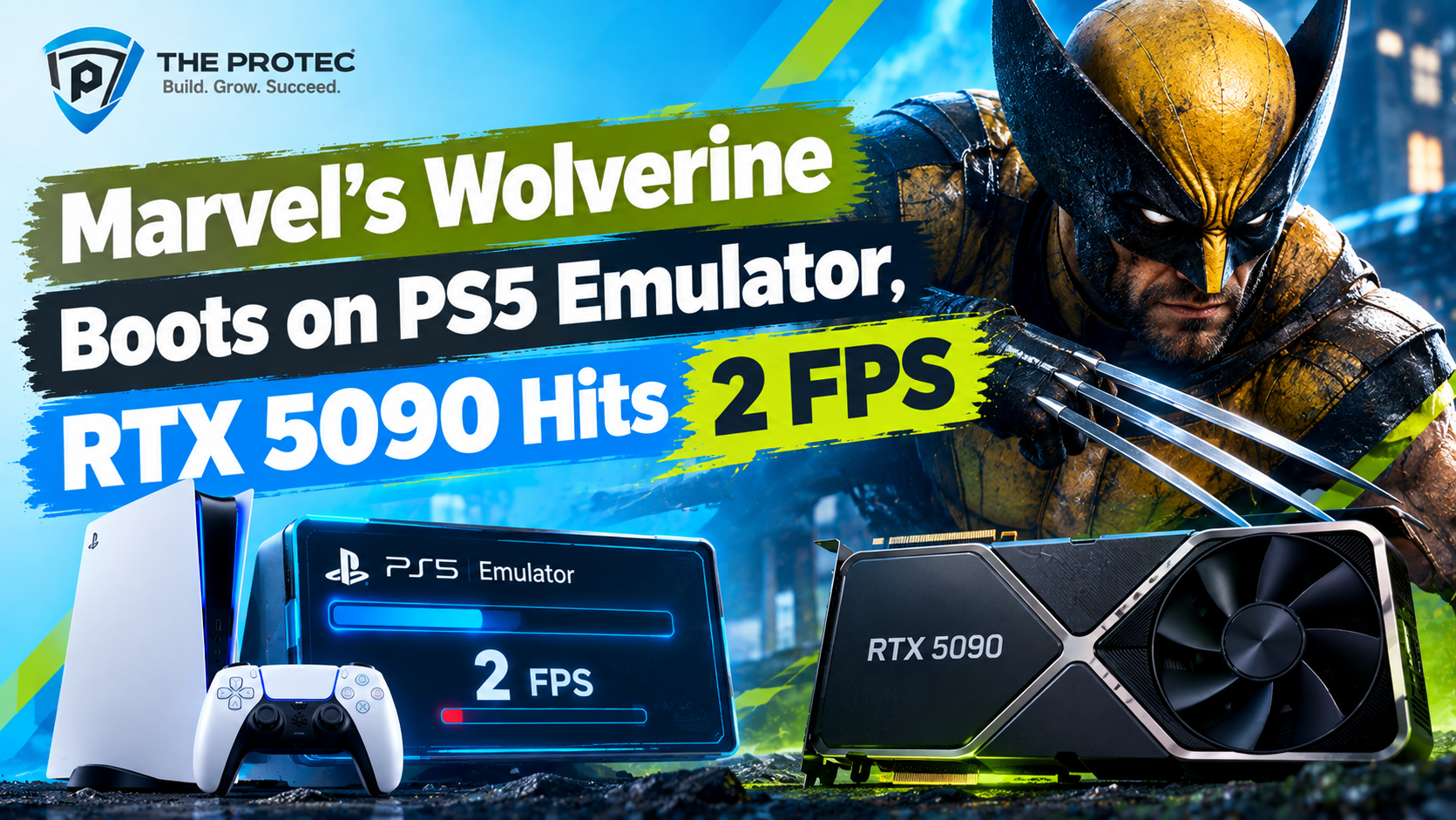
Marvel’s Wolverine has reportedly reached its main menu through an experimental PS5 emulator running on one of the fastest gaming PCs available. That sounds like a major step toward Marvel’s Wolverine on PC, but the headline comes with an equally important qualification: the demonstration runs at approximately 2 frames per second, and no playable gameplay has been shown.
The reported test pairs the KyTyPS5 emulator with an AMD Ryzen 7 7800X3D and Nvidia GeForce RTX 5090. Despite that formidable hardware, the software advances at a crawl. The result is nowhere near a commercial PC port or even a usable emulation experience. Still, reaching the menu of a demanding, unreleased PS5 title is technically significant because it suggests that the emulator can process enough of the game’s executable code, graphics calls, memory operations and system-service requests to produce recognizable output.
As of September 2026, the Marvel’s Wolverine PS5 emulator demonstration should be viewed as an early compatibility experiment rather than evidence of an imminent PC release. It is unofficial, has not produced playable gameplay and does not represent support from Sony, Insomniac Games or Nvidia. What it does offer is a revealing snapshot of how quickly PS5 emulation is evolving—and how far it still has to go.
What the KyTyPS5 Wolverine demonstration reportedly achieved
The reported setup uses KyTyPS5 to boot Marvel’s Wolverine on a PC powered by the Ryzen 7 7800X3D and GeForce RTX 5090. The emulator apparently progresses far enough to display the game’s main menu, with output hovering around 2 FPS. That is the central achievement. Claims that the game is fully running, playable or ready for ordinary Wolverine PC gaming would overstate what has been demonstrated.
There is a meaningful difference between displaying a menu and executing the complete game. Menus can still depend on a substantial portion of the rendering pipeline, user-interface framework, shader system and game engine, but they generally place fewer demands on simulation, streaming, artificial intelligence, physics and controller input than active gameplay. A menu that updates at 2 FPS therefore confirms partial execution, not broad compatibility.
The available result also needs to be treated as a report from an experimental environment. Emulator builds, game revisions, configuration changes and custom patches can dramatically affect whether software reaches a menu or crashes during startup. Until the result is reproduced with documented settings, it remains a promising but unofficial technical demonstration.
To a player, a 2 FPS menu has little practical value. To an emulator developer, however, every additional stage of the boot process provides useful information. A modern console game must pass through multiple layers before anything recognizable appears on screen. The emulator may need to load executables, map virtual memory, respond to operating-system calls, initialize graphics resources, compile or translate shaders, mount game data and keep dozens of threads synchronized.
If any required function is missing or behaves incorrectly, the game may close immediately, freeze on a blank screen or produce corrupted graphics. Reaching the main menu indicates that KyTyPS5 Wolverine support has moved beyond a simple executable launch. At least some of the game’s CPU instructions, GPU workloads and PS5 software interfaces are being handled well enough to create visible, structured output.
This is why early emulator progress is often measured through stages rather than average frame rates. Developers commonly distinguish among software that does not boot, boots to a logo, reaches menus, enters gameplay and becomes playable from beginning to end. Marvel’s Wolverine appears to have reached one of those intermediate steps. It is a real milestone, but not the final one.
How early-stage PS5 emulation works
The PS5 and modern gaming PCs both use x86-64 CPU technology, which removes some of the instruction-set translation challenges associated with consoles built around radically different processors. That similarity does not make PS5 emulation straightforward. A PS5 game is designed for Sony’s operating system, graphics interfaces, memory behavior, storage pipeline and fixed hardware configuration—not for Windows and a GeForce graphics card.
An emulator must recreate or translate the environment the game expects. Depending on the implementation, that work can include several demanding tasks:
- Mapping PS5 system calls to compatible host-PC functions.
- Translating console graphics commands into APIs supported by Windows GPUs.
- Recompiling shaders and reproducing PS5-specific rendering behavior.
- Emulating memory allocation, protection, synchronization and cache assumptions.
- Providing expected audio, input, file-system and timing services.
- Handling errors caused by incomplete or inaccurate hardware behavior.
Early PS5 emulation is especially vulnerable to small inaccuracies. A timing issue that seems insignificant can break thread synchronization. A missing graphics feature can prevent a scene from rendering. An incorrect memory flag can cause a crash several minutes after startup. Developers must identify these failures game by game while improving the underlying emulator so that fixes do not break other software.
KyTy is an open-source experimental project associated with PS4 and PS5 emulation. Its public development history can be viewed through the project’s GitHub repository. Experimental forks or builds may be described as KyTyPS5, but capabilities can differ considerably between versions. A successful result in one customized environment does not guarantee identical behavior in a public build.
Why an RTX 5090 can still be limited to 2 FPS
Seeing Marvel’s Wolverine RTX 5090 performance at only 2 FPS may appear absurd. The RTX 5090 is vastly more powerful than the PS5 GPU in conventional PC benchmarks, while the Ryzen 7 7800X3D remains a highly capable gaming processor. Emulation, however, is not a normal native rendering workload.
A native PC game sends work through drivers and graphics APIs designed for the installed hardware. An emulator adds translation, validation and synchronization between the game and host system. If that translation path is incomplete or inefficient, additional GPU power cannot remove the bottleneck. The RTX 5090 may spend much of its time waiting for the emulator, CPU or shader translation process rather than rendering at full capacity.
CPU performance can also become the limiting factor even when the emulated console and host PC share the same broad instruction architecture. The emulator may need to intercept calls, maintain console-accurate state and coordinate threads more carefully than a native application. A task that requires one operation on the PS5 can expand into multiple operations on the host.
Shader compilation is another likely source of poor Wolverine emulator performance. Console shaders may need to be converted into a format understood by the PC graphics stack. Early translation can produce inefficient code, visual errors or long stalls. Some effects may temporarily rely on slow fallback paths simply to display an image. Accuracy is often prioritized before optimization because a slow, correct frame gives developers more useful feedback than a fast but broken one.
Frame rate at this stage therefore says more about emulator maturity than the raw capabilities of the RTX 5090. The reported Marvel Wolverine 2 FPS result does not indicate that the GPU is incapable of handling the game. It indicates that the software layer connecting the game to the GPU is still highly experimental.
Booting a game is not the same as playable compatibility
A title can reach its main menu and still fail as soon as gameplay begins. Moving into an interactive scene introduces far more complex workloads, including world streaming, physics, animation, combat systems, artificial intelligence, audio mixing and continuous controller input. The game may call PS5 functions that were never needed during startup.
Playable compatibility typically requires more than entering a level. An emulator must maintain acceptable performance, render scenes correctly, preserve saves, produce stable audio and avoid progression-blocking crashes. Input latency and frame pacing also matter. A game that averages 30 FPS but freezes repeatedly during shader compilation would still provide a poor experience.
No such level of Marvel’s Wolverine performance has been demonstrated here. There is no confirmed campaign footage running through KyTyPS5, no evidence that missions can be completed and no indication that the title can maintain a remotely playable frame rate. Describing the result as a Marvel Wolverine PC emulator release would therefore be inaccurate.
It is equally important to separate this demonstration from a native Insomniac Wolverine PC version. Sony and Insomniac have not turned the KyTyPS5 test into an official product. Emulation and native porting are entirely different processes: a native port is deliberately adapted, tested and optimized for PC, while an emulator attempts to reproduce the original console environment.
What this says about PS5 emulation progress
The most notable part of the result is not the frame rate but the pace at which the broader PS5 emulation scene is moving. Developers now have faster processors, increasingly capable graphics APIs and years of knowledge gained from PS4 emulation. Open-source collaboration also allows discoveries in shader translation, system libraries and debugging tools to spread across projects.
Even so, PS5 emulation remains much less mature than emulation for older platforms. Modern games are large, highly parallel applications built around advanced graphics features and rapid asset streaming. Achieving reliable compatibility requires far more than making a few lightweight titles boot. Demanding first-party software can expose missing functions and accuracy problems that simpler programs never touch.
The Wolverine PS5 emulator 2 FPS result illustrates both sides of that reality. Reaching a sophisticated game’s menu demonstrates genuine technical progress. Requiring an RTX 5090-class system to produce only a handful of frames demonstrates the enormous amount of optimization and compatibility work remaining.
Future improvements could come from better shader translation, more efficient system-call handling, smarter caching, reduced synchronization overhead and game-specific bug fixes. Performance gains in emulators are not always gradual; removing one major bottleneck can produce a dramatic jump. There is nevertheless no responsible basis for predicting when Marvel’s Wolverine might become playable through PS5 emulation.
What PC players should expect
PC players should not interpret the demonstration as a substitute for an official Marvel’s Wolverine PC release. The current result is aimed at technical experimentation, not ordinary gaming. Even enthusiasts with an RTX 5090 and a premium CPU would encounter severe performance limitations, incomplete compatibility and likely instability.
Reports involving unreleased games also demand caution. Game files and development material are copyrighted, and an emulator does not provide legal authorization to download or distribute them. The emulator itself and the software run through it are separate issues. This demonstration should be understood as news about PS5 emulation progress, not as guidance for obtaining the game.
For now, the accurate conclusion is narrow but fascinating: KyTyPS5 reportedly boots Marvel’s Wolverine far enough to reach the main menu on a Ryzen 7 7800X3D and RTX 5090 PC. The output is approximately 2 FPS, no playable gameplay has been established, and the test is completely unofficial. It is a glimpse at the future of PS5 emulator PC development, not a playable PC launch.
Frequently asked questions
Is Marvel’s Wolverine playable on the KyTyPS5 emulator?
No. The reported KyTyPS5 Wolverine demonstration reaches the game’s main menu at roughly 2 FPS. No playable gameplay, stable campaign progress or acceptable performance has been demonstrated. Booting to a menu is a compatibility milestone rather than proof of playability.
Why does Marvel’s Wolverine run so slowly on an RTX 5090?
The bottleneck is the immature emulation layer, not necessarily the RTX 5090’s rendering power. KyTyPS5 must translate PS5 graphics commands, system services, memory behavior and synchronization into operations a Windows PC can execute. Incomplete or inefficient translation can keep both the CPU and GPU waiting, resulting in extremely low performance.
Does the demonstration confirm Marvel’s Wolverine for PC?
No. This is an unofficial emulation test and has no connection to an official PC port. A native Marvel’s Wolverine PC release would need to be announced by Sony or Insomniac Games. The emulator demonstration neither confirms such a release nor provides a playable alternative.
Reaching the menu means the emulator has successfully handled a meaningful portion of the game’s startup process, including executable loading, memory operations, system calls and graphics output. Developers can use that progress to identify the next failures and optimize slow components. It is an engineering milestone even though it has no practical gaming value yet.