








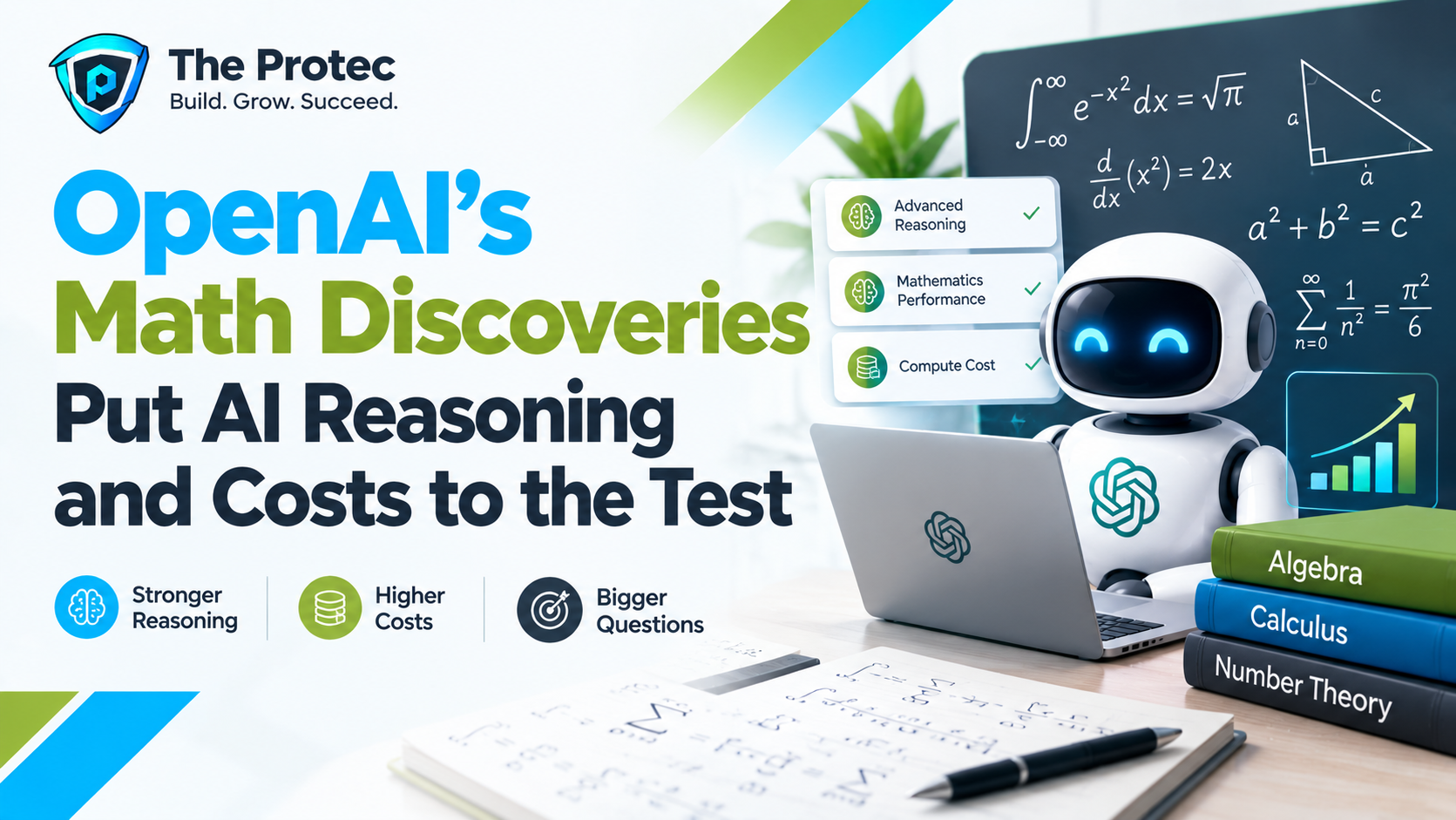
Artificial intelligence has been solving textbook exercises, generating proofs and explaining established theorems for years. OpenAI’s latest mathematical research points toward a more consequential possibility: using an AI model to help produce mathematical insights that were not already known to the researchers conducting the work.
The distinction matters. Reconstructing an existing proof from training data is fundamentally different from identifying a useful pattern, proposing a new conjecture or developing an argument that advances an open question. OpenAI says its model contributed to mathematical discoveries through an iterative process involving AI-generated ideas, computational experiments and expert evaluation. The company also disclosed information about the computing resources and costs involved, providing a rare look at the economics of advanced AI reasoning.
These results should be interpreted carefully. Some findings received stronger forms of expert or computational validation than others, and a claim made by a model developer is not automatically an independently established mathematical breakthrough. Even so, the work illustrates how AI mathematics research is moving beyond benchmark scores and toward collaboration on problems where the answer is not known in advance.
What OpenAI Says Its AI Model Contributed
OpenAI’s reported work did not involve asking a chatbot a single question and accepting its first answer. The model was used as part of a broader research workflow. Depending on the problem, its contributions included suggesting promising approaches, finding patterns in examples, proposing intermediate lemmas, generating candidate proofs and revising arguments after researchers identified errors or missing steps.
This is an important description of the model’s role. It was neither a completely autonomous mathematician nor merely a writing assistant. The AI operated as an exploratory tool capable of producing many possible lines of reasoning quickly. Human researchers then had to determine which suggestions were relevant, original and mathematically sound.
In practical terms, AI model solving mathematics at the research frontier can involve several stages:
- Translating an informal research question into a form the model can analyze.
- Generating candidate conjectures, constructions or proof strategies.
- Testing ideas against examples, edge cases and known results.
- Searching for counterexamples that could invalidate a claim.
- Refining promising arguments through repeated inference runs.
- Submitting the final reasoning to human experts or formal verification tools.
OpenAI’s contribution claims are most persuasive where the resulting argument is explicit enough for specialists to inspect. A fluent explanation is not evidence by itself. Mathematics requires each conclusion to follow from stated assumptions, regardless of how confident or sophisticated the model sounds.
Why AI-Generated Mathematical Discoveries Are Different
Most public demonstrations of artificial intelligence mathematical reasoning focus on problems with known answers. Olympiad questions, benchmark suites and university exercises are useful because performance can be measured objectively. However, they primarily test whether a system can reach a destination that humans have already mapped.
AI scientific discovery presents a harder challenge. The system must help identify a destination worth reaching and produce evidence that the route is valid. An AI-generated mathematical discovery might be a new bound, an unexpected relationship between mathematical objects, a shorter proof, a counterexample to a conjecture or a useful generalization of an existing result.
That does not mean every new-looking model output is genuinely novel. Training data may contain obscure papers, preprints or discussions that neither the user nor the evaluator immediately recognizes. Models can also rephrase known results in unfamiliar language. Establishing novelty therefore requires literature review and subject-matter expertise, not simply a failure to find the same wording through an online search.
The meaningful development in OpenAI’s research is the attempt to integrate generative reasoning with the normal safeguards of mathematical practice. If that approach proves reliable, AI could help researchers search a much larger space of possibilities than they could investigate manually.
How Researchers Evaluate OpenAI Math Discoveries
Evaluation is central to interpreting any OpenAI research breakthrough. Mathematical validity, novelty and importance are separate questions, and a finding can perform well on one measure while falling short on another.
Checking whether the reasoning is correct
Researchers can inspect each proof step, reproduce calculations and test the claim across relevant examples. For suitable problems, computer algebra systems or formal theorem provers can provide additional confidence. Tools based on formal languages such as Lean require proofs to be expressed in a machine-checkable form, reducing the risk that persuasive prose hides a logical gap.
Determining whether the result is new
A correct result is not necessarily a discovery. Specialists must compare it with published papers, preprints, reference databases and related formulations. This step can be difficult because the same theorem may appear under different notation or as a consequence of a broader result.
Assessing whether it matters
Novel mathematics ranges from minor observations to results that reshape a field. OpenAI’s reported findings should not be treated as landmark discoveries merely because an advanced model helped produce them. Their significance depends on whether they resolve meaningful questions, introduce reusable methods or enable further research.
Independent review remains especially important. Results checked by OpenAI researchers or collaborators have stronger support than unreviewed model output, but external scrutiny can uncover overlooked prior work, hidden assumptions or proof errors. Readers should distinguish independently verified results from OpenAI’s own characterization of what its system achieved.
How AI Could Change Mathematical Research
The most immediate opportunity is not replacing mathematicians. It is reducing the cost of exploration. Researchers routinely abandon potential approaches because investigating every possibility would take too much time. A capable model can rapidly propose variations, calculate examples and expose weaknesses before a human commits days to an unproductive direction.
AI theorem discovery could also connect ideas across specialties. Modern mathematics is highly fragmented, and techniques familiar in one field may be overlooked in another. Models trained across a broad technical corpus may suggest analogies or transformations that help experts cross those boundaries. Such suggestions still need validation, but even an imperfect connection can be valuable if it directs attention toward a productive method.
Another promising use is conjecture testing. A model paired with code execution can generate examples, search for exceptions and refine a statement when the original version fails. This loop resembles experimental mathematics, where computation guides the formation of claims before a proof is found.
As of October 2026, this human-model-tool combination is one of the clearest trends in advanced AI reasoning. Frontier systems increasingly operate with external software, retrieval, persistent workspaces and verification steps instead of relying on a single uninterrupted response.
What OpenAI’s Compute Cost Disclosure Tells Us
OpenAI’s discussion of compute costs adds an economic dimension that is often absent from AI research announcements. A model can appear highly capable while requiring enough repeated inference, sampling and verification to make its use impractical for many laboratories.
The disclosed costs are best understood as experiment-specific rather than a universal price for producing a theorem. AI model compute costs depend on several variables:
- Model architecture: Larger models and systems using mixture-of-experts routing have different hardware and memory requirements.
- Inference strategy: Generating one answer is cheaper than sampling many candidates, running search or allowing a model to reason for an extended period.
- Hardware: Accelerator type, utilization, energy prices and data-center efficiency affect the real expense.
- Context length: Long research histories, papers and intermediate calculations increase token processing.
- Experiment volume: Failed attempts, prompt revisions and validation runs can exceed the cost of the final successful output.
- Supporting tools: Code execution, retrieval systems, theorem provers and human review add resources beyond the core model call.
Training cost and inference cost must also be separated. The enormous expense of building a frontier model is generally amortized across many uses. The cost reported for a mathematical research project usually concerns post-training experimentation and inference, not the full cost of creating the underlying system.
For additional context on how the company presents its technical work, readers can consult OpenAI’s research publications. Cost figures should always be read alongside the experimental setup, model version and amount of search performed.
Why Compute Transparency Matters
Transparency around OpenAI computing expenses helps researchers judge reproducibility. If a result required thousands of model attempts, extensive private tooling or specialized infrastructure, another team may be unable to recreate it even with access to a similar model.
Compute reporting also makes comparisons more meaningful. A system that solves more problems by spending dramatically more inference compute may still be useful, but it is not directly comparable to a model operating under a limited budget. Accuracy, cost, latency and energy use should be evaluated together.
For universities and independent laboratories, the cost of AI research can determine which groups participate. Mathematical discovery has traditionally required far less capital than experimental sciences such as particle physics. If cutting-edge AI mathematics research depends on expensive proprietary models and large inference budgets, access could become concentrated among wealthy companies and institutions.
Better reporting would include the number of attempts, token usage, hardware class, elapsed time, verification expenses and human labor. No single metric captures the entire project, but consistent disclosure would help the industry distinguish efficient reasoning from brute-force sampling.
Limitations Behind the Excitement
Models remain capable of inventing citations, overlooking counterexamples and producing elegant but invalid proofs. Repeated sampling can amplify another problem: when enough outputs are generated, some will appear novel or successful by chance. Selectively presenting those successes may create a misleading picture unless the total experimental effort is disclosed.
There is also a difference between generating a proof and understanding why it matters. Human mathematicians choose questions based on context, taste and long-term research goals. AI can assist that judgment, but current evidence does not show that models consistently identify the most consequential problems independently.
OpenAI’s findings are therefore better viewed as evidence of an emerging research method than proof of autonomous mathematical intelligence. The strongest case is for collaboration: models expanding the search space while people supply objectives, skepticism and domain knowledge.
The Future of AI Mathematics Research
The next phase will likely combine language models with formal verification, symbolic computation and specialized search. This could produce systems that generate ideas in ordinary mathematical language, translate them into formal statements and automatically test whether each proof step is valid.
Progress will also be shaped by economics. More test-time compute can improve difficult reasoning, but escalating inference costs may limit adoption. Developers will need to make models more efficient, route only the hardest tasks to expensive systems and preserve reusable intermediate results instead of repeating the same exploration.
OpenAI’s mathematical discoveries do not settle whether AI will become an independent scientist. They do show why the question can no longer be judged solely through exams and benchmarks. The critical tests are whether models can contribute verifiable new knowledge, whether other researchers can reproduce it and whether the scientific value justifies the computational cost.
Frequently Asked Questions
Did OpenAI’s AI model independently discover new mathematics?
OpenAI says its model contributed to new mathematical findings, but the work involved human researchers, iterative prompting, computational tools and evaluation. It is more accurate to describe the results as AI-assisted discoveries than fully autonomous discoveries. Individual claims should be judged according to their published proofs and independent review.
How can researchers verify an AI-generated theorem?
Experts can inspect the proof line by line, reproduce calculations, search for counterexamples and compare the result with existing literature. Where possible, the argument can also be translated into a formal theorem prover that checks whether every logical step follows from accepted definitions and axioms.
Why do OpenAI compute costs vary between experiments?
Costs vary with the model, hardware, context length, number of generated candidates and amount of reasoning or search allowed. A successful result may also follow many failed runs. Human review, code execution and verification introduce additional expenses that are not always included in basic token pricing.
Will AI replace mathematicians?
The current evidence points more strongly toward augmentation. AI can accelerate pattern finding, conjecture testing and proof exploration, while mathematicians remain essential for selecting important questions, checking novelty, validating arguments and explaining the broader significance of a result.