








Most so-called Personal AI computers are familiar laptops or desktops with neural processing hardware and a chatbot button. Ghost AI is pursuing a more radical idea: a computer whose primary user is an AI agent.
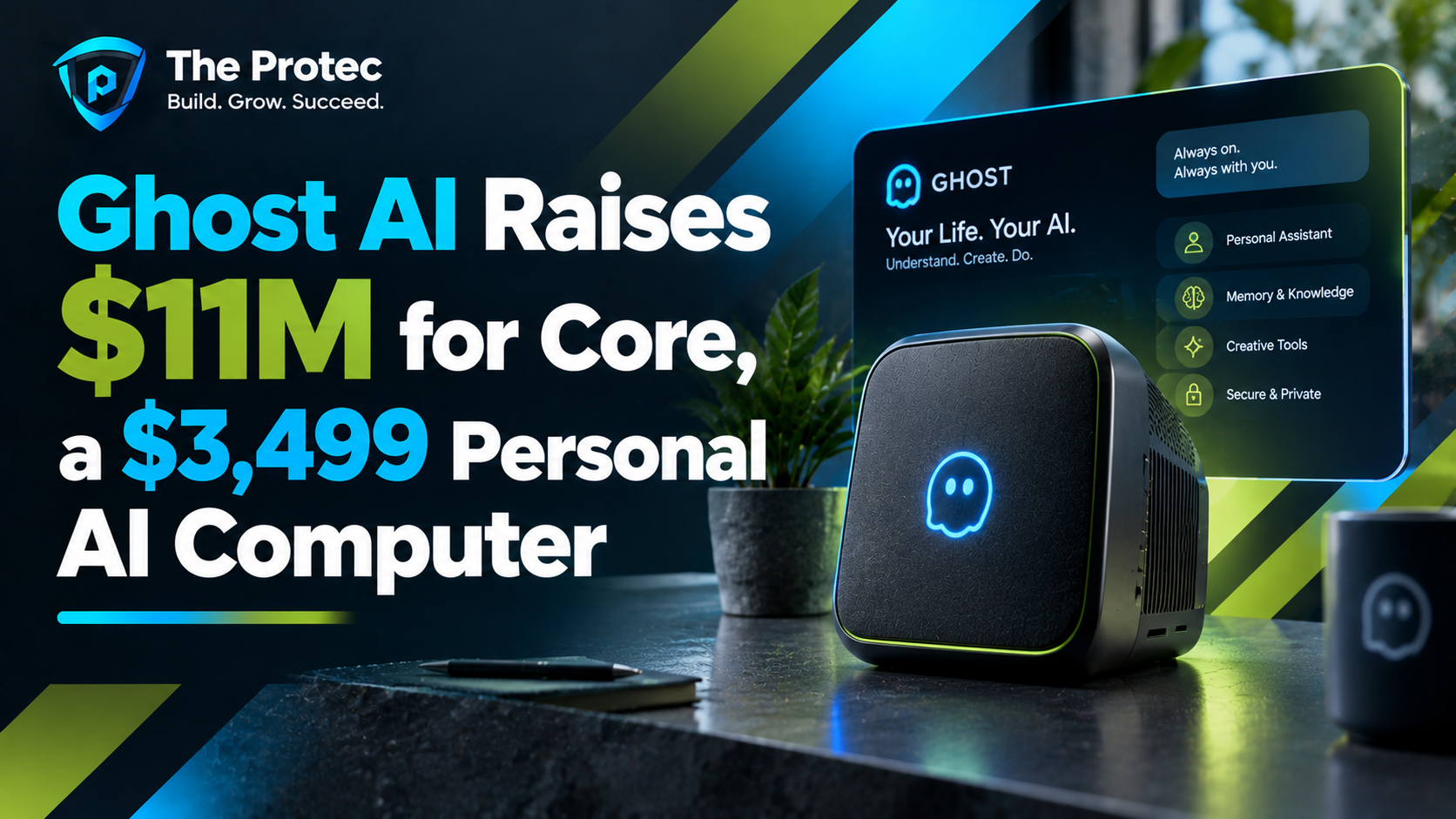
Led by 19-year-old CEO Zain Javaid, Ghost has raised an $11 million seed round led by Andreessen Horowitz to develop Core, a $3,499 personal AI computer designed to run agents locally and continuously. Rather than presenting users with a conventional desktop, Ghost Core combines a workstation-class Nvidia GPU, preinstalled open-source models, a local file system, a browser and a dedicated agent software layer. People interact with it through a smartphone or web interface.
That makes the Ghost AI computer less like a Mac Mini or gaming PC and more like a private “brain in a box.” The funding announcement is important, but the bigger story is the architecture behind Core—and the possibility that personal AI could shift from rented cloud services to user-controlled hardware.
What the Ghost $11 Million Seed Round Is Funding
The Ghost AI seed funding gives the startup capital to finish Core, build its software platform and move from early demand to broader production. Andreessen Horowitz, commonly known as a16z, led the round. The investment is a notable bet on dedicated AI agent hardware rather than another cloud-based assistant.
Ghost is not merely selling access to a model. It is attempting to integrate inference hardware, agent orchestration, persistent memory, security controls and a simple remote interface into one appliance. That integration is what separates the product from a do-it-yourself local AI workstation, even if technically capable users could assemble some of the underlying components themselves.
The company says the first batch sold out. Ghost has not publicly established the batch size, so the sellout should be treated as an early demand signal rather than proof of a mass market. As of October 2026, Core is listed for expected availability during October, with fulfillment timing still more important than the headline release window.
What Is the Ghost Core Computer?
Ghost Core is a personal AI computer optimized around autonomous and semi-autonomous agents. Those agents can use models, work with files, browse the web and remain available over long periods without requiring a conventional desktop session.
Its defining components include:
- An Nvidia RTX Pro 4000 SFF Blackwell GPU for local inference and accelerated AI workloads
- Preinstalled open-source AI models that run on the device
- A dedicated software layer for creating and operating personal agents
- A local file system that gives authorized agents persistent working context
- A web browser agents can use to research information or complete online tasks
- Smartphone and web access instead of a traditional monitor-first desktop environment
- User-controlled encryption keys and a firewall that monitors outgoing agent requests
The Nvidia RTX Pro platform is intended for professional graphics, AI and compute workloads. In Core, the RTX Pro 4000 SFF Blackwell GPU provides the local processing foundation for running models without sending every prompt, document or memory to an external inference provider.
Ghost has not positioned Core as a general-purpose Windows workstation. Its purpose is narrower: provide a persistent home for personal agents.
Why Core Is Not a Mac Mini, Gaming PC or Conventional AI PC
A Mac Mini can run local models, and a powerful gaming PC can deliver excellent inference performance. Conventional AI PCs also include dedicated neural processing units for features such as transcription, image generation and operating-system assistants. Hardware capability alone, however, does not create a persistent agent environment.
Those machines are still organized around human-operated applications. Users open programs, manage windows, select files and launch AI tools when needed. The AI remains a feature inside a traditional computing model.
Ghost reverses that relationship. Core is designed so an agent can remain active, retain context, access approved resources and perform work while the owner interacts remotely. There is no need for the machine to behave like a familiar desktop because Ghost expects most commands, approvals and results to flow through its phone and web interfaces.
A custom PC owner would also need to select models, configure runtimes, create agent workflows, manage permissions, secure remote access and monitor network activity. Ghost Core AI attempts to package those pieces into one managed product. Its value proposition is therefore closer to an appliance than a box of components.
Ghost’s Local-First AI Architecture
The most consequential feature of the Ghost personal AI computer is not its industrial design or even its GPU. It is the decision to keep models, agent logic and personal data on the device.
Cloud assistants normally send user requests and relevant context to remote servers. That model offers enormous compute capacity and effortless updates, but it also places sensitive information inside infrastructure controlled by another company. Persistent agents intensify that concern because they may need access to years of messages, documents, browsing history, preferences and ongoing projects.
Core is designed as a private AI computer where that working memory can stay local. Encryption keys are controlled by the user, reducing dependence on a vendor-held credential. The system also includes a firewall for observing and controlling agents’ outgoing network requests.
That firewall matters because “local” does not necessarily mean “offline.” An agent using the web must communicate with outside services. It may search websites, sign in to an account or retrieve live information. Ghost’s architecture seeks to make those connections visible and governable rather than allowing an autonomous process to communicate without supervision.
This distinction is central to the idea of AI agents without cloud dependence. Core can perform model inference and store private context locally while still using the internet when a task requires it. It is local-first, not necessarily air-gapped.
What the Ghost Core $3,499 Price Actually Buys
At $3,499, Core costs more than many mainstream desktops and compact computers. Comparing only processor, storage and GPU specifications misses the product’s intended value, however. Buyers are paying for an integrated personal AI hardware stack.
The price includes the Ghost Core GPU platform, an agent-oriented software environment, local model deployment, persistent storage, remote interfaces and security controls assembled around one purpose. It also buys convenience: users do not have to turn a gaming PC into an always-on agent server or maintain a collection of open-source tools.
That does not automatically make Core inexpensive. Ghost still has to demonstrate that its agents are reliable, that the software is easy to manage and that the hardware can run useful models at acceptable speeds. The company has also not made every hardware specification or future software cost central to its public pitch. Prospective buyers should evaluate the complete configuration and service terms available at purchase.
The strongest case for the Ghost AI computer price is therefore not raw compute per dollar. It is a turnkey, user-controlled environment for persistent agents.
Who Is Ghost Core For?
Core’s initial audience is likely to be developers, founders, researchers, privacy-conscious professionals and technically adventurous consumers. These users are more likely to accept an early product, understand the limits of local models and value control over their information.
Potential use cases include an agent that organizes research files, monitors selected websites, summarizes documents, maintains project memory or performs recurring browser-based work. Professionals handling confidential material may also prefer local inference over routinely uploading records to cloud services.
Core is less compelling for someone who only asks occasional questions or generates a few images. A cloud subscription or existing computer can handle those tasks at a much lower upfront cost. The product becomes more interesting when an agent needs to run continuously, remember substantial context and work with private data.
Why Andreessen Horowitz Is Backing Ghost AI
The Andreessen Horowitz investment in Ghost AI reflects a broader thesis about where value could emerge as AI models become more available. If capable open-source models are increasingly interchangeable, differentiation may move toward memory, interfaces, data access, agent reliability and ownership of the computing environment.
A persistent personal agent could develop a valuable understanding of its owner over time. It might know how someone organizes projects, which sources they trust, how they communicate and what requires approval. Keeping that intelligence on personal hardware creates a market distinct from cloud assistants whose memory lives in a vendor account.
Core also gives Ghost a position across hardware and software. If the company succeeds, it would control the agent runtime and user experience while avoiding the full cost of operating every inference workload in its own data centers. For a venture investor such as Andreessen Horowitz, that creates the possibility of a new device category rather than a single AI application.
Personal AI Hardware Is Moving Beyond Cloud-Only Assistants
The AI market is entering a phase in which local inference is practical for more than lightweight features. Efficient open models, quantization and newer GPUs are making it possible to run increasingly capable systems on compact hardware. At the same time, users are questioning whether every private document and personal memory should be processed remotely.
This creates an opening for local AI computers built around continuous agents. A cloud chatbot is available when a user opens an app. A personal agent computer can remain active, maintain its own workspace and respond through multiple devices. The difference resembles the gap between visiting a service and owning infrastructure.
There are trade-offs. Cloud providers can offer larger models, elastic compute and rapid upgrades. Local hardware has fixed capacity, consumes power and eventually becomes outdated. The likely future is not purely local or purely cloud-based. Hybrid systems may keep identity, memory and sensitive tasks on-device while selectively using external models for workloads that exceed local capacity.
Confirmed Core Features Versus Ghost’s Longer-Term Vision
It is important to separate the announced product from the larger ambition. Confirmed details include the $3,499 price, RTX Pro 4000 SFF Blackwell GPU, local models, agent software layer, local file system, browser access, remote phone and web interfaces, user-controlled encryption keys and outbound-request firewall. Ghost has also announced its first-batch sellout and October 2026 availability target.
The broader idea—that Core could become the standard home for a continuously learning personal intelligence—remains a vision. Its success depends on model quality, software stability, production execution and whether users trust agents with meaningful autonomy. A sold-out early batch does not answer those questions.
Ghost’s achievement so far is presenting a coherent alternative to cloud-only AI: an appliance where personal intelligence can live under the owner’s control. The $11 million round gives the company an opportunity to prove that this architecture can become a category rather than a niche experiment.
Frequently Asked Questions
How much does the Ghost AI computer cost?
The Ghost Core computer is priced at $3,499. That price covers a purpose-built local AI appliance centered on an Nvidia RTX Pro 4000 SFF Blackwell GPU and Ghost’s agent software environment, rather than a conventional desktop PC.
When is the Ghost Core release date?
Ghost has targeted October 2026 availability. The first batch is reported as sold out, but buyers should check current order and fulfillment information because an availability window does not guarantee that every unit ships on the same date.
Can Ghost Core run AI agents without the cloud?
Core is designed to run models, agent logic and persistent data locally. Agents can operate without cloud inference for supported workloads, although browser-based tasks and live online services still require network access. A firewall monitors outgoing requests.
Is Ghost Core just a powerful mini PC?
No. Although it contains capable AI hardware, Core is designed around persistent agents rather than desktop applications. Its dedicated software layer, local memory, browser, security controls and phone-first interface are intended to make it an AI agent computer, not a general-purpose mini PC.
Who founded Ghost AI?
Ghost AI is led by founder and CEO Zain Javaid, who is 19 years old. The company’s $11 million seed round was led by Andreessen Horowitz.