








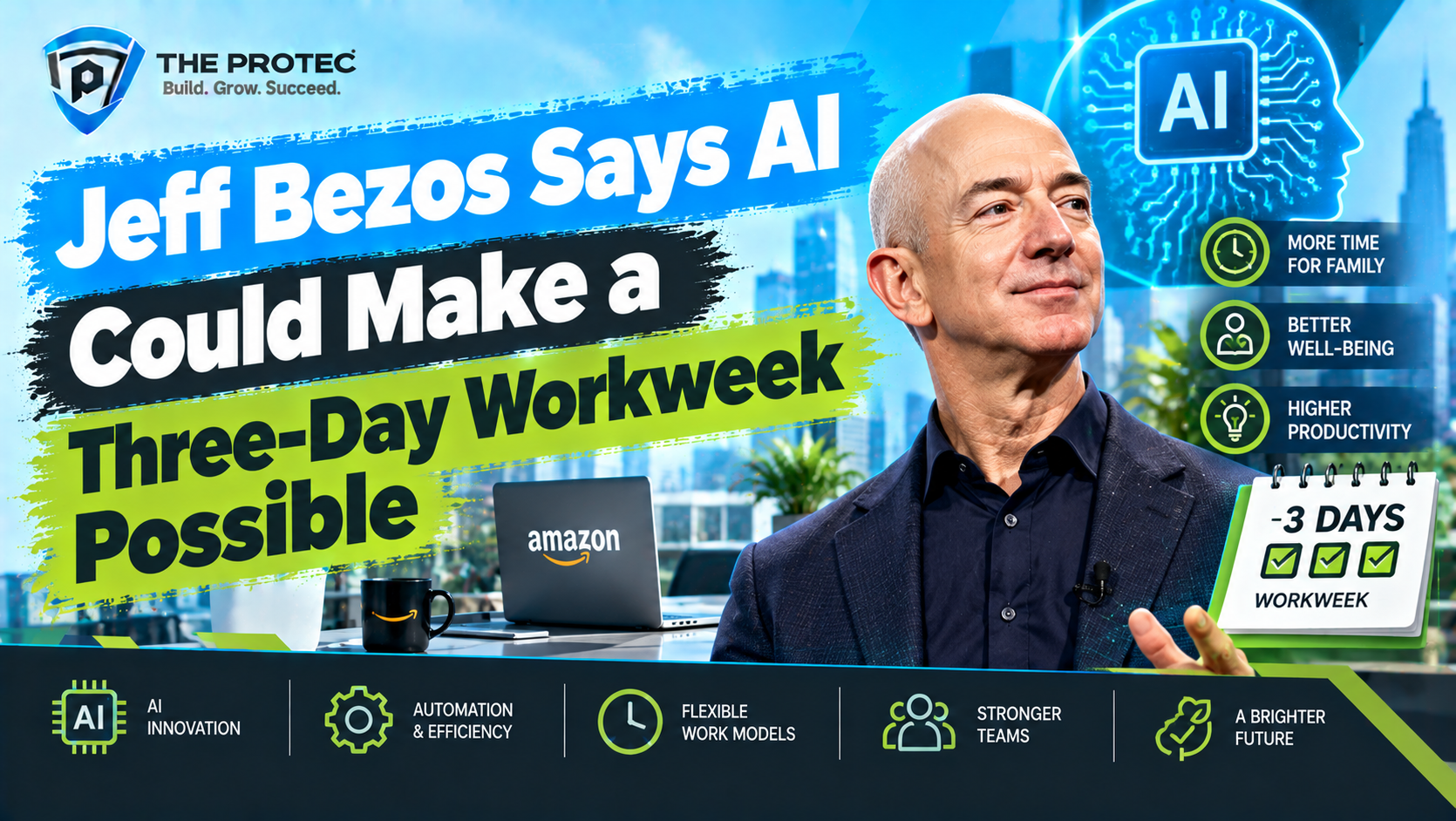
Could artificial intelligence make a three-day workweek economically practical? Amazon founder Jeff Bezos has suggested that AI-driven productivity gains could eventually allow some people to work fewer days while still producing enough value to support their families. The idea goes beyond flexible scheduling: in an optimistic version of the future, greater output per worker could even help more households live comfortably on a single income.
It is an attention-grabbing Jeff Bezos AI prediction, especially as businesses adopt AI agents, autonomous software and automated workflows. Yet it is a forecast—not a confirmed timetable, employment guarantee or promise that companies will voluntarily reduce working hours. Whether AI improves work-life balance will depend on who owns the technology, how productivity gains are distributed and whether workers have enough bargaining power to share in the benefits.
What the Jeff Bezos Three-Day Workweek Forecast Means
The economic logic behind the Jeff Bezos three-day workweek scenario is straightforward. If an employee supported by AI can complete five days of output in three days, an employer could theoretically maintain production while reducing that person’s schedule. Workers might receive the same weekly pay because their value to the business has not declined, even though they spend less time producing it.
That does not mean Bezos has announced a three-day schedule at Amazon or established a universal deadline. His comments are best understood as a long-term view of AI and the future of work. Different industries, occupations and countries will move at different speeds, and many jobs cannot be compressed simply by adding software.
The important question is not only whether AI can save time. It is whether employers will convert the saved time into shorter schedules, higher wages, lower prices, larger profits or additional output.
How AI-Driven Productivity Gains Could Reduce Working Hours
Previous workplace software generally waited for people to operate it. The emerging generation of AI agents can interpret requests, plan multistep tasks, use approved business applications and return completed work for review. Human employees remain responsible for judgment and accountability, but they may no longer have to execute every repetitive step.
A capable workplace agent might review an inbox, extract action items, update customer records, prepare a report and schedule follow-up meetings. Connected agents could also pass work between finance, sales and operations systems without requiring employees to copy data manually.
Evidence already suggests that generative AI can improve performance in defined tasks. An influential National Bureau of Economic Research study found productivity improvements among customer support agents using an AI assistant, with particularly strong gains for less-experienced workers. Such results do not prove that a three-day week is imminent, but they show how AI automation and employee productivity can move together.
Where AI Could Save the Most Time
Knowledge Work and Administration
Office employees often lose hours to searching for information, formatting documents, summarizing meetings and moving data between systems. Enterprise AI can search authorized records, draft routine correspondence, compare contracts and generate first-pass presentations. An operations manager could ask an agent to identify delayed projects and prepare a briefing rather than assembling the information manually.
Administrative teams may use automation for invoice matching, expense categorization, onboarding documents and calendar coordination. Humans would still resolve exceptions and approve consequential decisions, but routine processing could take minutes instead of hours.
Software Development
AI coding tools can suggest functions, explain unfamiliar code, generate tests and help developers investigate bugs. More autonomous coding agents can work through narrowly defined tickets in controlled environments. This does not eliminate the need for engineers: architecture, security, product decisions and code review remain deeply human responsibilities.
The practical gain is that a development team may spend less time on boilerplate and more time solving customer problems. If companies retain the same output target, those gains could support shorter hours. If they continually increase release targets, developers may work just as long despite higher AI productivity.
Customer Support
Support agents can receive real-time response suggestions, automatic conversation summaries and recommended troubleshooting steps. AI can also handle basic requests such as order-status questions while routing sensitive or unusual cases to people.
This model may reduce queues and emotional strain, but it carries risks. Poorly designed targets could turn every saved minute into a demand for more interactions. Businesses must measure resolution quality and customer trust—not simply the number of tickets closed.
Sales, Marketing and Finance
Sales teams can use AI to research accounts, prioritize leads and update customer relationship management records. Marketing departments can analyze campaign results and adapt content for different audiences, while finance teams can detect unusual transactions, model scenarios and accelerate monthly reporting.
These are realistic examples of AI workplace transformation because they combine automation with expert review. Fully autonomous operation remains inappropriate for many high-impact decisions involving credit, employment, legal obligations or personal data.
Will AI End the Traditional 40-Hour Workweek?
The future of the 40-hour workweek will not be determined by technical capability alone. Productivity has risen during previous waves of automation, yet working hours have not fallen evenly. Businesses frequently use efficiency gains to produce more, expand faster or improve margins rather than give employees additional leisure.
A shorter workweek and AI could fit together in several ways:
- Thirty-two hours across four days, with no reduction in salary.
- Three longer workdays for roles requiring scheduled coverage.
- Three standard workdays supported by substantial automation.
- Flexible, outcome-based schedules in which employees control when work is completed.
The four-day vs three-day workweek distinction matters. A four-day schedule usually requires a 20% reduction from five equal days, while a three-day schedule requires about 40%. The second transition demands much larger, sustained gains unless businesses redesign roles or accept lower output.
AI Automation, Jobs, Hiring and Wages
The debate over AI replacing jobs vs creating jobs is too often presented as a binary choice. AI can eliminate certain tasks, create new occupations and reshape existing roles simultaneously. A company might need fewer people for basic data entry while hiring AI governance specialists, automation designers, cybersecurity professionals and employees who manage complex customer relationships.
Hiring could slow in functions where agents absorb growing workloads. Some organizations may reduce headcount through attrition; others may use lower operating costs to expand and employ more people. Entry-level roles face a particular challenge because routine research, documentation and coding tasks have traditionally helped new workers develop expertise.
AI productivity gains and wages are also not automatically linked. Employees will receive higher pay or shorter hours only if labor markets, company policies, regulation or collective negotiations direct part of the added value toward them. Otherwise, AI-generated profits may flow mainly to technology owners, shareholders and highly specialized workers.
The broader AI impact on employment will therefore vary by occupation. Work involving predictable digital processes is more exposed to task automation, while jobs requiring physical dexterity, trust, caregiving, negotiation or responsibility in unpredictable environments are harder to automate completely.
Could AI Bring Back More Single-Income Households?
The single-income households AI argument assumes that one worker’s AI-enhanced output could earn enough to support a family. That outcome is possible in principle, but household security depends on more than productivity. Housing, healthcare, education, childcare, taxes and regional living costs all shape whether one salary is sufficient.
If productivity increases while wages remain flat, families will not suddenly become financially secure. A single-income model becomes more plausible only when workers share in productivity growth through better compensation, reduced essential costs, broader ownership or stronger public benefits. It should also remain a choice rather than an expectation that pushes unpaid caregiving disproportionately onto one family member.
Why Productivity Gains May Not Produce More Free Time
The optimistic Jeff Bezos future of work scenario faces several obstacles:
- Rising expectations: Employers may increase workloads once AI makes tasks faster.
- Unequal access: Large companies may adopt advanced systems faster than smaller businesses and public services.
- Job displacement: Some workers may lose roles before new opportunities become accessible.
- Surveillance: AI can be used to monitor employees rather than reduce unnecessary work.
- Reliability and security: Agents can make errors, expose sensitive information or take unintended actions without appropriate controls.
- Uneven applicability: Nurses, construction crews, hospitality workers and many other employees must provide real-time physical services.
Artificial intelligence and work-life balance can therefore move in opposite directions. Good implementation removes low-value work and gives employees more autonomy. Poor implementation accelerates the pace of work, reduces staffing and makes people responsible for correcting automated mistakes.
Is a Three-Day Workweek Realistic by 2026?
As of October 2026, a broad three-day workweek is not a realistic near-term outcome for the overall workforce. AI capabilities are advancing, and some organizations can use them to test reduced schedules. However, reliable autonomous operation across complex businesses remains difficult, and productivity gains vary significantly by task.
A three-day workweek in 2026 is most plausible for limited groups: highly digitized teams, specialized professionals, profitable technology businesses and companies willing to redesign processes around outcomes. It is much less practical for sectors requiring continuous staffing or direct physical service unless employers add shifts, hire more workers or deploy capable robotics.
The nearer-term trend is likely to be uneven: four-day pilots, flexible Fridays, reduced administrative workloads and smaller teams supported by AI agents. A genuine three-day standard is better viewed as a longer-term possibility than an immediate successor to the 40-hour week.
What Would Make a Three-Day Week Possible?
Technology is only one part of the transition. Companies would need to measure output rather than online presence, eliminate unnecessary meetings and redesign workflows before cutting schedules. Workers would need training so that AI complements their expertise instead of simply becoming a cost-cutting tool.
Clear policies for pay, availability, performance measurement and data protection would also be essential. Labor negotiations can help determine whether efficiency gains become time off, wage increases or both. Governments may influence the outcome through working-time laws, taxation, competition policy, education and support for displaced employees.
Most importantly, businesses must decide how AI-generated value is distributed. The same technology can support a shorter week or a smaller workforce working at greater intensity. That is an economic and political choice, not an inevitable feature of the software.
Frequently Asked Questions
Did Jeff Bezos confirm that workers will move to a three-day week?
No. The Jeff Bezos 3-day workweek idea is a prediction about what substantial AI productivity could eventually make possible. It is not a confirmed policy, universal outcome or fixed timetable.
Will AI reduce working hours for most employees?
AI can reduce the time required for specific tasks, but it will not automatically reduce paid working hours. Employers may use the time savings to shorten schedules, increase output, lower staffing costs or improve profits. Policies and worker bargaining power will shape the result.
Which workers could benefit first?
Employees doing digital, repeatable and information-heavy work may see the earliest gains. Software development, support, administration, finance, marketing and research are strong candidates, although each still requires human oversight and domain expertise.
Could a three-day week reduce salaries?
It could if employers treat it as part-time work. The more transformative model keeps weekly pay stable because AI allows employees to maintain output in fewer hours. Whether that happens depends on productivity evidence, labor demand and compensation policies.
Is a four-day week more realistic than a three-day week?
Yes, in the near term. A four-day schedule requires a smaller productivity improvement and already has a clearer base of workplace experimentation. Moving to three days would require deeper automation, major process redesign and deliberate sharing of the resulting economic gains.
The Bottom Line
Bezos’s forecast highlights a credible possibility: AI could help society produce more with less human time. But productivity does not distribute itself. A three-day workweek will become practical only if technical progress is matched by new business practices, fair compensation and decisions that treat time—not just profit—as a valuable return on innovation.