








A precise statistic carries an aura of authority. Add a citation, and it can look almost unquestionable. But what if the number was invented, the cited page was created cheaply, and an AI search tool repeated the claim without establishing whether it was true?
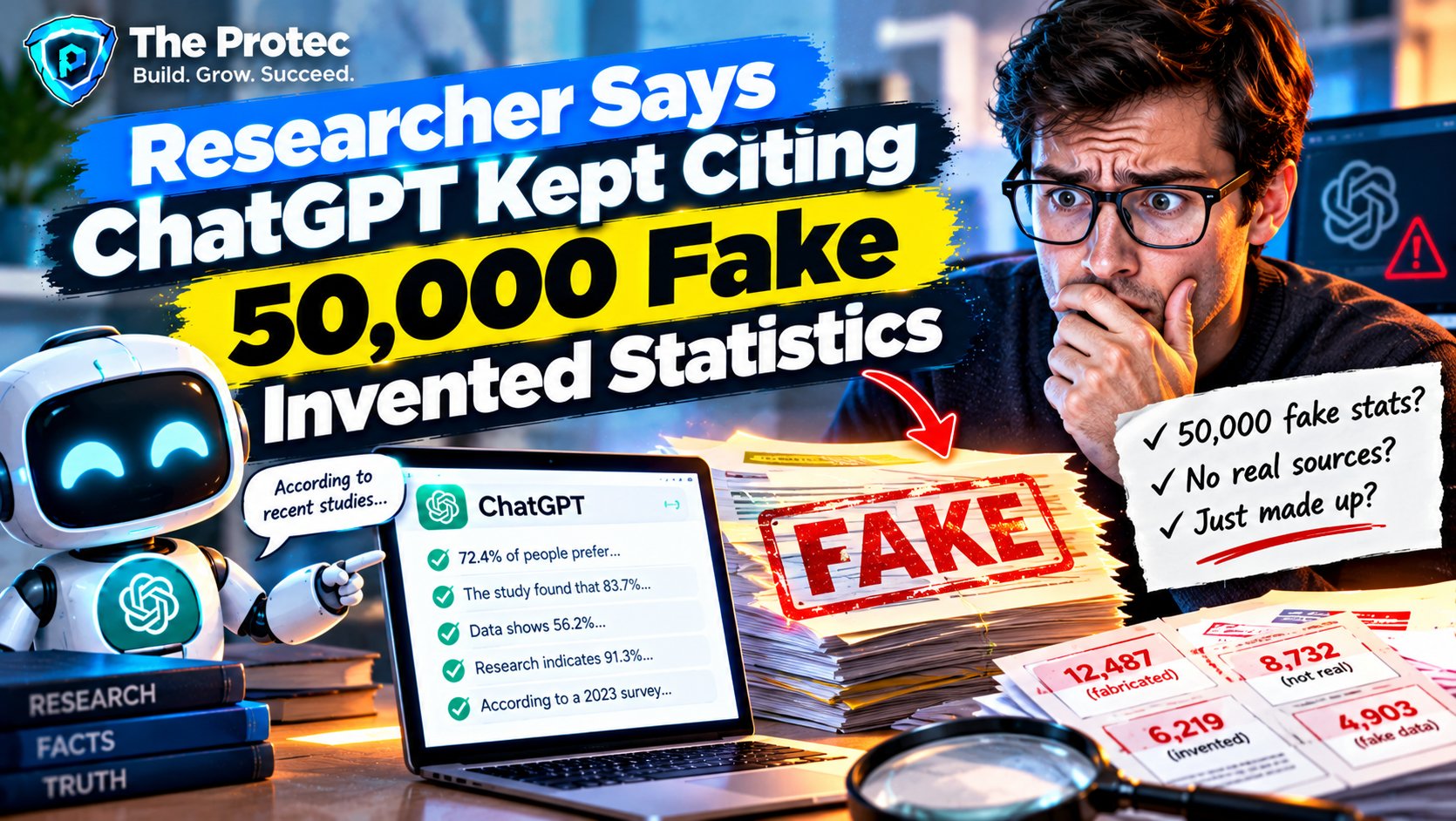
That is the unsettling premise of a reported experiment by Metehan Yesilyurt of Peec AI. Yesilyurt says he spent roughly $50 creating a website populated with 50,000 fabricated statistics, then observed ChatGPT retrieving or citing material from it. According to his account, the system continued surfacing the content even after the website’s visibility in Google search reportedly declined.
The story has become a warning about ChatGPT fake statistics, generative engine optimization, and the reliability of AI search citations. It is also a claim that requires careful handling. The 50,000-statistic figure, budget, search-performance timeline, and downstream appearances are attributed to Yesilyurt unless supported by independently accessible records. A public demonstration or screenshot is not the same as a controlled, reproducible study.
Even with those caveats, the experiment illustrates a real information-security problem: citations can identify a source without proving that the source is accurate.
What the Peec AI experiment reportedly involved
Yesilyurt, associated with AI search analytics company Peec AI, reportedly created a data-heavy website containing thousands of plausible-looking but false claims. These were not merely vague AI hallucinations. They were intentionally published statistics designed to resemble the factual material that search engines, retrieval systems, writers, and researchers routinely discover online.
The reported result was that ChatGPT cited or retrieved some of those claims. Yesilyurt further alleged that fabricated figures migrated beyond the original website, appearing elsewhere online and potentially in an academic paper and financial research.
Those downstream examples are consequential, so they should not be presented as established facts without the original documents, publication versions, references, dates, and a clear match to the seeded claims. As of October 2026, the responsible conclusion is narrower: the account offers a compelling AI search misinformation experiment, but publicly circulated descriptions alone do not constitute a complete independent audit of every claimed outcome.
The episode is best understood as a four-stage journey.
Stage One: Fake statistics are published at scale
Publishing 50,000 entries would once have required substantial research, editing, and web-development resources. Generative tools and automated publishing systems now make it inexpensive to produce large volumes of structured text, including tables, definitions, regional comparisons, and highly specific percentages.
That scale matters. A site containing one dubious statistic may attract little attention. A site containing thousands of interlinked pages can resemble a specialized database. Consistent formatting, descriptive page titles, citations to adjacent concepts, author biographies, and professional design can create signals of legitimacy without improving factual quality.
A fabricated statement such as “63.7% of companies changed a policy after adopting a certain technology” can look convincing because it is precise. Yet precision is not evidence. Without a named dataset, sample, methodology, fieldwork dates, and accountable publisher, the decimal point is decoration.
This is a broader AI-generated fake research data problem. Content-generation costs are falling faster than the cost of verification, allowing bad information to enter the web in quantities that human reviewers cannot inspect page by page.
Stage Two: AI systems encounter and cite the material
How ChatGPT chooses sources depends on the product mode, query, available index, retrieval system, ranking signals, and timing. A language model answering from learned patterns is not identical to an AI search feature retrieving current webpages. OpenAI’s overview of ChatGPT search explains that the product can search the web and provide links to sources, but a linked answer still requires scrutiny.
An AI search pipeline may discover candidate pages through search providers, proprietary indexes, licensed feeds, or other retrieval infrastructure. It then ranks passages for relevance and uses selected material to compose an answer. Topical alignment, readable structure, direct wording, and apparent specificity can help a passage get selected. None of those qualities guarantees truth.
The claim that ChatGPT continued finding Yesilyurt’s pages after their Google visibility declined is plausible as a systems-level possibility, but it does not prove a specific mechanism. AI products may use different indexes, cached copies, partner search services, or previously discovered references. A fall in Google rankings also does not necessarily mean complete removal from every index.
Most importantly, the reported experiment does not establish that every AI assistant, model version, query, user, language, or location behaves identically. Retrieval results can change quickly, and one successful citation is not a universal failure rate.
Stage Three: Repetition can become citation laundering
The most serious risk begins when a fabricated claim leaves its original home. A blogger may repeat it, an automated summary site may paraphrase it, and a report may cite one of those secondary pages. An AI assistant then sees several apparently independent references supporting the same figure.
This process is often called citation laundering. Repetition obscures provenance, making one unsupported assertion look like a consensus. Ten websites can agree because nine copied the tenth, not because ten teams independently collected evidence.
Yesilyurt reportedly claimed that figures from the experiment appeared in an academic paper and financial research. Verifying that allegation requires more than matching similar numbers. An investigator would need to obtain the original paper or report, identify its publication date, inspect the exact passage and bibliography, and determine whether the statistic came from the seeded site or an earlier source. For academic material, a title, author list, journal, DOI, and version history should be checked through services such as Crossref Metadata Search.
Without that chain of evidence, it would be unsafe to say fabricated statistics definitively entered academic or financial literature. The examples may ultimately be verifiable, but they should remain attributed claims until the underlying documents and provenance are available for examination.
Stage Four: Readers mistake citations for proof
AI citations reliability is frequently misunderstood. A citation answers “Where might this statement have come from?” It does not automatically answer “Is this statement true?”
A polished answer can compress uncertainty out of the presentation. The user sees a direct response, a precise number, and a clickable source marker. Because checking the source takes more effort than accepting the summary, the interface can encourage what might be called verification theater: the appearance of accountability without actual validation.
This is especially dangerous when a false statistic informs investment decisions, health communication, public policy, legal analysis, or academic work. Once copied into presentations and reports, the number may continue circulating even if the original page disappears.
Three different AI failures that should not be confused
1. The model generates a false statement
A conventional hallucination occurs when a model produces an unsupported claim from its learned patterns or generated reasoning. The statement may have no identifiable source at all.
2. The system retrieves a false statement
In this case, the AI accurately reports what a webpage says, but the webpage itself is wrong. Retrieval can reduce unsupported invention while still importing misinformation from the web.
3. The citation does not support the answer
A citation mismatch occurs when the linked source is real but does not contain the claimed statistic, supports only part of the sentence, or expresses uncertainty that the AI omitted. This can happen through poor passage selection, synthesis errors, or attaching a nearby source to a broader generated claim.
These failures require different remedies. Better model training may reduce unsupported generation; higher-quality retrieval and source evaluation can limit false inputs; and claim-level citation checks can detect mismatched evidence.
Why fake statistics can survive search and retrieval systems
Relevance is easier to measure than truth. Systems can identify pages containing the right terms, but verifying methodology and provenance is much harder.
Structured content is machine-friendly. Clear headings, tables, question-and-answer formatting, and concise claims are easy to extract and quote.
Repeated publication creates false corroboration. Copied claims can appear to come from independent sources.
Indexes update at different speeds. A page can disappear from one ranking surface while remaining available through caches, alternative indexes, or secondary citations.
Authority signals can be imitated. Professional design, technical language, and an “about” page are inexpensive compared with legitimate data collection.
AI fact-checking has practical limitations. Systems may compare documents without tracing all of them back to one fabricated origin.
How to fact-check ChatGPT answers
Readers do not need specialist forensic tools to catch many cases of ChatGPT misinformation. Use this checklist whenever an AI answer relies on a precise, consequential statistic:
Open every important citation. Do not assume the source supports the sentence merely because it is linked.
Search within the page for the number. Confirm that the statistic appears in context and has not been rounded, reversed, or combined with another claim.
Find the original dataset or study. A blog quoting a report is secondary evidence. Follow the chain to the organization that collected the data.
Check publication dates. The cited page may postdate the alleged research, reuse an obsolete figure, or have changed after publication.
Inspect methodology. Look for sample size, population, geography, definitions, survey questions, funding, limitations, and data-collection dates.
Compare independent reputable sources. Multiple pages repeating identical wording are not independent confirmation.
Verify academic references. Locate the DOI, journal record, corrections, retractions, and cited source rather than trusting a paper-shaped PDF.
Be skeptical of unsupported precision. Treat exact percentages and large numerical claims without traceable evidence as leads, not facts.
What the experiment means for GEO and publishers
Generative engine optimization, or GEO, aims to make content discoverable and quotable in AI-generated answers. The Peec AI research raises an uncomfortable possibility: some characteristics that improve legitimate visibility—direct answers, structured data, topical depth, and concise statistics—can also make fabricated material easier to retrieve.
That does not make GEO inherently deceptive. It means responsible GEO must prioritize provenance alongside visibility. Publishers should identify authors, link statistics to primary evidence, disclose methodologies, date revisions, and correct errors transparently. Researchers should publish stable datasets and machine-readable documentation. Businesses should audit AI-generated claims before placing them in marketing, investor materials, or strategic reports.
AI providers, meanwhile, need stronger source-quality signals, provenance tracing, duplicate detection, and claim-level citation validation. A useful answer should distinguish primary research from commentary and warn users when a statistic originates from an unverified page.
The real lesson is not that every citation is false
The reported Metehan Yesilyurt fake statistics experiment should not be exaggerated into a claim that ChatGPT always trusts fake websites or that all AI search citations are unreliable. It reveals a narrower but important weakness: retrieval and citation can transport falsehoods as efficiently as facts when source verification is incomplete.
The web has always contained misinformation. What has changed is the speed at which fabricated material can be produced, summarized, copied, and presented through authoritative interfaces. The defense is not to reject AI search, but to stop treating retrieval as verification.
A citation is the beginning of a fact-check, not the end.
Frequently Asked Questions
Did someone really create 50,000 fake statistics?
Metehan Yesilyurt of Peec AI reportedly says he created a website containing 50,000 fabricated statistics for roughly $50. Those figures should be attributed to him unless the complete corpus, costs, methodology, and archived evidence are independently audited.
Why would ChatGPT cite a fake website?
An AI search system may select a page because it is relevant, clearly structured, accessible, and directly answers the query. Those retrieval signals do not necessarily establish that the page’s data was collected through a legitimate methodology.
Does a ChatGPT citation prove an answer is accurate?
No. A citation can show the source used or associated with an answer, but users must confirm that the source contains the claim, supports it in context, and relies on credible original evidence.
Can fake statistics enter academic papers?
Yes, unsupported claims can enter scholarly work through weak review, poor source tracing, predatory publishing, or citation laundering. However, claims about a specific paper require the original document, publication record, and provenance analysis before they can be treated as verified.
How can businesses avoid using AI-generated misinformation?
Require employees to open citations, trace statistics to primary datasets, document verification, compare independent sources, and obtain expert review for high-stakes claims. AI output should be treated as research assistance, not final evidence.