








Most AI assistants wait. You open a chat, describe a task, provide context, and ask for an answer. The reported Claude Duet concept turns that sequence around: what if an assistant could notice useful work, prepare it, and bring it to you before you typed a prompt?
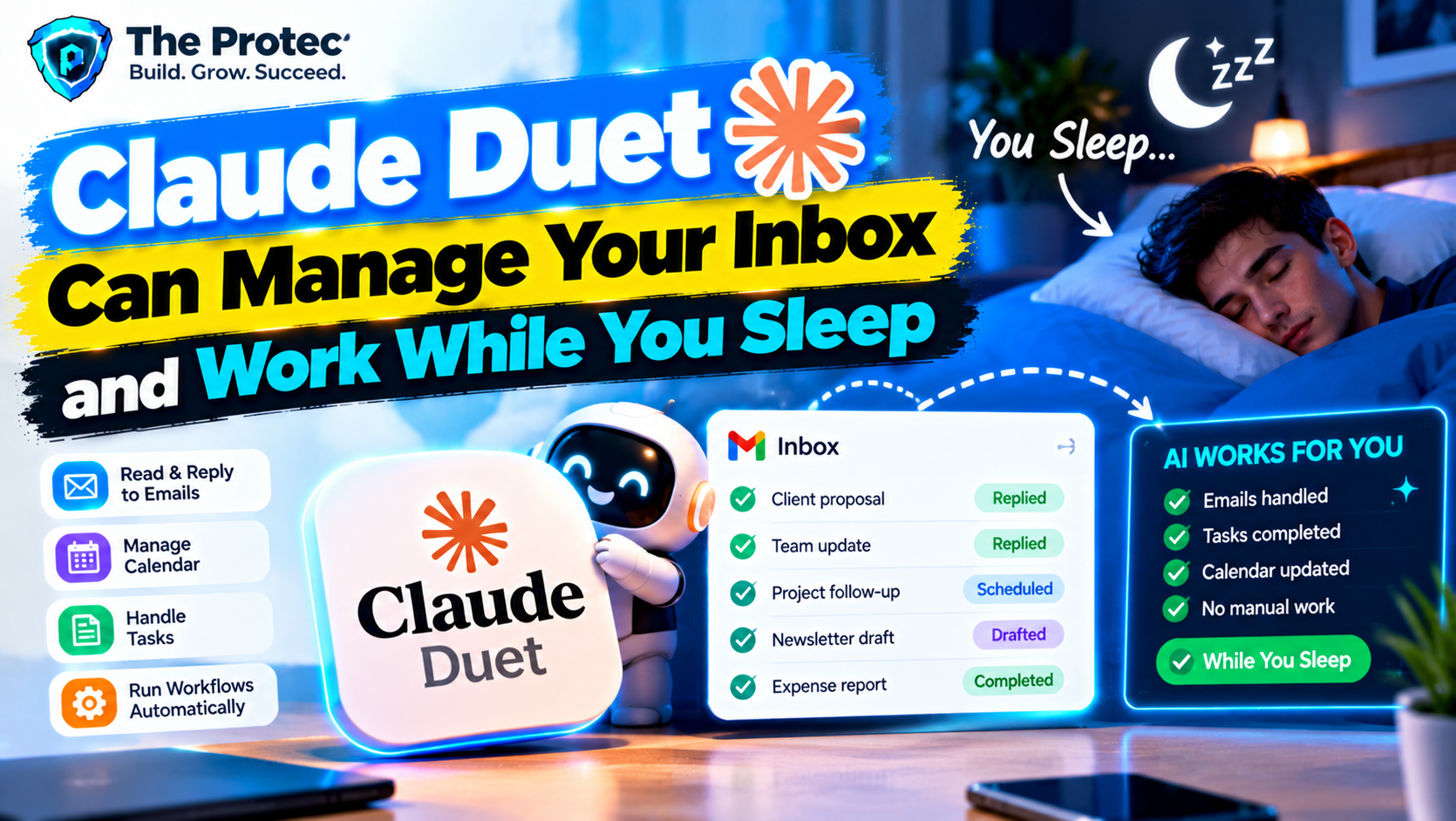
Reports about Claude Duet describe a proactive AI assistant that could monitor connected applications, assemble a morning briefing, draft email replies, coordinate meetings, and continue larger assignments on a cloud-based computer while its user is offline. The most ambitious descriptions extend to building dashboards, producing financial forecasts, and developing web applications.
That vision would move Anthropic Claude Duet beyond a conversational chatbot and closer to an AI employee with a persistent workspace. It also raises serious questions about authorization, data exposure, mistakes, and accountability. Crucially, several details circulating about the product, including the Claude Duet name, Claude Opus 5.5, OpenAI Dots, pricing, integrations, and release status, have not been consistently substantiated by publicly accessible first-party documentation. They should be treated as reported or unverified until confirmed by the companies involved.
What Is Claude Duet?
Claude Duet is described in industry reporting and online discussion as an Anthropic AI automation offering designed to work proactively across connected business tools. Instead of responding only when summoned, the reported Claude Duet AI agent could watch approved information sources for meaningful changes and initiate useful preparation.
For example, it might detect an urgent customer email, compare the message with account notes, draft a response, identify open calendar slots, and place both the reply and proposed meeting time in an approval queue. Overnight, it might process sales data and update a dashboard that is ready when the owner signs in.
At publication, readers should verify any claimed launch directly through Anthropic’s official announcements. An official announcement, support article, or product page should establish Claude Duet availability, supported regions, integrations, subscription requirements, Claude Duet pricing, and the actions that require user approval. Until those materials explicitly identify the product, Duet should not be represented as a generally available Anthropic service.
What Changes When an AI Starts Before You Ask?
The important change is not simply faster text generation. It is a shift from prompt-driven assistance to event-driven work. A conventional assistant needs a person to recognize that something happened, gather the relevant details, and issue instructions. An AI assistant that monitors connected apps could perform the first two steps continuously.
Consider a small-business owner returning to work. Rather than opening email, a CRM, analytics software, project management tools, and a calendar separately, the owner could receive a Claude Duet morning briefing. It might summarize overnight sales, highlight a delayed shipment, identify an overdue invoice, list messages requiring decisions, and show drafts prepared for review.
The human still makes consequential choices, but less time is spent discovering and organizing work. That is the practical appeal of proactive AI agents for productivity: they can reduce coordination overhead rather than merely help write individual documents.
Proactive Monitoring Is Not Full Autonomy
Discussion of AI agents often mixes together three distinct levels of capability. Separating them is essential when evaluating Claude Duet features.
- Proactive monitoring: The agent observes approved data sources and flags events that match defined priorities. It might identify a high-value sales inquiry or warn that spending has exceeded a threshold.
- Delegated task execution: The user assigns a goal and allows the agent to perform bounded steps, such as researching a topic, updating a spreadsheet, or preparing an email sequence. The task can continue without constant prompting.
- Autonomous decision-making: The agent chooses goals or takes consequential actions without specific approval. Sending commitments, changing production systems, hiring contractors, or making payments would fall into this riskier category.
A useful business agent does not need unrestricted autonomy. In many workflows, the best design is proactive preparation followed by explicit human approval. The agent can do the time-consuming work while the user retains authority over messages, money, legal commitments, and irreversible changes.
Inbox Management, Email Drafting, and Scheduling
AI inbox management and email drafting could be among Duet’s most immediately valuable applications. With narrowly scoped access, an agent could categorize incoming mail, connect messages to previous conversations, identify deadlines, and prepare replies in the user’s preferred style.
An AI meeting scheduling assistant could then examine authorized calendars, time zones, working hours, and meeting preferences. Instead of repeatedly exchanging availability, it could draft a response with suitable options or create a tentative hold. Sending the message or confirming an external meeting should normally require approval, especially when the agent is interpreting ambiguous language.
This workflow can fail if the agent mistakes a sales pitch for a customer request, overlooks confidential context, or treats an informal suggestion as a firm commitment. Draft-first operation, visible source references, and a clear activity log are therefore more important than polished prose.
Dashboards, Forecasts, and Web Applications
The reported Claude Duet cloud computer is the feature that could make longer assignments possible. A persistent remote environment would allow the agent to open tools, execute code, transform files, and preserve task state after the user’s device disconnects. This is the foundation of the claim that it is an AI agent that works while you sleep.
An AI dashboard builder might import approved sales and marketing data, clean inconsistent fields, calculate metrics, generate charts, and publish a draft dashboard. AI financial forecasting tools could assemble scenarios from historical revenue, expenses, pipeline data, and stated assumptions. Developers could delegate a test suite, documentation update, or prototype web application.
These outputs still require validation. A visually convincing dashboard can use the wrong denominator. A forecast can hide unrealistic assumptions. A web application can contain security flaws. Persistent execution increases convenience, not correctness.
Realistic Claude Duet Workflows
For entrepreneurs
An entrepreneur could ask Duet to monitor customer feedback, payment alerts, campaign performance, and the calendar. Each morning, the agent could present the three issues most likely to affect revenue, along with response drafts and supporting evidence. It should not issue refunds or make payments without approval.
For small-business owners
AI automation for small businesses often provides the most value in repetitive administrative work. Duet could reconcile order reports, identify inventory exceptions, prepare overdue-invoice reminders, and create a weekly operations dashboard. Access should be limited so that a compromised or mistaken agent cannot alter banking credentials or export an entire customer database.
For developers
Developers could delegate reproducible work such as running tests, investigating a bug, upgrading a dependency in a branch, or building an internal prototype. Claude autonomous computer use would be safer inside an isolated environment with restricted credentials, protected production systems, and mandatory code review before merging or deployment.
For managers
A manager could receive a briefing compiled from approved project tools, meeting notes, and operational metrics. The agent might identify blocked tasks, conflicting deadlines, and decisions awaiting attention. Managers should be careful not to use automated summaries as invisible employee surveillance or as the sole basis for performance judgments.
Claude Duet Security and Permissions
The quality of an agent’s reasoning matters, but permission design determines its potential blast radius. Claude Duet security and permissions should ideally support least-privilege access, granular connectors, temporary credentials, action-specific approval, and immediate revocation.
Sensitive actions should be separated from routine preparation. An agent may be allowed to read selected email folders but not send messages. It may prepare a payment request but not release funds. It may create a pull request but not deploy code. Organizations also need logs showing what the agent viewed, changed, generated, and attempted.
Broad access creates additional risks. Malicious instructions can arrive through email, documents, websites, or connected applications. An agent might expose confidential information while completing an otherwise legitimate task. It can also compound a small error by repeating it across hundreds of records. Sandboxed computing, connector-level controls, spending limits, data-retention policies, and review queues should be basic requirements rather than optional extras.
Does Claude Duet Use Claude Opus 5.5?
Some descriptions associate the product with Claude Opus 5.5, but the model name and its relationship to Claude Duet require first-party verification. A product can also use different models for planning, summarization, coding, and low-risk background tasks, so identifying one model would not fully explain the service.
Buyers should focus on observable capabilities: how reliably the agent completes multi-step work, how long tasks persist, what data it can access, which actions need approval, and how failures are surfaced. A model label alone cannot answer those operational questions.
Claude Duet vs OpenAI Dots and Other Assistants
A responsible Claude Duet vs OpenAI Dots comparison must begin by confirming that both names refer to officially announced, available products. OpenAI Dots has also appeared in unverified discussion, so its capabilities and commercial status should not be assumed. Official OpenAI releases can be checked through the company’s news archive.
If both offerings become documented products, the useful comparison is broader than model intelligence. Businesses should evaluate whether each assistant can detect events proactively, operate a persistent cloud computer, connect to required applications, resume interrupted tasks, and maintain context across long projects.
Security controls deserve equal weight. Compare read and write permissions, approval rules, audit logs, credential handling, data retention, administrative policies, and recovery options. Pricing should include subscription fees, usage charges, connector costs, and the staff time needed to review output. An agent that looks inexpensive per task can become costly if it produces frequent errors or demands extensive supervision.
Claude Duet Availability and Pricing
Claude Duet availability, subscription requirements, supported integrations, and Claude Duet pricing remain details that require an explicit Anthropic source. Reports or screenshots are not substitutes for product documentation. Prospective users should confirm regional access, usage limits, enterprise controls, data terms, and whether cloud-computer execution incurs separate charges before connecting business accounts.
Frequently Asked Questions
Can Claude Duet send email without approval?
No universal approval rule should be assumed until Anthropic documents it. Even if automatic sending is technically available, organizations should require review for external commitments, sensitive information, legal matters, and high-impact customer communication.
Can Claude Duet really work while a user is offline?
A persistent cloud environment could allow delegated tasks to continue after the user’s local computer disconnects. However, task duration, supported software, timeout rules, and background execution limits must be confirmed in official documentation.
Is Claude Duet safe for financial forecasting?
It may be useful for gathering data, generating scenarios, and documenting assumptions. It should not replace accounting controls or professional judgment. Users must verify source data, formulas, assumptions, and regulatory implications before relying on a forecast.
Is Claude Duet a fully autonomous AI employee?
That description would be misleading without strong evidence. Proactive monitoring and delegated execution do not equal independent authority. The safest and most useful pattern is an agent that prepares work, explains its sources, requests approval for sensitive actions, and leaves an auditable record.
The Bottom Line
The reported promise of Claude Duet is compelling because it changes when AI work begins. Morning briefings, prepared email replies, coordinated calendars, overnight dashboards, and persistent development tasks could return meaningful time to entrepreneurs and teams.
But usefulness depends on boundaries. A proactive agent should know what it may observe, what it may prepare, and what it may never do without approval. Until Anthropic confirms the product, model, integrations, pricing, and safeguards in official documentation, Claude Duet is best understood as a reported vision of proactive work rather than a set of guaranteed capabilities.