







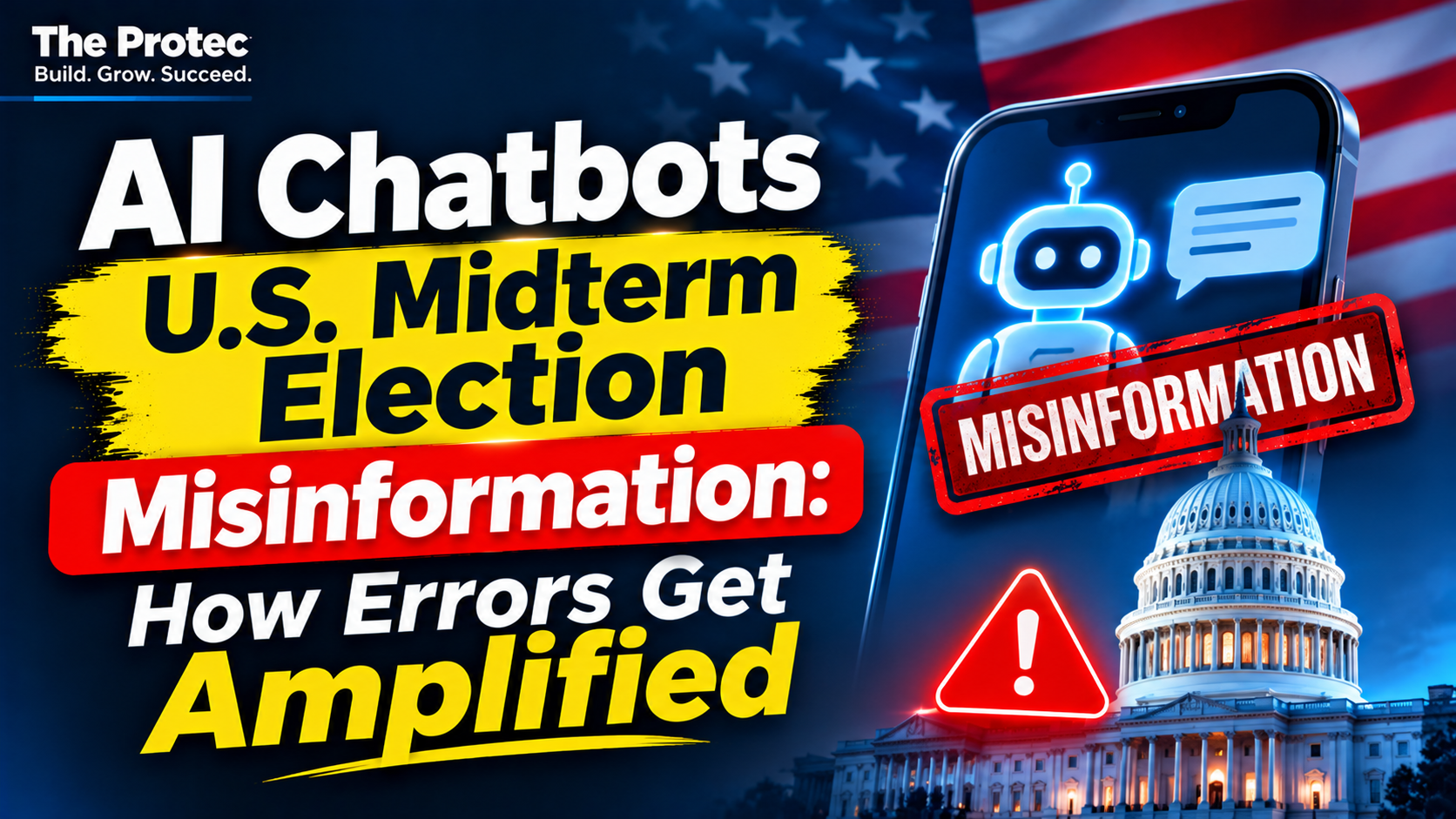
When a chatbot displays citations, its answer can look researched and dependable. But citations are only as reliable as the sources behind them. A Washington Post investigation into AI chatbots election misinformation found that prominent assistants answering questions about the 2026 U.S. midterm elections sometimes relied on small, largely AI-produced voter-information websites and repeated mistakes appearing on those sites.
The investigation highlights a consequential weakness in AI-assisted search: inaccurate material can move from one automated system to another, gaining apparent credibility along the way. A website publishes an incorrect district or incomplete candidate list, a chatbot finds and summarizes it, and a voter receives the resulting answer with a source attached. What looks like independent confirmation may instead be the same error traveling through an information loop.
This does not mean every chatbot answer, unofficial voter guide, or AI-generated website is wrong. It does mean voters should never treat a fluent answer or visible citation as proof that election information is official, accurate, or current.
What The Washington Post investigation found
In its investigation of chatbot responses about the 2026 US midterm elections, The Washington Post reported that Microsoft Copilot cited a site called Ballot Brief in 75% of the answers in its tests. ChatGPT cited Ballot Brief in 22% of its tested answers. The Post also found examples in which chatbots misidentified a congressional district or failed to name the district requested.
Those figures require careful interpretation. They represent results from The Post’s test set—not the share of all election questions answered by Copilot or ChatGPT, the percentage of users who encounter the site, or an overall measurement of either chatbot’s accuracy. They also do not show that every answer citing Ballot Brief was incorrect.
The percentages describe how often Ballot Brief appeared as a cited source within the investigation’s tested answers. Any assessment of the results should therefore consider the test’s sample size, query wording, locations, collection dates, chatbot modes, and methodology. Because those details can materially affect results and were not included in the source brief supplied for this article, editors should verify the original Post headline, publication date, complete sample, testing period, and linked methodology against the live investigation before publication.
That limitation does not erase the central finding. The reported examples demonstrate how a chatbot can surface an obscure voter-information website, paraphrase its material, and reproduce an error. They do not establish that every chatbot, query, voter guide, or election will produce the same pattern.
How an AI error can become a feedback loop
Generative AI systems can participate in an information chain rather than creating every part of an answer independently. Understanding that chain helps explain why an error can appear more credible after a chatbot repeats it.
- A website publishes election information. The material may be assembled manually, generated with AI, or produced through a mixture of automation and human editing.
- A search or retrieval system discovers the page. If the page is accessible and appears relevant to a user’s question, it may be included among the sources available to a chatbot.
- The chatbot extracts or summarizes the material. It may quote the page, paraphrase it, combine it with other sources, or infer an answer from incomplete information.
- The answer presents a citation. The visible source can make the response seem verified even when the underlying page is unofficial, outdated, or wrong.
- The repeated claim gains reach. Users may copy, share, or search for the chatbot’s answer, potentially giving the original error a larger audience.
This is amplification, not necessarily coordination. The Post’s reporting should not be interpreted as evidence that chatbot companies and voter-guide operators deliberately worked together, or that a site’s operators intended to deceive voters. An automated publishing system can produce inaccurate material without a coordinated campaign. Intent and information quality are separate questions.
AI voter guides can be polished, comprehensive, and easy to navigate. A site may contain pages for numerous states, districts, candidates, and races, with consistent formatting and confident language. Those qualities can help readers, but they can also create an appearance of authority that the site’s sourcing and editorial controls do not support.
Scale is particularly important. Generative tools make it possible to create many location-specific pages quickly. Election information, however, is unusually sensitive to small details. District boundaries, candidate qualification, ballot order, polling locations, registration rules, and voting dates vary by jurisdiction and can change after litigation, administrative decisions, recounts, withdrawals, or updated official guidance.
A page can therefore be mostly plausible while remaining dangerously wrong in one field. If a chatbot retrieves that field without comparing it with current government records, the error can appear in a concise and confident answer.
None of this means automation is inherently unsuitable for organizing public information. It means automated publishing needs traceable sources, update procedures, jurisdiction-specific review, and prominent corrections. Without those safeguards, professional presentation is a poor substitute for verified accuracy.
Why the wrong congressional district matters
A congressional district is not a minor label. It determines which U.S. House race applies to a voter’s residential address. If a chatbot identifies the wrong district, it may also provide the wrong candidates, campaign information, debate coverage, or election results.
District questions can be difficult because a city or county may contain several districts. Postal addresses do not always align neatly with municipal names, and redistricting can make older pages obsolete. A system may also confuse a congressional district with a state legislative, county, school-board, or city council district.
Failing to name a district is less obviously harmful than naming the wrong one, but an incomplete response can still mislead. A voter may assume that no district information exists, search for candidates in the wrong race, or rely on a generic guide that does not match the ballot issued at the voter’s address.
For this reason, district lookup should be based on an exact residential address and an official election or legislative map—not a chatbot’s inference from a ZIP code, city, or county alone.
Citation is not the same as verification
The most important lesson about chatbot source reliability is simple: naming a source does not validate it. A citation tells readers where information may have come from. It does not prove that the source is official, independent, current, or correct.
A strong verification process asks additional questions:
- Is the source operated by a state or local election authority?
- Does the page identify when its information was last updated?
- Does it link to primary records, certified candidate lists, or official district maps?
- Can the claim be confirmed through another authoritative source?
- Does the source clearly explain corrections and editorial responsibility?
Multiple citations are not automatically multiple confirmations. Several websites may repeat material from the same database, press release, AI-generated page, or earlier error. Likewise, a chatbot can cite one page while using language influenced by other material that is not displayed to the user.
Chatbots can still be useful for generating questions, explaining general election terminology, or helping users locate the type of office they need. They should not be the final authority for individualized voting instructions.
How voters should verify election information
Before acting on an AI answer or unofficial guide, verify every detail that could affect whether, where, when, or how a ballot is cast.
Check registration and deadlines
Use your state’s official voter-registration portal to confirm registration status, address, party affiliation where applicable, identification requirements, and relevant deadlines. The federal government’s Vote.gov directs voters to official state registration resources.
Confirm polling and ballot information locally
Consult the official state, county, parish, city, or municipal election office responsible for your address. Verify polling-place details close to Election Day because locations and operating arrangements can change. Request or review an official sample ballot when available.
Verify districts using an exact address
Do not rely on a ZIP code alone. Use an official address-based lookup tool, district map, or election-office record. Confirm congressional, state legislative, and local districts separately.
Check certified candidate lists
Candidate rosters can change during the qualification and certification process. Compare names from AI voter guides with the current list published by the relevant election authority. The U.S. Election Assistance Commission’s voter resources can also help users find authoritative election information.
Separate neutral logistics from campaign claims
Official offices are the preferred source for registration, polling places, district boundaries, ballot access, and election procedures. Candidate websites and campaigns can provide their positions, but they are not neutral authorities on every election-administration question.
What the investigation does—and does not—establish
The Post’s findings offer evidence of a specific source-quality problem observed during a defined investigation. They show that, in the tested responses, Copilot and ChatGPT cited Ballot Brief at notably different rates and that some answers contained district-related failures.
The findings do not establish universal performance rates for either product. Chatbot behavior may vary by date, model version, account settings, browsing mode, location, query phrasing, and changes to indexed web pages. A percentage from one test cannot be applied automatically to all users or all election topics.
The investigation also should not be used to infer partisan impact without evidence. Incorrect district information can affect any voter, candidate, or race. Unless reporting demonstrates a systematic benefit to a particular party or candidate, the responsible conclusion is narrower: unreliable sourcing creates a risk to voters seeking accurate information.
That narrow conclusion is still important. Election facts are time-sensitive, address-specific, and consequential. An answer can sound helpful while directing a voter toward the wrong race or outdated procedure. The safest habit is to use a chatbot as a starting point, then complete the task through official records.
Frequently asked questions
Are chatbots reliable sources for election information?
They can provide useful background, but they should not be treated as authoritative sources for registration, districts, polling places, deadlines, candidates, or ballot details. Confirm those facts through official state and local election offices.
What is Ballot Brief?
Ballot Brief is the voter-information website that The Washington Post reported was frequently cited in its chatbot tests. The site’s appearance in a citation does not by itself establish that its information is official or accurate. Each claim still requires verification against authoritative election records.
Do the 75% and 22% figures measure chatbot accuracy?
No. According to the reported findings, they measure how often Ballot Brief was cited within The Post’s tested answers: 75% for Microsoft Copilot and 22% for ChatGPT. They are not overall accuracy scores and should not be generalized beyond the investigation’s sample.
How can I tell whether a voter website is official?
Look for clear government ownership, official contact information, current update dates, and links from your state or local election authority. A polished design, chatbot citation, or high search ranking does not make a website official.
What should I do if a chatbot gives the wrong district?
Do not use the answer to identify your candidates or ballot. Enter your residential address into an official election-office or legislative district lookup, confirm the result with your sample ballot, and report the incorrect response through the chatbot’s feedback tool.
The bottom line
The Post’s investigation illustrates how an AI information ecosystem can recycle its own mistakes. A largely automated website can publish a faulty election detail; a chatbot can retrieve and cite it; and the citation can give the repeated claim an undeserved appearance of verification.
The remedy is not to assume that every AI answer is false. It is to apply the same verification standard to fluent, cited responses that should apply to any unofficial voter guide. Check the underlying source, confirm address-specific details, note when the information was updated, and rely on official election authorities before making voting decisions.