






A single AI agent can call tools, generate code, and reason over documents, but complex jobs often exceed one agent’s context, expertise, or available time. Multi-agent AI systems address that problem by dividing work among specialized agents and coordinating their results. The difficult part is not creating more prompts. It is choosing an architecture that makes responsibilities, communication, failure recovery, and evaluation explicit.
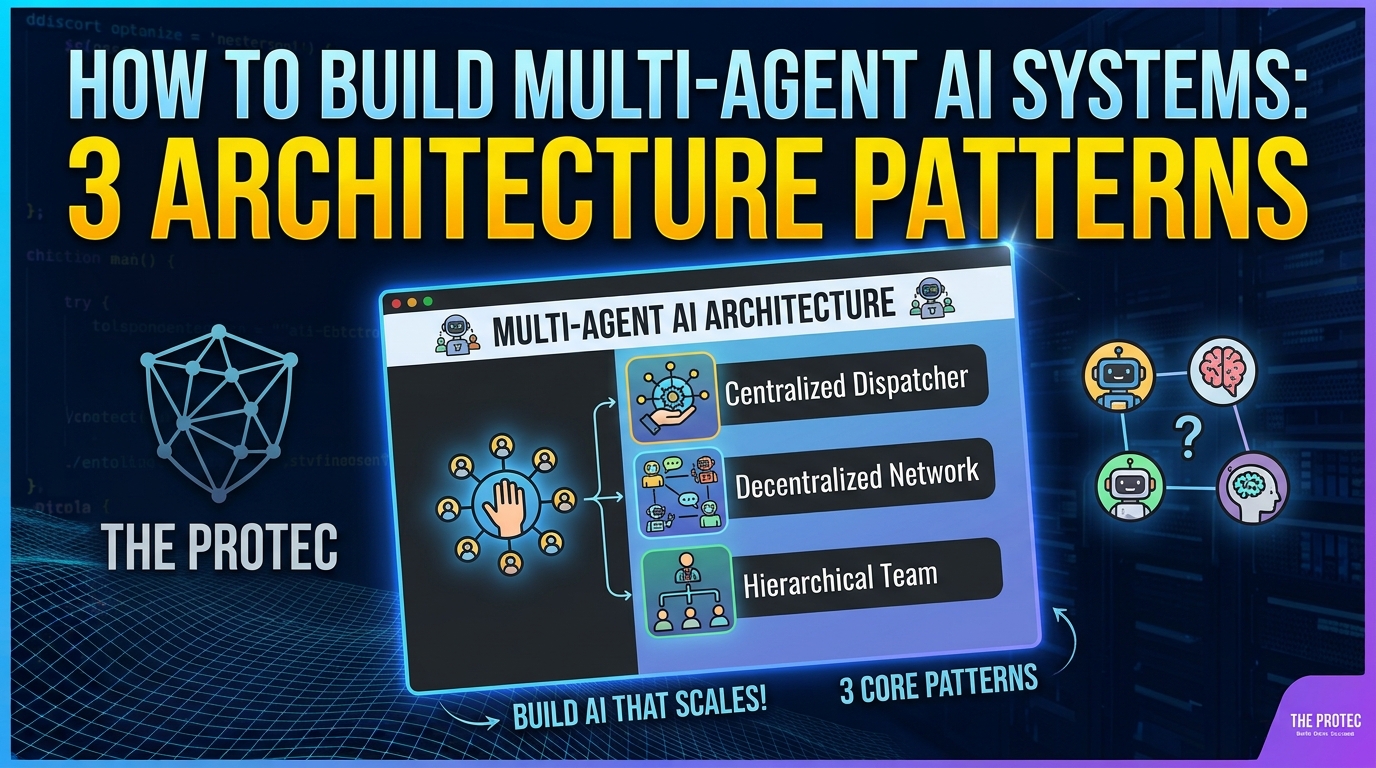
This guide covers three practical patterns: orchestrator–worker, blackboard, and pipeline. Each can support research, code generation, validation, and automated workflows, but they make different trade-offs. More agents do not automatically produce better answers. Without disciplined task decomposition and controls, they can instead multiply hallucinations, latency, and API costs.
What makes a multi-agent architecture useful?
An AI agent architecture is worthwhile when a task contains separable roles, benefits from parallel work, or requires independent checks. Examples include researching several sources simultaneously, having one agent generate code and another test it, or assigning different specialists to security, performance, and compliance reviews.
Before adding agents, compare the design with a simpler baseline. A single model call with tools may be faster and more accurate when the task is short or tightly coupled. A multi-agent workflow earns its complexity only when specialization, concurrency, isolation, or validation creates measurable value.
A useful architecture should define five things:
- Control flow: Who decides what happens next?
- Communication: What data can agents exchange, and in what format?
- State: Where are plans, evidence, outputs, and status stored?
- Evaluation: How are incomplete or incorrect results detected?
- Termination: What stops retries, delegation, and tool use?
Current agent frameworks simplify tool calls, routing, durable execution, and tracing, but framework features do not replace these design decisions. Anthropic’s guide to building effective agents similarly distinguishes predefined workflows from model-directed agents and recommends using the simplest effective approach.
Pattern 1: Orchestrator–Worker
The orchestrator worker pattern places one coordinating agent above several specialized workers. The orchestrator interprets the request, creates a plan, delegates bounded subtasks, and combines the returned results. Workers normally do not control the overall workflow.
User request
     |
     v
[Orchestrator]
  |     |      |
  v     v      v
[Research] [Coder] [Reviewer]
        |      /
   v     v     v
 [Validate and synthesize]
Execution flow
- The orchestrator classifies the request and creates a structured task plan.
- It assigns each subtask an objective, input context, output schema, and budget.
- Independent workers run concurrently; dependent workers wait for prerequisites.
- The orchestrator validates responses, requests limited corrections, and assembles the final result.
Consider a repository migration. A research worker examines the target framework’s documentation, a code worker proposes changes, and a test worker generates validation cases. The orchestrator reconciles those outputs and flags unresolved test failures rather than presenting the migration as complete.
function execute(request, depth = 0):
  require depth <= MAX_DELEGATION_DEPTH
  plan = planner.create(request, schema = TaskPlan)
  require plan.estimated_cost <= remaining_budget

  results = parallel_map(plan.independent_tasks, task =>
    run_worker(task, timeout = task.timeout, retries = 1)
  )

  checked = validator.check(results, plan.acceptance_tests)
  if checked.failed and retry_budget_available():
    results = repair_failed_tasks(checked.failures)
  if critical_failures_remain(results):
    return request_human_review(results)
  return synthesizer.combine(results)
Strengths, limitations, and use cases
This architecture supports parallelism, clear specialization, centralized policy enforcement, and independent review. It works well for broad research, software changes spanning multiple components, incident analysis, and workflows where one controller must maintain a global objective.
The orchestrator is also a bottleneck and a single point of failure. A weak plan contaminates every downstream task. Workers may duplicate effort, receive insufficient context, or return mutually incompatible assumptions. Recursive delegation is especially dangerous: if workers can create more workers without limits, the system can enter an infinite delegation loop and consume its budget before producing an answer.
Pattern 2: Blackboard collaboration
A blackboard architecture replaces top-down delegation with a shared workspace. Multiple agents read the current state, contribute evidence or hypotheses, critique existing entries, and decide whether more work is needed. A scheduler may select which agent acts next, but no single agent must own the complete solution.
       [Research agent]
              |
[Critic] <- [Shared blackboard] -> [Code agent]
              |
       [Validation agent]
Execution flow
- The system creates a shared state containing the objective, constraints, evidence, open questions, and version number.
- Eligible agents receive a snapshot and propose additions or corrections.
- A coordinator or transaction layer validates and commits proposals.
- The cycle continues until acceptance criteria, a deadline, or a budget limit is reached.
For technical research, one agent might collect primary documentation, another evaluate implementation feasibility, and a third challenge unsupported claims. In code generation, agents can post candidate patches, test results, security findings, and unresolved conflicts to the same workspace. Provenance should accompany every contribution so later agents can distinguish source evidence from model inference.
while not done(board) and within_budget():
  snapshot, version = board.read()
  candidates = scheduler.select_agents(snapshot)
  proposals = parallel_map(candidates, a => a.propose(snapshot))
  proposals = deduplicate(validate_schema(proposals))

  for proposal in rank_by_evidence(proposals):
    if board.compare_and_swap(version, proposal):
      log_commit(proposal)
      version = version + 1
    else:
      queue_for_recheck(proposal)
Strengths, limitations, and use cases
The blackboard pattern is useful when the path to a solution is uncertain and different specialists need to build on one another’s discoveries. It supports iterative investigation, hypothesis testing, threat modeling, design reviews, and collaborative diagnosis.
Its hardest problem is shared-state consistency. Concurrent agents may overwrite fields, repeat the same research, or react to stale snapshots. Conflicting writes require versioning, locks, append-only events, or compare-and-swap updates. The blackboard can also become an uncurated context dump. If every agent reads everything, token costs rise and important evidence disappears inside noise. Summaries, typed records, retrieval filters, and provenance are therefore part of the architecture—not optional optimizations.
Pattern 3: Pipeline
A pipeline assigns agents to sequential stages. Each stage transforms a defined input into an output consumed by the next stage. Unlike an orchestrator, the route is mostly predetermined; unlike a blackboard, collaboration occurs through stage contracts rather than an open shared workspace.
[Requirements] -> [Research] -> [Generate]
       -> [Test] -> [Security review] -> [Approval]
Execution flow
- The workflow validates the initial request and converts it into a canonical schema.
- Each stage processes the previous stage’s output.
- Validation gates reject, repair, or route failed outputs for human review.
- Successful outputs and metadata are checkpointed before the next stage begins.
An automated development workflow might turn an approved ticket into a specification, retrieve relevant documentation, generate a patch, run deterministic tests, perform an AI-assisted review, and prepare a pull request. The final action should still require approval when it can alter production systems or expose sensitive information.
state = validate_input(request)
for stage in PIPELINE:
  result = stage.run(state, timeout = stage.timeout)
  if not stage.contract.validate(result):
    result = retry_once_with_feedback(stage, result.errors)
  if not stage.contract.validate(result):
    return escalate(stage.name, state, result)
  state = checkpoint(result)
return state
Strengths, limitations, and use cases
Pipelines are easy to inspect, test, and operate because stage boundaries are explicit. They suit repeatable document processing, content review, data enrichment, code generation, testing, and approval workflows.
They are less flexible when tasks require backtracking or dynamic decomposition. Errors also compound: an invented requirement in stage one may become polished code by stage four. Passing only a compressed summary can cause context loss, while passing the entire history increases cost and distraction. Each handoff should therefore include the original objective, required evidence, assumptions, and machine-checkable outputs.
Failure modes that appear in real systems
- Infinite delegation loops: Agents repeatedly reassign ambiguous tasks. Enforce depth limits and prohibit workers from delegating unless explicitly authorized.
- Escalating API costs: Parallel calls, long shared histories, and repeated critiques amplify token use. Set per-task and system-wide budgets before execution.
- Conflicting concurrent writes: Blackboard participants update the same record from stale state. Use version checks, transactions, or an append-only event log.
- Duplicated work: Vague ownership sends several agents after the same result. Register active tasks and deduplicate plans by objective and inputs.
- Context loss: Agents receive summaries that omit constraints or provenance. Use typed handoff packets and preserve links between claims and evidence.
- Hallucination propagation: One agent’s unsupported statement becomes trusted input for others. Require source attribution, independent validation, and deterministic checks where possible.
Security concerns grow when autonomous AI agents can send messages, modify code, or invoke external tools. The OWASP guidance for LLM applications is a useful companion for threat modeling excessive agency, unsafe outputs, prompt injection, and resource consumption.
Implementation safeguards for reliable AI agent orchestration
Production controls should live in code and infrastructure rather than prompts alone:
- Limit delegation depth: Track lineage and reject work beyond a fixed depth.
- Apply token, cost, and time budgets: Reserve capacity for validation and stop before the total budget is exhausted.
- Require structured outputs: Validate JSON or typed objects and reject unknown fields, missing evidence, and invalid state transitions.
- Synchronize shared state: Use optimistic concurrency, idempotency keys, locks where necessary, and durable checkpoints.
- Add validation checkpoints: Combine model-based review with tests, schema validation, static analysis, and source verification.
- Cap retries: Retry only transient or repairable failures, use backoff, and prevent agents from repeating identical calls.
- Log every decision: Record prompts, model and tool versions, task lineage, state changes, token usage, latency, and approval events while protecting sensitive data.
- Require human approval: Pause before financial transactions, production deployments, data deletion, external communications, permission changes, or other consequential actions.
Evaluate the complete system against a single-agent baseline using task success, factual accuracy, latency, cost, recovery rate, and human intervention. AI agent collaboration is justified only when its measured gains outweigh its larger operational surface.
How to choose among the three patterns
Choose orchestrator–worker for dynamic decomposition and parallel specialists. Choose blackboard when agents must iteratively contribute to an evolving solution. Choose a pipeline for stable, repeatable stages with clear contracts. Hybrid designs are common: an orchestrator can launch a research blackboard and then feed approved findings into a validation pipeline. Keep the hybrid no more complex than the task demands.
Frequently asked questions
How many agents should a multi-agent system have?
There is no universally optimal number. Start with the fewest roles that create a meaningful separation of responsibility. Add an agent only when evaluation shows that specialization, parallelism, or independent validation improves results enough to justify added cost and failure risk.
Are multiple agents more accurate than one agent?
Not automatically. Agents may reinforce the same false assumption or treat another model’s output as evidence. Accuracy improves only when roles are genuinely complementary, agents have access to reliable sources or tools, and independent validation catches errors before they propagate.
Should agents communicate in natural language or structured data?
Use structured data for plans, status, tool inputs, evidence records, and stage handoffs. Natural language remains useful for analysis, but machine-readable schemas make validation, synchronization, replay, and failure diagnosis substantially safer.
Which pattern is easiest to operate in production?
A pipeline is usually the most predictable because its sequence and contracts are explicit. Orchestrator–worker designs offer greater flexibility, while blackboard systems handle open-ended collaboration but require the most careful state management. The right choice depends on task variability, concurrency, and acceptable operational complexity.