








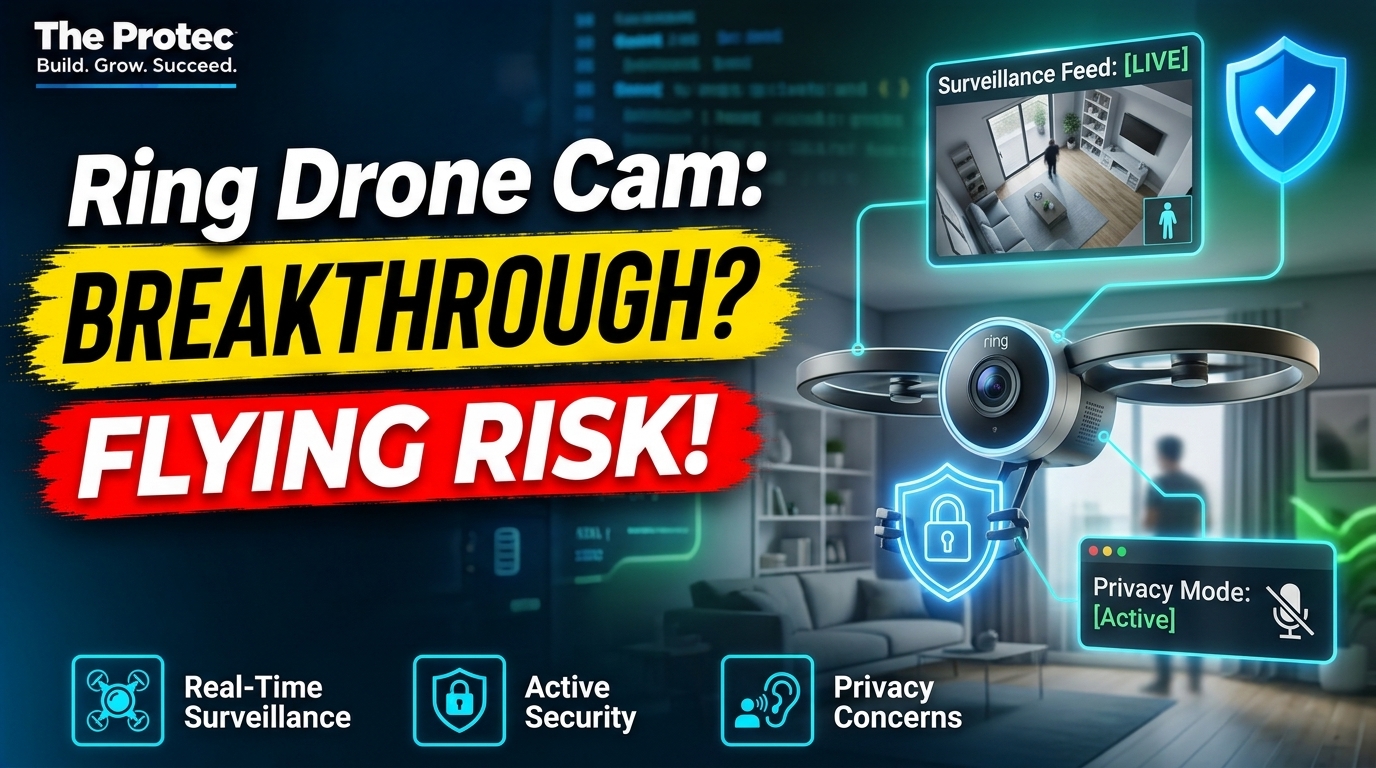
A camera that leaves its dock and flies toward a possible break-in sounds like science fiction—or an unsettling new form of indoor surveillance. Announced by Amazon Ring on November 10, 2026, the Ring Drone Cam is a $249.99 autonomous camera designed to investigate activity throughout a home instead of watching from one fixed position. It could fill important security blind spots, but its short flight time, reliance on cloud intelligence, and presence around family members and guests make the value proposition more complicated than simply replacing several stationary cameras.
Ring plans to ship the device in the United States on January 27, 2027, following years of development and earlier demonstrations of the Ring Always Home Cam concept. That date is not unconditional: the product still requires authorization from the Federal Communications Commission and cannot legally be sold or leased until that approval is granted. Here is what has been confirmed, what early hands-on reporting suggests, and what buyers should consider before inviting a flying camera into the home.
What is the Ring Drone Cam?
The Ring Drone Cam is a flying indoor security camera being launched under Ring Robotics, the company’s new division for mobile home-security devices. Rather than requiring a camera in every room, it can follow user-defined routes, fly on a schedule, or deploy on demand through the Ring system.
It can also respond automatically when compatible Ring cameras, contact sensors, motion sensors, or alarms detect activity. For example, if a downstairs sensor is triggered while the homeowner is away, the drone could leave its dock, travel to a designated patrol point, and provide a live view of that area.
This does not make it an independent security guard. The drone observes and records; it does not physically confront an intruder or contact emergency services solely because it sees something suspicious. Its practical role is to provide visual context so a homeowner can decide whether an alert is a false alarm or a genuine threat.
The core of the system is Ring AI Pilot, which combines the drone’s cameras and onboard sensors with cloud-based processing. During setup, the system maps rooms, identifies patrol points, plans routes, and learns how to move around obstacles. Users can then create flight paths and schedules for the areas they want monitored.
According to Amazon’s product announcement, the autonomous home security system is intended to launch in response to a connected Ring event or at the owner’s request. Built-in obstacle detection helps it navigate around furniture and other objects along a mapped route.
Cloud processing is central to that design. Ring says shifting more AI work away from the aircraft allowed it to reduce the hardware carried onboard, producing a smaller and lighter device. The trade-off is that the Amazon Ring Drone Cam depends on both Wi-Fi and Ring’s cloud services for normal autonomous operation. If connectivity is lost, it can land safely, but it cannot continue its usual patrol or investigation offline.
Confirmed specifications and requirements
Ring has confirmed the following details for its redesigned flying indoor security camera:
- Weight: Approximately 165 grams
- Video resolution: 2K
- Field of view: 148 degrees
- Camera movement: 360-degree rotation
- Low-light support: Built-in LED lights
- Reported flight time: About five to eight minutes
- Charging rate: Approximately eight minutes of charging for each minute of flight
- Announced US price: $249.99
- Planned shipping date: January 27, 2027
A compatible Ring Protect plan is required for stored video and advanced features. Buyers should therefore evaluate the subscription cost as part of ownership rather than treating the $249.99 price as the entire investment.
FCC authorization is another important condition. As of the announcement, the device had not received the required approval and could not be sold or leased in the United States. The announced release date reflects Ring’s plan, not a guarantee that regulatory clearance or shipping will occur on schedule.
Battery life is the biggest practical constraint
Five to eight minutes is enough to check a room or investigate a specific alert, but it is not enough for continuous patrols. The charging ratio is even more consequential: roughly eight minutes on the dock restores one minute of flight. A drone that spends five minutes investigating an event may need around 40 minutes of charging before regaining that amount of airtime, assuming the rate remains consistent.
That limitation changes how the product should be understood. This is not an airborne camera that continuously circles a house. It is an intermittently available response device that spends most of its time docked. Several alerts in quick succession—or an unnecessarily long scheduled route—could leave it unavailable when a more important event occurs.
Fixed cameras do not face that problem. Wired models can record continuously, and multiple cameras can observe different rooms at the same time. The drone’s advantage is mobility: one device can look into several mapped spaces and approach an alert from different angles. Its disadvantage is that it can only be in one place, for a few minutes, before returning to charge.
How it differs from the Ring Always Home Cam
Ring first demonstrated the Always Home Cam concept years before this launch announcement. That earlier idea established the basic pitch: a camera could fly along predetermined indoor paths, providing views of areas without permanently installing cameras in every room. It generated considerable attention but did not become a broadly available mainstream product.
The Ring Drone Cam is a redesign rather than a simple renaming. By moving more AI processing to the cloud, Ring reduced the computing hardware that must travel with the aircraft. The result is a device weighing approximately 165 grams, with upgraded 2K video, rotating camera coverage, and an AI Pilot system responsible for mapping and route planning.
That engineering decision helps explain both the smaller design and the cloud dependence. Local processing could offer more independence from internet outages and potentially reduce how much data leaves the home, but it would require additional onboard power and hardware. Ring has prioritized lower flying weight and centralized intelligence instead.
Security breakthrough or noisy novelty?
The strongest argument for a Ring drone camera is flexible verification. A door sensor cannot show why it opened, while a fixed camera may be pointed in the wrong direction. A mobile camera could travel to the area, rotate its lens, and give the homeowner a wider view. Its sound may also alert an intruder that the property is actively monitored.
However, deterrence is not the same as discretion. In The Verge’s hands-on reporting, the aircraft’s audible presence was a notable part of the experience. That observation should be separated from Ring’s marketing claims about convenient autonomous monitoring: propellers moving enough air to keep a camera aloft will be heard.
Noise could be helpful during a suspected intrusion, but irritating during routine patrols. It could wake a sleeping child, startle pets, interrupt a conversation, or make guests feel watched. Animals may also react unpredictably to a moving object, while temporary obstacles such as toys, bags, or people can make a familiar route more complex.
For many homes, the drone is therefore more plausible as a supplement to doorbell cameras, alarms, and a few strategically placed fixed cameras—not a complete replacement for them.
Smart home privacy goes beyond the camera lens
Ring says the camera is physically shuttered while the drone sits on its dock and that it records only during flight. Those are meaningful safeguards because the aircraft is not supposed to provide a silent, always-on view from its resting position.
Video is protected using Ring’s Throw Away the Key encryption system. The important qualification is that the drone relies on cloud processing, so Ring temporarily has access to encryption keys while performing the necessary tasks. That does not mean employees routinely watch recordings, but it is materially different from a fully local system in which the provider never has technical access to a usable key.
Privacy also depends on household behavior, not just encryption. A scheduled patrol could capture children, housemates, cleaners, caregivers, contractors, or visitors who did not expect a camera to enter the room. Unlike a fixed camera, whose location is visible and predictable, a flying AI home security camera changes position. That mobility can make consent and personal boundaries harder to manage.
Prospective owners should consider several practical rules:
- Tell residents and regular visitors where and when the drone may fly.
- Avoid routes through bedrooms, bathrooms, and other sensitive spaces.
- Use automatic deployments only for meaningful security events.
- Review video-retention settings and delete recordings that are no longer needed.
- Secure the Ring account with a unique password and multifactor authentication.
- Revisit routes when furniture, household members, or privacy expectations change.
Is one flying camera better than several fixed cameras?
It depends on the job. Fixed cameras are better for continuous coverage, simultaneous views, quiet operation, and predictable framing. They can also be positioned at entrances or high-risk areas where evidence is most likely to be useful.
The Ring Drone Cam is potentially better for inspecting multiple rooms after a specific alert. It may suit a home where residents dislike having visible cameras throughout the interior but still want a way to investigate unexpected activity while away. A single mobile device could also check whether a window was left open or determine what caused motion in a room outside the view of another camera.
Yet the short battery life means it cannot offer constant roaming coverage, and its cloud dependence introduces another failure point. A Wi-Fi outage, internet disruption, or unavailable cloud service can prevent normal autonomous operation at precisely the moment remote visibility is needed.
The most realistic conclusion is that Ring Robotics has created a distinctive response camera, not a universal camera replacement. Its mobility solves some blind spots while creating new questions about availability, noise, connectivity, and consent.
FAQ: Ring Drone Cam
How much does the Ring Drone Cam cost?
Ring announced a US price of $249.99. A compatible Ring Protect subscription is also required for video storage and advanced features, so the long-term cost will be higher than the hardware price alone.
When will the Amazon Ring Drone Cam be available?
Ring says shipping is planned for January 27, 2027. The device still requires FCC authorization, however, and cannot be sold or leased before that approval is received.
Can the drone operate without Wi-Fi?
Not normally. It uses Wi-Fi and cloud-based intelligence for mapping, route planning, and autonomous navigation. It can land if connectivity is lost, but it cannot continue its standard autonomous operation offline.
Does the camera record while docked?
Ring says no. The camera is shuttered while on the dock and records only when the drone is in flight. Owners should still review account security, retention settings, cloud-processing policies, and household consent before enabling automatic routes.
Can it replace every indoor security camera?
Probably not. It offers flexible views but flies for only five to eight minutes and cannot monitor several places simultaneously. Fixed cameras remain better for continuous coverage, while the drone may be useful for targeted investigation after an alert.
The bottom line
The Ring Drone Cam turns a long-discussed concept into a planned consumer product with credible benefits. Its 2K camera, wide field of view, rotating lens, LED lighting, and autonomous response features could help homeowners inspect an alert without placing a permanent camera in every room.
But mobility does not automatically equal better security. Limited airtime, slow recharging, Wi-Fi dependence, cloud-based processing, subscription requirements, and the social impact of a noisy flying camera all constrain its usefulness. At $249.99, it is best viewed as an experimental addition to a broader Ring security setup. Whether it feels like a breakthrough or an intrusion will depend as much on household boundaries and trust as on Ring AI Pilot’s ability to navigate the furniture.