




Why Web Scraping Proxy APIs Matter More Than Ever
Web scraping has changed dramatically over the last few years. Sites are harder to crawl, anti-bot systems are more aggressive, JavaScript-heavy pages are everywhere, and teams now expect scraping infrastructure to work reliably at scale without constant maintenance. That is why the best web scraping proxy is no longer just a proxy list or a basic rotating IP pool. In practice, most teams need a full web scraping API that can handle proxy rotation, browser rendering, retries, fingerprinting, and anti-bot bypass in one place.
This shift is especially important for product teams, ecommerce operators, SEO agencies, data providers, and AI workflows that depend on fresh public web data. Whether you are collecting search results, pricing data, SERP intelligence, or large-scale content feeds, the right rotating proxy API can save hours of engineering time and dramatically improve success rates. The wrong one creates endless 403s, timeouts, and fragile scripts that break every time a site updates its defenses.
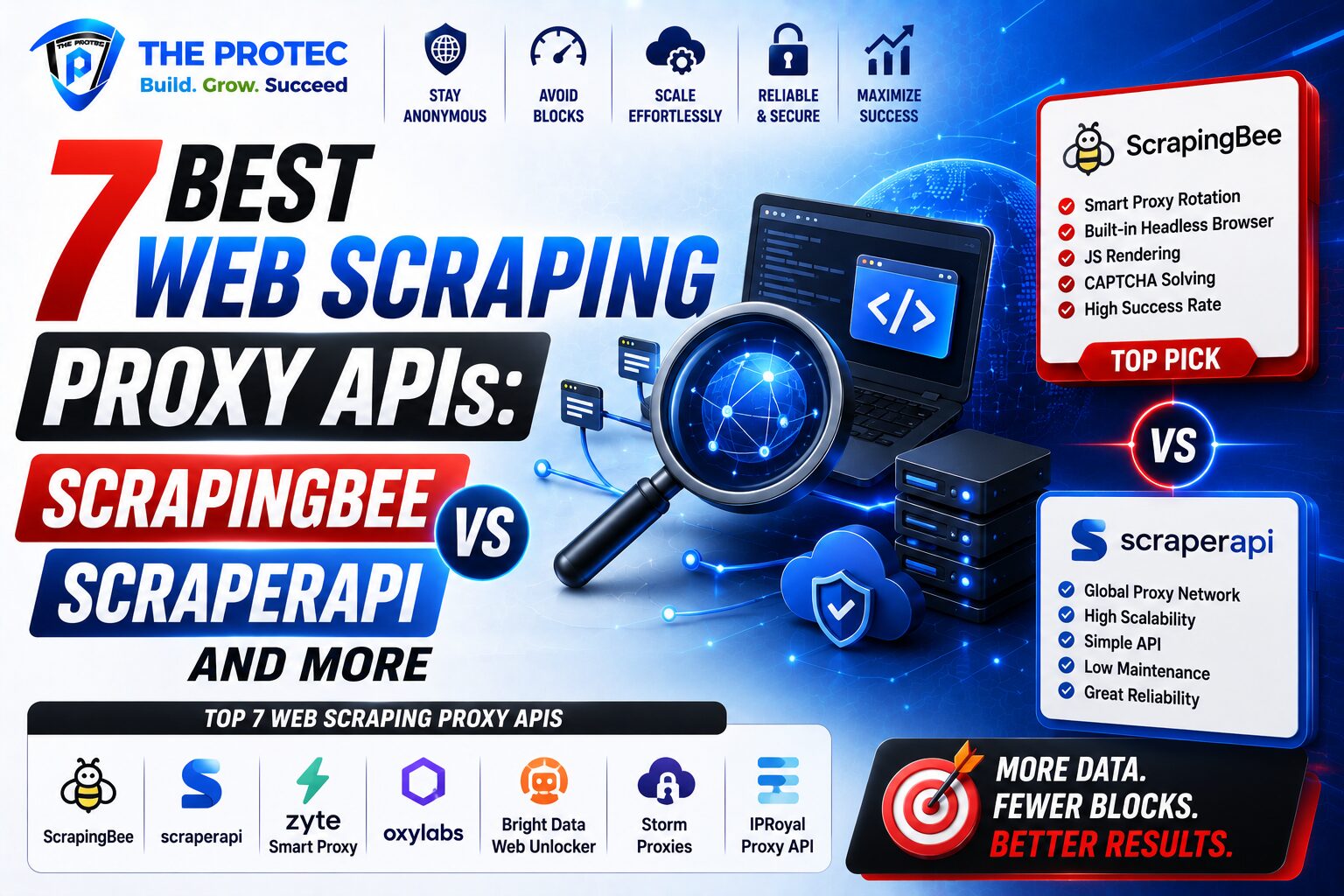
In this guide, we compare seven of the strongest web scraping proxy APIs available today, with a close look at pricing, JavaScript rendering, proxy rotation, speed, anti-bot handling, and developer experience. The goal is simple: help you choose the platform that fits your scraping workload and budget.
What to Look for in a Web Scraping API
Before comparing tools, it helps to define the features that matter most. A modern web scraping API should do far more than forward requests through a proxy. The best platforms combine several capabilities into one service.
- Proxy rotation: Automatic IP rotation helps distribute requests and reduce blocking.
- JavaScript rendering: Essential for pages built with React, Vue, Angular, or dynamic client-side content.
- Anti-bot bypass: Advanced systems can manage headers, fingerprints, browser behavior, and CAPTCHAs more effectively than raw proxies.
- Speed and reliability: Fast response times and high success rates matter more than vanity proxy counts.
- Developer experience: Clean APIs, good documentation, SDKs, and debugging tools reduce implementation time.
- Pricing transparency: You need to understand costs per request, render, or bandwidth usage before you scale.
With that in mind, here are the seven best options to consider.
1. Bright Data
Bright Data remains one of the most powerful names in the scraping infrastructure market. It is often the first choice for enterprise teams that need broad coverage, deep control, and a full-stack data collection platform. If your priority is scale and flexibility, Bright Data is usually on the shortlist.
The platform offers robust proxy rotation across residential, ISP, datacenter, and mobile IPs, plus a mature web scraping API and browser-based collection tools. It is especially strong when you need to target difficult websites with sophisticated blocking layers. Bright Data also invests heavily in compliance tooling, granular controls, and debugging features that enterprise teams tend to value.
Strengths
- Large proxy network with multiple IP types
- Strong anti-bot bypass capabilities
- Advanced control for enterprise-scale scraping
- Good for teams that need both proxies and managed scraping APIs
Trade-offs
- Can be expensive compared with lighter-weight alternatives
- Learning curve is steeper than simpler API-first tools
- May be more than smaller teams need
Best for: Enterprises, data platforms, and engineering teams that need maximum coverage and control.
Pricing note: Bright Data typically sits at the premium end of the market, so it is best evaluated by volume and use case rather than by headline entry price.
2. ScraperAPI
ScraperAPI is one of the most popular choices for teams that want an easy-to-use web scraping API without building proxy management themselves. For many developers, it is the fastest way to turn a failing scraper into a stable workflow.
The appeal is straightforward: send a URL, and ScraperAPI handles proxy rotation, retries, browser rendering options, and anti-bot challenges behind the scenes. It is known for being easy to integrate and practical for common scraping workloads like ecommerce, directory pages, search engines, and content extraction.
Strengths
- Very simple API and fast setup
- Automatic proxy rotation and retries
- Supports JavaScript rendering for dynamic pages
- Good developer experience and straightforward documentation
Trade-offs
- Less customizable than some enterprise platforms
- Pricing can grow quickly at scale
- Advanced users may want more control over fingerprinting and browser behavior
Best for: Developers and product teams who want a reliable scraping API with minimal operational overhead.
ScrapingBee vs ScraperAPI: This comparison is common because both tools serve the same core buyer: teams that want managed scraping instead of raw proxy infrastructure. ScraperAPI is often favored for broad ease of use and a very direct workflow, while ScrapingBee tends to appeal to developers who want a clean API plus a polished rendering experience.
3. ScrapingBee
ScrapingBee is another strong contender in the managed scraping API category, and it has long been a favorite among developers who want a smooth experience without dealing with low-level proxy logic. It is often discussed in the same breath as ScraperAPI because both are designed to simplify difficult scraping tasks.
ScrapingBee is especially attractive for projects that need browser rendering, rotating proxies, and anti-blocking logic in a single API call. It performs well for many common data collection tasks and is often praised for being developer-friendly and easy to test. For teams that care about fast implementation and a clear interface, it is a compelling option.
Strengths
- Easy-to-use web scraping API
- Strong focus on JavaScript rendering
- Managed proxy rotation and anti-blocking features
- Good fit for small to medium engineering teams
Trade-offs
- May not be the cheapest option for heavy usage
- Less enterprise breadth than Bright Data
- Performance can vary depending on target site complexity
Best for: Teams that value simplicity, fast integration, and reliable rendering.
Affiliate note: If you publish affiliate content, ScrapingBee is a strong candidate to link with a review-driven CTA because the product is easy to explain and easy to evaluate.
4. ZenRows
ZenRows has gained strong attention as the scraping market has shifted toward managed anti-bot infrastructure. It positions itself as a complete scraping API built for modern challenges, including JavaScript rendering, proxy rotation, CAPTCHA handling, and anti-ban protection.
What makes ZenRows interesting is that it focuses heavily on making scraping production-ready without forcing teams to become experts in browser evasion. Its developer experience is clean, and it is often appealing to startups and growth teams that need dependable extraction without hiring dedicated scraping specialists.
Strengths
- Modern scraping API with strong anti-bot emphasis
- Supports rendering and rotating proxy use cases
- Good for teams that want a balance of power and simplicity
- Often positioned well for growth-stage companies
Trade-offs
- Smaller ecosystem than the biggest enterprise providers
- Feature depth may be narrower for highly specialized workflows
- Pricing and usage tiers should be reviewed carefully at scale
Best for: Startups, agencies, and product teams that need a modern web scraping API with strong anti-bot handling.
5. Oxylabs
Oxylabs is one of the best-known enterprise proxy and scraping providers, and it remains a major option for companies that need high reliability and global scale. Like Bright Data, it serves customers who want more than a simple proxy service. Its portfolio includes proxy networks, scraping APIs, and managed data collection capabilities.
Oxylabs is especially strong in environments where accuracy, geographic targeting, and operational stability matter. It is often used for ecommerce monitoring, travel data, market intelligence, and other business-critical scraping workloads. The platform is mature, and its service quality is generally associated with serious enterprise use.
Strengths
- Enterprise-grade proxy network and scraping tools
- Strong geographic targeting options
- Reliable for large-scale collection
- Good support for business-critical use cases
Trade-offs
- Premium pricing
- May be more complex than smaller teams require
- Not always the simplest option for quick experiments
Best for: Enterprises that need dependable infrastructure and global coverage.
6. NetNut
NetNut is known for offering a different angle on proxy infrastructure, with an emphasis on stable connectivity and enterprise use cases. It is frequently considered by teams that want a high-performance proxy network without necessarily committing to the most complex platform on the market.
For scraping, NetNut can be a strong option when you need proxy rotation and scale with lower operational friction. It is often evaluated by teams that care about uptime, speed, and consistent access across difficult targets. While it may not be as widely discussed in consumer-level comparisons, it has a solid reputation in the data collection space.
Strengths
- Strong proxy infrastructure
- Useful for high-volume scraping tasks
- Enterprise-friendly reliability
- Good option for teams that need stable throughput
Trade-offs
- Less famous as a scraping API brand than some competitors
- Feature set should be checked closely for browser-rendered use cases
- May require more evaluation to match specific workflows
Best for: Teams that prioritize reliable proxy access and throughput.
7. Smartproxy
Smartproxy is a popular choice for teams that want a more approachable proxy and scraping experience without jumping immediately into the most complex enterprise stack. It offers proxy products and scraping tools that can be attractive for smaller teams, agencies, and developers who need dependable results without excessive setup.
Its biggest advantage is accessibility. Smartproxy tends to be easier to adopt than heavyweight enterprise systems, and it offers enough capability for many standard scraping scenarios. For users who want a rotating proxy API with a simpler learning curve, it is a worthy contender.
Strengths
- Accessible for smaller teams
- Practical proxy rotation options
- Useful balance of simplicity and capability
- Good for general-purpose scraping workflows
Trade-offs
- May lack some of the deepest enterprise features
- Advanced anti-bot challenges can require testing
- Not always the strongest choice for highly dynamic targets
Best for: Agencies, SMBs, and developers who want a straightforward proxy and scraping solution.
ScrapingBee vs ScraperAPI vs Bright Data vs ZenRows: Which One Wins?
Choosing the best web scraping proxy API depends on your workload, team size, and target sites. There is no single winner for every use case, but there are clear patterns.
- Best for enterprise scale: Bright Data or Oxylabs
- Best for simplicity: ScraperAPI or ScrapingBee
- Best modern anti-bot focus: ZenRows
- Best value for accessible proxy workflows: Smartproxy
- Best for stable enterprise proxy infrastructure: NetNut
When comparing ScrapingBee vs ScraperAPI, the decision often comes down to workflow preference. ScraperAPI is frequently the easiest path to production for teams that want a straightforward managed API. ScrapingBee is equally attractive for many developers, especially when rendering and API simplicity are top priorities. If you need a fast rollout and a clean integration, both are excellent candidates.
Bright Data and Oxylabs are more likely to win when the challenge is less about convenience and more about scale, coverage, and difficult target access. These platforms are typically more expensive, but they can justify that cost for high-value workflows. ZenRows sits in a very compelling middle ground: modern, focused on anti-bot realities, and well aligned with teams that want a strong managed experience without heavy infrastructure complexity.
Pricing, Speed, and Developer Experience: The Real Decision Factors
It is tempting to compare these platforms by feature lists alone, but real-world selection usually comes down to three things: pricing, speed, and developer experience.
Pricing
Scraping APIs are often priced by requests, rendered pages, bandwidth, or a mix of those variables. That means a cheap-looking entry plan can become expensive if your workflow requires JavaScript rendering or retries. For high-volume projects, always estimate total cost at your actual usage level, not just at the starter tier.
Speed
Speed is not only about raw response time. It is about how quickly a system can succeed on difficult pages without repeated failures. A slower API that succeeds on the first attempt can outperform a faster one that gets blocked and retried multiple times. If you are scraping search pages or ecommerce data, this distinction matters a lot.
Developer experience
This is where managed scraping APIs can create major ROI. Good docs, SDKs, predictable error handling, and easy debugging can save engineering weeks. If your team needs to ship quickly, the best platform may be the one that reduces integration friction the most.
Best Web Scraping Proxy API Use Cases
Different teams need different tools. Here is a practical way to map use cases to platforms:
- SEO and SERP tracking: ScraperAPI, ZenRows, Bright Data
- Ecommerce price monitoring: Bright Data, Oxylabs, ScrapingBee
- Startup data extraction: ScrapingBee, ScraperAPI, ZenRows
- Enterprise data operations: Bright Data, Oxylabs, NetNut
- Fast prototyping: ScrapingBee or ScraperAPI
If your project involves AI-powered scraping pipelines, a managed API can also reduce the maintenance burden of feeding clean, structured data into downstream models. That is one reason the market for anti-bot tools and scraping APIs continues to grow: more teams are treating web data collection as an infrastructure layer, not a one-off script.
External Resources Worth Checking
If you are comparing vendors or validating what scraping actually looks like in production, these external resources can help:
FAQ
What is a web scraping API?
A web scraping API is a service that helps you fetch web pages and extract data without managing proxies, browser rendering, retries, or anti-bot logic yourself. It is often the easiest way to build a production-ready scraper.
What is the difference between a proxy and a scraping API?
A proxy only routes traffic through another IP address. A scraping API usually includes proxy rotation plus extra features like browser rendering, fingerprint handling, retries, and anti-bot bypass support. That is why many teams prefer a managed API over raw proxy infrastructure.
Is ScrapingBee better than ScraperAPI?
It depends on your workflow. In the ScrapingBee vs ScraperAPI comparison, both are strong managed scraping tools. ScraperAPI is often chosen for its straightforward setup and broad practicality, while ScrapingBee is attractive for its clean API and rendering experience. Test both if your use case is important.
Which tool is best for difficult websites?
For difficult targets, Bright Data and Oxylabs are often the strongest enterprise choices, while ZenRows is appealing for teams that want modern anti-bot handling in a more streamlined package. The best option depends on the specific site and blocking behavior.
Are scraping APIs better than building my own proxy rotation?
For most teams, yes. Building and maintaining your own rotating proxy API stack can become expensive and time-consuming, especially when sites change defenses frequently. Managed scraping APIs usually offer better reliability and faster deployment.
Final Verdict: Which Web Scraping Proxy API Should You Choose?
If you want the shortest path to reliable data extraction, the best web scraping proxy is usually a managed scraping API rather than a raw proxy pool. That is especially true now that websites rely on advanced anti-bot systems and dynamic front ends. The strongest options in this comparison each serve a distinct type of buyer.
Choose Bright Data or Oxylabs if you need enterprise-scale infrastructure, broad IP coverage, and maximum control. Choose ScraperAPI or ScrapingBee if you want a fast, developer-friendly web scraping API that gets you productive quickly. Choose ZenRows if anti-bot handling and modern managed scraping are at the center of your workflow. Choose NetNut or Smartproxy if you want strong proxy infrastructure with a more approachable setup.
The real winner is the platform that gives you the highest success rate at the lowest operational cost for your specific targets. If you are evaluating tools today, start with your hardest pages, test JavaScript rendering, compare latency, and calculate cost per successful page. That is the most honest way to decide which rotating proxy API deserves a place in your stack.