








AI Model Routers Explained: How Developers Can Reduce LLM Costs Without Sacrificing Quality
Large language models have changed how teams build products, but they have also introduced a new operational problem: every request can be expensive. As applications scale, simple choices like which model to call, when to escalate, and how much context to send can have a major impact on spend. That is why the AI model router has become one of the most practical tools in modern AI infrastructure.
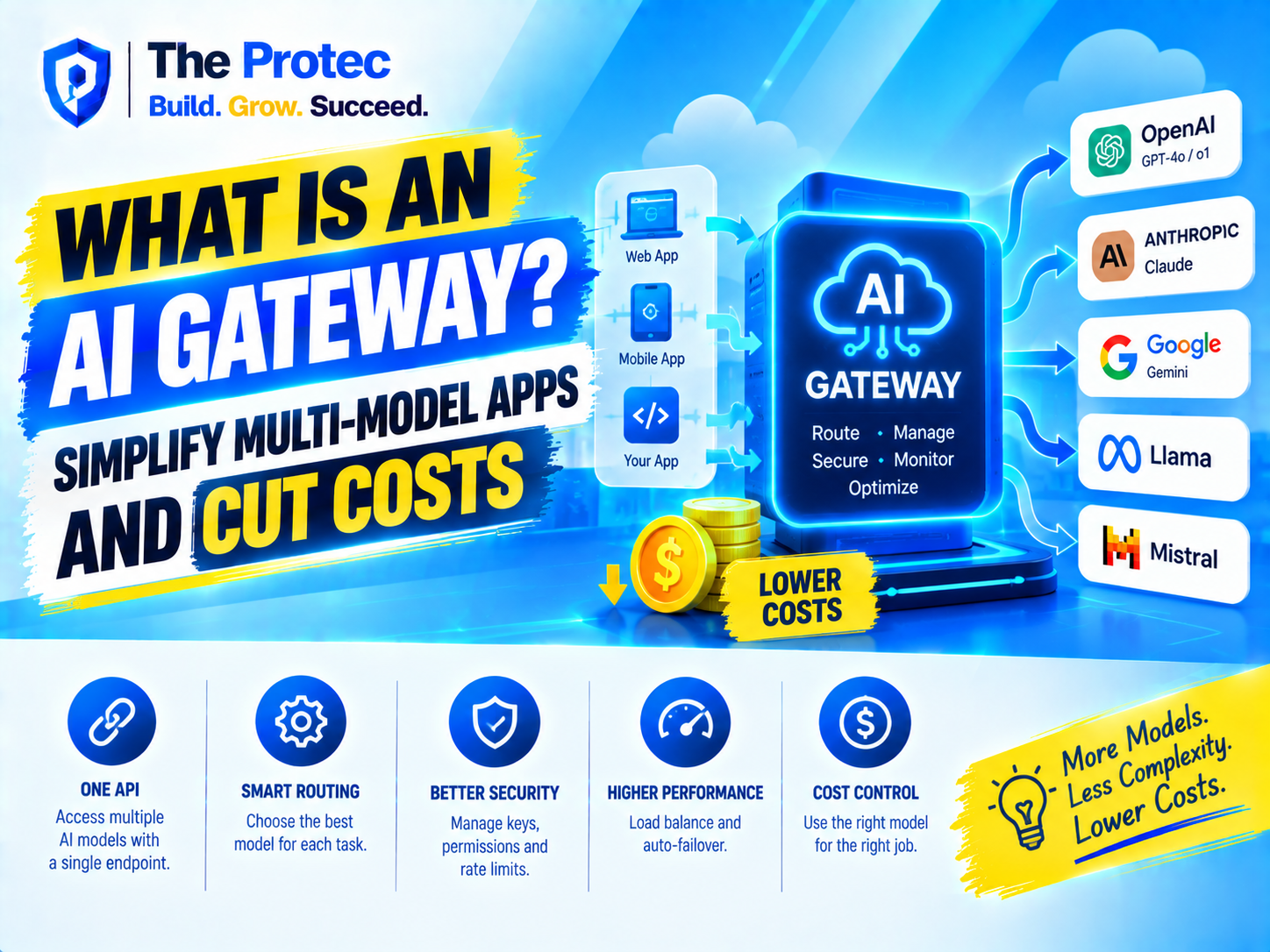
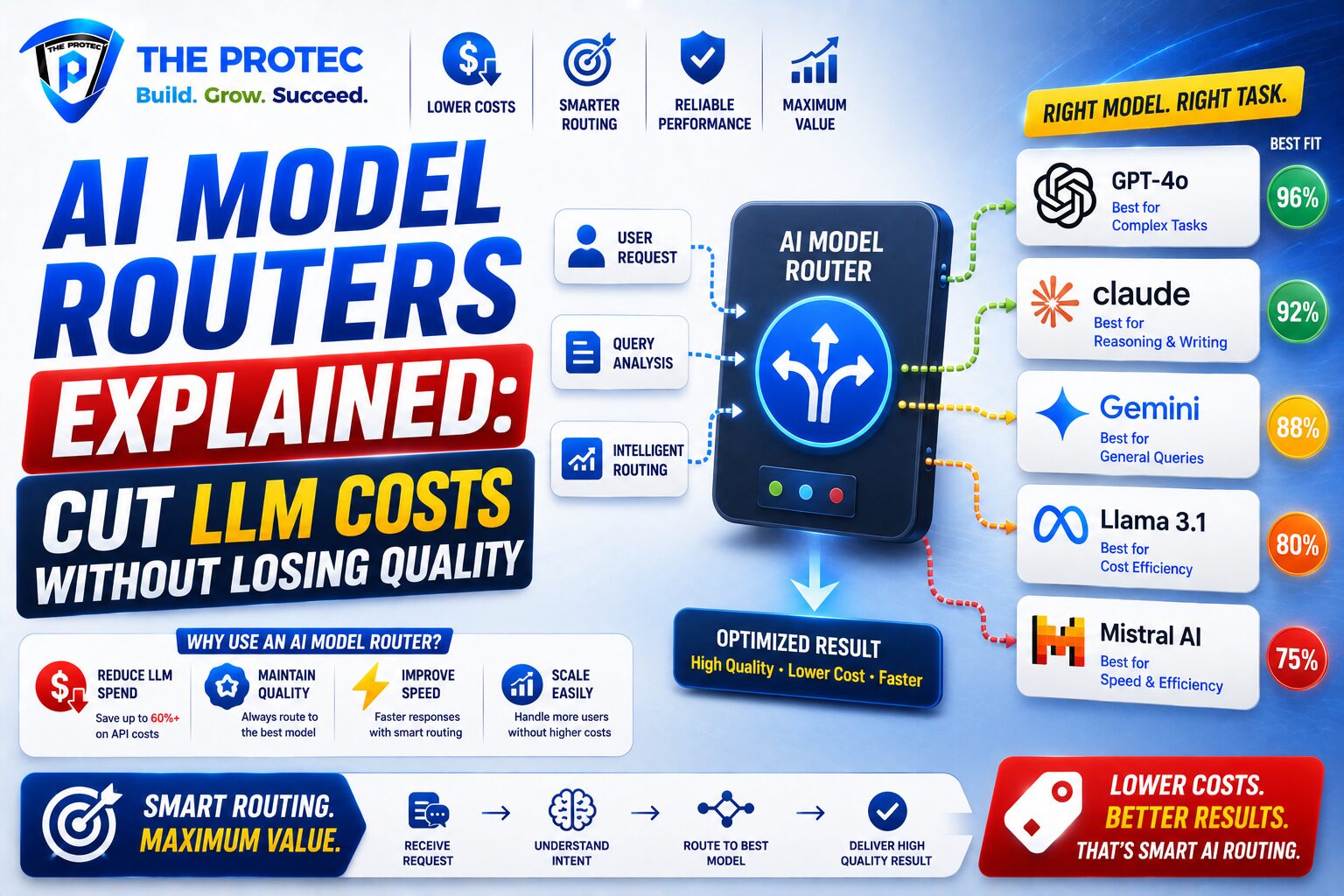
An AI model router acts like a traffic controller for model usage. Instead of sending every prompt to the most expensive or most capable model, it evaluates the task and routes each request to the model most likely to deliver the right balance of cost, latency, and quality. For teams building customer support assistants, content workflows, coding copilots, agentic systems, or enterprise search, this approach can dramatically improve LLM cost optimization without forcing quality tradeoffs.
The rise of multi-model AI has also changed expectations. Developers are no longer locked into a single provider or model tier. They can combine frontier models, smaller fast models, reasoning models, and specialized tools in one architecture. The challenge is no longer access to models; it is orchestration. Model routing solves that orchestration problem by making model selection dynamic instead of static.
In this article, we will break down how AI model routers work, the main routing strategies developers use, the tradeoffs behind each one, and how to design a routing stack that reduces API costs while preserving output quality.
What Is an AI Model Router?
An AI model router is a decision layer that selects the best model for a given task based on predefined rules, learned signals, or real-time evaluation. It sits between your application and the model providers. When a request comes in, the router analyzes the prompt, context, user intent, cost constraints, latency targets, and sometimes historical performance data, then chooses the most appropriate model.
This is not just about picking the cheapest model. A good router balances multiple goals:
- Cost: Use lower-cost models whenever they are good enough.
- Quality: Escalate to more capable models when the task is complex or high-risk.
- Latency: Route quick interactions to faster models.
- Reliability: Avoid models that frequently fail on certain task types.
- Compliance: Keep sensitive data within approved model boundaries when needed.
In practice, this means a simple user question might go to a lightweight model, while a legal summary, deep reasoning task, or production-critical response may be routed to a stronger model. That selective behavior is what makes AI model routers such an effective LLM cost optimization strategy.
Why Multi-Model AI Is Becoming the Default Architecture
For a while, many teams tried to standardize on one flagship model. That approach was convenient, but it often led to overspending. Today, multi-model AI is increasingly the default because model capabilities are more differentiated than ever. Some models are optimized for speed. Others excel at reasoning. Some are ideal for structured extraction. Others are better for long-context summarization or code generation.
Using one model for everything is like using a sports car for every trip. It works, but it is rarely efficient. Multi-model AI allows developers to assign the right tool to the right task. A router makes this manageable by abstracting away the complexity of model selection from the application layer.
This shift is also driven by product expectations. Users want immediate responses, but they also expect accuracy. Businesses want lower costs, but they cannot afford quality regressions. Model routing offers a middle path: reduce unnecessary calls to premium models while preserving high-value output where it matters most.
According to OpenAI’s pricing and model documentation, cost differences between model tiers can be substantial, and selecting the right tier for each use case is a major lever for controlling spend: OpenAI Platform Docs. Similar pricing and capability differences exist across major model providers, which is why routing is now a core architecture pattern rather than an optimization afterthought.
How AI Model Routing Works
At a high level, routing involves four steps: classify the request, estimate requirements, select a model, and validate the result. The specifics vary by implementation, but the architecture usually looks like this.
1. Request classification
The router first identifies what kind of task it is handling. Is the prompt asking for summarization, extraction, classification, brainstorming, coding, translation, or open-ended reasoning? Is it a short, low-risk request or a complex, high-stakes one?
Classification may use simple rules, embeddings, lightweight classifiers, or another model. The key is to infer the task type quickly and cheaply.
2. Cost and quality estimation
Next, the router estimates what level of capability is needed. A short FAQ answer does not need the same model as a multi-document synthesis task. A well-designed router also considers context length, required structured output, expected creativity, and tolerance for error.
This stage is where LLM cost optimization becomes strategic. If the router can predict that a smaller model will succeed with high confidence, it avoids an unnecessary premium-model call.
3. Model selection
The router selects the model that best fits the request. This could be a rules-based choice, a score-based ranking, or a learned policy. Some systems also route to tools instead of models, such as search, retrieval, code execution, or deterministic parsers, when those options are cheaper and more reliable.
4. Result validation and escalation
After the response is generated, the system may validate it for format, completeness, safety, or accuracy. If the output fails checks, the router can retry with a stronger model or a different prompt strategy. This fallback mechanism is crucial because routing is not only about saving money; it is about reducing cost without introducing fragile behavior.
Core Routing Strategies Developers Use
There is no single best routing method. The right approach depends on your product, traffic patterns, and tolerance for mistakes. The most effective systems typically combine several strategies.
Rule-based routing
Rule-based routing uses hand-crafted logic. For example, if a prompt contains more than 8,000 tokens, route to the long-context model. If the task is labeled “simple classification,” route to the cheapest model. If the user is in a premium workflow, route to the highest-quality model.
This approach is easy to implement and easy to debug. It works especially well when task boundaries are clear. The downside is rigidity. As traffic changes, rules can become brittle and may miss opportunities for better optimization.
Classifier-based routing
In classifier-based routing, a lightweight model or ML classifier predicts which downstream model is most likely to perform well. This is a strong option when you have enough historical data to learn patterns from past requests.
For example, the router may learn that a compact model handles product FAQ questions with excellent accuracy, while the premium reasoning model is needed for multi-step policy analysis. Because the classifier is cheap to run, the system can make a smarter decision before spending on the final generation model.
Confidence-based routing
Confidence-based routing uses the model’s own uncertainty or a secondary evaluator to decide whether the output is good enough. If the first model produces a high-confidence response, the system accepts it. If confidence is low, the request escalates to a stronger model.
This strategy is useful for tasks with a clear correctness threshold, such as extraction, classification, and structured generation. It can save a lot of money because premium models are only used when the first pass is uncertain.
Prompt-aware routing
Prompt-aware routing analyzes prompt length, complexity, domain language, and requested output format. A concise prompt asking for a short rewrite may be routed to a small model, while a prompt requiring synthesis across documents, nuanced tone control, or code explanation may be routed to a more capable one.
This method often performs well in production because prompt features are available immediately and do not require a separate training pipeline.
Cascade routing
Cascade routing tries a cheaper model first and escalates only when necessary. This is one of the most effective LLM cost optimization patterns because many requests are solved satisfactorily by lower-cost models.
The key is to define clear escalation triggers. Those triggers may include low confidence, failed validation, poor JSON structure, missing citations, or user feedback signals. Cascades are especially useful when response quality is more important than first-pass speed, but not so urgent that every request needs the strongest model.
Specialist routing
Specialist routing assigns certain tasks to specialized models. For example, one model may be better at coding, another at summarization, another at translation, and another at extraction. This is a natural fit for multi-model AI because it mirrors how human teams assign work to specialists.
Specialist routing improves quality when task categories are stable and distinct. It can also reduce costs if the specialized model is cheaper than a general-purpose flagship model.
What Makes an AI Model Router Effective?
A router is only useful if it consistently makes good decisions. The best systems are designed around measurable outcomes, not vague assumptions. Developers should evaluate routing decisions based on actual performance, not just theoretical savings.
- Routing accuracy: How often does the router choose a model that meets the task requirement?
- Cost per successful task: Are you saving money while still getting acceptable results?
- Latency impact: Does routing reduce or increase end-to-end response time?
- Fallback rate: How often do lower-cost models fail and require escalation?
- User satisfaction: Are users noticing better speed, lower friction, or improved answer quality?
The most important metric is often not raw cost per request, but cost per successful outcome. A cheap model that fails often can be more expensive in the long run if it causes retries, rework, or poor user experiences.
Best Practices for LLM Cost Optimization with Routing
If your goal is to cut API spend without degrading the product, the following practices matter more than the choice of router framework.
Use cheap models for predictable tasks
Tasks like intent classification, tagging, formatting, translation, and simple summarization are often well within the capabilities of smaller models. Do not over-allocate premium compute to routine work.
Trim context aggressively
Even the best routing strategy can be undermined by bloated prompts. Remove irrelevant history, compress documents, and retrieve only the most useful context. Since token volume often drives cost more than model choice alone, context control is one of the highest-ROI optimizations.
Escalate only when there is a measurable reason
Set precise escalation rules. Examples include invalid schema output, low confidence, failed retrieval grounding, or poor benchmark performance on a known task type. Without explicit triggers, escalation can become arbitrary and expensive.
Instrument everything
Log prompt type, selected model, token counts, latency, cost, fallback events, and outcome quality. Routing becomes much more effective when you can see where the money is going and which decisions produce the best results.
Continuously test routing policies
Model quality changes over time. New releases, provider updates, and prompt shifts can alter the cost-quality balance. A routing policy that worked last quarter may no longer be optimal today. Run periodic evaluations and A/B tests to keep the routing logic current.
Combine routing with retrieval and tools
Sometimes the cheapest and most accurate option is not another model, but a retrieval step, a database lookup, or a deterministic function. Modern multi-model AI architectures increasingly mix LLM calls with tools to minimize unnecessary generation.
Common Mistakes Teams Make
Many routing initiatives fail because teams focus too much on theoretical savings and not enough on user experience. Here are the most common pitfalls.
- Overcomplicating the first version: Start with a simple routing policy before building a complex learned system.
- Routing by cost alone: Cheap is not helpful if the output is wrong or unusable.
- Ignoring failure modes: Some tasks look simple but are surprisingly brittle for small models.
- Not measuring fallback costs: A cheap first pass can become expensive if it frequently escalates.
- Forgetting governance: Sensitive use cases may require routing constraints based on policy or compliance.
The best AI model router is not the one that minimizes spend at all costs. It is the one that consistently delivers the required quality at the lowest practical cost.
How Developers Can Start Implementing Model Routing
If you are introducing model routing into an existing product, start small. Identify one or two task categories where model quality needs are clearly different. Good candidates include classification, summarization, support triage, or structured extraction.
Then build a baseline policy using rules. For example, route short low-risk prompts to a small model and route long, ambiguous, or high-value prompts to a stronger one. Measure the results against your current single-model setup. If the savings are meaningful and quality remains stable, expand the policy.
Once you have enough data, you can move toward smarter routing with classifiers, confidence scores, or learned decision policies. The goal is not to introduce complexity for its own sake. It is to create a routing layer that improves economics while preserving product trust.
Teams working in production often pair routing with observability dashboards and prompt evaluation pipelines. That combination makes it easier to detect drift, model regressions, and cost spikes before they impact users. For broader context on responsible AI operations and deployment considerations, Google’s Vertex AI documentation offers useful background on model management and evaluation workflows: Google Cloud Vertex AI Docs.
The Future of Multi-Model AI
The future of LLM applications is not single-model dependency. It is orchestration. As model ecosystems expand, developers will increasingly mix frontier models, compact models, reasoning layers, and external tools in one workflow. AI model routers will become more sophisticated, using task embeddings, runtime signals, user segments, and quality predictions to make better choices automatically.
This will also push the industry toward more outcome-based pricing conversations. Teams will care less about raw token cost and more about the cost of completing a task successfully. That shift favors systems that can route intelligently, because they make it possible to spend premium compute only when it creates real value.
In other words, routing is not just a cost-saving trick. It is a foundational pattern for building scalable, resilient, and economically sustainable AI products.
FAQ
What is an AI model router in simple terms?
An AI model router is a decision system that chooses which model should handle each request. It sends simple tasks to cheaper models and complex tasks to stronger ones, helping reduce cost while keeping output quality high.
Does model routing always save money?
Not always. Routing saves money when the decision logic is accurate and the cheaper model can complete the task successfully. If routing causes frequent retries or poor results, the savings can disappear. That is why evaluation and fallback design are essential.
What types of tasks are best for multi-model AI?
Multi-model AI works especially well for systems with varied task types, such as customer support, content moderation, document processing, enterprise search, coding assistants, and agent workflows. These use cases often include both simple and complex requests, making routing valuable.
Should developers use rules or ML for routing?
Start with rules if your task categories are clear and you want easy debugging. Move to ML-based routing when you have enough traffic data and need more nuanced decisions. Many production systems use a hybrid approach.
How do I measure routing quality?
Track success rate, fallback rate, latency, user satisfaction, and cost per successful task. The most useful measure is whether routing improves the overall business outcome, not just whether it lowers token spend.
Conclusion
AI model routers give developers a practical way to control LLM costs without sacrificing product quality. By matching each request to the right model, teams can reduce waste, improve latency, and build smarter multi-model AI systems that scale more gracefully. The real advantage is not simply using cheaper models; it is using the right model at the right time.
As model choices keep expanding, routing will become a standard part of modern AI architecture. Developers who invest early in routing logic, observability, and evaluation will be better positioned to deliver fast, reliable, and cost-efficient applications in a highly competitive market.