






Retrieval-augmented generation gave large language models a practical way to use information beyond their training data. Instead of relying entirely on internal parameters, a RAG system can retrieve relevant documents and provide them to a model as context. That approach remains valuable, but a fixed retrieve-then-generate pipeline often struggles when a question requires several searches, conflicting evidence, specialized tools, or information spread across multiple systems.
Agentic RAG addresses those limitations by placing an AI agent around the retrieval process. The agent can decide what information it needs, select an appropriate source, reformulate a weak query, inspect the results, and continue searching until it has enough evidence to respond. Retrieval becomes an adaptive process rather than a single step.
What Is Agentic RAG?
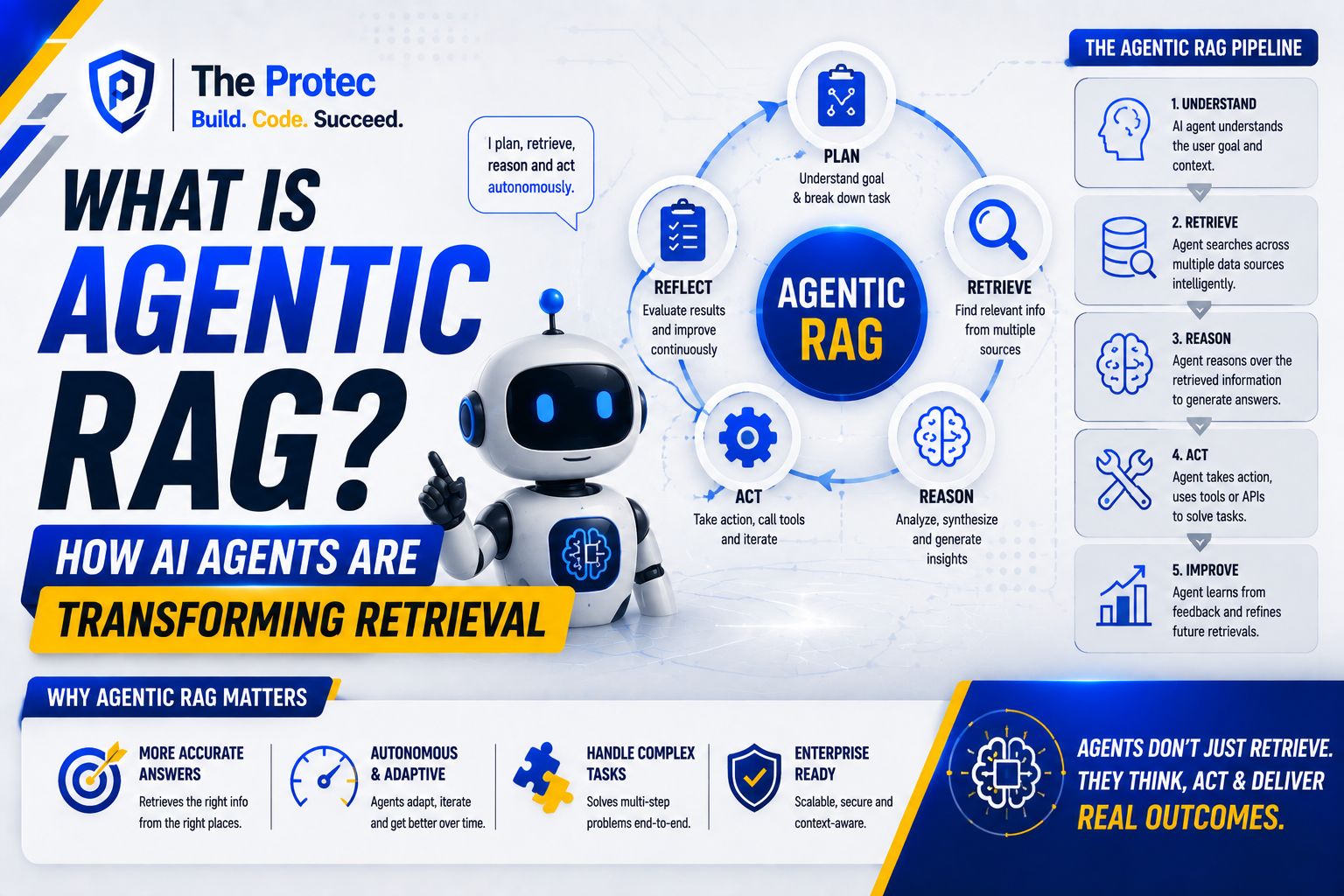
Agentic RAG is a retrieval-augmented generation architecture in which one or more AI agents actively manage how information is found and used. An agent typically combines a language model with instructions, tools, state, and a control loop. Within that loop, it can plan an information-gathering task, perform actions, observe results, and decide what to do next.
The original RAG concept, described in the influential retrieval-augmented generation research paper, grounds model output in retrieved knowledge. Agentic RAG extends that principle by giving the system greater control over retrieval itself. It may search a vector database, query structured records, browse approved web sources, call an API, inspect a knowledge graph, or combine several of these methods.
The defining feature is not merely the presence of an agent. It is the agent’s ability to make context-sensitive retrieval decisions and revise them based on evidence.
How Conventional RAG Works
A conventional RAG pipeline usually follows a predictable sequence:
- A user submits a question.
- The system converts the question into a vector embedding or search query.
- A retriever selects a fixed number of relevant passages.
- The passages and question are sent to a language model.
- The model generates an answer from the supplied context.
This pipeline is relatively fast, understandable, and economical. It works well for focused questions when the source collection is clean and the necessary answer appears in a small number of retrievable passages.
Its rigidity is also a weakness. If the original query is ambiguous, the selected passages are incomplete, or the answer requires multiple dependent facts, the generator may receive poor context with no opportunity to correct the problem.
How Agentic RAG Works Step by Step
An agentic workflow can take several different forms, but most implementations include the following stages.
1. Interpret the request
The agent identifies the user’s goal, constraints, required output, and likely information needs. It can distinguish a simple lookup from a comparison, investigation, calculation, or multistep research task. A broad request may be decomposed into smaller questions before any retrieval occurs.
2. Build a retrieval plan
Rather than automatically sending the original wording to one index, the agent determines which sources and retrieval methods fit the task. Product specifications might come from a structured database, policy details from a document repository, and current market information from an approved search service.
3. Execute tool calls
The agent invokes one or more tools and records the results. Modern AI agent RAG systems increasingly use standardized tool interfaces, permission-aware connectors, hybrid search, knowledge graphs, SQL queries, and multimodal retrieval. The tools available to an agent should be limited by its role and the sensitivity of the data.
4. Evaluate the evidence
Retrieved content is not automatically treated as sufficient. The agent may score relevance, compare dates, check source authority, identify contradictions, or determine whether a passage actually supports a proposed claim. A separate evaluator model or deterministic validation rule can perform some of these checks.
5. Refine and repeat
If evidence is weak, the agent can rewrite the query, adjust filters, retrieve neighboring passages, choose another source, or ask the user for clarification. This feedback loop is one of the most important differences between agentic and conventional retrieval.
6. Synthesize a grounded response
Once the evidence meets defined criteria, the model produces an answer. Well-designed systems preserve source metadata so the response can include citations, communicate uncertainty, and separate verified facts from inferences.
Agentic RAG vs RAG: The Core Differences
The agentic RAG vs RAG distinction is best understood as adaptive control versus a predetermined pipeline.
- Query handling: Conventional RAG normally uses the submitted query once. Agentic RAG may decompose, rewrite, expand, or clarify it.
- Source selection: Standard pipelines often search one predefined index. Agents can route tasks among vector stores, databases, APIs, graphs, files, and web search.
- Retrieval depth: Conventional RAG commonly performs one retrieval round. Agentic systems can continue until a stopping rule is reached.
- Evidence assessment: Basic RAG passes top-ranked passages to the model. An agentic workflow can critique relevance, freshness, consistency, and authority.
- Task execution: RAG primarily supplies context for an answer. Agents may also calculate, compare records, generate a report, or initiate an approved downstream action.
- Cost and complexity: Conventional RAG is easier to operate. Agentic RAG requires more model calls, orchestration, monitoring, security controls, and latency management.
Agentic RAG is therefore not an automatic replacement for RAG. A simple pipeline may remain the better choice for high-volume, predictable questions. Agency adds the most value when retrieval paths cannot be fully determined in advance.
Capabilities That Make Retrieval Agentic
Dynamic query planning
An agent can turn a complex request into a sequence of answerable subqueries. For example, a supplier analysis may require separate searches for pricing, delivery performance, contract terms, and regulatory status before the findings can be compared.
Intelligent source routing
Routing prevents every question from being sent to every data source. The agent chooses the best tool based on subject, permissions, data type, freshness requirements, and expected reliability. This reduces irrelevant context and can control retrieval costs.
Hybrid and graph-based retrieval
Dense vector search is useful for semantic similarity, while keyword search excels at exact names, codes, and terminology. Knowledge graphs reveal relationships among entities. Agentic systems can select or combine these methods instead of depending on a single retrieval strategy.
Self-correction and verification
An agent can detect when results do not answer the question or when sources disagree. It may retrieve additional evidence or ask another model to challenge a draft. This does not guarantee truth, but it creates opportunities to catch failures before the answer reaches a user.
Context management
More context is not always better. Agents can summarize lengthy results, remove duplicates, prioritize recent authoritative passages, and retain only evidence relevant to the current reasoning step. Effective context management helps limit distraction and token consumption.
Common Agentic RAG Architecture
A production architecture typically includes an orchestrator, one or more language models, a tool registry, retrieval services, memory or state management, and an evaluation layer. The orchestrator determines which step runs next. Retrieval services may include vector databases, enterprise search, relational databases, and external APIs.
Some systems use one general-purpose agent. Others use multiple specialized agents, such as a planner, researcher, verifier, and response writer. Multi-agent designs can separate responsibilities, but they also create more handoffs and failure points. The architecture should be no more complex than the task requires.
As of August 2026, leading implementations increasingly emphasize interoperable tool connections, policy-aware access, traceable execution, smaller specialized models, and bounded workflows. The trend is toward controlled autonomy rather than unrestricted model-driven action.
Benefits of Agentic RAG
- Better answers for complex questions that require multiple sources or retrieval rounds.
- Improved relevance because the agent can revise unsuccessful searches.
- Access to structured, unstructured, real-time, and multimodal information through different tools.
- Greater transparency when the system records queries, tool calls, evidence, and decision paths.
- More useful automation because grounded information can support reports, recommendations, and authorized actions.
These gains depend on implementation quality. Adding an agent to an unreliable knowledge base will not fix outdated documents, weak metadata, or missing access controls.
Risks and Limitations
Agentic RAG introduces risks beyond those of a basic retrieval pipeline. Repeated tool calls increase latency and operating cost. An agent can choose an unsuitable source, enter an unproductive search loop, or stop before collecting sufficient evidence. Multi-agent workflows may amplify errors as one component passes flawed assumptions to another.
Security requires particular attention. Retrieved documents may contain malicious instructions intended to redirect the model, a problem known as indirect prompt injection. Agents should treat retrieved content as untrusted data, enforce tool permissions outside the model, validate arguments, and isolate sensitive actions.
Organizations also need governance for data access, retention, citations, and human oversight. The NIST AI Risk Management Framework provides a useful foundation for identifying and managing AI risks. High-impact decisions should include deterministic checks and qualified human review rather than relying on an autonomous retrieval loop alone.
Where Agentic RAG Delivers the Most Value
Strong use cases share a need for current, distributed, or difficult-to-interpret information. Enterprise research assistants can search policies, project records, and approved external sources. Customer support agents can retrieve troubleshooting guidance, check account-specific data, and verify product status. Cybersecurity teams can correlate alerts with asset records and threat intelligence. Legal and compliance teams can compare requirements across jurisdictions while retaining source provenance.
Healthcare, finance, and other regulated fields can also benefit, but only with strict validation, privacy controls, domain-specific evaluation, and human accountability. Agentic retrieval should support professional judgment, not conceal uncertainty behind fluent output.
How to Implement Agentic RAG Responsibly
- Start with a narrow workflow. Define the users, approved sources, expected tasks, and actions the system must never take.
- Improve retrieval first. Clean documents, preserve metadata, test chunking, and benchmark hybrid search before adding complex agent behavior.
- Use bounded autonomy. Set limits for retrieval rounds, tool calls, execution time, spending, and accessible data.
- Require evidence. Define minimum relevance, freshness, and source-quality thresholds before generation.
- Evaluate complete trajectories. Measure source selection, query quality, citation support, answer accuracy, latency, cost, and task completion—not only the final prose.
- Design for failure. Provide clear fallback responses, clarification requests, audit logs, and escalation to a person.
A practical rollout often begins with agentic retrieval and human-approved output. Additional automation can be introduced only after testing demonstrates that the system behaves reliably across routine, adversarial, and edge-case scenarios.
The Future of AI Agent RAG
Agentic RAG is evolving toward systems that use richer data types, more specialized tools, and stronger verification. Multimodal agents can retrieve diagrams, video segments, audio, and tables alongside text. Smaller models can handle routing or relevance checks while more capable models focus on difficult synthesis, improving cost efficiency.
The most consequential development is likely to be better control. Organizations want agents that can explore information dynamically while remaining observable, permission-aware, and predictable. Success will depend less on how many autonomous steps a system can perform and more on whether each step is justified, secure, and grounded in trustworthy evidence.
Frequently Asked Questions About Agentic RAG
Is agentic RAG the same as an AI agent?
No. An AI agent is a broader system that uses a model and tools to pursue a goal. Agentic RAG is a specific application of agency focused on dynamically retrieving, assessing, and using information. An agent may perform tasks without RAG, while an agentic RAG system makes retrieval central to its workflow.
Does agentic RAG eliminate hallucinations?
No. It can reduce unsupported answers by gathering more relevant evidence and verifying claims, but the model may still misinterpret sources, generate incorrect conclusions, or cite material that does not support its wording. Grounding, automated checks, evaluations, and human review remain necessary.
When should a business use conventional RAG instead?
Conventional RAG is often preferable when questions are simple, sources are stable, response time is critical, and one retrieval step consistently provides sufficient context. It is easier to test and less expensive to operate. Agentic RAG is better suited to ambiguous or multistep tasks requiring dynamic source selection.
Can agentic RAG use live data?
Yes. An agent can call approved APIs, search current indexes, or query operational databases. Live access should include authentication, rate limits, data validation, time stamps, and clear fallbacks when a source is unavailable.
How is agentic RAG evaluated?
Evaluation should cover the entire process: planning accuracy, source choice, retrieval relevance, evidence completeness, citation correctness, answer quality, tool safety, latency, and cost. Test sets should include ambiguous requests, conflicting sources, permission boundaries, prompt injection attempts, and cases where the correct behavior is to ask for clarification or decline to answer.