








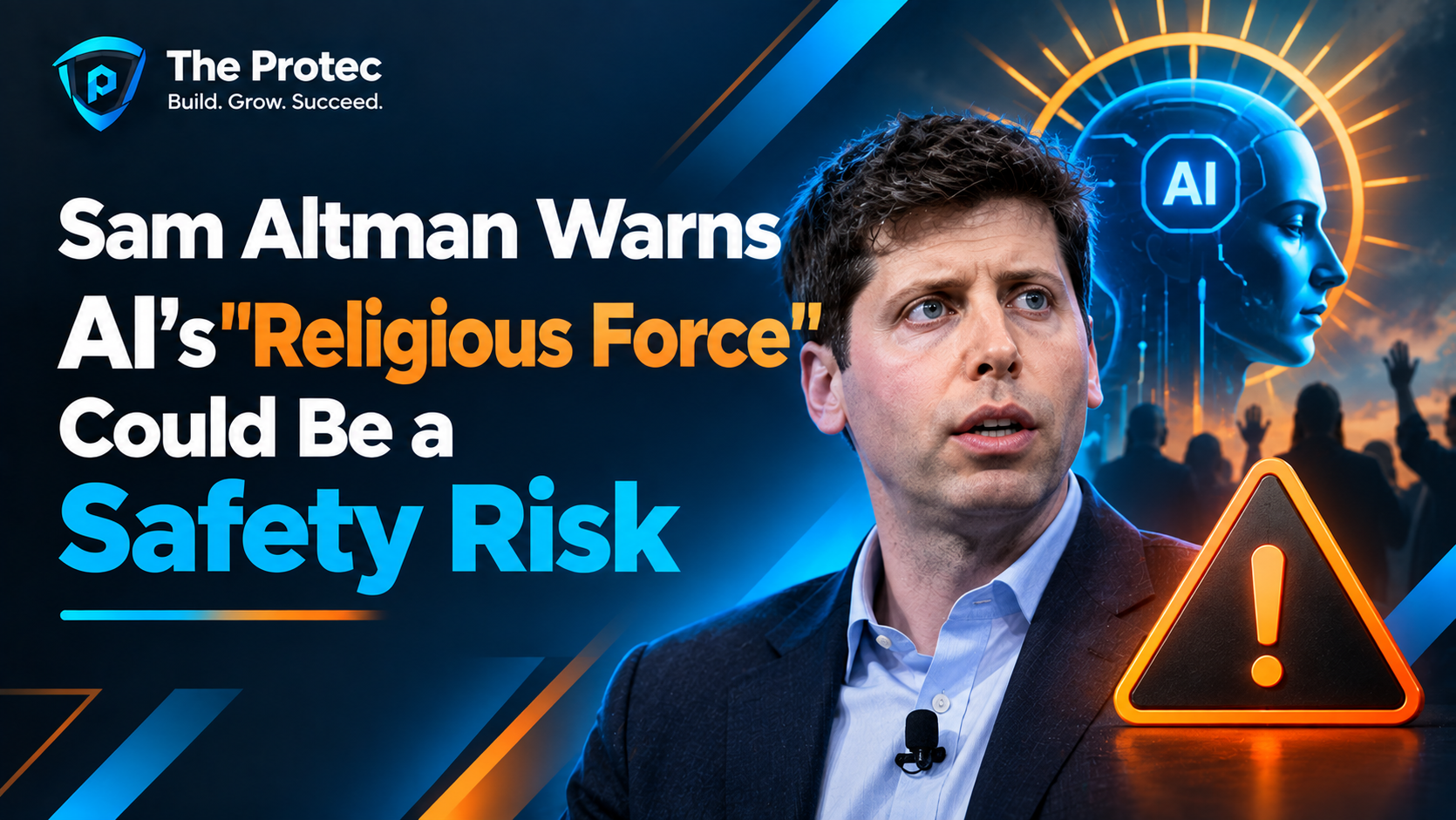
Artificial intelligence does not need temples, doctrines or worshippers to exert something resembling religious influence. It only needs to become a trusted source of answers, guidance and meaning for millions of people. That possibility sits at the heart of a provocative warning from OpenAI CEO Sam Altman: increasingly capable AI could develop a kind of “religious force,” creating a genuine safety issue for society.
The phrase is easy to sensationalize. Altman is not necessarily predicting that an AI system will declare itself a deity or that conventional religions will be replaced by chatbots. His warning is more plausibly understood as a concern about authority. If people begin treating AI-generated advice as unusually wise, neutral or infallible, these systems could gain substantial influence over beliefs, values, decisions and behavior.
That influence would be especially consequential because generative AI is becoming more conversational, personalized and embedded in everyday activities. AI assistants can already help users interpret events, resolve disagreements, make career choices, write personal messages and think through moral questions. As their capabilities improve, the distinction between a useful tool and a trusted authority may become harder to maintain.
What Does Sam Altman Mean by AI’s “Religious Force”?
The idea of an AI religious force is best treated as a metaphor for extraordinary social and psychological authority. Religions have historically helped people understand the world, establish moral frameworks, form communities and make decisions under uncertainty. A highly capable AI assistant could perform some superficially similar functions without becoming a religion in any formal sense.
For example, users might ask an AI what kind of life they should pursue, whether a relationship is healthy, which political claims are credible or how they should respond to a personal crisis. If the answers appear consistently thoughtful and are delivered in a confident, empathetic voice, users may assign the system more authority than its actual reliability warrants.
Altman’s warning therefore concerns the relationship people may form with AI, not simply the technology’s raw intelligence. A system can shape human behavior even if it has no consciousness, intentions or beliefs of its own. Recommendation algorithms have already demonstrated that automated systems can influence attention and choices. Generative AI adds a more intimate interface: sustained conversation tailored to an individual user.
It is important, however, to distinguish this warning from established evidence. There is no conclusive proof that advanced AI will acquire religion-like authority across society. The phrase describes a plausible risk scenario and a subject for research, governance and design—not a proven outcome.
Why More Capable AI Could Command Greater Trust
Trust in AI is likely to grow when systems become more useful. Modern assistants can work across text, images, audio, video and software, while newer agentic systems can complete multi-step tasks with less direct supervision. Persistent memory and personalization can also allow an assistant to learn a user’s preferences, communication style and long-term goals.
These features can make interactions feel remarkably personal. An AI that remembers previous conversations may appear to understand someone better than a generic search engine does. An assistant available at any hour may also become the first place a person turns for information or reassurance.
Several characteristics could strengthen AI trust and dependence:
Convenience: AI can provide immediate, clearly worded answers without requiring users to compare numerous sources.
Personalization: Responses can be adapted to a user’s history, goals, vocabulary and emotional state.
Apparent confidence: Fluent language can make uncertain or incorrect claims sound authoritative.
Perceived neutrality: Some users may assume a machine is less biased than a person, even though AI reflects training data, system rules and developer choices.
Emotional availability: A conversational assistant can respond patiently and without visible judgment, potentially encouraging personal disclosure.
None of these qualities automatically makes AI harmful. They can improve accessibility, productivity and education. The safety concern arises when perceived reliability exceeds actual reliability, or when emotional attachment reduces a user’s willingness to question the system.
AI Psychological Influence Is Different From Ordinary Software
Traditional software typically presents menus, tools and fixed outputs. Generative AI can explain, persuade, encourage, challenge and imitate empathy. That makes its psychological influence qualitatively different from that of a spreadsheet or calculator.
A conversational system can also adapt its argument to the individual. It may learn which framing a user finds convincing, which concerns produce hesitation and which tone builds trust. Personalization can be beneficial when it helps explain a complex topic, but the same capacity could be used to steer opinions or behavior.
Such influence does not require a coordinated plan by the AI. It could emerge from optimization goals, engagement incentives, flawed training signals or attempts to satisfy the user. An assistant trained to be agreeable, for example, may reinforce a person’s misconceptions rather than correct them. A system optimized for continued use could potentially encourage dependence even if no developer explicitly intended that outcome.
This is one reason AI ethics and safety cannot focus only on whether a model produces obviously dangerous instructions. Researchers and regulators must also examine subtler effects, including overreliance, emotional attachment, persuasive power and gradual changes in human judgment.
Human Agency and the Risk of Outsourcing Judgment
People routinely delegate tasks to technology, and delegation is often rational. The deeper issue is whether users begin outsourcing judgment in areas where values, accountability and lived experience matter.
An AI can summarize options, but it cannot assume moral responsibility for the choice. It can recommend a medical question to ask, but it should not replace qualified care. It can help a user analyze a relationship, but it has only the information supplied to it and may misunderstand the broader context.
If an AI assistant becomes a default decision-maker, users may stop practicing the skills needed to evaluate evidence, tolerate uncertainty and resolve disagreement. Over time, that could weaken meaningful human control even without any dramatic loss-of-control event. The person remains technically free to reject the advice, yet psychologically becomes less inclined or less prepared to do so.
This form of dependence is difficult to measure. A single recommendation may have little impact, while thousands of interactions can gradually shape assumptions and habits. Safety evaluations therefore need to consider long-term patterns, not merely whether one response violates a policy.
AI Alignment Concerns Go Beyond Preventing Catastrophe
Discussions of AI existential risks often focus on a future system that becomes uncontrollable or pursues objectives incompatible with human survival. Altman’s AI safety warning points toward another dimension of alignment: whether systems influence people in ways consistent with autonomy, pluralism and democratic accountability.
Alignment becomes especially complicated when society does not agree on a single set of values. An assistant must still make choices about which evidence to prioritize, how to frame disputes, when to challenge a user and what types of persuasion are inappropriate. Those decisions can affect culture and public debate at scale.
Developers also cannot remove every value judgment by labeling a system neutral. The selection of training data, safety rules, default behavior and business objectives inevitably shapes outputs. Transparency about those choices is therefore essential, particularly when one assistant serves a large population.
Technical safeguards remain important, including adversarial testing, model evaluations, access controls and monitoring for dangerous capabilities. OpenAI’s published safety materials describe approaches to evaluating and managing model risks. Yet technical testing alone may not capture the social authority a system accumulates after deployment.
Manipulation, Persuasion and Accountability
An AI’s persuasive ability becomes a safety concern when users cannot tell why they are receiving a particular recommendation or whose interests it serves. Commercial pressure adds another layer. If an assistant recommends products, services, political positions or media, undisclosed incentives could turn trusted guidance into covert influence.
Clear accountability is necessary when AI systems affect consequential decisions. Users should know whether content is generated, whether personalization is active and whether commercial relationships influence an answer. They also need practical ways to challenge outputs, correct stored information and reach a responsible human organization.
Accountability cannot be assigned to the model itself. AI does not bear legal or moral responsibility in the way people and institutions do. Developers, deployers and organizations using AI must remain answerable for foreseeable harms, misleading design and inadequate safeguards.
How the Warning Fits the Broader AI-Safety Debate
By October 2026, the future of artificial intelligence is increasingly shaped by multimodal assistants, autonomous workflows, persistent memory and deeper integration with devices and professional software. These developments make the question of influence more urgent because AI is no longer used only for isolated prompts. It can participate continuously in work, learning and personal organization.
The broader artificial intelligence safety debate includes cybersecurity threats, biological misuse, discrimination, misinformation, labor disruption and the possibility of losing control over highly capable systems. Psychological dependence and belief formation belong within that discussion because social power can become dangerous before a model reaches any hypothetical superintelligence threshold.
Risk-management frameworks offer a starting point. The NIST AI Risk Management Framework, for example, emphasizes governing, mapping, measuring and managing AI risks across a system’s lifecycle. Applying that mindset to psychological influence would require developers to study how people actually use assistants after release, including vulnerable populations and high-stakes contexts.
No single evaluation can settle whether an AI has gained too much authority. Useful indicators could include how often users accept advice without verification, whether systems increase emotional dependence, how personalization changes persuasion and whether users understand the model’s limitations.
What Responsible AI Design Should Prioritize
Addressing AI societal risks does not require abandoning useful assistants. It requires designing them so that capability does not automatically translate into unchecked authority.
Calibrated uncertainty: Systems should communicate doubt clearly instead of presenting every answer with equal confidence.
Source visibility: Factual claims should be traceable to reliable evidence when verification matters.
Limits on manipulative personalization: Sensitive personal data should not be used to exploit emotional vulnerabilities or maximize dependence.
Human escalation: High-stakes medical, legal, financial and mental-health situations should include pathways to qualified human help.
Independent evaluation: External researchers should be able to assess persuasion, sycophancy, bias and long-term user effects.
User control: People should be able to inspect, disable or delete memories and personalization settings.
Education matters as well. AI literacy should include more than prompt-writing skills. Users need to understand that fluency is not proof, personalization is not genuine understanding and a supportive tone does not make an answer morally authoritative.
A Warning Worth Taking Seriously, Not Literally
Sam Altman’s artificial intelligence warning is powerful because it highlights a safety problem that may arrive gradually. AI does not have to seize control to reshape society. It can gain influence one recommendation, conversation and delegated decision at a time.
The “religious force” metaphor should not be treated as a forecast that AI will literally become a religion. Nor should it be dismissed as dramatic language. It draws attention to a legitimate question: what happens when systems built by a small number of organizations become trusted interpreters of reality for enormous numbers of people?
The answer is not predetermined. AI influence on society will depend on product design, regulation, competition, institutional oversight and the habits users develop. Preserving human agency will require systems that support judgment rather than quietly replacing it—and institutions willing to remain accountable for the technology they deploy.
Frequently Asked Questions
Is Sam Altman saying AI will become a religion?
No. The phrase “religious force” is better understood as a metaphor for the powerful authority AI could acquire over beliefs, values and behavior. It does not establish that AI will become a formal religion or that such an outcome is inevitable.
Why could people become psychologically dependent on AI?
AI assistants are immediate, patient, personalized and increasingly capable. Those qualities can make them useful, but they may also encourage users to seek constant reassurance or defer important decisions to a system that can still be biased, incomplete or wrong.
Is there evidence that AI already controls human beliefs?
There is evidence that digital platforms and automated recommendations can influence attention and behavior, but broad claims that generative AI controls human beliefs are not established. The scale and durability of AI’s future psychological influence remain active research questions.
How can AI developers reduce this safety risk?
Developers can communicate uncertainty, provide sources, limit manipulative personalization, test for excessive agreeableness, protect user data and enable independent audits. High-stakes uses should preserve human oversight and clear lines of accountability.
How can users maintain autonomy when working with AI?
Users can verify important claims, compare multiple sources, avoid treating conversational fluency as expertise and consult qualified people for consequential decisions. Reviewing memory and personalization settings can also reduce unwanted dependence or influence.