








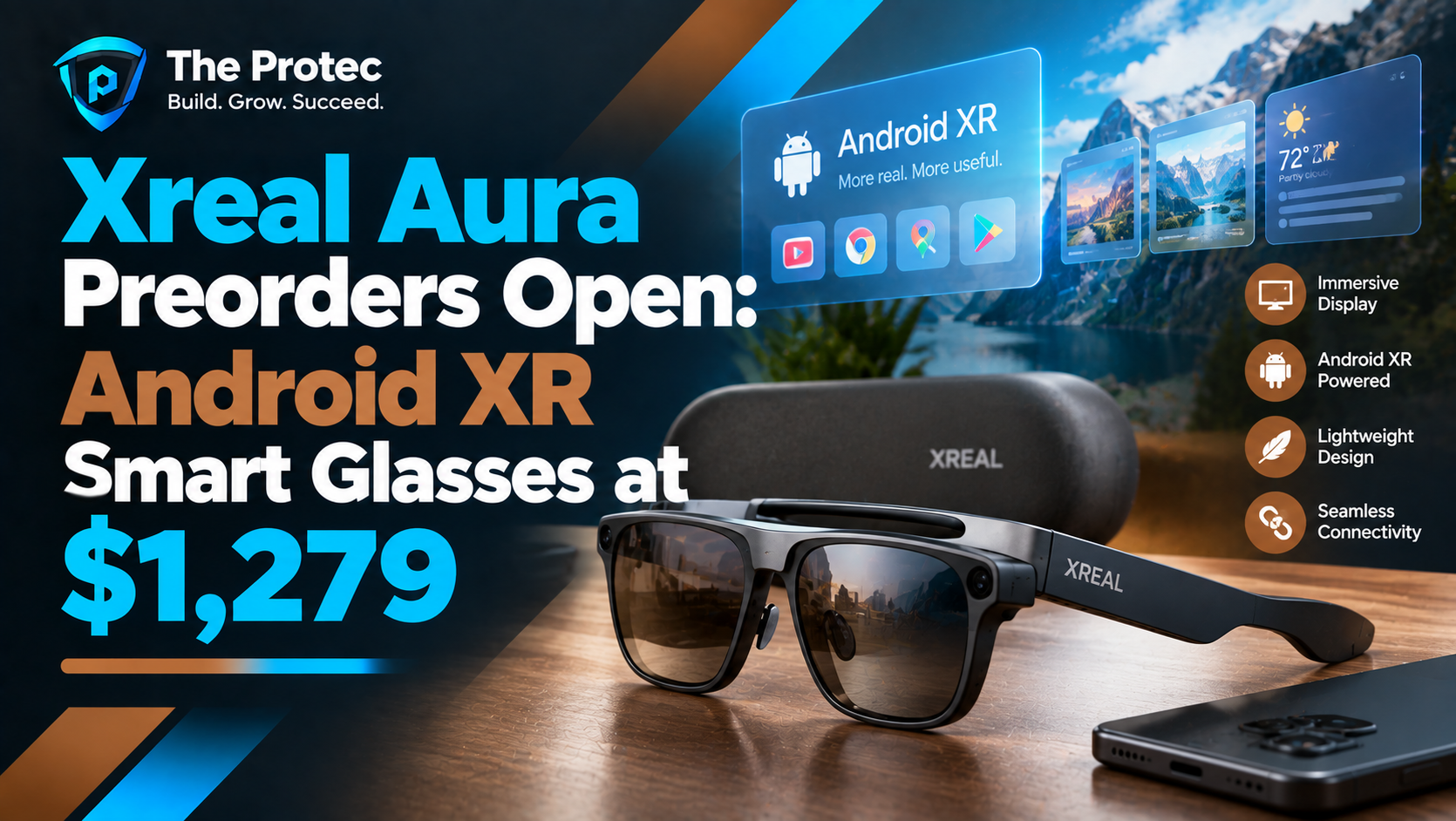
Xreal has opened preorders for the Aura smart glasses, putting an announced $1,279 price on one of the most closely watched Android XR devices. The launch is significant not simply because another pair of premium smart glasses is entering the market, but because Aura is designed around a more ambitious idea: bringing persistent digital screens, spatial applications and AI-assisted computing into a wearable form.
Unlike conventional smart glasses centered on cameras, speakers and notification lights, the Xreal Aura smart glasses are positioned as display-first augmented-reality eyewear. They are intended to place interactive digital content within the wearer’s field of view while preserving a view of the physical world. Android XR supplies the software foundation, giving Xreal a route into Google’s emerging ecosystem for glasses, headsets and other spatial devices.
The $1,279 figure is the announced preorder price, not necessarily the final amount every buyer will pay. Taxes, accessories, shipping charges and regional availability can affect the total. Shipping estimates and included components should therefore be confirmed on Xreal’s official preorder page before purchase.
Xreal Aura smart glasses: What has been confirmed?
Aura grew out of Xreal’s work on optical see-through augmented-reality displays and its collaboration with Google and Qualcomm. The finished product is being marketed as an Android XR device rather than a simple external display. That distinction suggests a deeper combination of displays, environmental sensing, spatial tracking, software and input technologies.
- Preorders are open: Xreal has announced a preorder price of $1,279, placing Aura firmly in the premium smart glasses category.
- Android XR is the core platform: Aura is designed to run within Google’s spatial-computing ecosystem rather than relying only on Xreal’s proprietary display software.
- It uses optical see-through AR: Wearers can view their surroundings directly through the lenses while projected digital images appear in their field of view.
- Spatial computing is a central capability: The glasses combine visual output with sensors and cameras intended to help digital content respond to head movement and the surrounding environment.
- Computing is separated from the eyewear: Xreal’s approach uses an external processing component, reducing the amount of heat, silicon and battery capacity that must sit on the wearer’s face.
Prospective buyers should separate these confirmed platform characteristics from expectations about future applications. Android XR can support spatial interfaces, AI assistance and immersive media, but the availability of individual features may depend on software versions, regions, developer support and account requirements. Xreal provides the most relevant product and preorder information through its official website.
How Aura differs from conventional smart glasses
Many mainstream smart glasses prioritize discreet designs and familiar functions such as photography, calls, audio playback and voice assistance. Those devices may look close to ordinary eyewear, but they generally provide little or no rich visual information in front of the user’s eyes.
Xreal Aura AR glasses take a different route. Their optical display system is designed to create a large virtual workspace that can contain app windows, videos, navigation elements or three-dimensional objects. The wearer still sees the real world through the lenses, avoiding the fully enclosed feeling associated with virtual-reality headsets.
This approach makes display quality especially important. Text must remain legible, virtual screens need stable positioning, and images must be bright enough to compete with ambient light. A wide, sharp display can make spatial applications feel useful; limited brightness, visible optical artifacts or a narrow field of view can quickly undermine the experience. Buyers should assess final production reviews rather than assuming that every demonstration reflects everyday performance.
The external processing design also distinguishes Aura from lightweight AI smart glasses. Moving major computing and battery functions away from the frame can improve thermal comfort and enable stronger processing. The trade-off is a cable and an additional device that must be carried, charged and managed. Aura is consequently closer to wearable computing equipment than to a completely self-contained pair of glasses.
Why Xreal Aura Android XR integration matters
Hardware alone cannot make augmented reality useful. Previous AR products have often delivered impressive demonstrations without attracting enough applications, users or developers to create a sustainable platform. Android XR is Google’s attempt to solve that problem with a shared operating system for spatial devices.
Google describes Android XR as a platform built for headsets and glasses, with interfaces that can move beyond a flat phone display. Its importance lies in familiar Android foundations: established development tools, account services, application frameworks and access to a broad developer community. These do not guarantee a large catalog of polished AR software, but they lower the barrier compared with building an ecosystem from the ground up.
For Xreal, Android XR integration could give Aura access to software that is designed to work across multiple manufacturers’ devices. For Google, Xreal contributes practical experience in compact augmented-reality displays. The partnership therefore links an operating-system provider with a company already known for consumer display glasses.
AI is likely to be another defining layer. An Android XR wearable can potentially combine voice interaction, visual context and spatial interfaces, allowing an assistant to respond without requiring the user to reach for a phone. However, potential should not be confused with guaranteed launch functionality. Specific AI features, camera permissions, language support and app integrations may evolve after the hardware ships.
A different approach to Xreal spatial computing
Xreal mixed reality is not based on blocking the outside world and recreating it through cameras. Aura’s optical see-through design lets light from the physical environment reach the user directly, with digital imagery added over it. This can provide a more natural sense of presence and reduce the isolation of enclosed headsets.
Useful applications could include pinning multiple work screens around a desk, watching video on a private virtual display, following contextual instructions or viewing spatial models. Hands-free prompts could also help with field service, training and accessibility. These examples reflect the direction of Android XR wearable devices, not a promise that every workflow will be complete at launch.
The quality of tracking will determine whether these experiences feel convincing. Virtual objects must remain stable as the user turns or moves, while input needs to be predictable enough for routine use. Hand tracking and voice controls can be convenient, but neither always matches the speed and precision of a keyboard, mouse or touchscreen.
Is the Xreal Aura $1,279 preorder price justified?
At $1,279, Aura costs far more than basic smart glasses and enters territory occupied by premium computers and immersive headsets. The price may be understandable for early adopters who value portable displays, optical AR and access to the Android XR ecosystem. It is harder to justify for consumers who mainly want music, photography or occasional voice-assistant access.
The value proposition depends on several factors:
- Display performance: Resolution, brightness, contrast, field of view and edge-to-edge clarity directly affect whether virtual screens can replace a portable monitor in some situations.
- Comfort: Weight distribution, frame pressure, heat and prescription-lens support matter more during extended sessions than they do in a short demonstration.
- Battery life: Spatial tracking and bright displays consume substantial power. An external battery can reduce frame weight, but runtime remains critical for travel and mobile work.
- Application support: Premium hardware needs software that takes advantage of depth, positioning and hands-free input instead of merely reproducing flat mobile apps.
- Everyday setup: Cables, calibration, account sign-ins and environmental limitations can determine whether the glasses become a daily tool or an occasional accessory.
The announced price should also be evaluated against what is included in the preorder package. Buyers should verify whether prescription inserts, controllers, carrying accessories or optional battery components cost extra. Return policies are particularly important for wearable displays because fit, visual comfort and interpupillary alignment vary by person.
Aura arrives as Xreal augmented reality technology becomes more capable, but physics still imposes constraints. Optical see-through displays must balance transparency with image brightness. Outdoor sunlight can wash out digital content, while increasing brightness can raise power consumption and heat. A wider field of view may improve immersion but can also make optics larger or more difficult to fit across different faces.
Battery life remains another practical concern. The external compute architecture can keep heavy components off the frame, but users must remember to charge and carry the connected hardware. That makes Aura less frictionless than ordinary eyewear, even if it is more portable than a laptop-and-monitor setup.
App support may be the biggest long-term question. Android compatibility does not automatically mean every phone app will become a compelling spatial experience. Developers need reasons to optimize layouts, interaction models and AI functions for glasses. Privacy will also demand attention because cameras and environmental sensors can be more socially sensitive than those on a phone.
For these reasons, Xreal wearable computing should be viewed as complementary technology. Aura may reduce the need to open a laptop for certain media, productivity or information tasks, but Xreal has not established that it can replace a smartphone or traditional computer for everyone.
Can Aura make Android XR a consumer platform?
Among Xreal AR glasses in 2026, Aura represents a shift from accessories that primarily mirror external screens toward a platform capable of hosting spatial experiences. Its success will depend on more than preorder demand. Xreal and Google need to deliver reliable software updates, intuitive controls and enough useful applications to keep owners engaged after the novelty fades.
The timing is favorable. The wider market is moving toward immersive displays, multimodal AI and hands-free access to digital services. Some companies are pursuing subtle glasses with audio and cameras, while others are building powerful enclosed headsets. Aura occupies the space between them: more visually ambitious than camera-first glasses, but potentially lighter and less isolating than a full headset.
If developers can build once for multiple Android XR smart glasses and headsets, Aura could benefit from an ecosystem larger than Xreal could create independently. If support remains fragmented or major applications arrive slowly, the $1,279 price will limit adoption to enthusiasts and specialized professional users.
Who should consider an Xreal smart glasses preorder?
A preorder makes the most sense for developers, spatial-computing enthusiasts, frequent travelers and professionals who already understand the compromises of wearable displays. These buyers may value early Android XR access and the ability to experiment with large virtual workspaces.
Mainstream consumers should wait for independent reviews covering display clarity, comfort, battery endurance, prescription compatibility and real-world app availability. Waiting is especially sensible for anyone expecting ordinary-glasses styling or a complete smartphone replacement. Aura’s appeal is its focused combination of AR displays and wearable computing, not the elimination of every other screen.
Final perspective
Xreal Aura is an important test for both its manufacturer and the Android XR ecosystem. The announced $1,279 preorder price makes it a premium, early-stage product, but its optical AR design, external computing architecture and platform integration distinguish it from conventional smart glasses.
Aura will matter if it turns spatial computing into something people can use regularly rather than merely demonstrate. Strong displays, comfortable hardware and useful software could establish it as a credible bridge between today’s mobile devices and future AI-powered eyewear. Weak battery life, limited apps or cumbersome setup could keep it within a smaller enthusiast market. The preorder opening begins that test; real-world performance will determine the outcome.
Frequently asked questions
How much do Xreal Aura smart glasses cost?
Xreal has announced a $1,279 preorder price for Aura. The final amount may vary with taxes, shipping, region and optional accessories, so customers should review the official checkout details.
Does Xreal Aura run Android XR?
Yes. Xreal Aura Android XR integration is one of the product’s defining features. The platform is designed for spatial interfaces, immersive applications and AI-assisted experiences, although individual features and apps may differ by region or software version.
Are Aura glasses the same as ordinary AI smart glasses?
No. Many AI smart glasses focus on audio, cameras and voice commands without a rich visual display. Xreal Aura augmented reality glasses project digital content into the wearer’s view and use spatial sensing to support AR experiences.
Can Xreal Aura replace a phone or laptop?
Aura may handle selected entertainment, productivity and hands-free information tasks, but it should not be assumed to replace a phone or computer. Application support, input precision, battery life and comfort will determine which tasks are practical.
What should buyers check before preordering?
Buyers should confirm regional availability, estimated shipping, included accessories, prescription options, return policies and supported applications. Independent testing of display quality, tracking, comfort and battery life will also be valuable.