







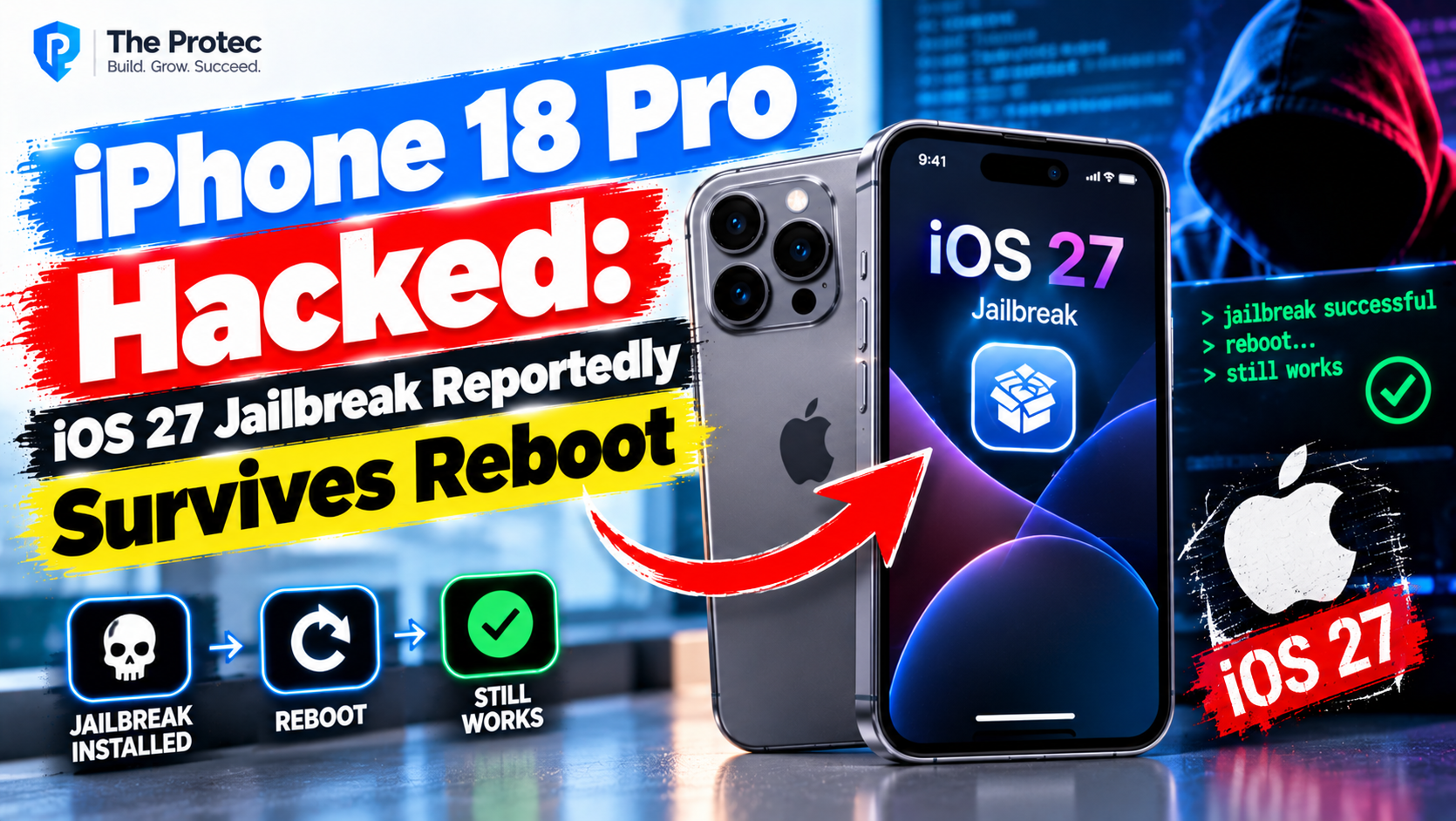
A reported iOS 27 jailbreak on a hacked Apple iPhone 18 Pro is drawing attention across the security community for one particularly important reason: Calif researchers say the result survived a reboot. If substantiated, that persistence would make the demonstration more technically significant than a jailbreak that disappears as soon as the phone restarts.
The claim concerns an iPhone 18 Pro running iOS 27.0.1. According to Calif, its researchers demonstrated that the modified state remained available after restarting the device. However, the public claim should be interpreted carefully. A reboot-surviving demonstration does not, by itself, establish that every jailbreak component loaded automatically, that the technique works against every iPhone 18 Pro, or that attackers can use it remotely.
The original source for the claim is Calif’s research blog. At publication time, no broadly usable jailbreak tool, complete technical write-up, reproducible exploit chain, or public proof-of-concept code had been identified. The Protec has not independently reproduced the demonstration. Exact researcher names, the demonstration date, and implementation details should be treated as unconfirmed unless they appear in Calif’s current public disclosure or supporting evidence.
That distinction matters because an impressive laboratory result is not the same as evidence of active attacks. Here is what the reported iPhone 18 Pro hack may mean, what reboot persistence actually proves, and what iPhone owners should do while the unanswered questions remain.
What Did Calif Demonstrate on the iPhone 18 Pro?
The central claim is that Calif demonstrated a jailbreak on an iPhone 18 Pro running iOS 27.0.1 and that the effect survived a device reboot. In other words, restarting the phone apparently did not fully erase the researchers’ ability to return to or retain the jailbroken environment.
That is more notable than merely showing unauthorized code execution. Security researchers regularly distinguish between gaining temporary execution and maintaining meaningful control across changes in system state. A reboot terminates processes, resets volatile memory, reloads the operating system and reinitializes multiple security mechanisms. Many jailbreaks lose some or all of their capabilities during that sequence.
The available public claim does not answer every question necessary to classify the result. A complete assessment would need evidence showing what happened before the reboot, the exact restart method, what loaded afterward, whether a user action was required and which privileges remained available. It would also need to establish whether the tested handset was a retail device in a standard configuration.
A video or live demonstration can support authenticity, but it does not substitute for a technical disclosure that other qualified researchers can review and reproduce. Until more evidence is published, the safest description is that Calif reportedly demonstrated an iOS 27.0.1 jailbreak with some form of reboot persistence. It should not yet be described categorically as a fully untethered public jailbreak.
Why an iPhone Jailbreak After Reboot Matters
Reboot persistence is valuable because restarting an iPhone is one of the simplest ways to interrupt temporary access. A reboot clears memory-resident processes and can force an attacker or researcher to repeat an exploit. It can also restore the phone to a non-jailbroken state when the original technique has no persistent component.
A persistent iOS jailbreak could reduce or eliminate that reset advantage. Depending on its design, it might preserve files, configuration changes, a mechanism for restoring privileges, or an automatically activated jailbroken environment. For defensive researchers, that possibility is important because it affects incident response. A phone that appears normal after restarting may still contain modifications that become active again.
But the phrase “survives a reboot” can describe several different outcomes. The filesystem modifications might remain while privileged execution stops. A loader might persist but require the owner to open an app. The device might boot normally and then permit the jailbreak to be reactivated without a computer. Alternatively, all relevant components might launch automatically during startup.
Those scenarios carry different technical and security implications. Without a detailed account of the post-reboot state, persistence should not be interpreted as proof that every element of the jailbreak remained continuously active.
Tethered, Untethered and Persistent Jailbreaks Explained
Tethered jailbreak
A tethered jailbreak generally requires the iPhone to be connected to another device, such as a computer, whenever it starts. The external system helps the phone boot into a jailbroken state. If the iPhone restarts without that assistance, it may fail to boot normally or return without jailbreak functionality, depending on the implementation.
Semi-tethered and semi-untethered jailbreaks
A semi-tethered jailbreak lets the phone restart into a normal or limited state, but a computer is needed to restore jailbreak functionality. A semi-untethered jailbreak can usually be reactivated directly on the phone, often through an installed application, although the user still must take an additional step after rebooting.
Untethered iPhone jailbreak
A true untethered iPhone jailbreak normally becomes active automatically when the device boots. It does not require a computer or manual re-exploitation after every restart. Untethered jailbreaks are difficult to build on modern iPhones because the necessary chain must contend with protections applied during startup as well as defenses enforced after iOS loads.
Persistent exploit
Persistence is a broader security term. It refers to an ability, artifact or mechanism that remains available across reboots or other state changes. Persistence does not necessarily mean that a complete jailbreak automatically runs during startup. A surviving file, entitlement change or reactivation method could be persistent even if another action is needed to regain elevated privileges.
For that reason, the reported Calif iPhone hack should not be labeled definitively as an untethered jailbreak until the researchers document what remained active and whether any post-reboot intervention was required.
Which Apple iOS Security Boundaries May Be Involved?
Modern Apple iOS security uses overlapping defenses rather than relying on a single barrier. A functional jailbreak often needs to bypass or undermine more than one of those controls. The Calif report may indicate that important boundaries were crossed, but the undisclosed technical details prevent firm conclusions about which ones.
- Code signing restricts the software that can execute and helps ensure that authorized code has not been modified.
- Application sandboxing limits what an app can access, even when the app itself contains a vulnerability.
- Kernel protections defend the most privileged part of the operating system and attempt to prevent unauthorized changes to critical memory and control structures.
- Secure boot mechanisms verify components involved in startup and establish trust before iOS becomes operational.
- Hardware-backed protections help secure sensitive data and constrain what compromised software can do.
- Entitlements regulate access to powerful services and capabilities that ordinary applications do not receive.
A jailbreak demonstration may show that some combination of these restrictions was bypassed, disabled or worked around. It does not automatically prove the existence of an iPhone kernel exploit. Jailbreak chains can involve application-level flaws, sandbox escapes, privilege escalation, kernel vulnerabilities, configuration weaknesses or other mechanisms.
Unless Calif publishes supporting technical evidence, it would be speculation to identify a specific exploit chain. There is also no responsible basis for assigning an invented CVE, declaring a secure-boot compromise or claiming that a particular hardware protection failed.
Did AI-Assisted Vulnerability Research Play a Role?
Calif has been associated with AI-assisted vulnerability research, which makes the role of artificial intelligence another point of interest. AI systems can help researchers review code, prioritize suspicious behavior, generate test cases, organize crash data, compare patches and accelerate repetitive analysis. They can also support fuzzing workflows by suggesting inputs or highlighting patterns across large datasets.
Those capabilities do not mean an AI system independently discovered, weaponized and executed the reported jailbreak. Vulnerability research typically involves extensive human judgment: choosing targets, validating crashes, eliminating false positives, understanding mitigations, building an exploit chain and testing results safely.
Any claim that AI autonomously hacked the iPhone 18 Pro would require direct confirmation from the researchers and detailed evidence of the workflow. Without that disclosure, the accurate description is limited to AI-assisted vulnerability research, if Calif confirms that such tools contributed to the project. The degree of automation remains unknown.
Has Calif Released an iOS 27.0.1 Jailbreak Tool?
No public, consumer-ready iOS 27.0.1 jailbreak tool or reproducible proof of concept has been established in connection with the reported demonstration. Calif also has not publicly supplied enough exploit details for independent researchers to reconstruct the technique, based on the information available for this report.
That absence is significant. A research demonstration can prove that a security boundary is breakable under controlled conditions without giving the public a practical method for repeating it. Researchers may withhold details while coordinating disclosure, reducing the risk of misuse or protecting proprietary research.
iPhone owners should be skeptical of websites, social-media accounts or downloadable packages claiming to offer the Calif jailbreak. Fake jailbreak tools are a recurring avenue for malware, credential theft, unwanted configuration profiles and payment scams. A demonstration does not validate third-party downloads using its name.
Does This Represent a Threat to Ordinary iPhone Users?
There is currently no public evidence that the reported iPhone security vulnerability is being exploited in the wild. There is also no confirmation that it supports a remote attack, a zero-click compromise or a technique capable of hacking any iPhone 18 Pro over the internet.
Important attack requirements remain undisclosed. The demonstration might require physical access, an unlocked phone, developer features, a connected computer, a malicious app, a specially prepared environment or user interaction. It is not yet clear whether the underlying issue affects other iPhone models, other iOS 27 releases or only a narrow device and software combination.
Apple’s awareness and response also cannot be assumed. Unless Apple publishes a security advisory or Calif confirms coordinated disclosure, readers should not infer that Apple has acknowledged the issue, assigned it a CVE or prepared a patch. Likewise, installing an update should not be described as fixing this specific technique until Apple confirms a relevant security correction.
The reported result is therefore best understood as a potentially important research demonstration, not proof of a widespread consumer emergency.
Confirmed vs. Unknown
Reported or supported by the public claim
- Calif reportedly demonstrated a jailbreak involving an iPhone 18 Pro.
- The reported device was running iOS 27.0.1.
- The central claim is that jailbreak-related capability survived a reboot.
- No broadly usable public jailbreak tool or complete exploit chain has been established.
Still unknown or not independently verified
- Whether all jailbreak components activated automatically after startup.
- Whether the result qualifies as fully untethered.
- The vulnerabilities and security boundaries used in the exploit chain.
- Whether a kernel exploit was involved.
- The required access, interaction and device configuration.
- The range of affected iPhone models and iOS versions.
- The exact contribution of AI tools to the research workflow.
- Whether Apple has received, acknowledged or patched the underlying findings.
- Whether the technique has ever been used outside a controlled research setting.
What iPhone Owners Should Do Now
There is no reason for most users to panic, but basic security hygiene remains important. Install official iOS security updates when they become available, particularly on phones used for work, banking, healthcare or sensitive communications. Updating reduces exposure to known vulnerabilities, although no update should be represented as fixing this specific research finding without confirmation from Apple.
Avoid installing unknown configuration profiles, enterprise certificates or apps distributed through untrusted websites. Do not enter an Apple Account password into a page advertising an unreleased jailbreak. Users should also avoid connecting an unlocked iPhone to unfamiliar computers or accessories.
Review authoritative information through Apple’s security releases rather than relying on viral posts. People at elevated risk, including journalists, government personnel and human-rights workers, should follow their organization’s security guidance and seek professional assistance if they observe credible signs of compromise.
Restarting an iPhone can still interrupt many memory-resident attacks, but the Calif claim illustrates why rebooting should not be treated as a universal cure. Persistence mechanisms, if present, may survive that action.
What Happens Next?
The significance of this reported iOS 27.0.1 jailbreak will depend on what Calif publishes next. A technical report could clarify whether the post-reboot behavior was automatic, identify affected security boundaries and explain how AI-assisted analysis contributed. Apple may also release an advisory if a relevant vulnerability is reported and patched.
Until then, precise language is essential. “iPhone 18 Pro hacked” is an attention-grabbing summary, but it does not mean every unit is compromised. “Jailbreak survives reboot” describes the reported result without proving that the demonstration is a complete untethered jailbreak. The absence of public exploit code also sharply limits what outsiders can verify or reproduce.
This is a developing cybersecurity story. Its technical conclusions should be updated as Calif releases evidence, independent researchers validate the result or Apple provides an official response.
Frequently Asked Questions
Was an iPhone 18 Pro really jailbroken on iOS 27.0.1?
Calif reportedly demonstrated a jailbreak on that device and operating-system version. The Protec has not independently reproduced the result, and a complete public exploit chain is not available. The claim should therefore be attributed to Calif rather than presented as independently verified fact.
Does surviving a reboot make it an untethered jailbreak?
Not necessarily. The term depends on what happens after startup. If the full jailbroken environment activates automatically without an external device or user action, it may qualify as untethered. If files persist but the user must rerun an app or reconnect to a computer, a different classification would be more accurate.
Can attackers remotely hack any iPhone 18 Pro with this technique?
There is no evidence supporting that conclusion. The access requirements, interaction requirements and affected configurations are undisclosed. Nothing publicly established about the demonstration proves that it is remote, zero-click or broadly exploitable.
Did Calif release the jailbreak for download?
No verified public jailbreak tool or proof-of-concept package has been identified. Downloads claiming to provide the Calif technique should be treated as untrusted unless the researchers authenticate an official release.
Should iPhone owners update immediately?
Users should generally install official Apple security updates promptly. However, an update should not be claimed to fix this specific issue unless Apple confirms that it includes a relevant patch. Continue monitoring Apple advisories and Calif’s original research publication for verified developments.