







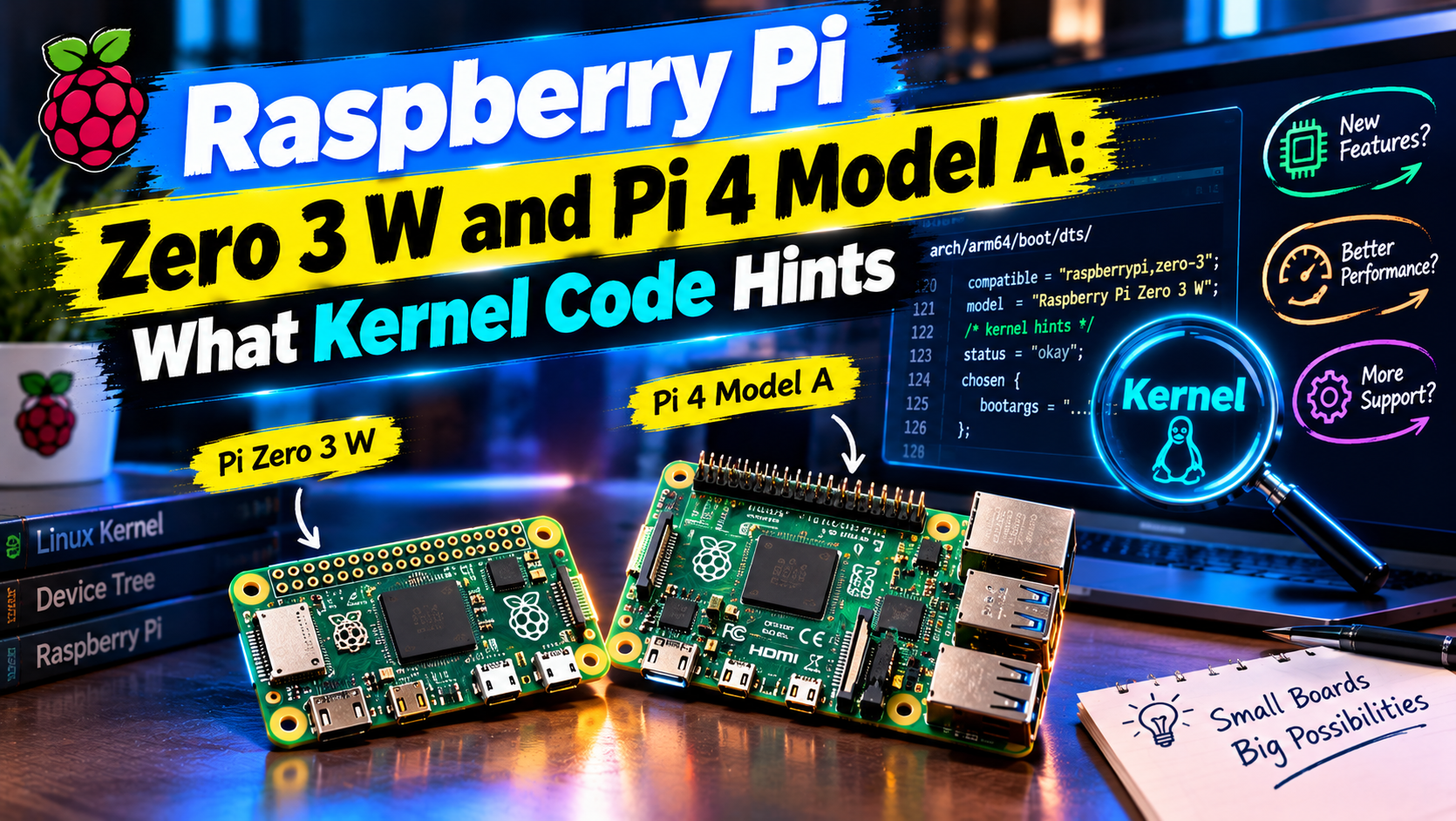
Two names associated with unreleased hardware have prompted an obvious question: are a Raspberry Pi Zero 3 W and Raspberry Pi 4 Model A on the way? The speculation has been attributed to Linux kernel files, but a board name in source code is not a product announcement. The available clues may indicate engineering work, compatibility testing, or placeholders. They do not confirm final hardware, specifications, pricing, or a release schedule.
That distinction matters because kernel discoveries often travel from a repository to social media stripped of their original context. After reviewing the reported references and the public Raspberry Pi Linux tree, the defensible conclusion is narrow: the names are interesting technical signals, but neither board should be treated as an announced product unless Raspberry Pi publishes product documentation.
What sparked the Raspberry Pi rumors?
The speculation centers on board-specific names reportedly found among Linux device-tree material associated with Raspberry Pi hardware. The relevant public source is Raspberry Pi’s downstream Linux kernel device-tree repository, where supported Broadcom-based boards are described so the operating system can initialize their hardware.
Reports circulating in October 2026 pointed to names corresponding to a Zero 3 W and a Pi 4 Model A. However, no public Raspberry Pi announcement accompanied those references, and a durable, attributable developer discussion explaining final products was not available. That limits what can be concluded from the discovery. A filename, target name, compatible string, or build entry can reveal which board identity developers expect software to recognize. By itself, it does not disclose a shipping configuration.
This is also why the date needs careful wording. The references were being reported and examined by late October 2026, but their appearance in a branch or snapshot should not be confused with a product launch date. Kernel branches can incorporate work at different times, and downstream code may never be submitted to the mainline Linux kernel.
What device-tree files can—and cannot—tell us
A device tree describes hardware that software cannot automatically discover. It can identify a processor family, memory-mapped peripherals, GPIO controllers, wireless components, display interfaces, clocks, regulators, and board-specific connections. Linux loads that description during startup and uses it to select the appropriate drivers and hardware configuration.
Consequently, a complete device-tree source file can offer meaningful clues. References to a particular system-on-chip or enabled controller may show what engineers are testing. A model name appearing only in a Makefile or compatibility list is much weaker evidence because it may be a placeholder prepared before the design is settled.
Kernel support can precede commercial hardware, but it can also cover:
- engineering samples and internal validation boards;
- designs that are revised or canceled before production;
- shared files created for several possible board variants;
- factory-test hardware unavailable to consumers;
- incomplete work whose enabled interfaces do not match a final board.
The reported names therefore support only the possibility that software preparation or testing has occurred. They do not independently verify Raspberry Pi Zero 3 W specs, a Raspberry Pi Zero 3 W release date, a Raspberry Pi Zero 3 W price, or any final Raspberry Pi 4 Model A specs.
Evidence, implications, and major unknowns
| Rumored product | What is supported by available evidence | Plausible implications | What remains unknown |
|---|---|---|---|
| Raspberry Pi Zero 3 W | A board name has been associated with reported Linux device-tree or hardware-support references. No official product page or announcement confirms it. | The name suggests another compact Zero-family board with wireless networking, but that interpretation remains provisional. | Processor, architecture, RAM, Wi-Fi generation, Bluetooth, USB, display output, dimensions, power use, cooling, GPIO layout, price, production status, and release date. |
| Raspberry Pi 4 Model A | A Model A-style Pi 4 identity has appeared in the kernel-related speculation. Raspberry Pi has not published a final specification or availability notice. | Historically, Model A boards have offered a simplified configuration compared with Model B products. A smaller or less connected Pi 4-class design is conceivable. | Relationship to the Pi 4 Model B, processor, memory, Ethernet, USB count, display connectors, wireless features, dimensions, thermal design, price, and whether it will ship. |
What a Raspberry Pi Zero 3 W could mean for makers
The attraction is easy to understand. The Zero format is useful where a full-size single-board computer consumes too much space, power, or project budget. A newer wireless model could interest makers building environmental sensors, lightweight gateways, home-automation controllers, compact displays, portable instruments, camera projects, and low-power embedded systems.
More performance could improve application startup times, local data processing, encryption, and modern Linux usability. Better wireless hardware could also benefit crowded home networks. Those are project needs, however, not confirmed features. It would be unsafe to infer a particular processor from the name “3,” or to assume the board will inherit silicon from another Raspberry Pi model.
How it compares with the Raspberry Pi Zero 2 W
The existing Zero 2 W provides the only responsible baseline. According to Raspberry Pi’s official hardware documentation, it uses a quad-core, 64-bit Arm Cortex-A53 processor running at 1GHz with 512MB of LPDDR2 SDRAM. Connectivity includes 2.4GHz 802.11b/g/n Wi-Fi, Bluetooth 4.2, and Bluetooth Low Energy.
The 65 × 30mm board has a microSD slot, mini-HDMI output, one micro-USB On-The-Go port, a separate micro-USB power connector, a CSI-2 camera connector, and a 40-pin GPIO footprint. The header is normally unpopulated, allowing builders to choose whether to solder pins directly or use a lower-profile connection.
Raspberry Pi specifies a 5V DC, 2.5A power input recommendation for the Zero 2 W. That is a supply requirement, not a claim that the board continuously consumes 12.5 watts. Actual draw varies with workload, attached USB devices, radio activity, and peripheral use.
No verified evidence establishes whether a Zero 3 W would retain these dimensions or connectors. Even apparent GPIO compatibility should not be assumed until pinout documentation, mechanical drawings, and operating-system support are published. A familiar 40-pin footprint would not guarantee identical power behavior, camera support, case fit, or peripheral clearance.
Where a Raspberry Pi 4 Model A might fit
The Raspberry Pi 4 Model B is capable but relatively large and connector-rich. Its documented features include a quad-core Cortex-A72 processor, LPDDR4 memory options, dual-band wireless networking, Gigabit Ethernet, two USB 3.0 ports, two USB 2.0 ports, dual micro-HDMI outputs, and the standard 40-pin GPIO header.
Some projects do not need all of that. A reduced Pi 4 configuration could suit compact appliances, kiosks, robotics controllers, digital signage endpoints, industrial interfaces, and embedded systems where networking or USB expansion is handled another way. Fewer connectors might reduce board area or simplify integration into a custom enclosure.
Past Model A products generally omitted Ethernet and reduced the number of USB ports relative to their Model B counterparts. That history makes a simplified design plausible, but it is not a specification. The rumored board could use a familiar form factor, a new layout, or never reach production. Even the phrase “Pi 4” does not prove that every Raspberry Pi 4 Model B capability would be retained.
The specifications that remain unresolved
Processor architecture and memory
No verified public specification identifies either rumored board’s processor, clock speed, graphics hardware, or RAM. It would be especially misleading to assign a chip to the Zero 3 W by extrapolating from other products. Memory capacity and packaging often depend on cost, supply, thermal limits, and board space.
Wireless, USB, and displays
The “W” convention makes wireless connectivity a reasonable interpretation, but Wi-Fi band support, Bluetooth version, antenna design, and regulatory approvals remain unknown. Likewise, there is no confirmed USB port arrangement or display connector. Kernel controllers may exist in the underlying silicon without being routed to physical connectors.
GPIO compatibility
Raspberry Pi’s 40-pin header has become an important ecosystem standard. Maintaining it would make sense, but compatibility includes more than physical pin placement. Voltage behavior, enabled buses, device-tree overlays, HAT clearance, and software libraries all need verification.
Power, cooling, and dimensions
No trustworthy power figures or mechanical drawings have been released. A faster processor may require more power or cooling, but process improvements and clock choices can change that equation. Makers should not buy cases, heatsinks, power supplies, or custom carrier boards based on an unofficial name.
Expected pricing and availability
There is no confirmed Raspberry Pi Zero 3 W price or release date. The same applies to the Pi 4 Model A. Historical product positioning may help explain why enthusiasts expect lower-cost boards, but it cannot establish a retail price. Regional taxes, shipping charges, supply constraints, and reseller practices would also affect the real project cost.
Should you wait for either board?
For most projects, no. Choose hardware using requirements that can be documented today: processing load, memory, physical size, network interfaces, GPIO needs, operating-system support, camera compatibility, and power budget. The Zero 2 W remains a practical option for compact wireless projects when 512MB of memory and its available interfaces are sufficient. The Pi 4 Model B remains suitable when more RAM, wired Ethernet, multiple USB ports, and dual displays are useful.
Before ordering any single-board computer, calculate the complete cost. Include the board, a reputable power supply, microSD card or other storage, enclosure, cables, adapters, cooling, headers, and shipping. An inexpensive board can become a more costly system when a project requires several accessories.
Software deserves equal attention. Confirm that your chosen operating-system image supports the board and that critical packages run on its CPU architecture. Check camera modules, displays, HATs, USB devices, and GPIO libraries individually. For deployments rather than experiments, consider board availability and the effort required to replace or revalidate hardware later.
A promising clue, not a purchasing plan
The kernel reports are worth watching because Linux hardware-support work sometimes provides an early view of products under development. Yet the strongest conclusion available today is that Raspberry Pi Zero 3 W and Pi 4 Model A names may have entered some stage of software consideration. That is evidence of possible engineering activity—not proof of production hardware.
Until Raspberry Pi publishes product pages, specifications, compliance information, pricing, and availability, every proposed configuration remains speculative. Curious makers can follow the source code, but active projects should be designed around boards that can be purchased, tested, and supported now.
Frequently asked questions
Has the Raspberry Pi Zero 3 W been officially announced?
No official product announcement, final specification, price, or release date was available at the time of this review. Kernel-related references should not be treated as confirmation that a retail board will launch.
What are the rumored Raspberry Pi Zero 3 W specs?
No complete specifications have been verified. The name suggests a successor within the compact, wireless Zero family, but its processor, RAM, networking, connectors, dimensions, power requirements, and cooling needs remain unknown.
Is the Raspberry Pi 4 Model A a smaller Pi 4 Model B?
That is one plausible interpretation, not a confirmed fact. Previous Model A boards were simplified relative to Model B versions, but Raspberry Pi has not documented the rumored board’s layout or relationship to the Pi 4 Model B.
Why would Linux include support for hardware that is not for sale?
Kernel work may support prototypes, validation systems, future products, shared internal designs, or projects that are eventually canceled. Early software support can shorten development time, but its presence does not guarantee commercial release.
Should I delay an IoT project for the Zero 3 W?
Not unless your schedule can tolerate an indefinite wait and major specification uncertainty. Select an available board that meets documented requirements, then design the project so hardware can be upgraded later if a suitable new model appears.