







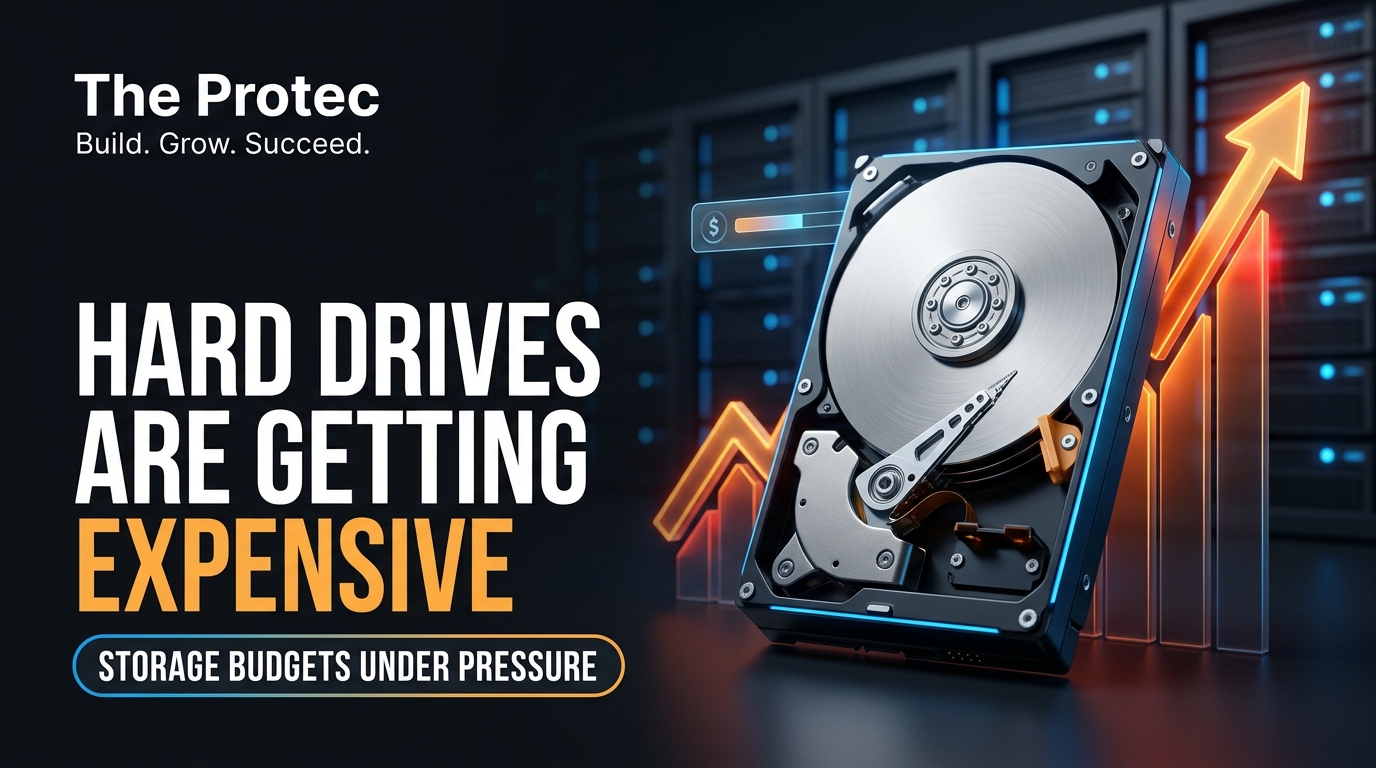
A hard drive that once looked like an affordable route to 20TB of storage can now cost as much as an entire entry-level NAS. By November 2026, rising hard drive prices had become a serious budgeting problem for home server owners, media archivists, IT departments, and businesses expanding data storage infrastructure. The immediate answer is simple: buyers are paying substantially more per terabyte. Explaining why is harder because documented retail changes, manufacturer disclosures, and theories about AI demand do not all carry the same evidentiary weight.
The practical response is not to assume that every drive will keep appreciating. Buyers should instead calculate usable capacity, account for redundancy and backup requirements, and compare the total cost of HDDs with refurbished drives, SSDs, tape, and cloud services.
A 20TB drive illustrates the scale of the increase
One widely reported retail comparison tracks a 20TB Western Digital EasyStore external drive from $249.99 in November 2024 to $549.99 in November 2026. That is a $300 increase, or approximately 120%.
- November 2024: $12.50 per raw terabyte
- November 2026: $27.50 per raw terabyte
- Change: approximately $15 more per raw terabyte
This is a documented comparison between two retail observations, not a complete HDD market index. EasyStore products are frequently discounted, and the earlier figure may reflect promotional pricing while the later figure may represent limited inventory or a less aggressive sale. External drives also have different pricing, warranties, firmware, and distribution channels from internal NAS or enterprise models.
Even with those qualifications, the comparison captures what many shoppers have encountered: attractive high-capacity promotions have become harder to find, while replacement and expansion costs have climbed. Other capacities, brands, and regions may show smaller or larger changes, so buyers should compare current street prices rather than extrapolating from one model.
What is—and is not—known about the HDD price increase
Several forces could be contributing to hard drive prices in 2026. Some are supported by public industry reporting; others remain plausible explanations rather than proven causes of a particular retail price.
Enterprise and AI data center demand
AI infrastructure is often described as an all-flash market, but that is only partly true. GPUs need fast SSD storage for active training and inference workloads, while data centers also retain source datasets, model checkpoints, logs, backups, generated media, and replicated archives. Much of that colder data can reside on high-capacity nearline HDDs.
Public manufacturer disclosures have documented strong demand for high-capacity nearline products from cloud and enterprise customers. Company earnings reports and filings can be reviewed through the SEC EDGAR database. This supports the conclusion that large buyers are consuming substantial capacity. It does not prove that AI data center demand alone caused the EasyStore price change. Retail external drives and enterprise nearline disks are related through manufacturing resources, but they are not identical products or sales channels.
Limited manufacturing capacity
Hard drives require specialized heads, platters, motors, controllers, and precision assembly. Production cannot be expanded as quickly as orders can change. Manufacturers also spent years adapting to declining PC HDD demand while concentrating investment on higher-capacity enterprise products.
When enterprise orders strengthen, vendors have an incentive to prioritize profitable, contracted products over deeply discounted consumer inventory. Transitions to technologies such as energy-assisted recording can improve capacity over time, but qualification, yield, and supply-chain requirements make the transition gradual.
Industry consolidation
The HDD business is concentrated among Western Digital, Seagate, and Toshiba. Consolidation does not by itself demonstrate coordinated pricing, and there is no basis for making that accusation. It does mean that the market has fewer independent manufacturers able to respond when supply tightens or demand changes unexpectedly.
Shifting demand between HDDs and SSDs
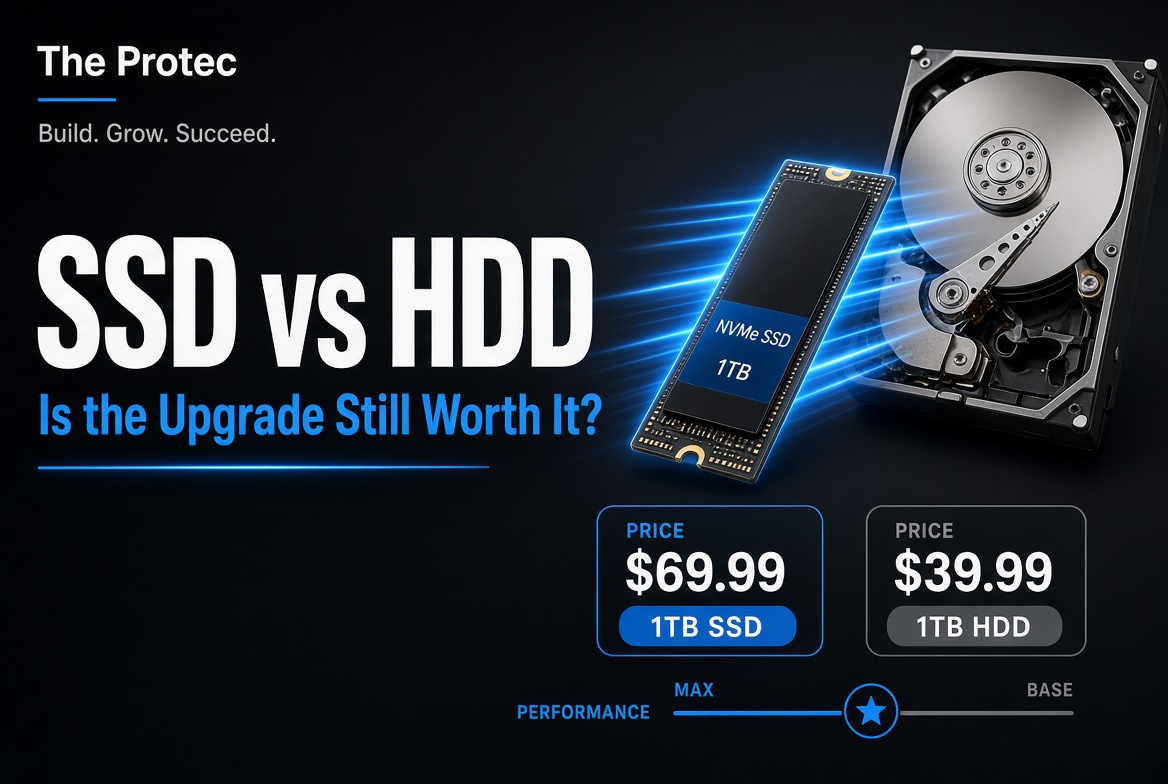
SSDs have displaced hard drives in laptops, desktops, and performance-sensitive servers. That reduces mass-market HDD volume and leaves the industry increasingly dependent on capacity-focused applications. At the same time, flash pricing is volatile. A fall in NAND prices can make SSDs more competitive, while a flash shortage can send bulk-storage buyers back toward disks.
The result is not a simple HDD-versus-SSD replacement cycle. HDDs remain attractive for large, sequential, infrequently accessed datasets, while SSDs offer better latency, density, noise, and power characteristics. Purchase price per terabyte is only one part of that decision.
How higher prices affect real storage projects
NAS and RAID arrays
A single drive price can understate the effect on a redundant array. Eight 20TB drives at $249.99 cost $1,999.92 before tax. At $549.99 each, the same set costs $4,399.92.
In a simplified RAID 6 layout, two drives are reserved for parity, leaving 120TB of nominal usable capacity. The drive-only cost rises from about $16.67 to $36.67 per usable terabyte. Filesystem overhead, spare drives, decimal-versus-binary capacity differences, and the NAS enclosure push the real figure higher.
NAS storage costs also rise when owners replace disks proactively to keep an array consistent. Mixing capacities may leave space unusable, while mixing recording technologies or performance classes can complicate rebuilds. NAS buyers should confirm whether a drive uses conventional magnetic recording or device-managed shingled magnetic recording before placing it in a write-intensive RAID workload.
Backups and media archives
Redundancy is not a backup. A 100TB primary dataset may require another 100TB locally plus an off-site copy, version history, or both. A price increase therefore multiplies across several storage tiers. Photographers, video teams, and home media collectors may find that acquisition is still affordable but protection and migration are not.
Surveillance storage
Camera systems generate continuous writes and often retain footage for a fixed number of days. Higher disk costs can force a choice among shorter retention, lower bit rates, fewer cameras, or a larger capital budget. Workload ratings and warranty terms matter here; the cheapest desktop or refurbished disk may not offer the best total cost of ownership under constant recording.
Cloud storage pricing
An HDD price increase does not translate directly into an immediate cloud storage pricing increase. Providers buy under long-term contracts, use multiple storage media, and charge for redundancy, operations, data retrieval, and egress as well as physical capacity. Hardware is only one cost input.
Persistent enterprise storage costs can nevertheless reduce the room providers have for discounts. Businesses comparing cloud and on-premises systems should model retrieval and network charges rather than treating the cloud’s monthly per-gigabyte rate as equivalent to buying a disk.
Practical ways to control storage costs
Buy capacity, not merely a low drive price
Calculate cost per usable terabyte after RAID protection. A larger disk with a higher sticker price can be cheaper than several smaller drives once enclosure bays, host bus adapters, cables, and power are included. Larger drives can also postpone the purchase of another NAS.
There is a concentration risk: losing one high-capacity disk places more data into a rebuild process. Rebuild windows can be long, so tested backups and suitable redundancy remain essential.
Consider refurbished enterprise drives carefully
Refurbished or recertified enterprise HDDs can lower acquisition cost and may provide workload ratings designed for server use. They are not risk-free. Buyers should investigate the seller, warranty length, return process, power-on history, shipping protection, sector errors, and compatibility with the intended enclosure.
Run extended diagnostics before trusting a used drive, monitor SMART data, and keep a spare available. SMART indicators are useful but cannot predict every failure. Large public datasets such as Backblaze Drive Stats can provide model-level context, although results from data center racks do not guarantee performance in a home NAS.
A discounted used drive makes the most sense when data is redundant and independently backed up. It is a poor bargain if a failure causes downtime, emergency shipping costs, or unrecoverable data loss.
Use storage tiering
Not every file needs identical performance or availability. Keep active databases, virtual machines, and current projects on SSDs. Move completed projects and infrequently accessed files to high-capacity HDDs. Send long-retention archives to tape or an appropriate archival cloud tier.
Tiering reduces the amount of premium storage that must be purchased. It also requires lifecycle policies so that data is migrated, verified, and deleted according to business and compliance requirements.
Reduce the data footprint
- Enable compression for compressible documents, logs, and virtual machine images.
- Use deduplication where repeated backups or system images justify its memory and processing cost.
- Delete obsolete snapshots, caches, duplicate media, and expired surveillance footage.
- Adjust retention rules instead of keeping every version indefinitely.
- Measure growth by dataset so future purchases are based on evidence.
Already-compressed video, photos, and encrypted files may shrink very little. Deduplication also performs poorly on some encrypted or compressed data, so projected savings should be tested before hardware budgets depend on them.
Evaluate tape and cloud backup by workload
LTO tape can offer compelling economics for large archives, offline ransomware protection, and infrequent retrieval. The drive, automation, software, and operational process create a high entry cost, making tape less attractive for small collections.
Cloud backup avoids buying duplicate hardware and provides geographic separation. Its total cost depends on stored volume, retention, API operations, retrieval fees, and egress. Test a full restore; a backup that is affordable to upload but too slow or expensive to recover may not meet the actual requirement.
How to plan a purchase during a hard drive shortage
Avoid panic buying based on one retailer or SKU. Track several suitable models, compare internal and external products with their warranty implications, and set a target cost per terabyte. Confirm that unusually cheap listings are sold by reputable vendors and include a valid regional warranty.
Organizations should forecast capacity at least through the next replacement cycle, but they should not overbuy without considering warranty expiration and idle inventory. Keep enough headroom for rebuilds and near-term growth, maintain tested backups, and purchase critical spares while matching drives are available.
Frequently asked questions
Will hard drive prices fall again?
They may, especially if enterprise demand softens, manufacturing yields improve, or retailers resume aggressive promotions. However, the industry has limited suppliers and increasingly prioritizes high-capacity enterprise products. A return to one exceptional sale price is possible, but it should not be treated as a dependable forecast.
Are external drives safe to use in a NAS?
Some users remove, or shuck, drives from external enclosures, but the practice can affect warranty service and expose differences in firmware, connectors, recording technology, or error recovery behavior. Confirm the exact model and NAS compatibility. For business-critical systems, supported internal drives may justify their premium.
Are SSDs now a better value than HDDs?
For latency-sensitive workloads, SSDs can deliver better total value through performance, lower noise, and reduced power use. HDDs generally remain more economical for very large, colder datasets on purchase cost per terabyte. Compare endurance, capacity, energy, rack space, replacement rates, and workload performance rather than sticker price alone.
Should I delay a NAS expansion?
Delay it if the capacity is optional and your current system has safe headroom. Do not delay a necessary backup, a failing-drive replacement, or capacity required for reliable rebuilds. Data loss and emergency purchases usually cost more than a planned expansion.
The bottom line
The sharp retail increase seen in the 20TB EasyStore example is real, but no single explanation accounts for the entire market. Enterprise purchasing, AI-related data growth, constrained manufacturing, consolidation, and changing SSD economics are credible influences with different levels of evidence. The best defense against rising hard drive prices is disciplined capacity planning: calculate usable storage, protect data properly, compare full lifecycle costs, and place each dataset on the least expensive tier that still meets its reliability and recovery requirements.