







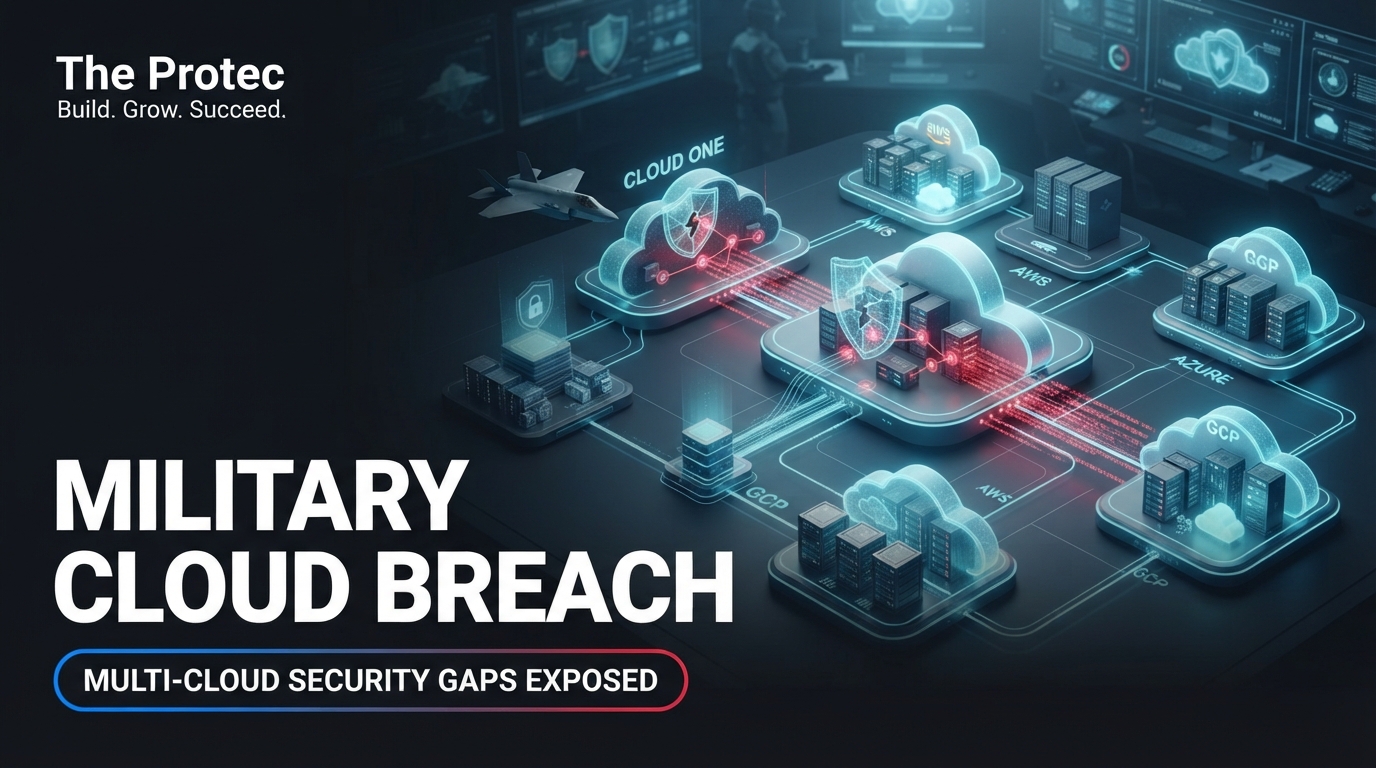
A reported intrusion into the U.S. Air Force’s flagship cloud platform has raised difficult questions about how the military protects centralized digital infrastructure. The US Air Force Cloud One breach, disclosed in November, reportedly involved attackers exploiting a software vulnerability to reach part of the platform’s control plane. Although the incident disrupted important administrative work, public evidence does not establish that classified systems, aircraft controls or operational weapons were compromised.
The distinction matters. Cloud One supports applications associated with personnel, payroll, logistics, aircraft maintenance, air defense information and munitions tracking, but the presence of those workloads does not prove that attackers accessed their underlying data. As of late November 2026, the attackers’ identity, the full extent of their access and whether they stole information remained unresolved publicly.
What is confirmed about the Cloud One breach?
Reuters reported that attackers used a software vulnerability to penetrate Cloud One and reach its control plane. The incident led the Air Force to take precautionary steps affecting cloud administration and application delivery while investigators assessed the environment.
Reported response measures included pausing some application migrations, blocking or delaying software updates and revoking administrator privileges. These actions are consistent with an effort to contain unauthorized access, prevent additional changes and rebuild trust in privileged accounts. They do not, by themselves, reveal how far the attackers moved or what they could see.
Based on Reuters reporting and information released through official U.S. Air Force channels, the defensible conclusions are limited:
- A cybersecurity incident affected the Cloud One environment.
- Reporting linked the initial access to exploitation of a software vulnerability.
- The response disrupted administrative processes, migrations and software delivery.
- Administrator access was restricted or revoked as part of containment.
- The investigation had not publicly established the attackers’ identity, complete reach or possible data theft.
Secondary reports may offer additional claims, but details that have not been corroborated by the Air Force or reliable independent reporting should not be presented as fact.
What Cloud One does for the Air Force
Cloud One is a foundational military cloud computing environment designed to help Air Force organizations host, deploy and manage applications without every program building a separate cloud architecture. It supplies common services for security, networking, identity, compliance and software delivery across multiple commercial cloud providers.
The platform incorporates infrastructure and services from Amazon Web Services, Microsoft Azure, Google Cloud and Oracle Cloud Infrastructure. That multi-cloud model gives programs access to different technical capabilities and contract options while reducing dependence on a single provider. It can also help teams select an environment based on mission requirements, data sensitivity, geographic availability and application architecture.
Multi-cloud does not mean every application runs simultaneously in all four providers. A workload may reside primarily in one environment while Cloud One applies shared governance, connectivity and security processes. The result is better standardization, but it also creates common administrative layers that require especially strong protection.
Why the supported applications matter
Cloud One supports or enables applications connected to personnel management, payroll, logistics, aircraft maintenance, air defense information and munitions tracking. These categories illustrate the platform’s operational importance, but they should not be interpreted as a list of breached systems.
A maintenance application, for example, may help personnel track parts, inspection records or repair schedules without connecting directly to aircraft flight controls. Likewise, an application involving munitions tracking is not the same as a weapons-control system. Public reporting has not shown that attackers manipulated aircraft, weapons or classified combat networks.
Why control-plane access is serious
Cloud environments are commonly separated into a data plane, where applications process information and perform tasks, and a control plane, where administrators configure resources. The control plane can include identity policies, deployment tools, network rules, logging configurations, application inventories and permissions governing who may change cloud services.
If attackers obtain meaningful control-plane access, their potential options could include:
- Creating or modifying privileged accounts.
- Changing security groups, network routes or access policies.
- Interfering with monitoring and audit-log collection.
- Deploying altered software or modifying deployment pipelines.
- Discovering connected applications and trust relationships.
- Using administrative privileges to seek access to individual workloads.
These are potential consequences, not confirmed outcomes of the US Air Force cyberattack. Actual impact depends on which control-plane component was reached, the permissions available, segmentation between tenants, the duration of access and whether additional authentication barriers remained effective.
Control-plane access also does not automatically provide access to every application or database. Properly designed environments use separate accounts, encryption keys, role boundaries and network controls to limit movement. Investigators must determine whether those safeguards held and whether attackers established persistence outside the initially affected system.
How the incident disrupted Air Force cloud operations
The reported containment measures help explain why a government cloud breach can cause problems even before data loss is confirmed. Pausing migrations prevents new applications from entering an environment whose integrity is under review. Blocking software updates limits the chance that compromised deployment tools could distribute malicious code. Revoking administrator privileges removes potentially exposed credentials and forces teams to revalidate access.
Each measure also carries an operational cost. Applications awaiting migration may remain on older infrastructure. Security patches and feature releases can be delayed. Administrators may lose access to systems needed for routine maintenance. These trade-offs are often necessary because continuing normal operations through a potentially compromised management layer could magnify the damage.
The disruption therefore shows the importance of the platform without proving that every supported mission was impaired. Public reporting has not established a loss of aircraft availability, interruption of weapons operations or compromise of air defense command systems.
What remains unknown—and must not be assumed
Several of the most important questions remain unanswered. The Air Force has not publicly established who conducted the intrusion, whether the attackers were linked to a government, how long they had access or whether they removed information. It is also unclear which software flaw was exploited and how broadly the affected component was deployed.
Claims that the Air Force was hacked should therefore be framed precisely. Cloud One experienced a reported cyberattack, but that is not equivalent to the compromise of the entire Air Force network. There is no confirmed public evidence that classified military systems, flight controls or weapons-control functions were accessed.
Absence of public confirmation is not proof that no data was exposed. Incident investigations can take weeks or months because analysts must review identity records, network telemetry, software artifacts and cloud-provider logs. The correct conclusion is that information theft has not been publicly established—not that it has been ruled out.
What the incident exposes about multi-cloud security
Centralization creates efficiency and concentration risk
Shared cloud infrastructure can improve security by replacing inconsistent program-level systems with common controls. However, a widely trusted management service can become a high-value target. If many workloads depend on the same identity, deployment or policy layer, disruption to that layer can affect numerous teams even when individual applications remain isolated.
Multi-cloud complexity can obscure privilege
Amazon, Microsoft, Google and Oracle use different identity models, logging formats and security controls. A central platform must translate policies across those environments without creating excessive permissions. Security teams need a current view of human administrators, service accounts, automated pipelines and cross-cloud trust relationships.
Vulnerability management must cover platform software
Cloud security is not limited to protecting resources supplied by hyperscale providers. The software used to orchestrate, secure and monitor those resources can introduce vulnerabilities of its own. Agencies need rapid asset discovery, patch testing and compensating controls for internet-facing systems and high-privilege management components.
Administrator access requires continuous verification
Privileged access should be temporary, narrowly scoped and strongly authenticated. Just-in-time permissions, phishing-resistant authentication, dedicated administrative devices and session monitoring can reduce the value of stolen credentials. Emergency revocation procedures should also be tested before a crisis.
Monitoring must survive a control-plane compromise
If logs are stored only inside the environment being investigated, an attacker with administrative access may be able to alter or suppress evidence. Critical audit records should be copied to protected, separately administered storage. Cross-cloud monitoring also needs consistent timestamps, identity context and retention policies so investigators can reconstruct activity.
Priorities for Air Force cloud security after containment
The immediate objective is to determine the initial entry point, remove persistence and rebuild trusted administrative access. That process should include rotating credentials and secrets, checking deployment artifacts, validating network and identity policies, and reviewing activity across every connected provider.
Longer-term resilience requires more than patching one vulnerability. Cloud One should be able to isolate a compromised management component without freezing unrelated workloads. Recovery exercises should test how quickly teams can restore software delivery, administrator access and security monitoring from known-good configurations.
The Pentagon cybersecurity lesson is not that multi-cloud architecture is inherently unsafe. It is that shared platforms need controls proportionate to their reach. Segmentation, independent telemetry and minimal privilege determine whether a breach remains local or becomes a systemic government cloud crisis.
Frequently asked questions
Was the entire U.S. Air Force hacked?
No public evidence supports that conclusion. Reporting concerns Cloud One, a major cloud platform used by Air Force programs. The incident should not be equated with compromise of every Air Force network, application or mission system.
Did attackers steal classified military information?
Information theft had not been publicly confirmed as of late November 2026. The scope of access remained under investigation. There was also no established public evidence that classified systems, aircraft controls or weapons-control functions were compromised.
Were Amazon, Microsoft, Google or Oracle directly breached?
Public reporting did not establish that the underlying cloud providers were breached. The reported intrusion involved a software vulnerability associated with the Cloud One environment. A customer platform compromise is not automatically a compromise of the commercial providers’ core infrastructure.
Why were software updates and migrations stopped?
Pausing changes reduces uncertainty during containment. Investigators need to ensure that deployment tools, administrator accounts and software packages are trustworthy before allowing them to modify additional systems. The pause can delay operations, but it helps prevent a compromised management layer from spreading risk.
What is the central lesson from the Cloud One breach?
Large cloud environments must treat control-plane systems as critical infrastructure. Multi-cloud flexibility does not eliminate concentrated risk; it moves much of that risk into shared identity, orchestration, monitoring and software-delivery services that must be segmented, continuously observed and recoverable.