









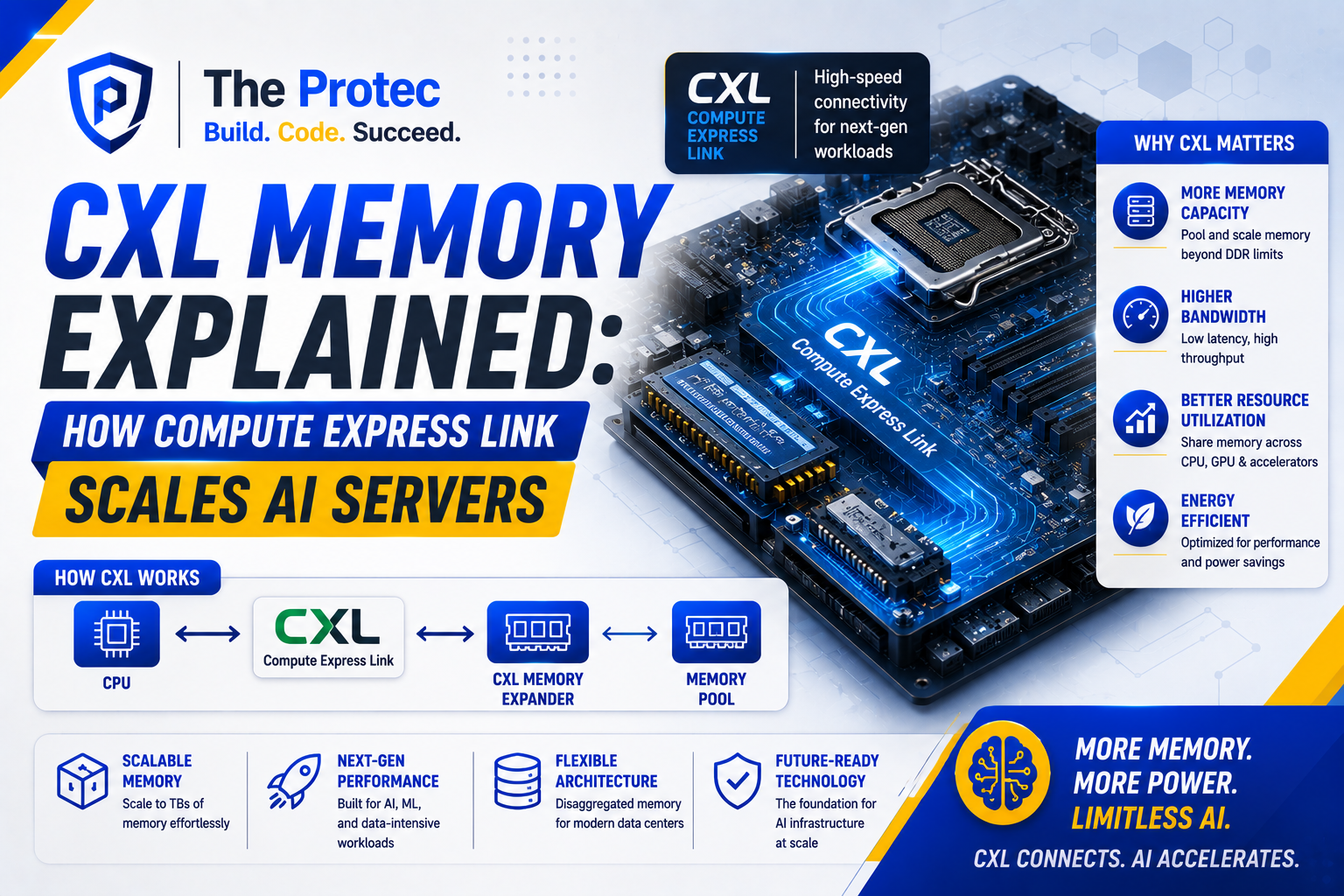
AI servers have a memory problem. Models are growing, inference contexts are getting longer, and data-intensive applications increasingly need more capacity than a server can economically provide with conventional DRAM alone. High-bandwidth memory delivers exceptional performance close to accelerators, but it is expensive and limited in capacity. Standard system memory is larger, yet it remains tied to processor sockets and fixed hardware configurations.
CXL memory offers another option. Built on Compute Express Link, it allows processors, accelerators, and memory devices to communicate through a coherent, high-speed interconnect. The result is a more flexible memory architecture in which capacity can be expanded, pooled, shared, and divided into performance tiers. For AI servers and cloud platforms, that flexibility could improve utilization while reducing the need to overprovision every machine.
What Is CXL Memory?
CXL memory is memory attached through the Compute Express Link standard rather than directly through a processor’s traditional DDR memory channels. CXL uses the PCI Express electrical interface while adding protocols designed for low-latency memory access and cache coherence.
The technology defines three primary protocols. CXL.io handles discovery, configuration, interrupts, and familiar PCIe-style functions. CXL.cache allows a device to access and coherently cache host memory. CXL.mem enables a processor to access memory attached to a CXL device using load-and-store semantics.
For memory expansion, the most relevant products are Type 3 devices. These devices provide memory capacity without functioning as general-purpose processors or accelerators. A server can access their DRAM or other media as an additional memory resource, although CXL-attached capacity generally has higher latency than local DDR memory.
How Compute Express Link Changes Server Architecture
Traditional server memory is physically and logically associated with a CPU socket. Capacity is determined by the number of memory channels, DIMM slots, supported module sizes, and processor limitations. Adding memory can require replacing DIMMs, populating additional sockets, or moving the workload to a larger server.
Compute Express Link separates part of the memory capacity from those fixed channels. Depending on the platform and CXL generation, memory can reside in an add-in card, an EDSFF device, a rack-level appliance, or a switched fabric. The operating system and platform software then determine how applications use that capacity.
CXL does not make all memory identical. Local DRAM remains faster, and accelerator HBM provides far greater bandwidth for highly parallel computation. Instead, CXL introduces a practical capacity tier between local memory and storage. Software can place latency-sensitive data in faster memory while moving colder or less bandwidth-intensive data to the CXL tier.
Four Core Capabilities of CXL Memory
1. Memory Expansion
The simplest use case is adding capacity to one server. A CXL memory expander can supplement local DRAM without consuming additional CPU memory channels. This can help systems hold larger databases, model parameters, embedding tables, in-memory analytics datasets, and inference caches.
Expansion is especially useful when capacity matters more than uniform latency. A workload may keep frequently accessed pages in local DRAM while allocating bulk data to CXL memory. This gives system designers more control over the balance among capacity, bandwidth, latency, and cost.
2. CXL Memory Pooling
CXL memory pooling allows multiple hosts to draw capacity from a common pool through a switch or fabric. Capacity can be assigned according to demand instead of being permanently installed in each server. A host running a large job might receive additional memory, then return it to the pool when the job ends.
Pooling should not be confused with simultaneous sharing. A pooled region can be dynamically allocated to one host at a time without being concurrently accessible by every host. This approach can still increase utilization because cloud operators no longer need to configure each server for its worst-case requirement.
3. Memory Sharing
Memory sharing allows more than one host or device to access selected memory regions, with the platform maintaining the required coherency and access controls. CXL 3.0 significantly expanded the fabric capabilities needed for this model.
Shared memory may reduce unnecessary data movement between processors, accelerators, and services. Potential uses include shared datasets, communication buffers, distributed databases, composable infrastructure, and multi-host AI pipelines. Effective sharing nevertheless depends on software coordination, isolation, failure handling, and hardware support across the complete platform.
4. Memory Tiering
Tiering places data according to its performance needs. A server might use HBM as the highest-bandwidth tier, local DDR as the primary system-memory tier, and CXL memory as a larger capacity tier. NVMe storage remains available for persistent or much colder data.
Operating systems, hypervisors, runtimes, or applications can monitor access patterns and migrate pages between tiers. The goal is to keep hot data close to compute while preventing expensive memory from being occupied by infrequently accessed pages. Good tiering policy is critical: excessive page migration can consume bandwidth and erase the economic benefit.
Why CXL Memory Matters for AI Servers
Modern AI infrastructure is constrained by both memory capacity and data movement. Training requires model states, activations, optimizer data, and large input pipelines. Inference systems must hold model weights while managing growing key-value caches for long-context and concurrent requests. Recommendation engines and retrieval systems may also maintain enormous embedding tables or vector indexes.
CXL memory can support these workloads in several ways:
- Expanding CPU-accessible memory for preprocessing, data loading, checkpoint handling, and model serving.
- Providing a capacity tier for model weights, embeddings, sparse data, or colder inference cache entries.
- Helping cloud platforms allocate memory independently from compute, reducing stranded capacity.
- Supporting shared buffers and lower-copy data paths in heterogeneous CPU-accelerator systems.
- Enabling larger memory footprints without forcing every node into its maximum DRAM configuration.
CXL is not a replacement for HBM on GPUs or other AI accelerators. HBM is designed for extremely high bandwidth and remains essential for active tensor computation. CXL memory is better viewed as a complementary capacity layer. Its value is greatest when software can distinguish the data that needs maximum bandwidth from the data that mainly needs to remain addressable.
CXL 3.0 and the Move Toward Memory Fabrics
Earlier CXL generations established coherent device connectivity and basic switching. CXL 2.0 introduced standardized switching and memory pooling, but CXL 3.0 transformed the standard into a more capable fabric architecture.
Based on the PCIe 6.0 physical layer, CXL 3.0 increases the data rate to 64 GT/s while adding multi-level switching, enhanced fabric management, peer-to-peer communication, and stronger support for shared memory. These features make it possible to design topologies that extend beyond a single host connected to a single expander.
Follow-on CXL 3.x refinements have concentrated on manageability, monitoring, security, and operational reliability. The newer CXL 4.0 specification continues the roadmap with a PCIe 7.0-based 128 GT/s data rate and capabilities intended for larger, higher-bandwidth fabrics. However, specification availability does not mean every feature is broadly deployed. Servers, processors, switches, memory devices, firmware, operating systems, and management tools must mature together.
As of August 2026, much of the practical industry focus remains on deploying and validating CXL 2.0 and CXL 3.0-class systems while preparing for the next generation. Technical specifications and official updates are available from the CXL Consortium.
CXL Memory Pooling in Cloud and Composable Infrastructure
Cloud providers routinely encounter stranded memory: one server exhausts its capacity while another has unused DRAM. Because processors and memory are purchased as fixed configurations, operators may add servers even when compute resources are available elsewhere.
CXL memory pooling makes memory a more composable resource. Orchestration software can allocate capacity according to workload requirements, potentially improving utilization and creating more granular instance configurations. Providers could offer temporary memory expansion for analytics jobs, AI inference bursts, or database maintenance rather than reserving that capacity permanently.
The same model can benefit private clouds and high-performance computing environments. It may allow administrators to build memory-heavy nodes dynamically, support jobs with uneven capacity requirements, and reduce the amount of idle DRAM across a cluster.
Performance, Security, and Deployment Challenges
CXL memory is promising, but successful deployments require careful engineering. Important considerations include:
- Latency: Access must cross a CXL link and potentially one or more switches. Applications sensitive to memory latency need placement policies that favor local DRAM.
- Bandwidth: Link bandwidth is finite and can be shared. Capacity expansion does not automatically provide the bandwidth of additional native memory channels.
- Software awareness: Operating systems can expose CXL memory through NUMA or tiering mechanisms, but application-aware allocation may deliver more predictable results.
- Security: Shared and pooled fabrics require isolation, access control, device authentication, encryption strategies, and secure management interfaces.
- Reliability: Operators need telemetry, error reporting, poison handling, failover planning, and clear policies for device or switch failures.
- Interoperability: Real-world behavior depends on compatible CPUs, firmware, switches, expanders, kernels, hypervisors, and management software.
Organizations should benchmark complete workloads rather than relying only on link specifications. Page-fault behavior, access locality, migration overhead, contention, and the ratio of local to CXL memory can have a larger impact than peak transfer rates.
Planning a CXL Memory Strategy
A practical evaluation begins with workload profiling. Teams should measure peak capacity, memory bandwidth, latency sensitivity, page access frequency, NUMA behavior, and the cost of current overprovisioning. Workloads with large but unevenly accessed datasets are often stronger candidates than applications that continuously stream through all allocated memory.
Pilot projects should compare static expansion with software-managed tiering and, where supported, CXL memory pooling. Tests should include failure scenarios, tenant isolation, observability, and performance under contention. Procurement plans also need to account for platform generations because CXL features vary by processor, chipset, device, and firmware implementation.
The Outlook for CXL in AI Infrastructure
As AI models and cloud workloads consume more memory, the ability to scale capacity independently from compute becomes increasingly valuable. CXL provides the industry with a standard path toward disaggregated and composable memory without forcing applications to treat every additional byte as storage.
The transition will be gradual, and local DDR and HBM will remain central to server design. Even so, CXL memory is positioned to become an important layer in heterogeneous systems—one that helps data centers use memory more efficiently while supporting workloads too large for conventional server configurations.
Frequently Asked Questions
Is CXL memory as fast as local DDR memory?
No. CXL-attached memory normally has higher latency than memory connected directly to the CPU’s DDR channels. Performance depends on the link generation, device, topology, switch count, and access pattern. CXL is primarily valuable for flexible capacity, pooling, sharing, and tiering rather than replacing all local DRAM.
What is the difference between CXL memory pooling and sharing?
Pooling allows capacity from a common resource to be assigned to different hosts as demand changes. Sharing allows multiple hosts or devices to access selected memory regions concurrently. Sharing requires more complex coherency, access control, and software coordination.
Can CXL memory replace GPU HBM for AI?
Not for bandwidth-intensive AI computation. HBM provides substantially higher bandwidth near an accelerator. CXL memory can complement HBM by holding larger datasets, model components, embeddings, or colder data that does not need to remain in the fastest tier.
Does an application need to be modified to use CXL memory?
Not always. An operating system may expose CXL memory as another NUMA node or manage it through automatic tiering. Applications that explicitly classify hot and cold data, however, can often achieve more stable performance and make better use of the available tiers.