




NVMe Gen 6 SSDs Explained: What the Next Storage Leap Really Means
Storage technology has been moving fast for years, but NVMe Gen 6 SSD support marks one of the most important turning points yet. After the widespread adoption of PCIe Gen 4 and the early rollout of Gen 5 drives, the industry is now preparing for a new wave of PCIe Gen 6 SSD performance that could reshape everything from enterprise data centers to high-end workstations. For buyers, builders, and IT teams, the big question is not just how much faster these drives will be, but whether the rest of the system can keep up.
This guide breaks down what Gen 6 means in practical terms, how fast the next generation of storage is expected to be, where it will matter first, and when it makes sense to wait or upgrade. If you are tracking future SSD technology, the answer is more nuanced than a simple speed number. Gen 6 is about bandwidth, efficiency, latency reduction, and scaling storage for workloads that are already pushing today’s best SSDs to their limits.
What Is an NVMe Gen 6 SSD?
An NVMe Gen 6 SSD is a solid-state drive that uses the NVMe protocol over a PCIe 6.0 interface. NVMe, short for Non-Volatile Memory Express, is the command protocol that allows SSDs to communicate efficiently with a system’s CPU and memory. The PCIe generation determines how much bandwidth is available between the drive and the rest of the computer.
The jump from PCIe Gen 5 to Gen 6 is especially important because it doubles the available bandwidth again. In other words, a PCIe Gen 6 SSD is not just a slightly faster Gen 5 drive. It is part of a platform shift that expands what storage can do for AI, analytics, virtualization, real-time content creation, and massive database workloads.
While consumer Gen 6 drives are not broadly available yet, the ecosystem is advancing quickly. Controller vendors, NAND manufacturers, motherboard makers, and server platform designers are all working toward support for the standard. That means the next few product cycles should bring a gradual but meaningful transition from “top-end niche” to “new performance baseline.”
How Fast Will NVMe Gen 6 SSDs Be?
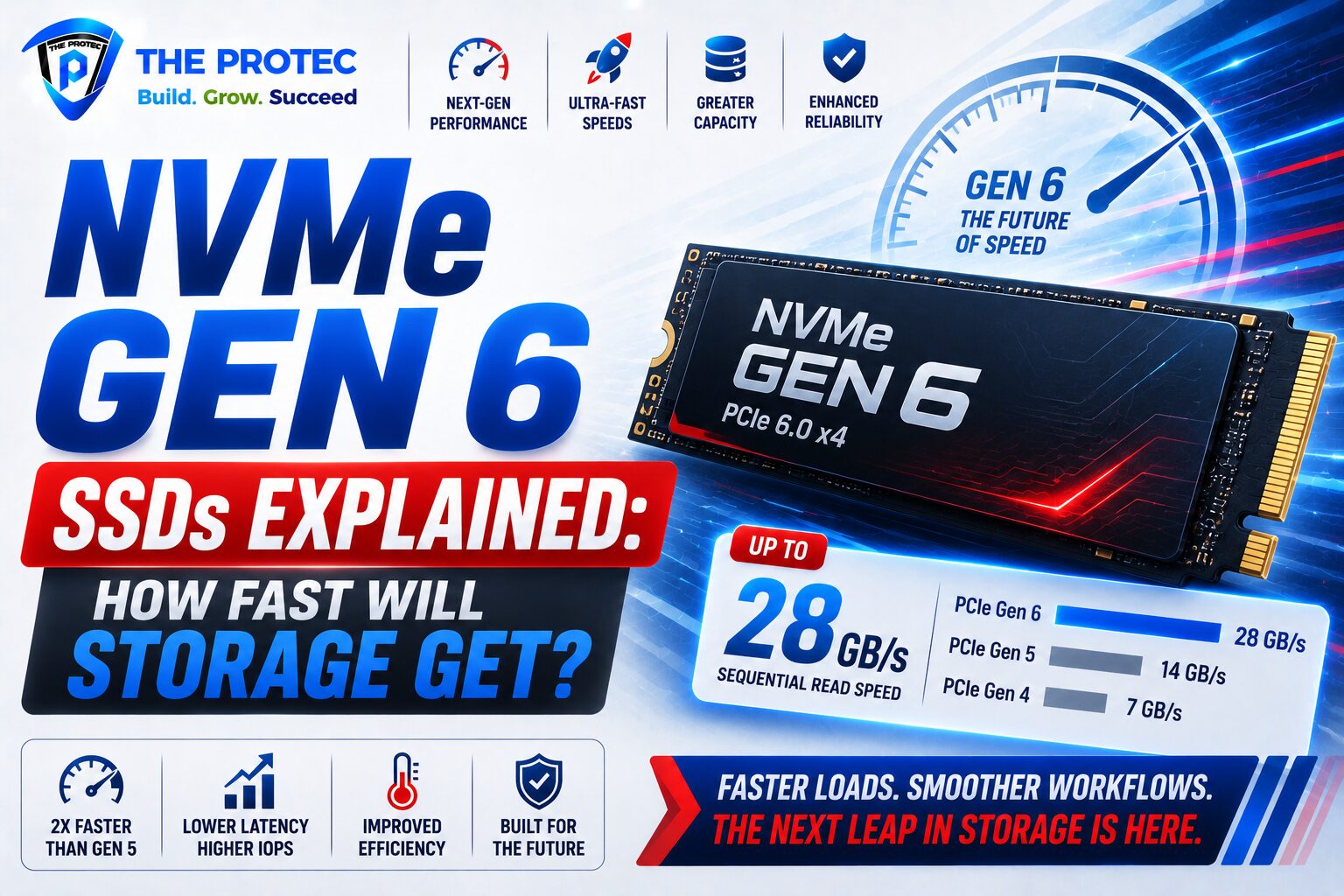
The headline number is bandwidth. PCIe 6.0 roughly doubles raw transfer rates compared with PCIe 5.0, and real-world NVMe Gen 6 SSDs are expected to push sequential read speeds far beyond today’s flagship drives. Early expectations point to well above 20 GB/s for high-end implementations, with some enterprise models likely going even higher as controllers and flash packages mature.
That said, raw sequential speed is only part of the story. The biggest gains may appear in:
- Queue depth performance for server and database workloads
- Lower latency under heavy multitasking
- Better parallelism for large file transfers and content pipelines
- Improved efficiency per watt as controllers become more advanced
It is worth noting that storage benchmarks do not always reflect everyday use. Opening apps, loading games, and booting Windows are already very fast on Gen 4 and Gen 5 SSDs. For many users, Gen 6 will feel less like a dramatic “speed boost” and more like a smoother, more scalable platform for demanding workloads.
For context on the PCIe 6.0 specification itself, the PCI-SIG overview is a useful reference: PCI-SIG. For a broader primer on NVMe and SSD architecture, Samsung’s storage education resources are also helpful: Samsung SSD.
Why PCIe Gen 6 Matters More Than Just a Speed Increase
Every generation of PCIe brings more bandwidth, but PCIe Gen 6 is different because the storage industry is now operating in a world where data movement is becoming the bottleneck. AI training, machine learning inference, high-resolution media workflows, and massive cloud databases all depend on moving huge amounts of data quickly and efficiently.
That makes the Gen 6 transition about more than bragging rights. It is about unlocking a storage layer that can keep pace with modern compute hardware. In systems where GPUs, accelerators, and multi-core CPUs are already extremely powerful, storage needs to feed them with much less delay. A slower drive can hold back an otherwise expensive platform.
For enterprises, this matters in practical ways:
- Faster access to large datasets
- Reduced application bottlenecks in virtualization clusters
- Better throughput for AI pipelines
- Improved responsiveness in high-transaction databases
For enthusiasts and creators, the benefit is most visible when moving large project files, compiling codebases, working with high-bitrate video, or running multiple storage-heavy applications at once.
Compatibility: Will You Need a New Motherboard?
In most cases, yes. A PCIe Gen 6 SSD can only reach its full potential on a system that supports PCIe 6.0. That means motherboard and platform compatibility will be a major factor in adoption. If you install a Gen 6 drive into a Gen 5 or Gen 4 slot, it will typically work backward-compatibly, but at reduced speeds.
That backward compatibility is good news, because it means early adopters will not necessarily be locked out. However, people expecting a dramatic leap should understand the limits:
- A Gen 6 SSD in a Gen 5 slot will generally operate at Gen 5 speeds
- Thermal design remains critical, especially at high sustained transfer rates
- System firmware, chipset support, and lane allocation can affect performance
Another point often overlooked is power delivery and heat management. As storage controllers become more capable, they can also become more demanding. High-end NVMe drives already benefit from heatsinks, active cooling in servers, and careful chassis airflow. Gen 6 hardware will likely continue that trend, especially in dense enterprise environments.
Who Will Benefit First from Future SSD Technology?
Not every user needs the latest storage generation on day one. Gen 6 will be most valuable where storage is a direct performance bottleneck. That is why the first wave of adoption will likely be led by enterprises, infrastructure teams, and specialized creators rather than mainstream consumers.
Enterprise and data center deployments
Data centers are the clearest fit for NVMe Gen 6 SSDs. Workloads such as cloud hosting, AI training, real-time analytics, object storage acceleration, and transactional systems can consume enormous amounts of bandwidth. In these environments, a small latency improvement across thousands of requests can translate into major efficiency gains.
AI and machine learning systems
AI pipelines move data constantly. Faster storage helps with dataset staging, model checkpoints, feature extraction, and rapid iteration. As models grow larger and storage hierarchies become more complex, Gen 6 drives can reduce the time spent waiting for data to arrive.
Media production and post-production
Video editors, VFX artists, and 3D creators often work with huge files and multiple layers of assets. A PCIe Gen 6 SSD could make large cache files, project timelines, and raw footage handling noticeably smoother, especially in shared workstations and render nodes.
High-end workstations and prosumer builds
For power users who routinely move multi-gigabyte files, run local VMs, or compile large projects, Gen 6 storage may be compelling once platform support matures. The benefit is not just speed, but headroom.
Will Gamers Notice a Difference?
Probably not as much as enterprise users will. That does not mean gamers should ignore Gen 6 entirely, but it does mean expectations should stay grounded. Game load times are influenced by many factors, including engine optimization, CPU decompression, shader compilation, and asset streaming design. Once you are already on a strong NVMe drive, the returns diminish quickly.
For most gaming PCs, a high-quality Gen 4 SSD still offers excellent real-world performance. Gen 5 drives are already more than enough for current gaming needs in most cases. Gen 6 may become attractive for gamers who also create content, run multiple heavy applications, or want a future-proof platform for many years. But if your primary goal is shaving a second or two off load screens, the upgrade is unlikely to feel transformative.
The better question for gamers is whether future SSD technology will help with larger game installs, faster patching, and improved asset streaming as game sizes continue to grow. In that sense, Gen 6 is less about today’s frame rates and more about supporting the next generation of game engines and storage-heavy experiences.
Gen 6 vs Gen 5: Is the Upgrade Worth Waiting For?
That depends on what you need right now. If you are building a new system today and need immediate performance, a top-tier Gen 4 or Gen 5 SSD is still a smart choice. Those drives are mature, widely supported, and already extremely fast for most tasks.
Waiting for Gen 6 makes sense if:
- You are planning a new high-end workstation or server platform
- Your workload is clearly storage-bound
- You want to align with the next platform refresh cycle
- You are standardizing hardware for future enterprise deployment
Buying Gen 5 now makes more sense if:
- You need a system immediately
- You are mainly gaming or doing general productivity
- Your motherboard does not support PCIe 6.0
- You want mature pricing and proven compatibility
In short, Gen 6 is the future, but not everyone needs to be first in line. The best value often comes one generation after the launch wave, when controllers stabilize, thermals improve, and pricing becomes more reasonable.
What to Expect from Early NVMe Gen 6 SSD Products
Early Gen 6 SSDs will likely focus on enterprise and flagship workstation markets first. That is typical for new storage interfaces because the initial hardware tends to be expensive and optimized for specialized workloads. Consumer models usually arrive later, once platform adoption improves and manufacturing scales up.
Expect first-generation products to emphasize:
- Very high sequential throughput
- Enterprise-grade endurance and data protection features
- Advanced thermal management requirements
- Premium pricing
In practical terms, the first wave of NVMe Gen 6 SSDs may not be the best value for mainstream buyers. That is normal. Early adopters are often paying for access, not efficiency. Over time, the technology trickles down into more affordable consumer products, and the real market shift begins.
How to Prepare for the Transition to PCIe Gen 6 SSDs
If you are planning ahead, the smartest move is to think beyond the drive itself. Storage upgrades work best when the entire platform is ready. That means checking motherboard support, CPU lane allocation, airflow, and workload needs before spending on next-generation hardware.
Here are a few practical steps:
- Audit your bottlenecks to confirm storage is the limiting factor
- Check platform roadmaps if you are building a new PC or server
- Prioritize cooling for high-performance SSDs
- Match the drive to the workload instead of buying on speed alone
For businesses, the best approach is to test Gen 6 in pilot deployments before broad rollout. That allows IT teams to measure latency, throughput, power draw, and compatibility in real environments rather than relying only on spec sheets.
When Should Consumers Consider Upgrading?
Most consumers should upgrade when their current drive no longer meets their needs, not simply because a new generation exists. If your current SSD is slowing down under heavy use, running out of space, or lacking the endurance you need, then an upgrade can make sense today. If you already have a fast NVMe drive and your workload is mostly everyday computing, Gen 6 is probably not urgent.
Consider upgrading to an NVMe Gen 6 SSD when:
- You are buying a brand-new high-end system and want the latest platform
- You regularly handle large media files or AI workloads
- You need enterprise-class performance for business operations
- Your existing storage is a measurable bottleneck
Otherwise, it may be smarter to wait for broader adoption. Future SSD technology often becomes more attractive after the first generation of products matures.
FAQ: NVMe Gen 6 SSDs
How much faster is an NVMe Gen 6 SSD than Gen 5?
Gen 6 roughly doubles the PCIe bandwidth available to SSDs compared with Gen 5, so flagship drives should deliver significantly higher sequential speeds. Real-world gains depend on workload, controller design, and system support.
Will a PCIe Gen 6 SSD work in a Gen 5 motherboard?
Yes, in most cases it should work because PCIe is backward compatible. However, it will be limited to the speed of the older interface, so you will not get full Gen 6 performance.
Do gamers need NVMe Gen 6 SSDs?
Usually no. Most gaming systems will see very little practical benefit compared with a good Gen 4 or Gen 5 SSD. Gen 6 is more compelling for creators, prosumers, and enterprise workloads.
What is the biggest advantage of future SSD technology?
The biggest advantage is not just raw speed. It is the ability to move more data with lower latency and better efficiency, which helps modern applications that depend on rapid access to huge datasets.
Final Thoughts: Is Gen 6 the Beginning of a New Storage Era?
Yes, but it will arrive in stages. NVMe Gen 6 SSDs represent the next major leap in storage bandwidth, and they will matter most in places where data movement is critical. Enterprises, AI systems, creators, and high-end workstations will feel the impact first. Consumers will eventually benefit too, but for many users the best time to upgrade will be when the platform ecosystem is mature and pricing has settled.
The bottom line is simple: PCIe Gen 6 SSD technology is not just about faster benchmarks. It is about building storage that can keep pace with the next wave of computing. If today’s SSDs are already good enough for most everyday tasks, Gen 6 is the answer to what comes after “good enough” — a faster, more scalable foundation for the future of digital work.